Alternative Investments for Retirement
Learn how alternative investments for retirement can add income, reduce volatility, and improve diversification through asset-backed strategies.
Alternative Investments for Retirement Read More »


Learn how alternative investments for retirement can add income, reduce volatility, and improve diversification through asset-backed strategies.
Alternative Investments for Retirement Read More »

Review rollover 401k to IRA investment options, from traditional funds to self-directed real estate credit, with risk, income, and liquidity in focus.
Rollover 401k to IRA Investment Options Read More »

Learn what to do with old 401k assets, compare rollover options, avoid taxes and penalties, and evaluate income-focused retirement strategies.
What to Do With Old 401k Money Read More »

Learn how to invest old 401k in real estate through rollover IRAs and private credit, with a focus on income, collateral, and risk control.
How to Invest Old 401k in Real Estate Read More »

Learn how to roll over 401k into real estate investment, including SDIRA rules, rollover steps, tax risks, and passive income options.
How to Roll Over 401k Into Real Estate Investment Read More »

Unused 401k investment strategies can turn old retirement assets into income. Learn rollover options, risks, and where private credit may fit.
Unused 401k Investment Strategies That Fit Read More »

Retirement investing has fundamentally changed. For decades, retirees could rely on traditional fixed income products such as Treasury bonds, CDs, municipal bonds, and dividend-paying blue-chip stocks to generate predictable income. But after years of historically low interest rates, elevated inflation, market volatility, and growing longevity risks, many investors are reevaluating what sustainable retirement income truly looks like. Today’s retirees face a challenge that institutional investors have been addressing for years: How do you generate reliable income while preserving capital in an increasingly uncertain market environment? This is one reason private credit, real estate debt funds, and alternative income-oriented investments have grown rapidly among institutional investors, family offices, and accredited investors seeking more stable, asset-backed passive income strategies. According to Preqin, the global private credit market surpassed approximately $1.7 trillion in assets under management in recent years, fueled by demand for yield, downside protection, and reduced correlation to public markets. At the same time, the Federal Reserve’s elevated interest-rate environment has reshaped traditional fixed income investing. Bond market volatility between 2022 and 2024 reminded many investors that “safe” fixed income assets can still experience substantial price declines when interest rates rise aggressively. For retirees and income-focused investors, this has accelerated interest in alternative retirement income strategies designed around: cash flow consistency, capital preservation, collateral-backed lending, lower market correlation, and income-focused investing. This guide explores how passive income strategies for retirement are evolving and why private credit and real estate debt investing have become increasingly important components of modern retirement portfolios. What Are Passive Income Strategies for Retirement? Definition Passive income strategies for retirement are investment approaches designed to generate recurring cash flow with limited day-to-day involvement from the investor. The goal is typically to create sustainable income streams capable of supporting retirement expenses while preserving long-term capital. Common passive income investments include: dividend-paying equities, bonds, CDs, REITs, rental properties, private lending, real estate debt funds, and private credit investments. For many retirees, passive income investing focuses on replacing earned income from employment with investment-generated cash flow. Why Retirement Income Planning Has Changed The Retirement Landscape Is Different Today Several macroeconomic trends have fundamentally changed retirement investing: 1. Longer Lifespans According to the Social Security Administration, many retirees may spend 20–30 years in retirement. That significantly increases the importance of sustainable income generation. 2. Inflation Risk Inflation can dramatically erode purchasing power over time. Even moderate inflation can substantially reduce real income over a multi-decade retirement horizon. For example: 3% annual inflation cuts purchasing power nearly in half over approximately 24 years. This is one reason retirees increasingly seek investments capable of producing higher income yields than traditional savings products. 3. Traditional Fixed Income Challenges Historically, retirees relied heavily on: Treasury bonds, municipal bonds, CDs, and investment-grade corporate bonds. However, traditional fixed income markets experienced meaningful volatility during recent Federal Reserve tightening cycles. Long-duration bond funds experienced significant drawdowns as rates increased rapidly. Many retirees discovered that: interest-rate risk matters, duration risk matters, and public market volatility impacts retirement portfolios more than expected. 4. Sequence-of-Returns Risk One of the largest retirement risks is experiencing market losses early in retirement while simultaneously withdrawing funds for living expenses. This can permanently impair portfolio longevity. As a result, many investors now seek retirement income strategies with: lower public market correlation, more predictable cash flow, and asset-backed downside protection. What Is Private Credit Investing? Definition Private credit investing refers to non-bank lending provided directly to businesses, real estate projects, or borrowers outside traditional public bond markets. Private credit investments may include: real estate bridge lending, secured promissory notes, commercial real estate loans, asset-backed lending, receivable financing, direct lending, and private debt funds. Unlike publicly traded bonds, private credit investments are often: negotiated directly, secured by collateral, shorter duration, and less correlated to daily market volatility. Why Private Credit Has Grown So Rapidly Institutional investors have increasingly allocated capital toward private credit for several reasons: Higher Yield Potential Private credit often provides higher income potential than traditional public fixed income. This is partially due to: reduced liquidity, specialized underwriting, direct origination, and asset-backed structures. Asset-Backed Security Many private credit investments are secured by: real estate, receivables, inventory, or hard assets. This collateral-focused approach can enhance downside protection relative to unsecured debt. Lower Correlation to Public Markets Private lending investments are not typically priced daily like publicly traded bonds or equities. As a result, they may experience lower volatility compared to traditional market-based investments. Shorter Duration Many real estate debt investments have shorter maturities compared to long-duration bonds. Shorter duration can reduce sensitivity to interest-rate volatility. How Real Estate Debt Funds Work Real estate debt funds pool investor capital to originate or participate in loans secured by real estate assets. These loans may include: bridge loans, acquisition financing, construction loans, stabilized asset lending, or commercial real estate financing. Rather than owning the underlying property equity directly, debt funds typically operate in the lender position within the capital stack. This distinction is important. Debt-focused investing prioritizes: contractual interest payments, collateral protection, senior lien positioning, and downside mitigation. Many institutional investors view senior secured lending as a more defensive approach compared to pure real estate equity ownership. Private Lending vs Traditional Fixed Income Factor Traditional Bonds Private Lending Yield Potential Lower Higher Market Volatility Higher sensitivity Lower correlation Collateral Often unsecured Frequently asset-backed Duration Longer Often shorter Liquidity Daily liquidity Less liquid Pricing Public market pricing Privately negotiated Income Focus Moderate Strong income orientation Are Debt Funds Safer Than Stocks? Direct Answer Debt funds and private credit investments are generally designed to prioritize income generation and capital preservation rather than high-growth equity appreciation. However, all investments carry risk. Compared to equities, many private credit strategies may experience: lower volatility, reduced market correlation, and stronger downside protection through collateral structures. That said, investors should carefully evaluate: underwriting discipline, loan-to-value ratios, asset quality, sponsor experience, and risk management practices. Why Accredited Investors Use Alternative Income Strategies Accredited investors often seek diversification beyond traditional public markets. Alternative investments may provide: differentiated income

What Is a Self-Directed IRA (SDIRA)? A self-directed IRA (SDIRA) is a retirement account that allows investors to hold alternative assets beyond traditional stocks, bonds, and mutual funds. Unlike conventional retirement accounts typically limited to public market securities, self-directed IRAs can invest in: real estate, private credit, mortgage funds, private lending, real estate debt funds, private equity, precious metals, and other alternative investments permitted under IRS rules. In recent years, SDIRA investing has grown significantly as investors seek: diversification, passive income, inflation mitigation, and greater control over retirement capital allocation. According to Federal Reserve retirement data and industry research from the Retirement Industry Trust Association (RITA), trillions of dollars remain concentrated in traditional market-based retirement portfolios despite growing interest in private market alternatives. As volatility, inflation concerns, and retirement income uncertainty persist, many investors are increasingly exploring self-directed IRAs as a way to access institutional-style investment strategies historically reserved for pension funds and family offices. What Makes Self-Directed IRAs Different? Traditional IRAs generally limit investors to: publicly traded equities, ETFs, mutual funds, and traditional fixed-income securities. A self-directed IRA expands the opportunity set considerably. With an SDIRA, investors may allocate retirement capital into: real estate-backed lending, private mortgage funds, private credit, alternative income strategies, and asset-backed investments. This flexibility is one reason self-directed retirement investing continues gaining momentum among: accredited investors, business owners, retirees, and high-net-worth households. Why Investors Are Turning to SDIRA Real Estate Investing 1. Diversification Beyond Public Markets Many retirement accounts remain heavily exposed to: public equities, interest-rate-sensitive bonds, and correlated financial markets. Private credit and real estate-backed investments may provide diversification benefits because they often behave differently than traditional public securities. 2. Income-Focused Investing Retirement planning increasingly emphasizes predictable income generation rather than solely long-term appreciation. Many SDIRA investors prioritize: cash flow consistency, downside awareness, and contractual income structures. 3. Inflation Concerns Persistent inflation has increased interest in real assets and alternative investments that may better withstand purchasing power erosion over time. 4. Greater Investment Control Self-directed investors often value direct participation in portfolio construction and investment selection. What Is SDIRA Real Estate Investing? SDIRA real estate investing involves using a self-directed IRA to invest in real estate-related assets. This may include: direct real estate ownership, private lending, mortgage notes, real estate debt funds, private mortgage funds, bridge lending, and asset-backed private credit strategies. Importantly, many sophisticated investors increasingly favor debt-oriented real estate investing because it may provide: contractual income, collateral protection, and reduced volatility relative to equity-heavy real estate strategies. How Real Estate Debt Funds Work Inside an SDIRA Real estate debt funds pool investor capital to originate or acquire loans secured by real estate assets. Rather than purchasing property ownership directly, debt funds typically operate in the lender position within the capital stack. This distinction matters. Debt-focused investing often prioritizes: income generation, downside mitigation, collateral security, and repayment structures. Common loan types may include: bridge loans, acquisition financing, renovation financing, commercial real estate loans, multifamily financing, and short-duration secured lending. Many SDIRA investors use real estate debt funds because they may offer: passive income potential, portfolio diversification, and exposure to private markets. Why Private Credit Has Become a Major Institutional Asset Class Private credit has experienced extraordinary growth over the past decade. According to Preqin and BlackRock research, global private credit assets under management have surpassed $1.7 trillion, driven by: institutional capital inflows, tighter banking regulations, higher interest rates, and increased demand for alternative income solutions. Institutional allocators including: pension funds, insurance companies, sovereign wealth funds, and endowments have steadily expanded exposure to private credit strategies. Today, self-directed IRA investors increasingly seek access to similar institutional-style investment approaches. SDIRA Real Estate Investing vs Traditional Retirement Portfolios Feature Traditional IRA Portfolio SDIRA Real Estate Investing Asset Types Stocks & bonds Alternative assets Public Market Exposure High Lower Income Structure Market dependent Often contractual Diversification Traditional only Broader alternatives Inflation Sensitivity Potentially higher Real asset exposure Control Over Investments Limited Greater flexibility What Types of Investments Can an SDIRA Hold? Self-directed IRAs may hold: real estate, mortgage notes, private credit funds, real estate debt funds, private placements, tax liens, precious metals, and alternative investments allowed under IRS rules. However, SDIRAs must follow strict compliance requirements regarding: prohibited transactions, self-dealing, disqualified persons, and custodial administration. Important SDIRA Rules Investors Should Understand Prohibited Transactions The IRS prohibits SDIRA investors from personally benefiting from IRA-owned assets. Examples include: living in IRA-owned property, personally repairing IRA property, or lending money to disqualified persons. Disqualified Persons Certain family members and related entities are prohibited from transacting with IRA-owned investments. Custodial Requirements SDIRAs must be administered through approved custodians specializing in alternative assets. Many investors work with self-directed IRA custodians such as: The Entrust Group Advanta IRA American IRA IRA Club Why Investors Use SDIRAs for Private Credit Private credit strategies may align well with retirement-oriented investing because they often emphasize: income generation, secured lending, contractual repayment, and asset-backed structures. For investors focused on: retirement cash flow, long-term capital preservation, and portfolio diversification, private credit may offer compelling portfolio characteristics relative to purely equity-based approaches. Risks of SDIRA Real Estate Investing All investments involve risk. SDIRA investors should understand several considerations. Illiquidity Private investments are generally less liquid than publicly traded securities. Credit Risk Borrowers may default on loans. Real Estate Market Risk Property values and financing conditions may fluctuate. Regulatory Complexity Self-directed IRAs require strict adherence to IRS compliance rules. Manager Selection Risk The quality of underwriting and operational discipline matters significantly. This is why many investors prioritize: experienced management, conservative lending, asset-backed structures, and institutional underwriting processes. Why Institutional Investors Favor Asset-Backed Lending Many institutional investors increasingly allocate toward: private lending, real estate-backed debt, and asset-backed credit strategies because collateral may help reduce downside exposure. Examples include: first-position mortgage loans, secured commercial loans, residential collateral, receivable-backed financing, and contractual repayment structures. This differs materially from unsecured lending or speculative equity investing. The Growing Demand for Retirement Income Strategies Retirement planning has changed dramatically. According to Federal Reserve retirement data:
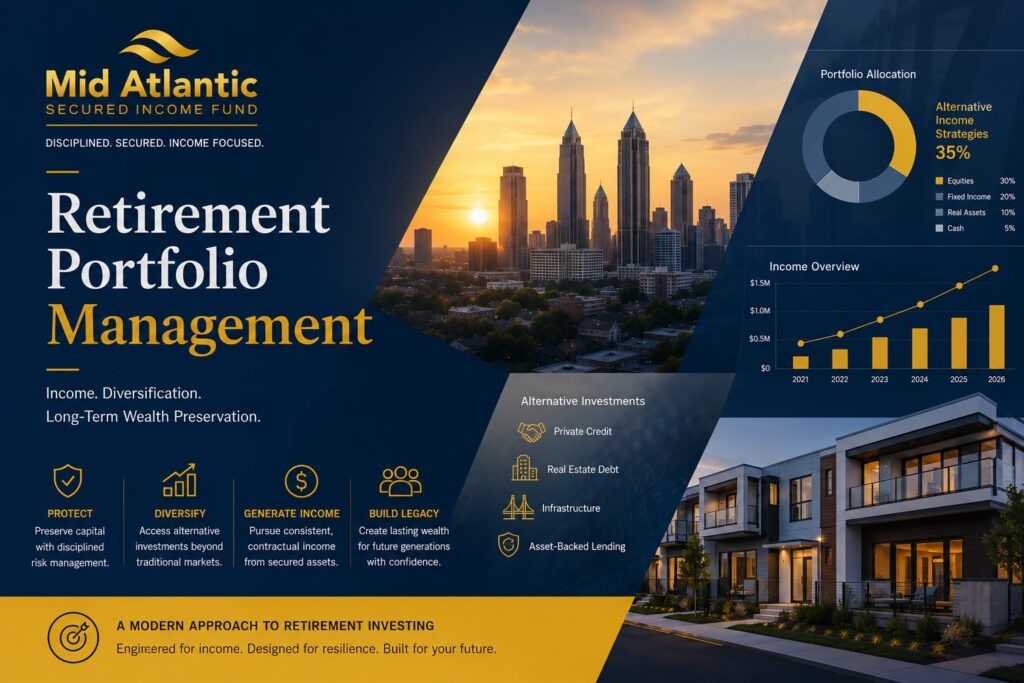
Retirement Portfolio Management in a New Investment Era For decades, retirement portfolio management followed a relatively predictable formula: a mix of public equities and investment-grade bonds designed around a traditional 60/40 allocation model. Equities provided growth. Bonds provided income and stability. Investors accumulated assets during their working years and gradually transitioned toward income-oriented portfolios in retirement. That framework is now under pressure. Persistent inflation volatility, elevated interest-rate sensitivity, rising public market correlations, demographic shifts, geopolitical instability, and growing concerns around retirement longevity have forced investors to rethink how portfolios are constructed. At the same time, alternative investments once reserved primarily for institutions—including private credit, real estate-backed debt, infrastructure, and private income strategies—have become increasingly accessible to accredited investors and retirement-focused portfolios. The result is a fundamental shift in how affluent investors, family offices, financial advisors, and retirement-focused investors approach portfolio construction. Retirement portfolio management in 2026 is no longer solely about maximizing returns. It is increasingly centered around: Income durability Capital preservation Inflation resilience Diversification beyond public markets Tax efficiency Reduced volatility Long-term purchasing power protection Institutional investors have already adapted. According to BlackRock, private market allocations among institutional portfolios have steadily increased over the past decade as investors seek diversification and income sources outside traditional fixed income markets. Preqin estimates global private capital assets under management will exceed $18 trillion by 2027, driven significantly by private credit and alternative income strategies. Individual investors are beginning to follow the same playbook. For accredited investors and retirement-focused individuals, the modern retirement portfolio increasingly includes exposure to alternative investments, private lending, secured income strategies, and self-directed retirement accounts that provide access to investments beyond stocks and mutual funds. This article explores how retirement portfolio management is evolving, why diversification has become more important than ever, and how income-focused alternative investments may complement long-term retirement strategies. What Is Retirement Portfolio Management? Direct Answer Retirement portfolio management is the process of structuring, monitoring, and adjusting an investment portfolio to support long-term retirement goals, income generation, risk management, capital preservation, and sustainable wealth accumulation. It typically involves balancing multiple asset classes, including: Equities Bonds Cash equivalents Real estate Alternative investments Private credit Income-producing assets Tax-advantaged retirement accounts Modern retirement portfolio management increasingly focuses on generating reliable income streams while reducing exposure to excessive volatility and inflation-related erosion of purchasing power. Why Traditional Retirement Models Are Being Reevaluated The Decline of the Traditional 60/40 Portfolio For years, the classic 60% stock / 40% bond portfolio served as a foundational retirement strategy. However, structural market shifts have exposed weaknesses in relying exclusively on public markets. Several macroeconomic realities have contributed to this reassessment: 1. Inflation Risk The U.S. experienced its highest inflationary environment in decades between 2021 and 2023. While inflation has moderated, elevated price levels continue to impact retirees disproportionately because retirement income must maintain purchasing power over long periods. According to the U.S. Bureau of Labor Statistics, cumulative inflation materially increased living costs for healthcare, housing, insurance, and essential services. Retirees relying solely on fixed bond yields often face declining real returns after inflation. 2. Bond Volatility Historically, bonds provided stability during equity downturns. However, rising interest rates created unusual volatility in traditional fixed income markets. According to Morningstar and Bloomberg Fixed Income Index data, many bond portfolios experienced historically poor performance during the recent rate cycle. This challenged the assumption that traditional bonds alone can fully stabilize retirement portfolios. 3. Longevity Risk Americans are living longer than previous generations. According to the Social Security Administration: A 65-year-old today has a meaningful probability of living into their 90s. Many retirement plans must support 25–35 years of withdrawals. This increases the need for durable income-producing investments capable of sustaining long-term cash flow. 4. Public Market Correlation Periods of simultaneous equity and bond declines have highlighted the importance of non-correlated assets. Institutional investors increasingly use private markets and alternative investments to diversify risk exposures and smooth return profiles. The Rise of Alternative Investments in Retirement Portfolios What Are Alternative Investments? Alternative investments refer to assets outside traditional publicly traded stocks and bonds. These may include: Private credit Real estate debt Infrastructure Private equity Real estate-backed lending Structured income products Hedge strategies Asset-backed lending For retirement-focused investors, income-oriented alternatives have become particularly attractive because they may provide: Diversification Contractual cash flows Reduced public market correlation Asset-backed collateral structures Potentially enhanced income generation Why Private Credit Has Gained Attention Private credit has emerged as one of the fastest-growing institutional asset classes globally. According to Preqin and BlackRock research: Global private credit AUM surpassed $1.7 trillion. Institutional investors continue increasing allocations. Insurance companies, pension funds, and family offices increasingly use private lending strategies for income-focused mandates. What Is Private Credit? Private credit involves non-bank lending directly to businesses, real estate projects, or borrowers through privately structured loans. Examples include: Senior secured real estate loans Bridge lending Commercial real estate debt Asset-backed lending Receivables financing Construction lending Mezzanine debt Unlike public bonds, private credit investments are typically negotiated directly between lenders and borrowers. Why Investors Use Secured Income Strategies Direct Answer Secured income investments are strategies backed by collateral or underlying assets designed to generate recurring income while emphasizing capital preservation and downside protection. Examples may include: Senior secured real estate debt First-lien lending Asset-backed credit facilities Real estate-backed private credit Collateralized commercial loans These structures often appeal to retirement-focused investors because they prioritize: Income generation Asset backing Contractual payments Senior position in the capital stack Diversification from equities How Retirement Portfolios Are Evolving Modern Retirement Portfolio Construction Today’s retirement portfolios increasingly blend traditional and alternative investments. A modern diversified portfolio may include: Asset Class Portfolio Objective Public Equities Long-term growth Investment-Grade Bonds Stability and liquidity Private Credit Income generation Real Estate Debt Inflation sensitivity Cash & Treasuries Liquidity reserves Alternative Income Strategies Diversification Infrastructure Long-term cash flow SDIRA Alternative Assets Tax-advantaged diversification The Growing Role of Self-Directed IRAs (SDIRAs) What Is a SDIRA? A Self-Directed IRA (SDIRA) is a retirement account that allows investors to access a broader range
Retirement Portfolio Management Read More »
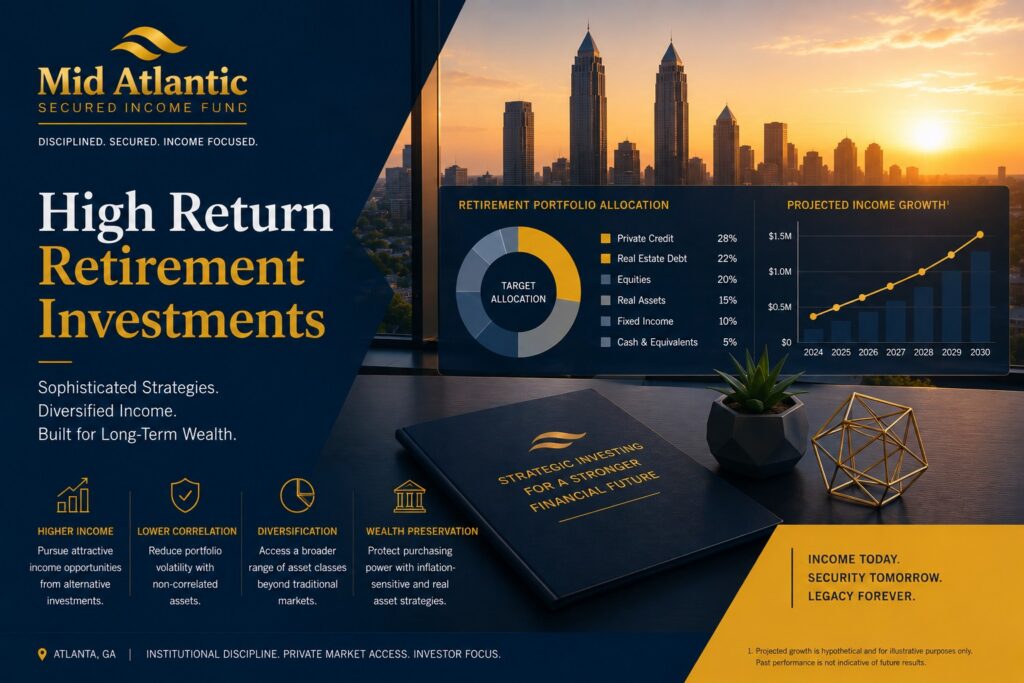
How Sophisticated Investors Are Redefining Retirement Portfolio Construction For decades, retirement investing in the United States centered around a relatively straightforward formula: maximize contributions to traditional retirement accounts, maintain broad stock market exposure, gradually shift toward bonds over time, and rely on long-term market appreciation. That framework worked reasonably well during prolonged periods of falling interest rates, strong equity performance, and stable inflation. Today’s environment is different. Persistent inflation pressures, elevated market volatility, rising geopolitical uncertainty, changing monetary policy cycles, and concerns surrounding retirement income sustainability are forcing investors to rethink traditional retirement portfolio construction. Increasingly, affluent investors, accredited investors, family offices, and retirement-focused allocators are seeking higher-quality diversification and alternative sources of return beyond conventional stock-and-bond allocations. This shift has accelerated interest in what many investors broadly describe as “high return retirement investments.” However, the most sophisticated retirement investors understand that pursuing higher returns is not simply about chasing yield. Instead, it involves balancing: capital appreciation, downside risk management, inflation resilience, income consistency, liquidity needs, tax efficiency, and long-term portfolio durability. The modern retirement portfolio is becoming increasingly multi-dimensional. What Are High Return Retirement Investments? Direct Answer High return retirement investments are assets or investment strategies designed to generate above-average long-term returns, enhanced retirement income, or stronger inflation-adjusted growth relative to traditional low-yield savings or conservative bond allocations. These investments may include: private credit, real estate debt funds, dividend-focused equities, infrastructure, alternative investments, private real estate, secured lending, REITs, self-directed IRA investments, and select private market opportunities. The objective is not merely maximizing raw returns. Rather, sophisticated retirement investing focuses on optimizing risk-adjusted returns over long time horizons. Why Traditional Retirement Strategies Are Under Pressure Several structural economic trends are reshaping retirement planning. 1. Longer Retirement Horizons Americans are living longer than previous generations. According to U.S. Census Bureau and Social Security Administration data, many retirees may need portfolios capable of supporting income needs for 25–35 years or more. This increases pressure on portfolio growth and sustainable income generation. 2. Inflation Risk Inflation remains one of the most significant long-term threats to retirement purchasing power. Even moderate inflation materially impacts retirees over multi-decade periods. According to Bureau of Labor Statistics data, cumulative inflation since 2020 has meaningfully increased costs across: housing, healthcare, insurance, utilities, food, and retirement living expenses. Portfolios heavily concentrated in low-yield fixed income may struggle to preserve purchasing power over time. 3. Bond Market Challenges Traditional retirement allocations historically relied heavily on bonds for income and stability. However, changing interest rate environments exposed weaknesses in conventional fixed-income assumptions. Many investors now seek alternative income-producing assets capable of generating potentially higher yields with differentiated risk characteristics. 4. Market Volatility Public equities remain critical to long-term growth portfolios, but market concentration and elevated volatility have increased interest in alternative diversification strategies. Investors increasingly recognize that relying exclusively on public markets may create concentration risk. The Evolution of Retirement Portfolio Construction Institutional investors and family offices have spent decades expanding beyond the traditional 60/40 stock-and-bond model. Alternative assets now play a substantially larger role in sophisticated portfolio construction. According to BlackRock, Preqin, and McKinsey research, institutional allocations to alternatives have grown steadily over the last two decades. These allocations frequently include: private credit, infrastructure, real estate, commodities, private equity, and secured lending. Retail retirement investors are increasingly adopting similar diversification frameworks. Categories of High Return Retirement Investments 1. Private Credit Investments Private credit has become one of the fastest-growing alternative asset classes globally. What Is Private Credit? Private credit generally refers to non-bank lending strategies where investors provide capital directly to borrowers outside traditional public bond markets. Examples may include: senior secured real estate loans, bridge lending, construction lending, asset-backed lending, and private debt funds. According to Preqin, private credit assets under management have grown dramatically over the past decade as banks reduced certain lending exposures following post-2008 regulatory changes. Why Retirement Investors Explore Private Credit Sophisticated investors often view private credit favorably because it may provide: income generation, floating-rate exposure, lower correlation to equities, collateral-backed structures, and enhanced yield potential. Many private credit investments prioritize downside protection through senior secured lending structures. 2. Real Estate Debt Funds Unlike traditional equity real estate investing, real estate debt investing focuses on lending against real estate collateral. Key Characteristics Real estate debt funds may offer: income-oriented strategies, monthly distributions, asset-backed exposure, and reduced volatility compared to certain equity investments. Senior secured lending structures place lenders higher in the capital stack than equity investors. This distinction matters significantly during market downturns. 3. Dividend Growth Investing Dividend-paying equities remain foundational components of many retirement portfolios. However, sophisticated retirement investors increasingly focus on: dividend sustainability, free cash flow quality, balance sheet strength, and inflation-adjusted growth potential. Dividend growth investing attempts to combine: current income, long-term appreciation, and compounding reinvestment effects. 4. Self-Directed IRA Investments (SDIRAs) Self-Directed IRAs allow retirement investors to access broader alternative investment opportunities beyond traditional brokerage assets. SDIRAs may hold: private credit, real estate, precious metals, secured lending investments, private funds, and other alternative assets. Many sophisticated investors use SDIRAs to diversify retirement exposure beyond public markets. 5. Real Estate Investments Real estate continues to play a major role in retirement diversification strategies. Investors may gain exposure through: direct ownership, REITs, private real estate funds, real estate debt, and income-producing commercial assets. Real estate may provide: inflation sensitivity, cash flow, tax advantages, and long-term appreciation potential. Are High Return Retirement Investments Riskier? Direct Answer Higher potential returns generally involve higher levels of risk, complexity, or reduced liquidity. However, not all “high return” investments carry identical risk characteristics. For example: Investment Type Primary Risk Growth Stocks Market volatility Private Credit Credit/default risk Real Estate Market & liquidity risk Bonds Interest rate risk Precious Metals Price volatility Private Equity Illiquidity & execution risk Sophisticated retirement investing focuses on balancing multiple forms of risk rather than simply maximizing returns. The Importance of Diversification Diversification remains one of the most important principles in retirement investing. Institutional portfolio construction generally avoids excessive concentration in any
High Return Retirement Investments Read More »