Retirement Investing Is Evolving
For decades, retirement investing in the United States followed a relatively standardized formula:
- Public equities for growth
- Bonds for income and stability
- Mutual funds for diversification
- Target-date funds for convenience
While those tools remain foundational for millions of investors, the modern retirement landscape has changed substantially.
Inflation has become more persistent. Market volatility has increased. Public equity valuations periodically reach elevated levels. Bond correlations have shifted. And retirees increasingly face the challenge of generating reliable income in a world where longevity risk continues to rise.
As a result, institutional investors, family offices, pension systems, and accredited investors have steadily expanded allocations to alternative assets within broader portfolio strategies.
Today, many sophisticated investors are asking:
Should retirement portfolios rely exclusively on traditional stocks and bonds?
Increasingly, the answer appears to be no.
According to research from BlackRock, Morgan Stanley, and Preqin, private market allocations have expanded materially across institutional portfolios over the past decade.
This trend reflects growing interest in:
- Diversification
- Inflation-sensitive investments
- Income-producing assets
- Lower correlation strategies
- Capital preservation frameworks
- Alternative sources of yield
For retirement-focused investors, alternative assets are increasingly viewed not as speculative side allocations, but as strategic portfolio components capable of complementing traditional investments.
What Are Alternative Assets?
Definition
Alternative assets are investments outside traditional publicly traded stocks, bonds, and cash equivalents.
Examples include:
- Private credit
- Real estate
- Infrastructure
- Private equity
- Hedge strategies
- Commodities
- Precious metals
- Venture capital
- Asset-backed lending
- Real estate debt funds
Alternative investments often involve different return drivers than public markets.
Why Investors Use Alternative Assets in Retirement Accounts
Alternative assets are increasingly used for several reasons:
|
Objective |
Why Alternative Assets May Help |
|---|---|
|
Diversification |
Lower correlation to public markets |
|
Income generation |
Contractual or recurring cash flows |
|
Inflation protection |
Exposure to real assets and floating-rate structures |
|
Capital preservation |
Certain secured lending structures emphasize downside protection |
|
Long-term growth |
Access to private market opportunities |
|
Reduced volatility |
Some private assets are less sensitive to daily market swings |
Importantly, alternative investments are not inherently safer than traditional investments. They simply behave differently.
Sophisticated portfolio construction often seeks diversification across:
- Economic environments
- Liquidity profiles
- Income drivers
- Interest rate sensitivity
- Market correlations
The Institutional Shift Toward Private Markets
Institutional investors have steadily increased allocations to private assets over the past 20 years.
According to McKinsey & Company global private markets research:
- Private capital assets under management have expanded dramatically since the early 2000s
- Pension funds increasingly allocate to alternatives
- Family offices frequently maintain significant private market exposure
- Institutional investors continue seeking diversification beyond public equities
This trend accelerated following:
- Historically low interest rates
- Bond yield compression
- Public market volatility
- Inflationary pressures
Alternative Assets Commonly Used in Retirement Portfolios
1. Private Credit
What Is Private Credit?
Private credit refers to lending conducted outside traditional public bond markets.
Examples include:
- Real estate-backed lending
- Bridge lending
- Construction financing
- Senior secured loans
- Asset-backed credit
- Commercial lending
Private credit has become one of the fastest-growing institutional asset classes globally.
Why Retirement Investors Look at Private Credit
Private credit strategies may offer:
- Income generation
- Floating-rate structures
- Collateral-backed investments
- Lower correlation to public equities
- Diversification benefits
Certain strategies focus specifically on:
- Senior secured positions
- Conservative underwriting
- Real estate collateral
- Cash-flow stability
These characteristics have attracted growing retirement-focused interest.
2. Real Estate Investments
Real estate remains one of the most widely used alternative assets in retirement portfolios.
Real Estate Ownership vs Real Estate Debt
These are distinct investment approaches.
Equity Real Estate
Investors own the property itself and participate in:
- Appreciation
- Rental income
- Equity growth
Real Estate Debt
Investors provide financing secured by property collateral.
Debt-oriented structures may emphasize:
- Defined repayment terms
- Income consistency
- Senior lien priority
- Downside protection
3. Infrastructure Investments
Infrastructure assets may include:
- Energy systems
- Transportation assets
- Utilities
- Communications infrastructure
Institutional investors often value infrastructure because of:
- Long-duration cash flows
- Inflation linkage
- Defensive characteristics
4. Precious Metals
Precious metals such as gold and silver are frequently used as diversification tools.
Why Investors Use Precious Metals
Potential reasons include:
- Inflation hedging
- Currency diversification
- Geopolitical uncertainty protection
- Crisis risk management
However, precious metals generally do not produce cash flow.
5. Private Equity
Private equity involves ownership stakes in privately held companies.
Potential characteristics:
- Long investment horizons
- Higher return potential
- Reduced liquidity
- Active management exposure
Private equity allocations are common among:
- Endowments
- Pension systems
- Family offices
What Is a Self-Directed IRA (SDIRA)?
Definition
A self-directed IRA is a retirement account structure that allows investors to hold alternative assets beyond traditional stocks and mutual funds.
Depending on the custodian and structure, SDIRAs may allow investments in:
- Real estate
- Private funds
- Private credit
- Precious metals
- Alternative lending
- Private placements
This expanded flexibility has contributed to growing SDIRA adoption.
Why Alternative Assets Matter for Retirement Planning
Traditional retirement portfolios face several structural challenges:
1. Inflation Risk
Inflation erodes purchasing power over time.
Assets with inflation-sensitive characteristics may help offset this risk.
2. Longevity Risk
People are living longer.
Longer retirement periods increase pressure on:
- Portfolio sustainability
- Income generation
- Capital preservation
3. Market Concentration Risk
Modern equity markets have become increasingly concentrated in a relatively small number of large technology companies.
Diversification beyond public equities may help reduce concentration exposure.
4. Sequence-of-Return Risk
Early retirement market declines combined with withdrawals can materially impact portfolio sustainability.
Diversified income-oriented investments may help mitigate this challenge.
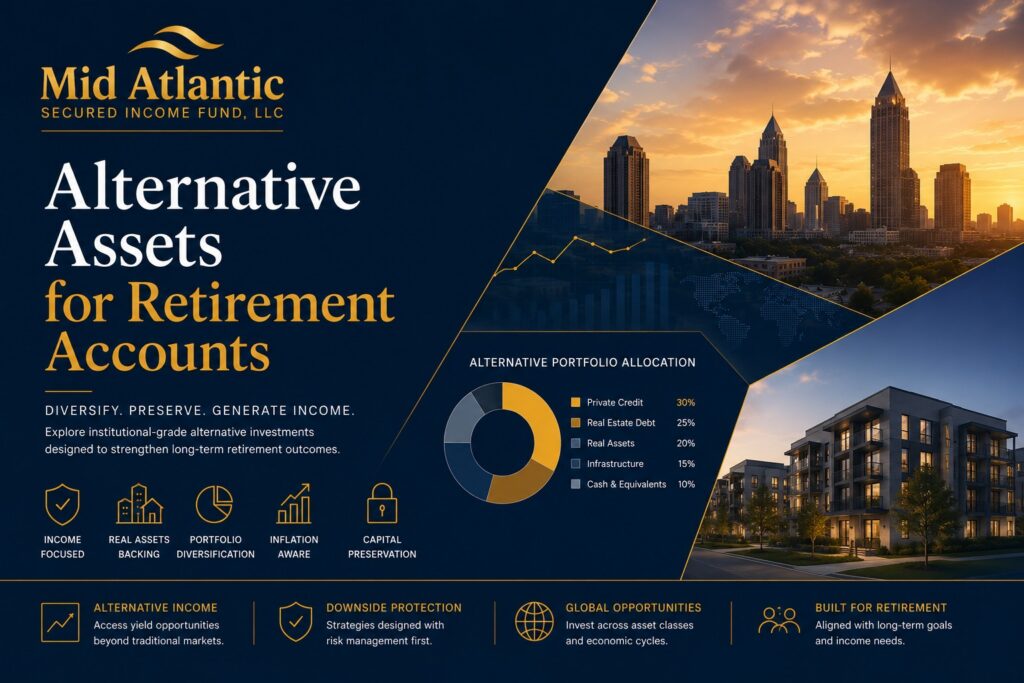
How Institutional Investors Build Diversified Retirement Portfolios
Sophisticated investors increasingly diversify across:
|
Asset Category |
Potential Role |
|---|---|
|
Public equities |
Long-term growth |
|
Fixed income |
Stability and liquidity |
|
Private credit |
Income and diversification |
|
Real estate |
Inflation-sensitive exposure |
|
Infrastructure |
Defensive cash flow |
|
Cash equivalents |
Liquidity management |
|
Alternative investments |
Reduced correlation |
The objective is not maximum short-term returns.
It is resilience across market cycles.
Are Alternative Investments Risky?
Yes.
Alternative investments carry meaningful risks including:
- Illiquidity
- Credit risk
- Operational risk
- Valuation complexity
- Manager risk
- Market risk
- Regulatory risk
Investors should evaluate:
- Underwriting quality
- Transparency
- Reporting standards
- Experience
- Portfolio concentration
- Fee structures
- Alignment of interests
Liquidity Considerations
Alternative investments often involve reduced liquidity compared to public securities.
Some investments may:
- Restrict withdrawals
- Require multi-year holding periods
- Have limited secondary markets
Liquidity planning is critical within retirement portfolios.
Institutional portfolio construction typically balances:
- Liquid assets
- Semi-liquid assets
- Long-duration allocations
Income-Focused Retirement Strategies
One reason alternative assets continue attracting attention is income generation.
Many retirement investors increasingly prioritize:
- Predictable cash flow
- Reduced dependence on equity appreciation
- Income diversification
- Capital preservation
Private credit and real estate-backed lending strategies may appeal to investors seeking contractual income streams.
How Alternative Assets May Complement Traditional Portfolios
Alternative assets are generally not designed to fully replace:
- Stocks
- Bonds
- Public market exposure
Rather, they may complement traditional allocations.
Potential benefits include:
- Diversification
- Additional income sources
- Reduced correlation
- Inflation sensitivity
- Expanded opportunity sets
Behavioral Finance and Retirement Investing
Diversification is not solely mathematical.
It is behavioral.
Severe volatility often causes investors to:
- Panic sell
- Overreact
- Chase momentum
- Abandon long-term strategies
Institutional diversification frameworks seek to improve portfolio durability and investor discipline over time.
Why Accredited Investors Often Explore Alternatives
Accredited investors frequently gain access to:
- Private funds
- Real estate debt strategies
- Direct lending opportunities
- Institutional-quality alternative investments
This expanded opportunity set may improve diversification flexibility.
However, access alone does not eliminate risk.
Manager selection and underwriting discipline remain critical.
How The Mid Atlantic Fund Fits Into Retirement Diversification Discussions
The Mid Atlantic Secured Income Fund focuses on:
- Income-oriented investing
- Real estate-backed secured lending
- Private credit exposure
- Asset-backed structures
- Conservative underwriting principles
For certain accredited investors, these characteristics may complement broader retirement diversification frameworks alongside traditional public market allocations.
The fund’s emphasis on:
- Income consistency
- Asset-backed lending
- Senior secured positions
- Institutional operational processes
Aligns with broader themes increasingly present in modern retirement portfolio construction discussions.
Learn more:
- https://themidatlanticfund.com/knowledge-hub/
- https://themidatlanticfund.com/ira-investing-with-mid-atlantic-fund/
- https://themidatlanticfund.com/passive-income-investment-calculator/
- https://themidatlanticfund.com/low-interest-rates-inflation-savers-dilemma/
The Future of Retirement Investing
The retirement landscape continues evolving.
Several structural trends appear increasingly important:
- Rising interest in private markets
- Growing SDIRA adoption
- Demand for inflation-aware investing
- Increased focus on income generation
- Expanded institutional alternative allocations
Sophisticated retirement planning increasingly involves broader diversification across:
- Public markets
- Private markets
- Real assets
- Income-oriented investments
- Alternative strategies
Conclusion
Alternative assets are becoming increasingly integrated into modern retirement portfolio discussions.
Institutional investors, family offices, and sophisticated accredited investors increasingly use alternative investments to:
- Diversify portfolios
- Generate income
- Reduce concentration risk
- Navigate inflation
- Improve long-term portfolio resilience
While alternative investments involve unique risks — including liquidity constraints and operational complexity — they may provide meaningful diversification benefits when incorporated thoughtfully within a disciplined portfolio framework.
Retirement investing is no longer defined solely by stocks and bonds.
Increasingly, it is defined by strategic diversification across multiple economic drivers, income streams, and asset classes designed to navigate uncertainty over decades — not quarters.
FAQ Section
What are alternative assets for retirement accounts?
Alternative assets are investments outside traditional stocks and bonds that may be held within certain retirement accounts, including private credit, real estate, infrastructure, private equity, and precious metals.
What is a self-directed IRA?
A self-directed IRA (SDIRA) is a retirement account structure that allows broader investment flexibility, including certain alternative assets not typically available in standard brokerage IRAs.
Why do investors use alternative investments in retirement portfolios?
Investors often use alternatives for diversification, income generation, inflation protection, and reduced correlation to traditional public markets.
Are alternative investments risky?
Yes. Alternative investments can involve liquidity constraints, credit risk, operational complexity, and valuation challenges. Investors should conduct thorough due diligence.
Can retirement accounts invest in private credit?
Certain self-directed retirement account structures may allow investments in private credit funds, real estate debt strategies, and alternative lending opportunities.
Are alternative assets good for retirement income?
Some alternative investments emphasize contractual or recurring cash flows that may complement broader retirement income strategies.