Retirement investing has undergone a structural transformation over the past two decades.
For much of modern financial history, traditional retirement planning centered around a relatively simple framework: accumulate equities during working years, gradually shift into bonds nearing retirement, and rely on a diversified stock-and-bond portfolio to generate long-term appreciation and income.
That framework is increasingly being challenged.
Persistent inflation volatility, elevated market correlations, rising interest-rate uncertainty, longer life expectancies, demographic pressures, and growing concerns surrounding sequence-of-returns risk have forced investors and advisors to rethink what true retirement savings optimization actually means.
Today’s retirement environment requires more than accumulation.
It requires:
- cash flow durability,
- risk-adjusted portfolio construction,
- inflation-aware income planning,
- tax efficiency,
- diversification beyond public markets,
- and disciplined downside management.
For many investors — particularly accredited investors and high-net-worth retirees — optimizing retirement savings increasingly involves incorporating alternative investments, private credit, real estate-backed income strategies, and Self-Directed IRA (SDIRA) structures alongside traditional public-market allocations.
The objective is no longer simply maximizing returns.
The objective is building a portfolio capable of sustaining purchasing power, generating consistent income, and preserving financial flexibility through multiple economic cycles.
What Is Retirement Savings Optimization?
Direct Answer
Retirement savings optimization is the process of structuring investment portfolios, tax strategies, income sources, and asset allocations to maximize long-term retirement outcomes while managing risk, inflation exposure, taxes, and income sustainability.
Unlike basic retirement planning, optimization focuses on improving portfolio efficiency across multiple dimensions simultaneously, including:
- total return,
- risk-adjusted return,
- passive income generation,
- tax efficiency,
- liquidity management,
- volatility control,
- and long-term capital preservation.
Why Retirement Planning Has Become More Complex
Several structural economic shifts have fundamentally changed retirement investing.
1. Longer Retirement Horizons
According to the Social Security Administration, a significant percentage of retirees today may spend 20–30 years in retirement.
Longer retirements create greater pressure on:
- portfolio withdrawal sustainability,
- inflation management,
- healthcare funding,
- and income reliability.
A portfolio that appears sufficient at age 65 may face significant stress by age 85 if growth and income planning are poorly balanced.
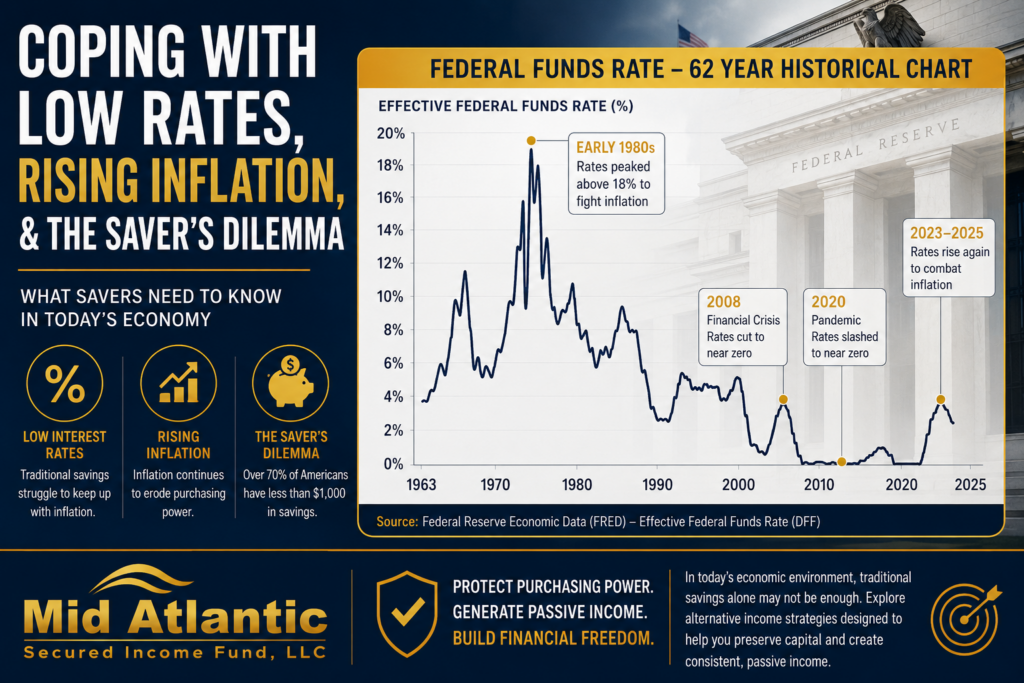
2. Inflation Has Re-Emerged as a Major Retirement Risk
Following the post-pandemic inflation spike, investors were reminded that purchasing power erosion can materially impact retirement outcomes.
Even moderate inflation compounds aggressively over time.
At 3% annual inflation:
Purchasing power declines substantially over multi-decade retirement periods.
This has increased demand for:
- real assets,
- income-producing investments,
- floating-rate structures,
- and inflation-resistant portfolio components.
3. Traditional Bonds No Longer Solve Every Income Need
Historically, retirees relied heavily on investment-grade bonds for income stability.
However, periods of rising interest rates demonstrated that bonds can experience meaningful price volatility while still delivering limited real returns after inflation and taxes.
This has accelerated institutional interest in:
- private credit,
- infrastructure,
- real estate debt,
- alternative income strategies,
- and non-correlated assets.
Core Pillars of Retirement Savings Optimization
1. Diversification Beyond Traditional Markets
Direct Answer
Modern retirement diversification increasingly includes exposure to alternative assets alongside traditional equities and bonds to reduce concentration risk and improve portfolio resilience.
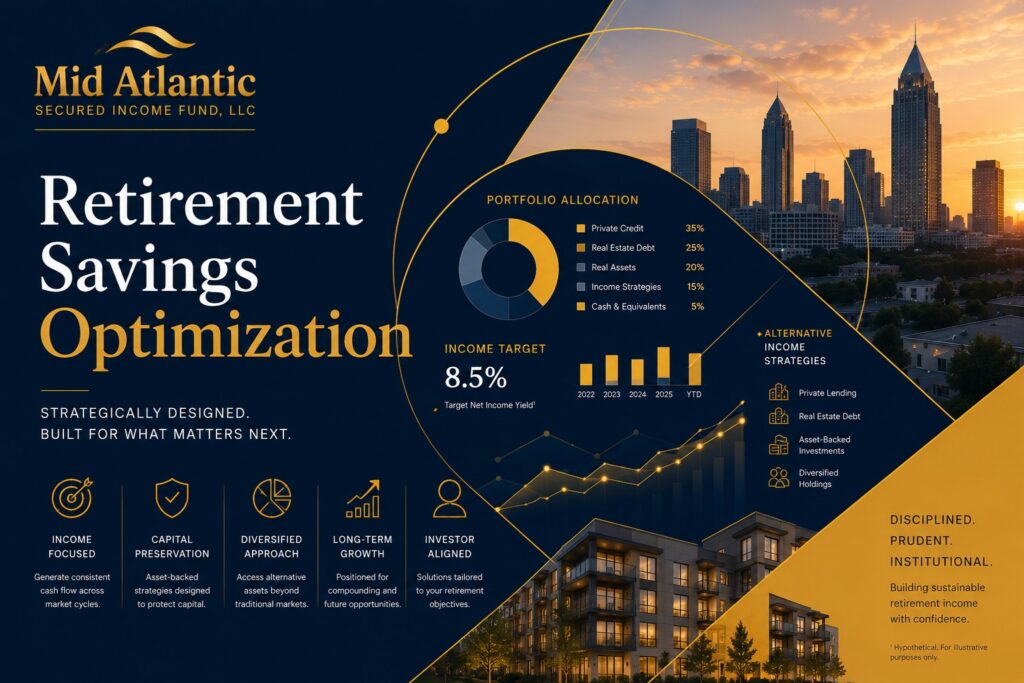
Traditional 60/40 portfolios dominated retirement planning for decades.
Today, many institutional allocators incorporate broader asset exposure including:
|
Asset Class |
Potential Role |
|---|---|
|
Public Equities |
Long-term growth |
|
Investment-Grade Bonds |
Stability & liquidity |
|
Private Credit |
Income generation |
|
Real Estate Debt |
Asset-backed yield |
|
Real Assets |
Inflation protection |
|
Cash Equivalents |
Liquidity reserve |
|
Alternative Strategies |
Diversification |
According to BlackRock and Preqin research, institutional portfolios have steadily increased alternative asset allocations over the last decade as investors seek differentiated income streams and lower correlation to public markets.
2. Income-Focused Portfolio Construction
Retirement portfolios must increasingly prioritize sustainable cash flow generation.
Many retirees underestimate how psychologically and financially valuable predictable income can become during volatile market periods.
Income-oriented portfolio construction may include:
- dividend-producing equities,
- bond ladders,
- real estate income,
- private lending,
- secured debt investments,
- and structured passive income vehicles.
For accredited investors, private credit strategies have attracted attention due to their historically higher yields relative to many traditional fixed-income products, though risks vary substantially depending on underwriting quality and structure.
Why Accredited Investors Are Increasingly Exploring Private Credit
Direct Answer
Many accredited investors use private credit investments to pursue enhanced income potential, portfolio diversification, and reduced correlation to traditional public equity markets.
Private credit has expanded significantly since the Global Financial Crisis.
According to Preqin and IMF research, the global private credit market has surpassed $1 trillion in assets under management.
Drivers include:
- tighter bank lending standards,
- institutional demand for yield,
- and investor preference for asset-backed income structures.
Common private credit strategies include:
- senior secured lending,
- bridge lending,
- real estate debt,
- asset-backed lending,
- and direct lending funds.
Are Debt Funds Safer Than Stocks?
Direct Answer
Debt funds and private credit investments may exhibit lower volatility than equities in certain market environments, but they carry distinct risks including credit risk, liquidity risk, underwriting risk, and market-cycle exposure.
Risk depends heavily on:
- loan quality,
- collateral structure,
- leverage levels,
- underwriting discipline,
- and manager experience.
Investors often evaluate:
- first-lien positioning,
- loan-to-value ratios,
- collateral protections,
- borrower quality,
- and historical default management processes.
The Mid Atlantic Secured Income Fund emphasizes real estate-backed secured debt strategies focused on income generation and capital preservation principles. However, all investments involve risk and past performance does not guarantee future results.
3. Tax-Efficient Retirement Structuring
Retirement optimization is not solely about investment selection.
Tax efficiency materially impacts long-term outcomes.
Common strategies include:
- Roth conversion analysis,
- tax-loss harvesting,
- asset-location optimization,
- SDIRA structuring,
- and income sequencing strategies.
Understanding Self-Directed IRAs (SDIRAs)
Direct Answer
A Self-Directed IRA allows eligible investors to hold alternative assets within retirement accounts, including private credit, real estate, precious metals, and certain private investments.
Unlike traditional brokerage IRAs, SDIRAs may permit broader investment flexibility.
Investors commonly explore SDIRAs for:
- diversification,
- passive income generation,
- tax-advantaged compounding,
- and alternative asset exposure.
The Mid Atlantic Fund works with several SDIRA custodial platforms and investor service providers, including:
- American IRA
- Advanta IRA
- IRA Club
- Rocket Dollar
- uDirect IRA Services
Additional information regarding retirement investing structures and alternative income strategies can be found at:
4. Managing Sequence-of-Returns Risk
One of the largest retirement threats is sequence-of-returns risk.
This refers to the danger of suffering major portfolio declines early in retirement while simultaneously taking withdrawals.
Poor timing can significantly impair portfolio longevity.
Strategies used to mitigate sequence risk may include:
- diversified income sources,
- reduced volatility exposure,
- liquidity reserves,
- structured withdrawals,
- and non-correlated assets.
5. Inflation-Resistant Retirement Assets
Certain assets may historically perform differently during inflationary periods.
Investors often evaluate:
|
Asset Type |
Potential Inflation Characteristics |
|---|---|
|
Real Estate |
Income and asset repricing potential |
|
Private Credit |
Floating-rate structures |
|
Commodities |
Inflation sensitivity |
|
Infrastructure |
Pricing power |
|
Dividend Growth Stocks |
Income growth potential |
No investment fully eliminates inflation risk, but diversified exposure may improve resilience.
The Behavioral Side of Retirement Optimization
Retirement planning is not purely mathematical.
Behavioral finance plays a major role.
Market volatility often triggers emotional decision-making:
- panic selling,
- over-concentration,
- excessive risk-taking,
- or abandoning long-term plans.
Institutional-quality portfolio construction seeks to create portfolios investors can realistically maintain across market cycles.
Consistency frequently matters more than chasing peak returns.
Why Passive Income Matters in Retirement
Direct Answer
Passive income strategies may help retirees reduce dependence on portfolio liquidation by generating recurring cash flow from investments.
Examples include:
- dividends,
- bond income,
- real estate cash flow,
- and private lending distributions.
Many investors psychologically prefer receiving income rather than selling assets during downturns.
This can improve long-term portfolio discipline.
Investors evaluating passive income strategies may also find value in tools such as:
Passive Income Investment Calculator
Portfolio Construction Is Increasingly Personalized
Retirement optimization is highly individualized.
Variables include:
- age,
- liquidity needs,
- risk tolerance,
- income objectives,
- tax profile,
- estate planning goals,
- and time horizon.
Institutional portfolio construction increasingly emphasizes customization over generic allocation formulas.
What Risks Should Retirement Investors Consider?
Direct Answer
All retirement investments involve risk, including market volatility, inflation risk, credit risk, liquidity risk, interest-rate risk, and manager risk.
Alternative investments may introduce additional considerations including:
- reduced liquidity,
- valuation complexity,
- underwriting risk,
- and regulatory considerations.
Investors should conduct thorough due diligence and consult qualified financial, legal, and tax professionals before making investment decisions.
The Growing Institutionalization of Alternative Investments
Large institutional allocators including pensions, endowments, sovereign wealth funds, and insurance companies have steadily expanded alternative asset exposure.
According to BlackRock, McKinsey, and Preqin research:
- private markets continue attracting institutional capital,
- income-oriented strategies remain in demand,
- and diversification beyond traditional 60/40 models is increasing globally.
Retail accredited investors are increasingly adopting similar frameworks through:
- private credit funds,
- real estate debt strategies,
- and SDIRA-enabled investing structures.
Retirement Optimization Is About Durability, Not Just Returns
The most sophisticated retirement portfolios are often designed around durability rather than maximizing headline performance.
That includes:
- managing downside exposure,
- preserving flexibility,
- improving income visibility,
- reducing concentration risk,
- and maintaining long-term purchasing power.
In practice, retirement optimization becomes a balance between:
- growth,
- income,
- risk management,
- tax efficiency,
- and behavioral sustainability.
Final Perspective
Retirement investing has evolved from a relatively straightforward accumulation strategy into a multidimensional portfolio engineering challenge.
Modern retirees face:
- longer retirements,
- inflation uncertainty,
- market volatility,
- and increasingly complex income planning needs.
As a result, many investors are broadening beyond traditional public-market-only portfolios and exploring diversified income-oriented strategies that incorporate:
- alternative investments,
- private credit,
- SDIRAs,
- real estate-backed income,
- and institutional-style portfolio construction principles.
For investors seeking long-term retirement resilience, the focus increasingly shifts toward:
- diversification,
- disciplined underwriting,
- sustainable passive income,
- downside awareness,
- and durable wealth preservation frameworks.
FAQ Section
What is retirement savings optimization?
Retirement savings optimization is the process of improving portfolio structure, tax efficiency, diversification, income planning, and risk management to enhance long-term retirement outcomes.
Why are investors adding alternative investments to retirement portfolios?
Many investors use alternative investments to pursue diversification, passive income generation, inflation resistance, and reduced correlation to public equity markets.
Can SDIRAs hold alternative investments?
Yes. Self-Directed IRAs may allow eligible investors to hold alternative assets including private credit, real estate, precious metals, and certain private investments.
Are private credit investments risky?
Yes. Private credit investments involve risks including borrower default risk, liquidity risk, underwriting risk, and market-cycle exposure.
What is sequence-of-returns risk?
Sequence-of-returns risk refers to the danger of poor investment performance early in retirement while taking withdrawals, which may reduce long-term portfolio sustainability.
Why is diversification important in retirement?
Diversification may help reduce concentration risk, improve portfolio resilience, and create more balanced exposure across different economic environments.