Advanced Strategies for Long-Term Wealth Preservation, Income Stability, and Portfolio Resilience
Retirement planning changes dramatically once wealth reaches a certain level.
For high net worth individuals, retirement is rarely defined by a single question like, “Will I have enough to retire?” Instead, the conversation becomes significantly more nuanced:
- How should wealth be structured for tax efficiency?
- How can portfolios generate durable income without excessive volatility?
- How should concentrated equity exposure be managed?
- What role should alternative investments play?
- How can families preserve purchasing power across decades?
- How can retirement income remain resilient during inflationary or recessionary cycles?
These are institutional portfolio construction questions — not simply retail investing concerns.
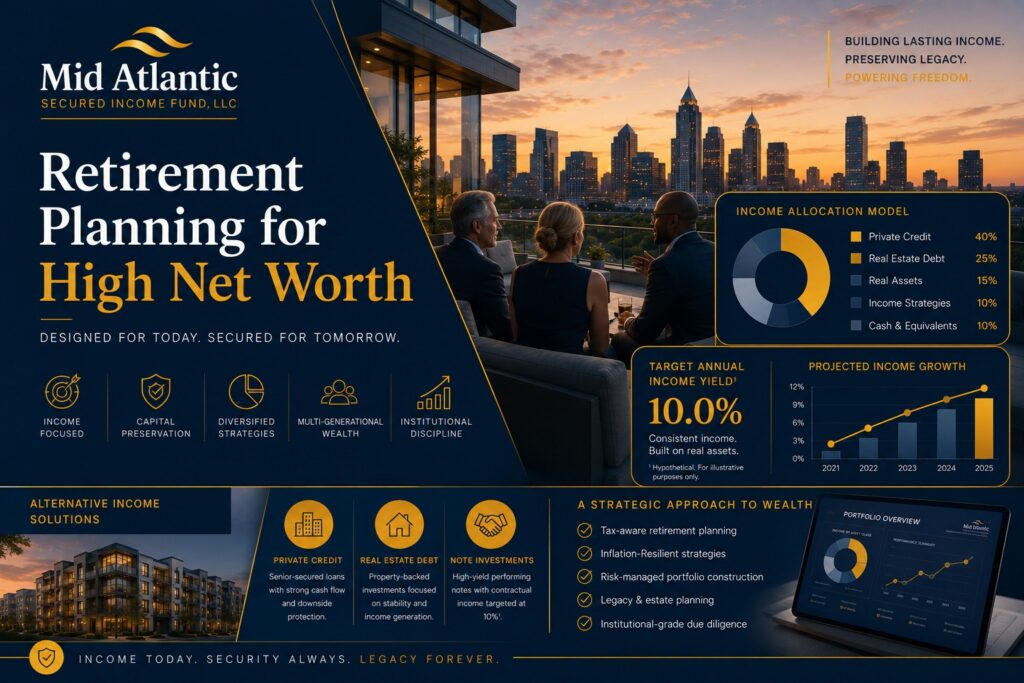
As global markets evolve, many affluent investors are increasingly reassessing the traditional 60/40 portfolio framework and exploring broader allocations across private credit, real assets, infrastructure, private real estate debt, and other income-oriented alternative investments.
The result is a more sophisticated retirement planning environment — one that increasingly resembles institutional capital management rather than conventional retirement investing.
What Is Retirement Planning for High Net Worth Individuals?
Direct Answer
Retirement planning for high net worth individuals is the process of structuring investment portfolios, income strategies, tax planning, estate planning, and alternative asset allocations to preserve wealth, generate sustainable income, and manage long-term financial risk throughout retirement.
Unlike traditional retirement planning, high net worth retirement planning typically focuses on:
- wealth preservation,
- tax efficiency,
- income durability,
- portfolio diversification,
- legacy planning,
- private market exposure,
- downside mitigation,
- and intergenerational wealth transfer.
Why Retirement Planning Looks Different for Affluent Investors
According to the Federal Reserve’s 2022 Survey of Consumer Finances, the top 10% of U.S. households control roughly 67% of total household wealth.
That concentration of wealth fundamentally changes retirement planning priorities.
For many affluent households:
- Social Security represents only a negligible portion of retirement income.
- Market volatility can materially impact long-term estate value.
- Taxes become one of the largest portfolio drags.
- Sequence-of-return risk becomes increasingly important.
- Capital preservation often becomes more important than maximizing speculative growth.
This creates a major shift in mindset.
Accumulation gradually transitions toward strategic wealth management.
The Evolution of Retirement Portfolio Construction
Traditional Retirement Models
Historically, retirement portfolios centered around:
- public equities,
- investment-grade bonds,
- municipal bonds,
- dividend-paying stocks,
- and mutual funds.
While these strategies still play an important role, institutional investors increasingly recognize several modern challenges:
1. Higher Interest Rate Volatility
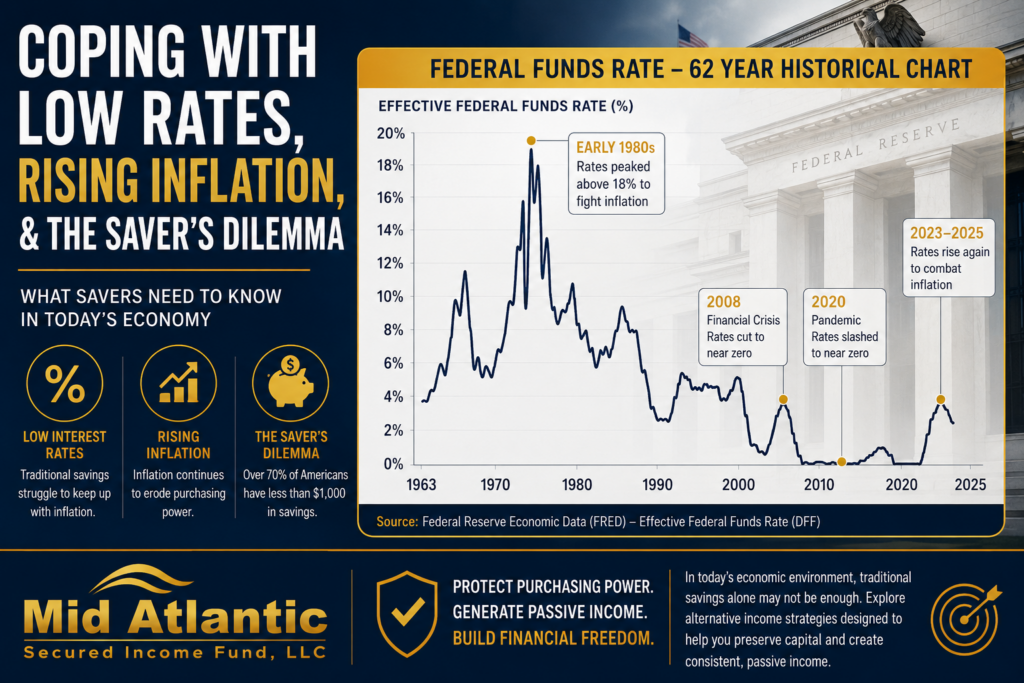
After years of near-zero rates, bond markets experienced historic repricing between 2022 and 2024.
Many investors discovered that traditional fixed income allocations may not always provide the downside protection they historically expected.
2. Persistent Inflation Concerns
Inflation remains one of the greatest long-term threats to retirement purchasing power.
According to the Bureau of Labor Statistics, cumulative inflation between 2021 and 2024 materially impacted consumer purchasing power across housing, healthcare, insurance, and services.
3. Elevated Equity Market Concentration
A significant percentage of S&P 500 performance has increasingly been driven by a small number of mega-cap technology companies.
This creates concentration risk that many retirees underestimate.
4. Longevity Risk
Affluent retirees are living longer.
According to actuarial estimates and wealth management research from firms like Morgan Stanley and BlackRock, retirement planning horizons increasingly extend 25–35 years.
That requires portfolios designed for both growth and durability.
Why High Net Worth Investors Are Increasingly Exploring Alternative Investments
Institutional Capital Has Already Shifted
Over the last two decades, institutional investors such as pension funds, sovereign wealth funds, endowments, and family offices have steadily increased allocations to alternatives.
Preqin estimates global alternative assets under management surpassed $16 trillion and continue growing.
Why?
Because alternatives may offer:
- diversification benefits,
- lower correlation to public markets,
- enhanced income potential,
- inflation sensitivity,
- and asset-backed structures.
What Are Alternative Investments?
Direct Answer
Alternative investments are assets outside traditional publicly traded stocks and bonds.
Examples include:
- private credit,
- real estate debt,
- infrastructure,
- private equity,
- hedge funds,
- commodities,
- real assets,
- and structured income investments.
The Growing Role of Private Credit in Retirement Planning
One of the most significant shifts in modern portfolio construction has been the rise of private credit.
What Is Private Credit?
Private credit refers to non-bank lending strategies where investors provide capital directly to businesses, real estate operators, or borrowers through privately structured debt investments.
Private credit has grown rapidly as banks face tighter regulatory capital requirements.
According to BlackRock and Preqin research:
- private credit AUM has expanded significantly over the past decade,
- institutional demand remains strong,
- and many investors seek income-focused alternatives outside traditional bond markets.
Why Affluent Retirees Are Interested in Income-Producing Investments
High net worth retirement planning increasingly focuses on cash flow durability.
Rather than relying exclusively on market appreciation, many investors prioritize:
- contractual income,
- recurring cash distributions,
- lower volatility,
- and asset-backed investment structures.
This is particularly important during retirement distribution phases.
What Are Income-Producing Investments?
Direct Answer
Income-producing investments are assets designed to generate recurring cash flow through interest payments, distributions, dividends, or contractual income streams.
Examples include:
- bonds,
- private credit,
- real estate debt,
- dividend-paying equities,
- infrastructure assets,
- REITs,
- and structured lending strategies.
The Importance of Portfolio Diversification in Retirement
Diversification Is Not Just About Asset Count
True diversification is about exposure differentiation.
Many investors believe they are diversified simply because they own:
- multiple mutual funds,
- several ETFs,
- or numerous stocks.
However, during periods of market stress, correlations often increase.
Institutional diversification instead focuses on:
- income source diversification,
- duration diversification,
- liquidity diversification,
- sector diversification,
- and correlation management.
How Institutional Investors Build Retirement Resilience
Sophisticated portfolio construction often incorporates multiple “return drivers” rather than relying solely on equity appreciation.
Examples include:
|
Asset Category |
Primary Objective |
|---|---|
|
Public Equities |
Long-term growth |
|
Investment-Grade Bonds |
Stability |
|
Private Credit |
Income generation |
|
Real Estate Debt |
Asset-backed yield |
|
Infrastructure |
Inflation sensitivity |
|
Cash & Treasuries |
Liquidity |
|
Alternatives |
Diversification |
This approach helps reduce dependency on any single market outcome.
Why Capital Preservation Matters More During Retirement
One of the biggest risks retirees face is permanent capital impairment.
Recovering from major drawdowns becomes increasingly difficult once portfolios enter the distribution phase.
This is why many affluent investors gradually prioritize:
- downside mitigation,
- lower volatility,
- asset-backed investments,
- and consistent income generation.
Are Debt Funds Safer Than Stocks?
Direct Answer
Debt funds are not inherently “safe,” but many income-oriented debt strategies may exhibit lower volatility and different risk characteristics compared to equities because they are structured around contractual repayment obligations rather than equity ownership.
However, risks still exist, including:
- credit risk,
- liquidity risk,
- borrower default risk,
- interest rate sensitivity,
- and underwriting quality.
The structure, collateral, and risk management process matter significantly.
The Role of Real Estate-Backed Investments
Real estate-backed lending strategies have become increasingly attractive to some retirees because they may combine:
- contractual income,
- tangible collateral,
- senior lien positioning,
- and shorter-duration structures.
Unlike speculative real estate appreciation strategies, debt-oriented real estate investments often focus more heavily on income generation and downside protection.
Understanding Sequence-of-Return Risk
Sequence-of-return risk refers to the danger of experiencing poor investment returns early in retirement while simultaneously withdrawing assets.
This can materially reduce long-term portfolio sustainability.
Income-producing investments may help reduce pressure to liquidate growth assets during market downturns.
Tax-Efficient Retirement Planning for High Net Worth Investors
Taxes are one of the largest long-term portfolio drags for affluent retirees.
Strategies frequently considered include:
- Roth conversion planning,
- tax-loss harvesting,
- municipal bond allocation,
- charitable giving structures,
- donor-advised funds,
- trust structures,
- and tax-deferred retirement vehicles.
Self-directed IRAs (SDIRAs) have also become increasingly popular among accredited investors seeking exposure to alternative assets.
What Is a Self-Directed IRA?
Direct Answer
A self-directed IRA is a retirement account that allows investors to allocate capital into a broader range of alternative investments beyond traditional stocks and mutual funds.
Examples may include:
- private credit,
- real estate debt,
- private real estate,
- precious metals,
- and certain private investment opportunities.
Behavioral Finance and Retirement Decision-Making
One of the most overlooked retirement risks is emotional decision-making.
Market volatility frequently causes investors to:
- panic sell,
- abandon long-term strategies,
- over-concentrate into trending sectors,
- or excessively de-risk during downturns.
Institutional portfolio construction attempts to reduce emotional decision-making through disciplined allocation frameworks.
Why High Net Worth Investors Often Shift Toward Income Orientation
As wealth grows, priorities often evolve:
Early Career:
- accumulation,
- aggressive growth,
- higher risk tolerance.
Pre-Retirement:
- preservation,
- diversification,
- cash flow planning,
- downside mitigation.
Retirement:
- income durability,
- estate efficiency,
- inflation management,
- long-term family wealth planning.
This transition explains why many affluent investors begin exploring private credit, structured income, and real asset strategies.
The Importance of Liquidity Management
Alternative investments can enhance diversification, but liquidity planning remains essential.
Sophisticated retirement plans often maintain:
- emergency liquidity reserves,
- short-duration holdings,
- cash equivalents,
- and staggered maturity structures.
Balancing liquidity with income generation is critical.
Estate Planning and Intergenerational Wealth
For affluent retirees, retirement planning often overlaps directly with legacy planning.
Core considerations include:
- trusts,
- gifting strategies,
- family governance,
- charitable planning,
- beneficiary structuring,
- and estate tax efficiency.
The focus extends beyond retirement itself toward multigenerational wealth preservation.
Inflation and Purchasing Power Risk
Inflation silently compounds over time.
Even moderate inflation can significantly reduce retirement purchasing power over multi-decade periods.
This is why many institutional investors incorporate:
- real assets,
- infrastructure,
- income-oriented alternatives,
- and inflation-sensitive investments.
What Risks Should High Net Worth Retirees Evaluate?
Direct Answer
Key retirement investment risks include:
- market volatility,
- inflation,
- longevity risk,
- tax risk,
- liquidity risk,
- concentration risk,
- interest rate risk,
- credit risk,
- and behavioral decision-making risk.
Diversification and disciplined portfolio construction aim to mitigate — not eliminate — these risks.
Why Many Investors Are Reassessing Traditional 60/40 Portfolios
The traditional 60/40 model dominated retirement planning for decades.
However, recent macroeconomic shifts have prompted many wealth managers to reconsider broader diversification frameworks.
Institutional investors increasingly incorporate:
- private credit,
- real assets,
- infrastructure,
- real estate debt,
- and alternative income strategies.
This does not necessarily replace traditional assets — it supplements them.
How Accredited Investors Use Private Credit
Direct Answer
Accredited investors often use private credit as part of broader income-oriented portfolio diversification strategies.
Potential objectives include:
- generating contractual income,
- diversifying away from public equity volatility,
- accessing asset-backed structures,
- and enhancing portfolio cash flow.
Investment suitability depends on liquidity needs, risk tolerance, and overall financial objectives.
The Rise of Family Office-Style Portfolio Construction
Many affluent households increasingly emulate institutional investment approaches used by:
- endowments,
- pension funds,
- sovereign wealth funds,
- and family offices.
This often includes:
- broader diversification,
- alternative investments,
- risk-adjusted income generation,
- and multi-asset portfolio engineering.
Where The Mid Atlantic Secured Income Fund Fits Into the Conversation
Income-oriented private credit and real estate-backed lending strategies continue gaining attention among accredited investors seeking:
- diversification,
- contractual income,
- and asset-backed structures.
The Mid Atlantic Secured Income Fund positions itself around:
- disciplined underwriting,
- secured lending,
- income-focused investing,
- and institutional-style portfolio management.
Rather than speculative growth investing, the emphasis centers on:
- real asset collateral,
- capital preservation principles,
- and long-term income consistency.
As with all investments, risks remain and investors should evaluate suitability carefully.
Conclusion
Retirement planning for high net worth individuals has evolved far beyond traditional stock-and-bond allocation models.
Modern retirement strategy increasingly incorporates:
- diversification across asset classes,
- alternative income-producing investments,
- private credit,
- real assets,
- tax efficiency,
- liquidity management,
- and institutional-style risk oversight.
The objective is not simply maximizing returns.
It is building resilient portfolios capable of sustaining income, preserving purchasing power, and supporting long-term financial flexibility across decades.
For many affluent investors, retirement planning is no longer about “retiring” in the traditional sense.
It is about constructing durable financial systems designed to support freedom, stability, and generational continuity.
FAQ Section
What is retirement planning for high net worth individuals?
Retirement planning for high net worth individuals involves structuring investments, taxes, estate plans, and income strategies to preserve wealth and generate sustainable retirement cash flow.
Why do affluent retirees invest in alternative assets?
Many affluent retirees seek diversification, contractual income, inflation sensitivity, and lower correlation to public markets through alternative investments.
What role does private credit play in retirement portfolios?
Private credit may provide income-focused exposure through direct lending and asset-backed investment structures outside traditional public bond markets.
Are alternative investments appropriate for retirement accounts?
Some accredited investors use self-directed IRAs to access alternative investments, though suitability depends on risk tolerance, liquidity needs, and investment objectives.
How important is diversification in retirement planning?
Diversification is essential because it helps reduce concentration risk and may improve portfolio resilience during volatile economic cycles.