
Retirement investing has fundamentally changed.
For decades, retirees could rely on traditional fixed income products such as Treasury bonds, CDs, municipal bonds, and dividend-paying blue-chip stocks to generate predictable income. But after years of historically low interest rates, elevated inflation, market volatility, and growing longevity risks, many investors are reevaluating what sustainable retirement income truly looks like.
Today’s retirees face a challenge that institutional investors have been addressing for years:
How do you generate reliable income while preserving capital in an increasingly uncertain market environment?
This is one reason private credit, real estate debt funds, and alternative income-oriented investments have grown rapidly among institutional investors, family offices, and accredited investors seeking more stable, asset-backed passive income strategies.
According to Preqin, the global private credit market surpassed approximately $1.7 trillion in assets under management in recent years, fueled by demand for yield, downside protection, and reduced correlation to public markets.
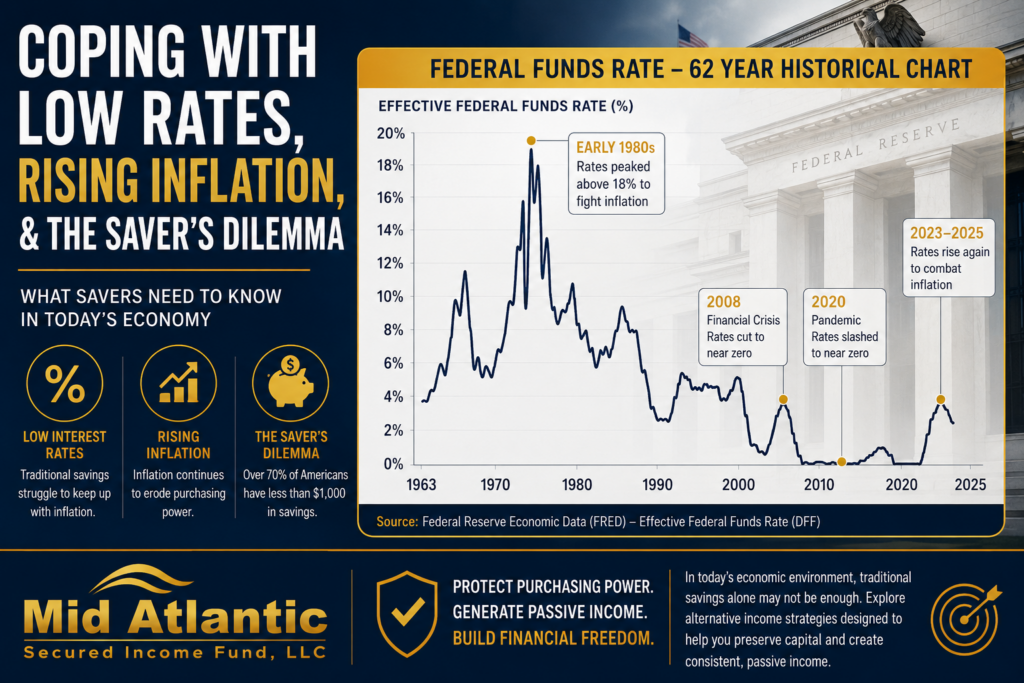
At the same time, the Federal Reserve’s elevated interest-rate environment has reshaped traditional fixed income investing. Bond market volatility between 2022 and 2024 reminded many investors that “safe” fixed income assets can still experience substantial price declines when interest rates rise aggressively.
For retirees and income-focused investors, this has accelerated interest in alternative retirement income strategies designed around:
- cash flow consistency,
- capital preservation,
- collateral-backed lending,
- lower market correlation,
- and income-focused investing.
This guide explores how passive income strategies for retirement are evolving and why private credit and real estate debt investing have become increasingly important components of modern retirement portfolios.
What Are Passive Income Strategies for Retirement?
Definition
Passive income strategies for retirement are investment approaches designed to generate recurring cash flow with limited day-to-day involvement from the investor.
The goal is typically to create sustainable income streams capable of supporting retirement expenses while preserving long-term capital.
Common passive income investments include:
- dividend-paying equities,
- bonds,
- CDs,
- REITs,
- rental properties,
- private lending,
- real estate debt funds,
- and private credit investments.
For many retirees, passive income investing focuses on replacing earned income from employment with investment-generated cash flow.
Why Retirement Income Planning Has Changed
The Retirement Landscape Is Different Today
Several macroeconomic trends have fundamentally changed retirement investing:
1. Longer Lifespans
According to the Social Security Administration, many retirees may spend 20–30 years in retirement.
That significantly increases the importance of sustainable income generation.
2. Inflation Risk
Inflation can dramatically erode purchasing power over time.
Even moderate inflation can substantially reduce real income over a multi-decade retirement horizon.
For example:
- 3% annual inflation cuts purchasing power nearly in half over approximately 24 years.
This is one reason retirees increasingly seek investments capable of producing higher income yields than traditional savings products.
3. Traditional Fixed Income Challenges
Historically, retirees relied heavily on:
- Treasury bonds,
- municipal bonds,
- CDs,
- and investment-grade corporate bonds.
However, traditional fixed income markets experienced meaningful volatility during recent Federal Reserve tightening cycles.
Long-duration bond funds experienced significant drawdowns as rates increased rapidly.
Many retirees discovered that:
- interest-rate risk matters,
- duration risk matters,
- and public market volatility impacts retirement portfolios more than expected.
4. Sequence-of-Returns Risk
One of the largest retirement risks is experiencing market losses early in retirement while simultaneously withdrawing funds for living expenses.
This can permanently impair portfolio longevity.
As a result, many investors now seek retirement income strategies with:
- lower public market correlation,
- more predictable cash flow,
- and asset-backed downside protection.
What Is Private Credit Investing?
Definition
Private credit investing refers to non-bank lending provided directly to businesses, real estate projects, or borrowers outside traditional public bond markets.
Private credit investments may include:
- real estate bridge lending,
- secured promissory notes,
- commercial real estate loans,
- asset-backed lending,
- receivable financing,
- direct lending,
- and private debt funds.
Unlike publicly traded bonds, private credit investments are often:
- negotiated directly,
- secured by collateral,
- shorter duration,
- and less correlated to daily market volatility.
Why Private Credit Has Grown So Rapidly
Institutional investors have increasingly allocated capital toward private credit for several reasons:
Higher Yield Potential
Private credit often provides higher income potential than traditional public fixed income.
This is partially due to:
- reduced liquidity,
- specialized underwriting,
- direct origination,
- and asset-backed structures.
Asset-Backed Security
Many private credit investments are secured by:
- real estate,
- receivables,
- inventory,
- or hard assets.
This collateral-focused approach can enhance downside protection relative to unsecured debt.
Lower Correlation to Public Markets
Private lending investments are not typically priced daily like publicly traded bonds or equities.
As a result, they may experience lower volatility compared to traditional market-based investments.
Shorter Duration
Many real estate debt investments have shorter maturities compared to long-duration bonds.
Shorter duration can reduce sensitivity to interest-rate volatility.
How Real Estate Debt Funds Work
Real estate debt funds pool investor capital to originate or participate in loans secured by real estate assets.
These loans may include:
- bridge loans,
- acquisition financing,
- construction loans,
- stabilized asset lending,
- or commercial real estate financing.
Rather than owning the underlying property equity directly, debt funds typically operate in the lender position within the capital stack.
This distinction is important.
Debt-focused investing prioritizes:
- contractual interest payments,
- collateral protection,
- senior lien positioning,
- and downside mitigation.
Many institutional investors view senior secured lending as a more defensive approach compared to pure real estate equity ownership.
Private Lending vs Traditional Fixed Income
|
Factor |
Traditional Bonds |
Private Lending |
|---|---|---|
|
Yield Potential |
Lower |
Higher |
|
Market Volatility |
Higher sensitivity |
Lower correlation |
|
Collateral |
Often unsecured |
Frequently asset-backed |
|
Duration |
Longer |
Often shorter |
|
Liquidity |
Daily liquidity |
Less liquid |
|
Pricing |
Public market pricing |
Privately negotiated |
|
Income Focus |
Moderate |
Strong income orientation |
Are Debt Funds Safer Than Stocks?
Direct Answer
Debt funds and private credit investments are generally designed to prioritize income generation and capital preservation rather than high-growth equity appreciation.
However, all investments carry risk.
Compared to equities, many private credit strategies may experience:
- lower volatility,
- reduced market correlation,
- and stronger downside protection through collateral structures.
That said, investors should carefully evaluate:
- underwriting discipline,
- loan-to-value ratios,
- asset quality,
- sponsor experience,
- and risk management practices.
Why Accredited Investors Use Alternative Income Strategies
Accredited investors often seek diversification beyond traditional public markets.
Alternative investments may provide:
- differentiated income streams,
- enhanced diversification,
- access to institutional-style opportunities,
- and potential inflation resilience.
Family offices and institutional allocators have steadily increased exposure to private markets over the past decade.
According to BlackRock and Preqin research, private market allocations continue growing among sophisticated investors seeking enhanced yield and portfolio diversification.
The Role of Real Estate in Retirement Income Investing
Real estate has historically played a significant role in retirement income planning because it combines:
- tangible asset exposure,
- income generation,
- inflation sensitivity,
- and collateral-backed value.
However, direct real estate ownership can create operational burdens including:
- property management,
- maintenance,
- vacancies,
- taxes,
- and tenant-related issues.
Real estate debt investing offers an alternative approach.
Instead of owning the property directly, investors participate as lenders secured by real estate collateral.
Understanding Downside Protection
What Does Downside Protection Mean?
Downside protection refers to structural features designed to reduce potential investment losses.
In private credit investing, this may include:
- senior lien positioning,
- conservative loan-to-value ratios,
- borrower guarantees,
- collateral-backed lending,
- disciplined underwriting,
- and diversified loan portfolios.
Institutional investors often prioritize downside protection during uncertain economic periods.
Income Consistency Matters in Retirement
Retirement planning is increasingly centered around cash flow reliability.
For many retirees, predictable monthly or quarterly income matters more than maximizing speculative upside.
This is particularly true during volatile market environments.
Income-focused investors frequently prioritize:
- consistency,
- preservation,
- and lower volatility.
The Importance of Diversification
No single investment strategy should dominate a retirement portfolio.
Diversification remains one of the most important principles in risk management.
A diversified retirement income portfolio may include:
- public equities,
- traditional fixed income,
- cash reserves,
- private credit,
- real estate debt,
- REITs,
- and alternative investments.
Diversification helps reduce concentration risk and improve long-term portfolio resilience.
How SDIRAs Are Used for Passive Income Investing
Self-Directed IRAs (SDIRAs) allow investors to hold alternative assets inside tax-advantaged retirement accounts.
This may include:
- private lending,
- real estate debt funds,
- private placements,
- and alternative income-oriented investments.
Many investors use SDIRAs to diversify beyond traditional stock-and-bond retirement portfolios.
Learn more about SDIRA investing at:
- /ira-investing/
Key Risks of Private Credit Investing
All investments involve risk.
Private credit investing risks may include:
- borrower default,
- liquidity risk,
- economic downturns,
- real estate market declines,
- interest-rate risk,
- and underwriting risk.
Investors should conduct careful due diligence and evaluate:
- manager experience,
- underwriting standards,
- collateral quality,
- diversification,
- and fund structure.
What Sophisticated Investors Often Look For
Institutional-quality income-focused investors frequently prioritize:
- experienced management,
- conservative underwriting,
- first-lien positioning,
- lower leverage,
- real asset collateral,
- disciplined risk management,
- and alignment of interests.
These principles are central to many institutional private credit strategies.
Why Alternative Income Investing Continues Growing
Several trends continue driving alternative income investing growth:
- aging populations,
- retirement income needs,
- institutional adoption,
- higher-rate environments,
- market volatility,
- and growing demand for diversification.
According to McKinsey and Preqin research, private markets are expected to remain a major institutional allocation theme over the coming decade.
Building a Retirement Income Strategy
A modern retirement income strategy should consider:
- cash flow needs,
- inflation protection,
- diversification,
- liquidity requirements,
- risk tolerance,
- tax efficiency,
- and long-term capital preservation.
For many investors, alternative income investments now play an increasingly important supporting role alongside traditional portfolio allocations.
The Role of The Mid Atlantic Secured Income Fund
The Mid Atlantic Secured Income Fund focuses on income-oriented, asset-backed lending strategies designed around:
- disciplined underwriting,
- collateral-backed investing,
- real estate-secured lending,
- and income-focused portfolio construction.
The fund’s approach reflects many principles institutional investors seek in private credit investing:
- conservative structures,
- downside-focused underwriting,
- and real-asset collateralization.
Learn more:
- https://themidatlanticfund.com/knowledge-hub/
- https://themidatlanticfund.com/why-invest-in-mid-atlantic-fund/
- https://themidatlanticfund.com/private-credit-products/
Conclusion
Retirement investing has evolved well beyond the traditional 60/40 portfolio model.
Today’s retirees face a more complex environment shaped by inflation, longevity risk, market volatility, and shifting interest-rate dynamics.
As a result, passive income strategies for retirement increasingly include:
- private credit,
- real estate debt funds,
- alternative income investments,
- and asset-backed lending strategies.
Institutional investors have utilized private credit for years because of its focus on:
- income generation,
- collateral-backed security,
- diversification,
- and downside-conscious investing.
For accredited investors and retirement-focused individuals seeking more resilient income-oriented strategies, private credit and real estate debt investing may provide an important complement to traditional retirement portfolios.
FAQ Section
What are the best passive income strategies for retirement?
Common retirement passive income strategies include dividend investing, bonds, REITs, rental real estate, private credit investing, and real estate debt funds.
What is private credit investing?
Private credit investing involves non-bank lending directly to borrowers or real estate projects through privately negotiated loans and debt investments.
Are private credit investments risky?
Yes. All investments carry risk. Private credit investments may involve borrower default, liquidity risk, and economic risk, though collateral-backed lending structures may help mitigate downside exposure.
What are real estate debt funds?
Real estate debt funds pool investor capital to originate or participate in loans secured by real estate assets.
Can SDIRAs invest in private credit?
Yes. Many self-directed IRAs allow investments into private credit, private placements, and real estate debt investments.