
Why the Definition of Retirement Is Changing
Retirement no longer means what it once did.
For previous generations, retirement was often associated with:
- pensions,
- predictable bond income,
- Social Security,
- and a gradual transition away from work after decades of traditional employment.
Today’s investors face a very different reality.
Longer life expectancy, inflation pressure, healthcare cost escalation, public market volatility, and uncertainty surrounding traditional retirement systems have fundamentally changed how investors think about financial independence.
Increasingly, investors are no longer asking:
“When can I stop working?”
They are asking:
“When will my investments generate enough recurring income to create flexibility, independence, and optionality?”
That distinction matters.
Modern retirement planning increasingly revolves around:
- cash flow sustainability,
- diversified income streams,
- inflation resilience,
- and long-term portfolio durability.
This shift has contributed to the rapid growth of:
- private credit,
- alternative income investments,
- secured lending,
- and asset-backed portfolio strategies.
Institutional investors have long understood a fundamental principle:
Financial independence is often built through durable income generation rather than speculative appreciation alone.
What Are Income-Generating Investments?
Direct Answer
Income-generating investments are investments designed to produce recurring cash flow through interest payments, dividends, rental income, or contractual distributions rather than relying solely on long-term appreciation.
Examples may include:
- private credit,
- real estate-backed lending,
- dividend-producing securities,
- bonds,
- infrastructure investments,
- REITs,
- and alternative income-producing assets.
Many investors use income-generating investments to support retirement planning, passive income objectives, and portfolio diversification.
Why Early Retirement Requires a Different Investment Strategy
Growth Alone Is Often Not Enough
Many investors pursuing early retirement focus heavily on portfolio growth during the accumulation phase.
However, transitioning from wealth accumulation to financial independence requires a different mindset.
The challenge becomes less about maximizing short-term returns and more about building:
- sustainable cash flow,
- income consistency,
- downside resilience,
- and inflation-adjusted purchasing power.
This is where income-generating investments become increasingly important.
A portfolio heavily dependent on market appreciation alone may become vulnerable during:
- recessions,
- prolonged bear markets,
- inflationary periods,
- or sequence-of-returns risk during retirement withdrawals.
Institutional portfolio construction increasingly prioritizes balancing:
- growth,
- income,
- diversification,
- and capital preservation.
The Psychology of Financial Independence
Early Retirement Is Ultimately About Optionality
For many investors, early retirement is not purely about leaving the workforce permanently.
It is about:
- reducing financial stress,
- increasing flexibility,
- gaining time autonomy,
- and creating the ability to make life decisions independent of immediate income needs.
Behavioral finance research consistently shows that investors often underestimate the emotional value of recurring cash flow.
Predictable income may improve:
- financial confidence,
- long-term planning,
- and investor discipline during volatile periods.
This partially explains why many institutional investors emphasize cash-flow-producing investments within long-term portfolio frameworks.
Why Passive Income Has Become Increasingly Important
Cash Flow Creates Portfolio Stability
One of the defining characteristics of financially independent portfolios is recurring income generation.
Passive income may reduce reliance on:
- forced asset liquidation,
- speculative appreciation,
- and market timing.
This becomes especially important during:
- inflationary periods,
- recessions,
- public market drawdowns,
- and retirement transitions.
Income-producing portfolios may provide:
- greater financial flexibility,
- improved liquidity management,
- and more stable long-term planning.
What Is Private Credit?
Direct Answer
Private credit is a form of non-bank lending where investors provide capital directly to borrowers through privately negotiated debt investments rather than traditional public bond markets or bank financing.
Private credit strategies may include:
- bridge lending,
- real estate-backed lending,
- construction financing,
- asset-backed lending,
- and specialty finance.
Private credit has become one of the fastest-growing alternative investment categories globally due to institutional demand for income-producing investments.
Why Private Credit Has Become Popular Among Income-Oriented Investors
Several structural factors have accelerated private credit growth:
|
Structural Driver |
Impact |
|---|---|
|
Bank retrenchment |
Increased demand for private lenders |
|
Higher interest rates |
More attractive yield structures |
|
Inflation concerns |
Increased demand for income |
|
Public market volatility |
Diversification demand |
|
Retirement income needs |
Greater interest in passive cash flow |
According to Preqin and Apollo Global Management, private credit continues to attract significant institutional capital globally.
Understanding Secured Investments
What Are Secured Investments?
Secured investments are investments backed by collateral or underlying assets that may provide additional layers of downside consideration compared to unsecured investments.
Examples may include:
- senior secured private loans,
- real estate-backed lending,
- collateralized debt structures,
- and asset-backed income strategies.
Secured structures are often designed to prioritize repayment rights and contractual income generation.
Why Asset-Backed Investments Matter for Retirement Planning
Collateral Awareness Becomes Increasingly Important
As investors transition toward income-focused portfolio construction, risk structure becomes increasingly important.
Many institutional investors evaluate investments based not only on return potential but also on:
- collateral quality,
- repayment positioning,
- and downside structure.
Real estate-backed lending strategies have attracted institutional interest because they often emphasize:
- underwriting discipline,
- collateral backing,
- contractual repayment structures,
- and senior positioning within capital structures.
This does not eliminate risk.
However, asset-backed investing may provide additional structural considerations relative to purely speculative growth assets.
Are Debt Investments Safer Than Stocks?
Direct Answer
Debt-oriented investments are not inherently safer than stocks, but certain income-producing debt investments may offer contractual income, lower volatility characteristics, collateral backing, or senior repayment positioning depending on the structure and underwriting quality.
All investments carry risk.
Key considerations include:
- borrower quality,
- collateral value,
- diversification,
- economic conditions,
- liquidity,
- and underwriting discipline.
Inflation and Early Retirement
Inflation Is One of the Greatest Threats to Financial Independence
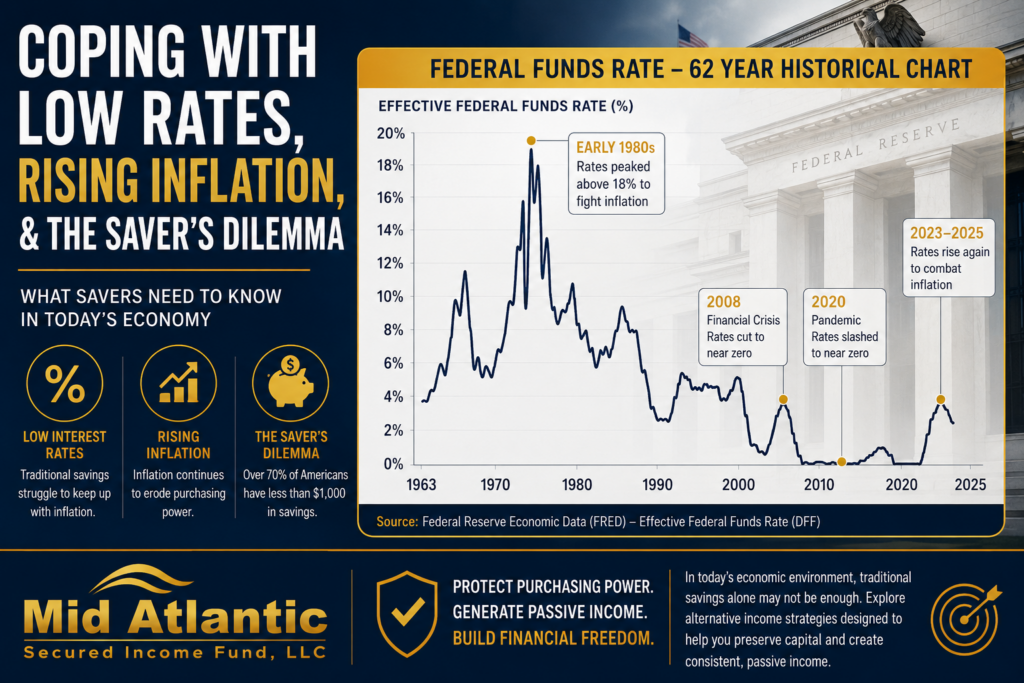
Inflation gradually erodes purchasing power over time.
According to the U.S. Bureau of Labor Statistics, inflation reached multi-decade highs following pandemic-era monetary expansion and supply chain disruptions.
This matters significantly for retirement planning.
A retirement portfolio must generate income capable of supporting:
- rising living expenses,
- healthcare inflation,
- and long-term purchasing power preservation.
This has increased investor focus on:
- income-producing investments,
- real assets,
- floating-rate credit,
- and diversified alternative income strategies.
Diversification Still Matters
Financial Independence Requires More Than One Income Source
Sophisticated investors rarely rely on a single asset class.
Institutional portfolio construction increasingly incorporates multiple income streams including:
- public fixed income,
- private credit,
- real estate-backed lending,
- dividend-producing securities,
- and alternative investments.
Diversification may help reduce concentration risk while improving portfolio resilience during changing economic environments.
Retirement Planning and Sequence-of-Returns Risk
Timing Matters More Than Many Investors Realize
One of the greatest risks facing retirees is sequence-of-returns risk.
This occurs when significant market declines happen early during retirement withdrawal periods.
Heavy reliance on liquidating growth assets during downturns may accelerate portfolio depletion.
Income-generating investments may help reduce reliance on forced asset sales during volatile periods.
This is one reason institutional investors increasingly emphasize cash-flow-oriented portfolio construction.
Behavioral Finance and Income Investing
Emotional Investing Often Damages Long-Term Results
Behavioral finance research consistently demonstrates that emotional decision-making may negatively impact long-term investment performance.
During volatile periods, investors often become vulnerable to:
- panic selling,
- speculative behavior,
- and reactionary portfolio shifts.
Recurring income-producing investments may help reduce psychological pressure by emphasizing:
- long-term planning,
- portfolio stability,
- and predictable cash flow.
This behavioral component is often underestimated in retirement planning discussions.
Why Institutions Prioritize Cash Flow
Institutional Investors Focus on Durability
Large institutional investors such as:
- pension funds,
- endowments,
- insurance companies,
- and family offices
frequently prioritize income durability and risk-adjusted performance rather than short-term speculative upside.
Several institutional principles increasingly influence accredited investor portfolios:
|
Institutional Principle |
Objective |
|---|---|
|
Diversification |
Reduce concentration risk |
|
Cash Flow Stability |
Improve portfolio durability |
|
Downside Awareness |
Preserve capital |
|
Collateral Analysis |
Strengthen structural positioning |
|
Long-Term Allocation |
Reduce emotional investing |
Self-Directed IRAs and Alternative Income Strategies
Retirement Diversification Beyond Public Markets
Self-directed IRAs allow eligible investors to hold certain alternative investments within retirement accounts.
Depending on custodial structures and regulations, these may include:
- private credit,
- real estate-backed investments,
- and alternative income-producing assets.
Investors exploring retirement diversification strategies may also review:
How The Mid Atlantic Fund Reflects Broader Industry Trends
The Mid Atlantic Secured Income Fund operates within the broader institutional movement toward:
- income-oriented investing,
- private credit,
- secured lending,
- and asset-backed portfolio construction.
The broader educational framework surrounding the fund emphasizes:
- long-term investing,
- passive income education,
- disciplined underwriting,
- and diversified portfolio construction principles.
Additional educational resources:
- Knowledge Hub
- Private Credit Products
- Passive Income Investment Calculator
- Why Invest in Mid Atlantic Fund
The Future of Retirement Investing
Several structural trends are likely to continue shaping retirement investing:
1. Greater Focus on Income Durability
Investors increasingly prioritize recurring cash flow.
2. Expansion of Alternative Investments
Private markets continue growing institutionally.
3. Inflation-Aware Portfolio Construction
Purchasing power preservation remains critical.
4. Institutional Portfolio Principles Moving Downstream
Individual investors increasingly adopt institutional frameworks.
5. Increased Demand for Diversified Income Streams
Retirement planning increasingly emphasizes multiple income sources.
Final Thoughts
Early retirement and financial independence are increasingly less about speculative wealth accumulation alone and more about building durable income-generating portfolios capable of supporting long-term lifestyle flexibility.
As public market volatility, inflation uncertainty, and longevity concerns continue reshaping retirement planning, many investors are increasingly exploring:
- private credit,
- secured investments,
- alternative income strategies,
- and institutional-style portfolio diversification.
The objective is not simply maximizing returns.
It is creating sustainable financial resilience capable of supporting independence across multiple economic environments over time.
Long-term financial freedom is often built gradually through:
- disciplined investing,
- recurring cash flow generation,
- diversification,
- and thoughtful portfolio construction.
Frequently Asked Questions (FAQ)
What are income-generating investments?
Income-generating investments are investments designed to produce recurring cash flow through interest payments, dividends, rental income, or contractual distributions.
How can passive income help support early retirement?
Passive income may reduce dependence on active employment income while improving long-term financial flexibility and portfolio sustainability.
What is private credit investing?
Private credit investing involves directly lending capital through privately structured debt investments outside traditional public bond and banking markets.
Are secured investments safer than stocks?
Certain secured investments may provide contractual income structures and collateral backing, but all investments carry risk.
Why are investors interested in asset-backed investments?
Asset-backed investments may provide diversification, recurring income, and additional structural considerations through collateralized investment frameworks.
How do accredited investors use private credit?
Accredited investors often use private credit to pursue passive income, diversification, and exposure to alternative investment strategies.
What role does diversification play in retirement investing?
Diversification may help reduce concentration risk while improving long-term portfolio resilience across changing economic environments.