High Yield Investments in a Changing Economic Era
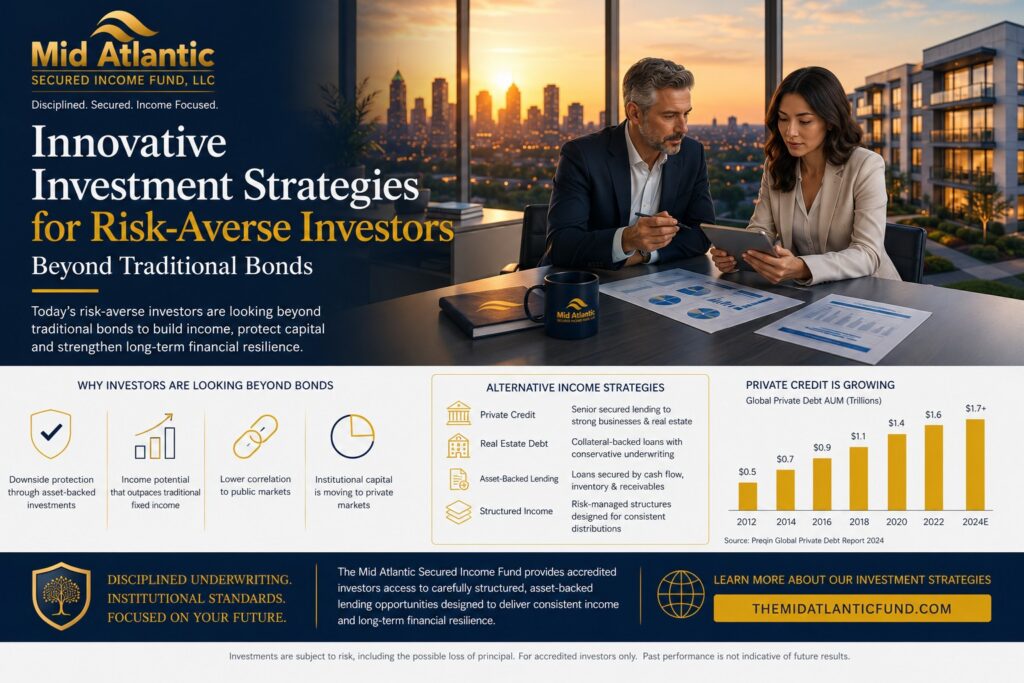
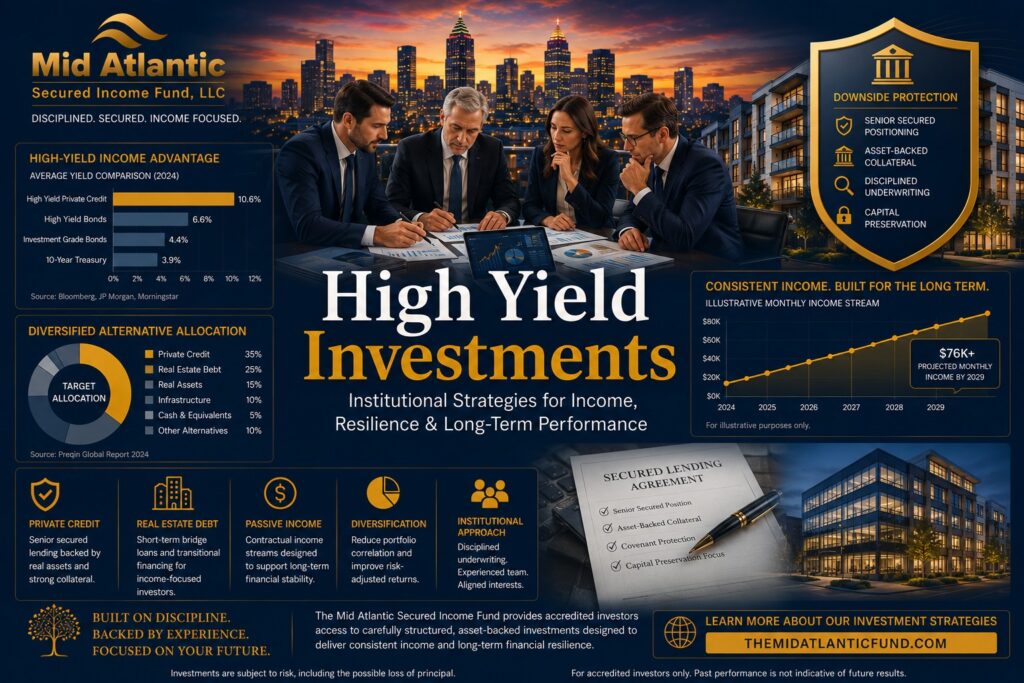
Why Sophisticated Investors Are Rethinking Traditional Income Portfolios For much of the past two decades, investors seeking reliable income largely relied on a familiar mix of stocks, bonds, dividend-paying equities, and investment-grade fixed income products. Yet the modern economic environment has fundamentally changed the conversation around portfolio income generation. Persistent inflation, elevated interest rates, banking instability, rising geopolitical tensions, and increased equity market volatility have forced both institutional and high-net-worth investors to reconsider how they pursue income, preserve capital, and build long-term financial resilience. As a result, high yield investments have moved from the periphery of portfolio construction toward the center of institutional allocation strategies. Today, pension funds, insurance companies, family offices, endowments, and sophisticated accredited investors are increasingly allocating capital toward alternative income-producing assets such as: Private credit Real estate-backed debt Asset-backed lending Infrastructure debt Specialty finance Senior secured lending Private real estate income strategies This evolution is not simply about chasing higher returns. It is about creating portfolios designed for modern market realities. In many cases, investors are prioritizing: Predictable cash flow Reduced correlation to public markets Enhanced downside protection Income durability Inflation resilience Conservative underwriting Capital preservation These themes are reshaping wealth management and institutional portfolio construction worldwide. What Are High Yield Investments? Direct Answer High yield investments are investment strategies designed to generate income returns above traditional savings accounts, Treasury securities, or conventional fixed-income products. These investments may include private credit, dividend-paying assets, real estate-backed debt, alternative income funds, and institutional lending strategies. Unlike speculative investing, many sophisticated high yield strategies prioritize cash flow generation, collateral protection, and structured risk management rather than aggressive capital appreciation alone. Why High Yield Investing Has Become a Global Institutional Trend The Global Search for Yield Institutional investors across the world have faced a major challenge in recent years: How do portfolios continue generating meaningful income while traditional bond markets remain volatile and inflation erodes purchasing power? According to data from the International Monetary Fund and major institutional research firms, global investors are increasingly shifting allocations toward alternative income strategies due to: Persistent inflationary pressures Lower real yields in traditional fixed income Greater stock market volatility Increased retirement income needs Rising demand for portfolio diversification Concerns around economic slowdowns Private credit alone has emerged as one of the fastest-growing segments of alternative investing. Preqin projects the global private debt market could exceed $2.8 trillion in assets under management before the end of the decade, driven largely by institutional demand for yield-producing alternative assets. This trend reflects a broader structural transformation in capital markets. The Evolution of Income Investing Traditional Income Portfolios Are Changing Historically, investors often relied heavily on: Certificates of deposit (CDs) Government bonds Municipal bonds Corporate bonds Blue-chip dividend stocks While these investments still serve important portfolio roles, the modern investment landscape has introduced new complexities. Challenges Facing Traditional Income Strategies 1. Inflation Risk Inflation can significantly reduce real purchasing power. Even moderate inflation compounds meaningfully over time, particularly for retirees and income-focused investors. 2. Interest Rate Volatility Bond prices can decline materially during rising rate environments. This has challenged the perception that traditional fixed income always provides stability. 3. Equity Market Correlation Dividend-paying stocks may still experience substantial drawdowns during periods of market stress. 4. Longevity Risk Longer life expectancy means retirement portfolios often need to produce income for decades. 5. Sequence-of-Returns Risk Large market losses early in retirement can materially impact long-term portfolio sustainability. These dynamics have pushed sophisticated investors toward diversified income strategies beyond conventional stocks and bonds. Why Private Credit Has Become Central to High Yield Investing The Rise of Asset-Backed Lending One of the most significant developments in modern investing has been the institutional expansion of private credit markets. Private credit broadly refers to non-bank lending strategies where capital is provided directly to borrowers outside traditional public debt markets. These strategies can include: Real estate-backed loans Bridge lending Commercial real estate debt Asset-backed lending Senior secured financing Specialty finance Receivables financing Purchase order financing Many institutional investors favor private credit because it often offers: Contractual income streams Floating-rate structures Collateral-backed positions Lower public market correlation Enhanced underwriting controls Structural protections What Makes Asset-Backed Lending Different? Understanding Collateralized Income Strategies Asset-backed lending strategies differ materially from unsecured investments. In many private credit structures, loans are secured by tangible collateral such as: Real estate Commercial property Land Multifamily assets Construction projects Business receivables Inventory Purchase orders This collateral framework can provide an additional layer of downside protection compared to unsecured corporate debt or highly speculative growth investments. Sophisticated investors often view collateral-backed investments as part of broader risk mitigation frameworks. How Institutional Investors Think About Risk High Yield Does Not Automatically Mean High Risk One of the biggest misconceptions in investing is the assumption that all high yield investments are inherently speculative. Institutional investors evaluate investments differently. Rather than focusing solely on headline return figures, professional allocators assess: Loan-to-value ratios Borrower quality Asset quality Cash flow coverage Collateral strength Market liquidity Duration risk Geographic exposure Sponsor experience Underwriting discipline This institutional approach helps distinguish disciplined high yield investing from speculative yield chasing. The Role of Private Credit in Portfolio Diversification Why Diversification Still Matters Diversification remains one of the foundational principles of portfolio construction. Modern institutional portfolios increasingly combine: Asset Class Typical Objective Public Equities Growth Investment-Grade Bonds Stability Private Credit Income Real Assets Inflation Protection Alternatives Diversification Cash Equivalents Liquidity Private credit and alternative income strategies can potentially reduce portfolio dependence on public market volatility. This diversification dynamic has become increasingly important in uncertain macroeconomic environments. Inflation and the Modern Investor Why Inflation Changes Everything Inflation has fundamentally reshaped investment decision-making. According to the Bureau of Labor Statistics, inflation reached multi-decade highs during recent economic cycles, materially affecting: Consumer purchasing power Retirement savings Housing affordability Real investment returns Sophisticated investors increasingly seek strategies capable of generating income above inflation over longer periods. This is one reason institutional investors have increased allocations toward: Real assets Infrastructure Private credit Floating-rate debt Asset-backed lending Why Real
High Yield Investments in a Changing Economic Era Read More »