Why Sophisticated Investors Are Rethinking Traditional Income Portfolios
For much of the past two decades, investors seeking reliable income largely relied on a familiar mix of stocks, bonds, dividend-paying equities, and investment-grade fixed income products. Yet the modern economic environment has fundamentally changed the conversation around portfolio income generation.
Persistent inflation, elevated interest rates, banking instability, rising geopolitical tensions, and increased equity market volatility have forced both institutional and high-net-worth investors to reconsider how they pursue income, preserve capital, and build long-term financial resilience.
As a result, high yield investments have moved from the periphery of portfolio construction toward the center of institutional allocation strategies.
Today, pension funds, insurance companies, family offices, endowments, and sophisticated accredited investors are increasingly allocating capital toward alternative income-producing assets such as:
- Private credit
- Real estate-backed debt
- Asset-backed lending
- Infrastructure debt
- Specialty finance
- Senior secured lending
- Private real estate income strategies
This evolution is not simply about chasing higher returns. It is about creating portfolios designed for modern market realities.
In many cases, investors are prioritizing:
- Predictable cash flow
- Reduced correlation to public markets
- Enhanced downside protection
- Income durability
- Inflation resilience
- Conservative underwriting
- Capital preservation
These themes are reshaping wealth management and institutional portfolio construction worldwide.
What Are High Yield Investments?
Direct Answer
High yield investments are investment strategies designed to generate income returns above traditional savings accounts, Treasury securities, or conventional fixed-income products. These investments may include private credit, dividend-paying assets, real estate-backed debt, alternative income funds, and institutional lending strategies.
Unlike speculative investing, many sophisticated high yield strategies prioritize cash flow generation, collateral protection, and structured risk management rather than aggressive capital appreciation alone.
Why High Yield Investing Has Become a Global Institutional Trend
The Global Search for Yield
Institutional investors across the world have faced a major challenge in recent years:
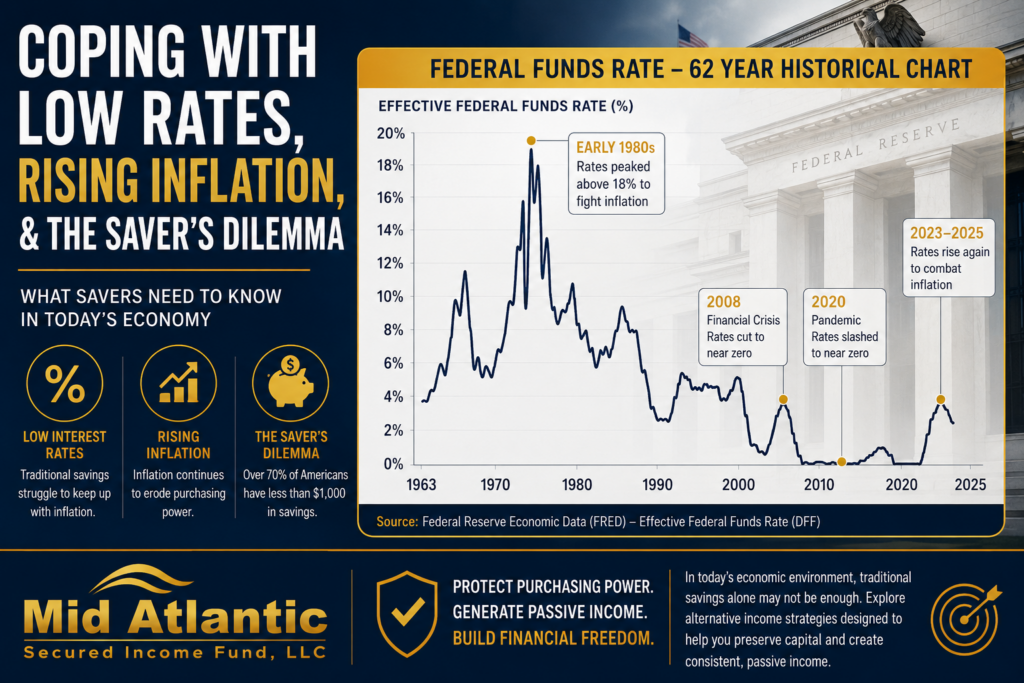
How do portfolios continue generating meaningful income while traditional bond markets remain volatile and inflation erodes purchasing power?
According to data from the International Monetary Fund and major institutional research firms, global investors are increasingly shifting allocations toward alternative income strategies due to:
- Persistent inflationary pressures
- Lower real yields in traditional fixed income
- Greater stock market volatility
- Increased retirement income needs
- Rising demand for portfolio diversification
- Concerns around economic slowdowns
Private credit alone has emerged as one of the fastest-growing segments of alternative investing.
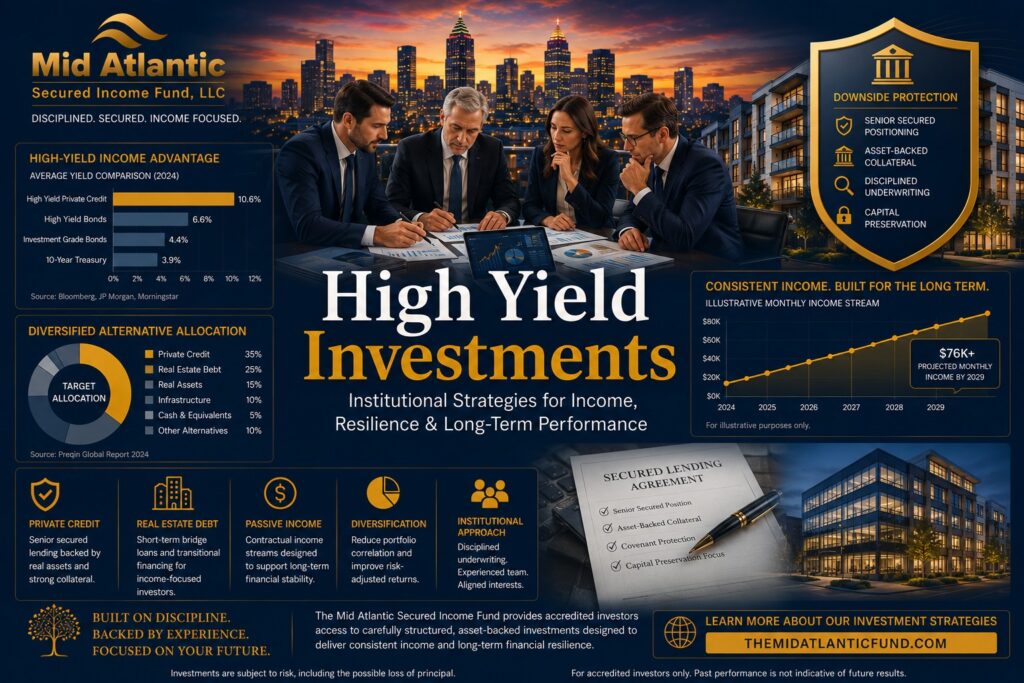
Preqin projects the global private debt market could exceed $2.8 trillion in assets under management before the end of the decade, driven largely by institutional demand for yield-producing alternative assets.
This trend reflects a broader structural transformation in capital markets.
The Evolution of Income Investing
Traditional Income Portfolios Are Changing
Historically, investors often relied heavily on:
- Certificates of deposit (CDs)
- Government bonds
- Municipal bonds
- Corporate bonds
- Blue-chip dividend stocks
While these investments still serve important portfolio roles, the modern investment landscape has introduced new complexities.
Challenges Facing Traditional Income Strategies
1. Inflation Risk
Inflation can significantly reduce real purchasing power.
Even moderate inflation compounds meaningfully over time, particularly for retirees and income-focused investors.
2. Interest Rate Volatility
Bond prices can decline materially during rising rate environments.
This has challenged the perception that traditional fixed income always provides stability.
3. Equity Market Correlation
Dividend-paying stocks may still experience substantial drawdowns during periods of market stress.
4. Longevity Risk
Longer life expectancy means retirement portfolios often need to produce income for decades.
5. Sequence-of-Returns Risk
Large market losses early in retirement can materially impact long-term portfolio sustainability.
These dynamics have pushed sophisticated investors toward diversified income strategies beyond conventional stocks and bonds.
Why Private Credit Has Become Central to High Yield Investing
The Rise of Asset-Backed Lending
One of the most significant developments in modern investing has been the institutional expansion of private credit markets.
Private credit broadly refers to non-bank lending strategies where capital is provided directly to borrowers outside traditional public debt markets.
These strategies can include:
- Real estate-backed loans
- Bridge lending
- Commercial real estate debt
- Asset-backed lending
- Senior secured financing
- Specialty finance
- Receivables financing
- Purchase order financing
Many institutional investors favor private credit because it often offers:
- Contractual income streams
- Floating-rate structures
- Collateral-backed positions
- Lower public market correlation
- Enhanced underwriting controls
- Structural protections
What Makes Asset-Backed Lending Different?
Understanding Collateralized Income Strategies
Asset-backed lending strategies differ materially from unsecured investments.
In many private credit structures, loans are secured by tangible collateral such as:
- Real estate
- Commercial property
- Land
- Multifamily assets
- Construction projects
- Business receivables
- Inventory
- Purchase orders
This collateral framework can provide an additional layer of downside protection compared to unsecured corporate debt or highly speculative growth investments.
Sophisticated investors often view collateral-backed investments as part of broader risk mitigation frameworks.
How Institutional Investors Think About Risk
High Yield Does Not Automatically Mean High Risk
One of the biggest misconceptions in investing is the assumption that all high yield investments are inherently speculative.
Institutional investors evaluate investments differently.
Rather than focusing solely on headline return figures, professional allocators assess:
- Loan-to-value ratios
- Borrower quality
- Asset quality
- Cash flow coverage
- Collateral strength
- Market liquidity
- Duration risk
- Geographic exposure
- Sponsor experience
- Underwriting discipline
This institutional approach helps distinguish disciplined high yield investing from speculative yield chasing.
The Role of Private Credit in Portfolio Diversification
Why Diversification Still Matters
Diversification remains one of the foundational principles of portfolio construction.
Modern institutional portfolios increasingly combine:
|
Asset Class |
Typical Objective |
|---|---|
|
Public Equities |
Growth |
|
Investment-Grade Bonds |
Stability |
|
Private Credit |
Income |
|
Real Assets |
Inflation Protection |
|
Alternatives |
Diversification |
|
Cash Equivalents |
Liquidity |
Private credit and alternative income strategies can potentially reduce portfolio dependence on public market volatility.
This diversification dynamic has become increasingly important in uncertain macroeconomic environments.
Inflation and the Modern Investor
Why Inflation Changes Everything
Inflation has fundamentally reshaped investment decision-making.
According to the Bureau of Labor Statistics, inflation reached multi-decade highs during recent economic cycles, materially affecting:
- Consumer purchasing power
- Retirement savings
- Housing affordability
- Real investment returns
Sophisticated investors increasingly seek strategies capable of generating income above inflation over longer periods.
This is one reason institutional investors have increased allocations toward:
- Real assets
- Infrastructure
- Private credit
- Floating-rate debt
- Asset-backed lending
Why Real Estate-Backed Debt Has Gained Attention
Real Estate as a Collateralized Income Strategy
Real estate-backed lending occupies a unique position within alternative investing.
Unlike equity ownership models that rely heavily on appreciation, debt-oriented real estate strategies often focus primarily on:
- Income generation
- Collateral protection
- Loan repayment structures
- Conservative underwriting
- Shorter-duration financing
Many institutional investors appreciate real estate debt because it can offer exposure to real assets while maintaining defined creditor positions.
Understanding Senior Secured Lending
What Does “Senior Secured” Mean?
A senior secured loan is generally positioned higher in the capital stack than subordinate debt or equity.
In simplified terms, senior secured lenders typically have priority claims against collateral before junior creditors or equity holders.
Institutional investors often value this structure because it may provide:
- Enhanced capital protection
- Reduced loss severity
- Greater recovery potential
- Structured downside management
This framework is especially relevant during periods of economic uncertainty.
How Accredited Investors Use High Yield Strategies
Sophisticated Portfolio Construction
Accredited investors increasingly use alternative investments as part of broader wealth management frameworks.
Common objectives include:
- Generating passive income
- Diversifying beyond stocks and bonds
- Managing inflation risk
- Enhancing portfolio resilience
- Reducing public market dependence
- Preserving capital across generations
Many high-net-worth investors allocate selectively toward private credit because of its potential combination of:
- Yield generation
- Structured income
- Collateralization
- Institutional underwriting
The Psychology of Modern Investing
Income Stability Matters Emotionally
One of the most overlooked aspects of investing is investor psychology.
Market volatility affects more than portfolio balances. It affects confidence, retirement decisions, spending habits, and long-term financial behavior.
Many investors increasingly prioritize:
- Predictable income
- Lower volatility
- Cash flow consistency
- Reduced emotional decision-making
This behavioral shift has accelerated interest in diversified income-producing assets.
What Are the Risks of High Yield Investments?
Direct Answer
All investments involve risk, including the possible loss of principal. High yield investments may involve credit risk, liquidity risk, interest rate risk, market risk, borrower risk, and economic risk.
Private investments may also be less liquid than publicly traded securities.
Investors should carefully evaluate:
- Investment structure
- Collateral quality
- Underwriting standards
- Sponsor experience
- Duration exposure
- Liquidity considerations
- Market conditions
Risk management remains essential in all investment strategies.
Why Institutional Due Diligence Matters
Sophisticated Investors Focus on Process
Institutional investors spend significant time evaluating investment processes rather than simply reviewing performance.
Key evaluation criteria often include:
- Underwriting methodology
- Risk controls
- Asset selection discipline
- Portfolio diversification
- Historical performance consistency
- Capital preservation philosophy
- Transparency
- Operational infrastructure
This institutional mindset increasingly influences accredited investor behavior as private markets become more accessible.
The Shift Toward Alternative Income Strategies
Public Markets Are No Longer the Only Option
For decades, traditional public markets dominated wealth management conversations.
Today, alternative investments have become far more mainstream.
According to BlackRock and Goldman Sachs research, alternative investments are increasingly viewed as core portfolio components rather than niche allocations.
This shift reflects broader institutional recognition that:
- diversification matters,
- income durability matters,
- and portfolio resilience matters.
Why Geographic Growth Trends Matter
Atlanta and the Southeast Economy
The Southeast United States continues attracting significant migration, business investment, and real estate development activity.
Cities such as Atlanta have benefited from:
- Population growth
- Corporate relocations
- Infrastructure investment
- Housing demand
- Economic diversification
These trends can influence real estate lending opportunities and broader private market activity.
Sophisticated investors increasingly analyze regional economic trends as part of investment due diligence.
The Importance of Capital Preservation
Yield Alone Should Never Be the Only Goal
Institutional investors rarely pursue yield in isolation.
Professional allocators understand that long-term success depends on balancing:
- income generation,
- risk management,
- liquidity,
- diversification,
- and capital preservation.
This distinction separates disciplined investing from speculative return chasing.
Why Financial Education Matters More Than Ever
Investors Need Better Information
Modern investing has become increasingly complex.
Investors today face decisions involving:
- alternative assets,
- private markets,
- inflation,
- tax considerations,
- retirement planning,
- income sustainability,
- and market volatility.
Educational content plays a critical role in helping investors make informed decisions.
This is one reason institutional-quality investor education has become increasingly important across the financial industry.
The Future of High Yield Investing
Long-Term Structural Trends
Several structural forces are likely to continue influencing high yield investing:
1. Aging Populations
Retirement income demand continues growing globally.
2. Institutional Expansion into Private Markets
Large allocators continue increasing exposure to alternative income strategies.
3. Bank Lending Constraints
Tighter banking regulations have expanded private lending opportunities.
4. Inflation Awareness
Investors remain increasingly focused on real returns.
5. Portfolio Diversification Demand
Modern portfolios increasingly incorporate alternative assets.
These themes suggest alternative income strategies may remain central to portfolio construction for years ahead.
Final Thoughts
High yield investing has evolved far beyond simplistic yield chasing.
Today’s sophisticated investors increasingly prioritize:
- income durability,
- collateral quality,
- diversification,
- institutional underwriting,
- and long-term financial resilience.
Private credit, real estate-backed lending, and alternative income strategies have emerged as important components of modern portfolio construction because they may offer:
- contractual cash flow,
- downside-focused structures,
- and diversification benefits beyond traditional markets.
For accredited investors seeking income-producing strategies in an increasingly uncertain world, institutional-quality due diligence, disciplined underwriting, and long-term portfolio thinking remain essential.
The modern investment landscape rewards thoughtful allocation—not speculation.
FAQ Section
What are high yield investments?
High yield investments are strategies designed to generate income returns above traditional savings accounts or conventional fixed income products. These may include private credit, alternative investments, dividend strategies, and real estate-backed lending.
Are high yield investments risky?
All investments involve risk. Some high yield investments may carry higher credit, liquidity, or market risks. Institutional investors often focus heavily on underwriting quality, collateral protection, and diversification to manage these risks.
What is private credit investing?
Private credit investing involves lending capital directly to businesses or borrowers outside traditional public bond markets. These investments may include real estate debt, bridge lending, and specialty finance strategies.
Why are institutional investors allocating more to private credit?
Institutional investors increasingly allocate toward private credit because of potential income generation, diversification benefits, floating-rate structures, and collateral-backed lending opportunities.
Are debt funds safer than stocks?
Debt-oriented investments may experience lower volatility than equities in some market environments, but all investments involve risk. Risk profiles vary significantly depending on structure, collateral quality, underwriting standards, and economic conditions.
How do accredited investors use alternative investments?
Accredited investors often use alternative investments to diversify portfolios, generate passive income, reduce public market correlation, and pursue long-term wealth preservation strategies.