Why Retirement Planning Has Fundamentally Changed
Retirement planning today looks dramatically different than it did for previous generations.
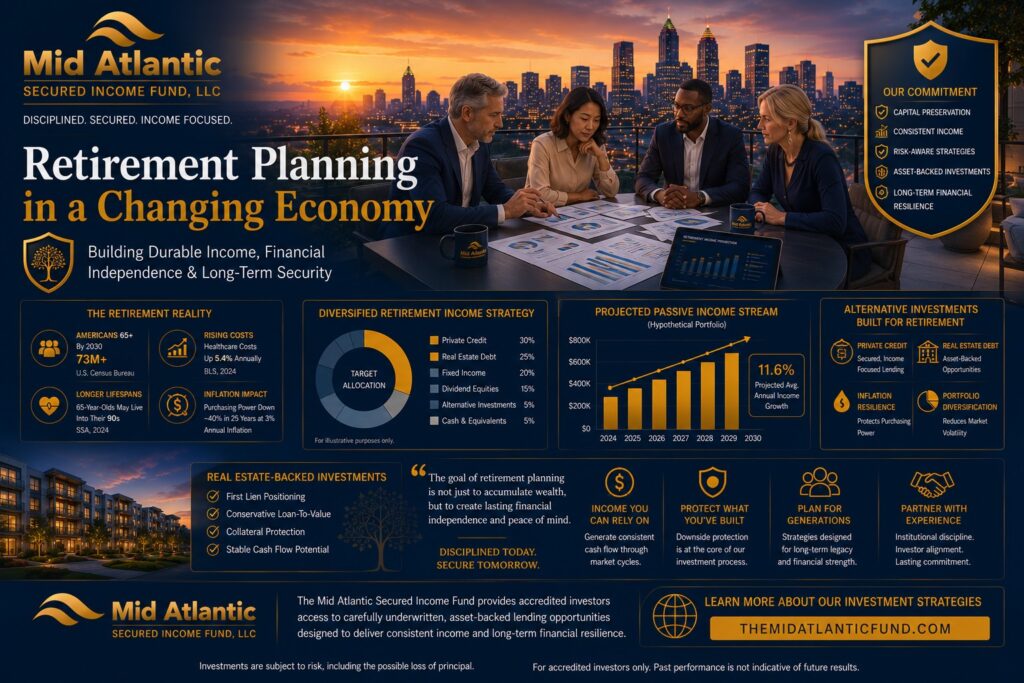
For decades, many Americans relied on a relatively predictable framework: pensions, lower inflation volatility, rising equity markets, predictable interest rates, and increasing home values. Today’s environment is far more complex. Persistent inflation pressures, elevated market volatility, rising healthcare costs, increased longevity, and uncertainty surrounding Social Security have fundamentally reshaped how investors approach retirement.
According to the Federal Reserve’s 2024 Survey of Consumer Finances, retirement preparedness remains one of the largest financial concerns among American households. Simultaneously, data from the Bureau of Labor Statistics continues to show that healthcare, housing, and insurance costs remain significant long-term pressures on retirees.
As a result, retirement planning has evolved from a simple savings exercise into a sophisticated discipline centered around:
- cash flow durability,
- risk mitigation,
- inflation resistance,
- portfolio diversification,
- tax efficiency,
- downside protection,
- and long-term income sustainability.
Modern retirement planning increasingly resembles institutional portfolio management.
Sophisticated investors are no longer asking only:
“How large is my portfolio?”
They are asking:
“How resilient is my retirement income under different economic conditions?”
That distinction is becoming critically important.
What Is Retirement Planning?
Direct Answer
Retirement planning is the process of preparing financially for life after active employment by building assets, generating sustainable income streams, managing investment risk, and preserving purchasing power over time.
Effective retirement planning includes:
- savings accumulation,
- investment management,
- tax optimization,
- risk management,
- estate planning,
- and long-term income generation.
Modern retirement planning increasingly emphasizes diversified income-producing assets rather than relying solely on traditional stock-and-bond portfolios.
The New Retirement Reality Facing Investors
Longer Lifespans Require Longer Investment Horizons
According to the Social Security Administration, a healthy 65-year-old couple today has a high probability that one spouse may live into their 90s.
That creates a major financial challenge:
Retirement portfolios may need to support 25–35 years of living expenses.
This longevity risk changes everything about portfolio construction.
Investors must now consider:
- inflation-adjusted income,
- sequence-of-return risk,
- market drawdowns,
- rising healthcare costs,
- and capital preservation.
A retirement portfolio is no longer simply designed to “grow.”
It must also endure.
Inflation Is One of Retirement’s Largest Threats
Inflation Quietly Erodes Purchasing Power
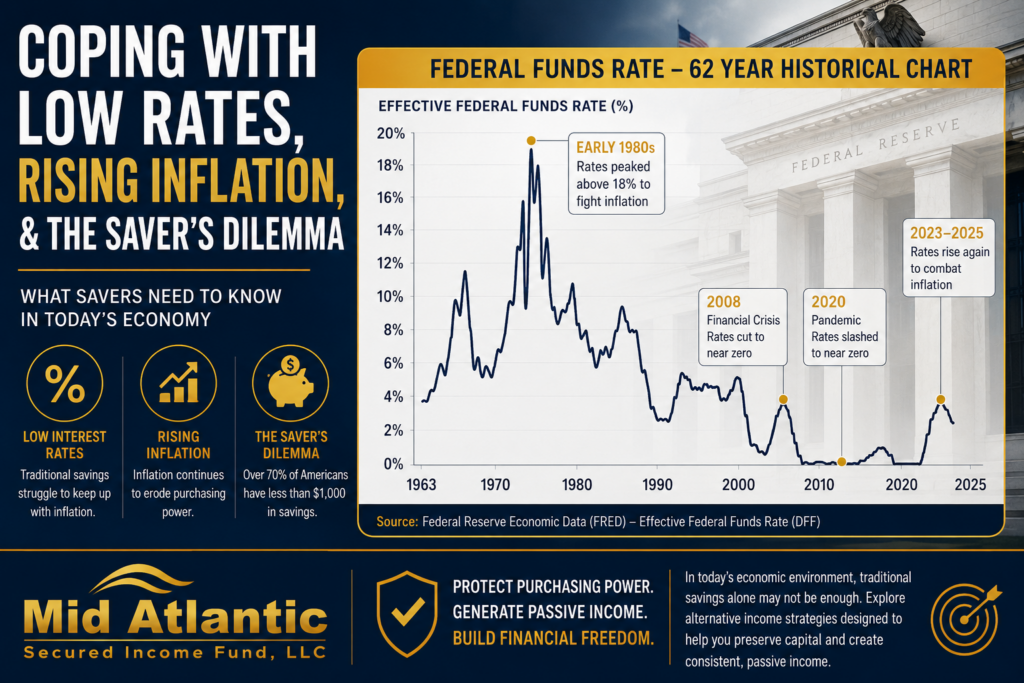
Inflation remains one of the greatest long-term risks to retirees because it compounds over time.
Even moderate inflation significantly reduces purchasing power over multi-decade retirement horizons.
Example:
At 3% annual inflation:
- $100,000 of purchasing power today falls to approximately:
- $74,000 after 10 years,
- $55,000 after 20 years,
- and roughly $41,000 after 30 years.
This explains why retirement planning increasingly prioritizes:
- income growth,
- inflation-resistant assets,
- alternative income streams,
- and diversified investment exposure.
Institutional investors have spent years increasing allocations to private credit, infrastructure, and real assets partly because these sectors may offer more attractive income characteristics during inflationary periods.
Retail retirement investors are beginning to follow similar strategies.
Why Traditional Retirement Portfolios Are Evolving
The Classic 60/40 Portfolio Faces New Challenges
For decades, the traditional 60/40 portfolio — 60% equities and 40% bonds — served as the foundation of retirement investing.
However, recent macroeconomic conditions exposed weaknesses in this structure.
Periods where both stocks and bonds decline simultaneously have forced investors to reconsider portfolio construction.
This has accelerated interest in:
- alternative investments,
- private credit,
- real estate-backed lending,
- non-correlated income assets,
- and institutional-style diversification.
According to Preqin and BlackRock research, private markets have seen substantial institutional capital inflows over the last decade as investors seek:
- enhanced yield potential,
- diversification,
- and lower correlation to public markets.
The Rise of Income-Focused Retirement Planning
Retirement Is About Cash Flow — Not Just Net Worth
One of the biggest misconceptions in retirement planning is that retirement success depends only on portfolio size.
In reality, retirement sustainability depends heavily on:
- predictable income,
- withdrawal efficiency,
- and portfolio resilience.
Sophisticated retirement investors increasingly focus on:
Durable Cash Flow Sources
Examples include:
- dividends,
- bonds,
- rental income,
- private credit,
- annuities,
- and real estate-backed lending.
The objective is to reduce dependence on selling volatile assets during unfavorable markets.
This approach can potentially improve:
- psychological stability,
- spending consistency,
- and long-term portfolio endurance.
What Are Private Credit Investments?
Direct Answer
Private credit investments involve non-bank lending opportunities where capital is provided directly to businesses, real estate projects, or borrowers outside traditional public bond markets.
Private credit strategies may include:
- real estate-backed loans,
- bridge lending,
- asset-backed lending,
- direct lending,
- receivables financing,
- and secured commercial lending.
Many institutional investors allocate capital to private credit because these investments may provide:
- higher income potential,
- contractual cash flow,
- and collateral-backed structures.
Why Accredited Investors Are Exploring Private Credit
Institutional Capital Has Shifted Toward Private Markets
Over the last decade, institutional investors including pension funds, endowments, and family offices have significantly expanded exposure to private markets.
According to Preqin:
- Global private debt assets under management surpassed $1.6 trillion in recent years.
- Institutional allocations continue growing due to demand for yield and diversification.
Several structural factors drive this trend:
1. Higher Interest Rate Environment
Private lending yields often adjust alongside broader interest rate markets.
2. Bank Lending Constraints
Regional banking pressures and tighter regulations have created lending gaps that private lenders increasingly fill.
3. Demand for Diversification
Private credit may behave differently than traditional public equities.
4. Asset-Backed Structures
Many private lending strategies involve collateral protection.
Are Debt Funds Safer Than Stocks?
Direct Answer
Debt funds and private credit investments are not risk-free, but some investors view certain secured lending strategies as potentially less volatile than equities because they prioritize contractual income and may include collateral-backed protections.
However, risks still exist, including:
- borrower default,
- illiquidity,
- market deterioration,
- underwriting errors,
- and economic downturns.
The quality of underwriting, collateral management, diversification, and sponsor discipline are critically important.
The Importance of Downside Protection in Retirement
Retirement Investing Requires Different Risk Priorities
A 35-year-old investor may recover from major market drawdowns over time.
A retiree withdrawing income often has far less flexibility.
This makes downside protection especially important during retirement.
Sophisticated retirement planning often prioritizes:
- capital preservation,
- volatility management,
- income durability,
- and diversified cash-flow generation.
Rather than chasing maximum returns, many retirees increasingly focus on:
“How much risk am I taking to pursue those returns?”
That shift is driving broader interest in:
- secured lending,
- private credit,
- real assets,
- infrastructure,
- and diversified fixed income alternatives.
Portfolio Diversification Matters More Than Ever
Diversification Is a Risk Management Tool
Diversification is not simply about owning many investments.
It is about owning investments that behave differently under varying market conditions.
Sophisticated retirement portfolios may include exposure to:
|
Asset Class |
Purpose |
|---|---|
|
Equities |
Long-term growth |
|
Bonds |
Stability and income |
|
Real Estate |
Inflation sensitivity |
|
Private Credit |
Income generation |
|
Cash Equivalents |
Liquidity |
|
Alternative Investments |
Diversification |
Institutional investors increasingly emphasize:
- uncorrelated income,
- alternative assets,
- and resilient portfolio structures.
How Inflation Impacts Retirement Withdrawals
Sequence-of-Return Risk Is Critical
Sequence-of-return risk occurs when retirees experience major market declines early in retirement while simultaneously withdrawing funds.
This combination can permanently impair portfolio longevity.
Income-producing strategies may help reduce reliance on forced asset sales during downturns.
This is one reason institutional-style retirement planning increasingly focuses on:
- recurring cash flow,
- diversified income,
- and conservative underwriting.
Real Estate-Backed Investments in Retirement Planning
Why Investors Continue to Favor Real Assets
Real estate remains one of the most widely used retirement investment sectors due to several characteristics:
- potential income generation,
- collateral value,
- inflation sensitivity,
- and tangible asset backing.
Real estate-backed lending strategies may offer investors exposure to:
- contractual loan payments,
- collateralized structures,
- and shorter-duration investments.
However, all real estate-related investments carry risk, including:
- property value declines,
- borrower default,
- liquidity constraints,
- and broader economic weakness.
How Sophisticated Investors Build Retirement Resilience
Institutional Retirement Framework
Modern retirement planning increasingly resembles institutional portfolio management frameworks focused on:
Capital Preservation
Protecting principal against catastrophic losses.
Income Stability
Generating recurring cash flow across market cycles.
Diversification
Reducing dependence on a single asset class.
Liquidity Management
Maintaining sufficient accessible capital.
Inflation Resistance
Ensuring purchasing power keeps pace over time.
Risk Layering
Balancing growth assets with defensive income-oriented assets.
Why Emotional Discipline Matters in Retirement Investing
Behavioral Finance Is Often Overlooked
One of the largest retirement risks is not mathematical.
It is behavioral.
During periods of volatility, many investors:
- panic sell,
- abandon long-term plans,
- or take excessive risk chasing returns.
Institutional investors often rely on structured allocation frameworks specifically to reduce emotional decision-making.
Retirement planning should account for both:
- financial risk,
- and behavioral risk.
How IRA Investors Use Alternative Investments
Self-Directed IRAs Are Growing
Many accredited investors use self-directed IRAs to access:
- private credit,
- real estate,
- alternative investments,
- and private lending opportunities.
These structures may provide:
- tax advantages,
- portfolio diversification,
- and expanded investment flexibility.
However, investors should understand:
- liquidity limitations,
- regulatory considerations,
- prohibited transaction rules,
- and sponsor risk.
What Risks Should Retirement Investors Consider?
Every Investment Strategy Involves Risk
No investment strategy eliminates risk entirely.
Key retirement investment risks include:
Market Risk
Public market volatility.
Inflation Risk
Loss of purchasing power.
Interest Rate Risk
Changes in rates impacting asset values.
Credit Risk
Borrower default or deterioration.
Liquidity Risk
Difficulty accessing capital quickly.
Longevity Risk
Outliving retirement assets.
Concentration Risk
Overexposure to one asset class.
Sophisticated retirement planning focuses on balancing these risks rather than eliminating them entirely.
Why Retirement Planning Is Becoming More Personalized
One-Size-Fits-All Portfolios Are Declining
Modern retirement investors have dramatically different goals:
- some prioritize income,
- others prioritize growth,
- others prioritize legacy planning,
- and many prioritize downside protection.
As a result, retirement planning increasingly emphasizes:
- customized allocations,
- tax-aware investing,
- and income-oriented portfolio construction.
Institutional strategies are becoming more accessible to individual accredited investors.
Retirement Planning and Economic Uncertainty
Economic Cycles Are Unavoidable
Markets will always experience:
- recessions,
- inflation cycles,
- interest rate shifts,
- geopolitical uncertainty,
- and volatility.
Successful retirement planning does not attempt to predict every cycle perfectly.
Instead, sophisticated investors focus on building resilient portfolios capable of adapting to multiple economic environments.
Why Secured Income Strategies Continue to Gain Attention
Investors Are Prioritizing Stability
As volatility persists, many investors increasingly prioritize:
- contractual income,
- asset-backed lending,
- diversification,
- and disciplined underwriting.
This trend has contributed to growing interest in:
- private credit,
- secured lending,
- real estate debt,
- and institutional income-focused investments.
The broader shift reflects changing investor psychology:
Stability and durability increasingly matter as much as return potential.
The Future of Retirement Planning
Retirement Planning Is Becoming Institutional
The future of retirement planning is likely to involve:
- broader use of private markets,
- increased income-oriented investing,
- greater diversification,
- enhanced risk management,
- and institutional-style portfolio construction.
Sophisticated investors increasingly recognize that retirement success is not solely determined by market performance.
It is determined by:
- resilience,
- discipline,
- cash-flow durability,
- and long-term planning consistency.
Final Thoughts
Retirement planning has evolved into one of the most important financial disciplines of modern investing.
Persistent inflation, economic uncertainty, longer lifespans, and market volatility have fundamentally changed how investors think about retirement security.
Increasingly, retirement investors are focusing on:
- income durability,
- downside protection,
- diversified portfolio construction,
- and institutional-quality risk management.
For many accredited investors, this includes exploring:
- private credit,
- real estate-backed lending,
- alternative investments,
- and diversified income-producing assets.
While no investment strategy eliminates risk, disciplined portfolio construction and long-term planning remain central to pursuing financial independence and retirement resilience.
The most successful retirement plans are rarely built around speculation.
They are built around consistency, discipline, diversification, and thoughtful risk management.
FAQ Section
What is retirement planning?
Retirement planning is the process of preparing financially for retirement through savings, investing, income planning, tax strategies, and risk management.
Why is retirement planning important?
Retirement planning helps investors pursue long-term financial independence, manage inflation risk, generate sustainable income, and reduce the likelihood of outliving their assets.
What are the biggest retirement risks?
Major retirement risks include inflation, market volatility, longevity risk, healthcare costs, sequence-of-return risk, and insufficient income generation.
Why are investors interested in private credit?
Many investors explore private credit because it may provide contractual income, diversification benefits, and asset-backed structures outside traditional public markets.
Are alternative investments appropriate for retirement portfolios?
Alternative investments may offer diversification and income benefits, but they also involve risks including illiquidity and complexity. Investors should evaluate suitability carefully.
How do self-directed IRAs work?
Self-directed IRAs allow investors to hold alternative assets such as real estate, private credit, and private investments while maintaining tax-advantaged retirement structures.
What is passive income in retirement?
Passive income refers to recurring income generated from investments such as dividends, interest payments, rental income, or lending investments.