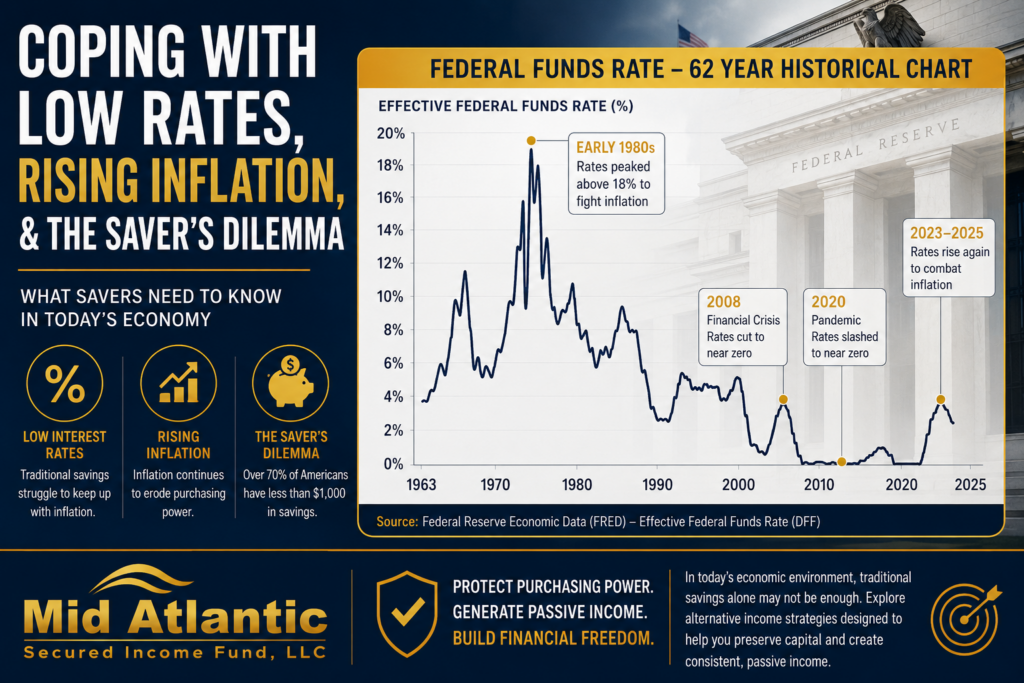

The Retirement Landscape Has Fundamentally Changed
Retirement planning in 2026 looks dramatically different than it did a generation ago.
For decades, investors relied heavily on a relatively predictable framework:
- pension income,
- Social Security,
- traditional bond allocations,
- and broad stock market appreciation.
Today, that framework is under increasing pressure.
Longer life expectancies, persistent inflation, volatile public markets, rising healthcare costs, shifting interest-rate environments, and uncertainty surrounding traditional retirement income sources have forced investors to rethink what financial security truly means.
According to the Federal Reserve, Americans collectively hold trillions of dollars in retirement assets across:
- 401(k)s,
- IRAs,
- pensions,
- and taxable investment accounts.
Yet despite record levels of retirement savings, many households remain concerned about:
- income sustainability,
- purchasing power erosion,
- sequence-of-return risk,
- and market volatility during retirement years.
As a result, affluent investors, family offices, and institutional allocators are increasingly incorporating secured income strategies into retirement portfolios to improve:
- diversification,
- cash flow stability,
- downside protection,
- and long-term financial resilience.
In modern retirement planning, the conversation is shifting from:
“How large is your portfolio?”
to:
“How resilient and durable is your income strategy?”
What Are Secured Income Funds?
Direct Answer
Secured income funds are investment vehicles designed to generate recurring income through asset-backed lending, private credit, structured income strategies, or collateralized investments that prioritize capital preservation and cash flow generation.
Many secured income strategies focus on:
- senior secured lending,
- real estate-backed loans,
- bridge financing,
- structured credit,
- and income-producing alternative investments.
These investments may offer:
- recurring distributions,
- lower public market correlation,
- and collateral-backed structures designed to enhance downside protection.
Why Retirement Planning Requires a Different Mindset in 2026
The Traditional 60/40 Portfolio Is Being Re-Evaluated
For decades, the classic 60/40 portfolio model — 60% equities and 40% bonds — served as the foundation of retirement investing.
However, recent market cycles have exposed vulnerabilities in relying exclusively on traditional public markets.
The bond market decline of 2022 demonstrated that:
- fixed income is not always immune to volatility,
- rising interest rates can materially impact bond prices,
- and traditional diversification assumptions can break down during inflationary environments.
At the same time:
- retirees are living longer,
- healthcare costs continue rising,
- and inflation remains a significant threat to purchasing power.
According to the Bureau of Labor Statistics, inflation-adjusted living costs for retirees have risen substantially over the last two decades, particularly in:
- housing,
- healthcare,
- insurance,
- and everyday consumer expenses.
This has caused many investors to increasingly prioritize:
- income durability,
- alternative income sources,
- real assets,
- and diversification beyond traditional stocks and bonds.
The Rise of Income-Focused Retirement Investing
Why Cash Flow Matters More Than Portfolio Size Alone
A growing number of affluent investors are shifting their retirement focus from speculative appreciation toward:
- recurring cash flow,
- passive income,
- and portfolio resilience.
This shift reflects a broader institutional investing trend emphasizing:
- income generation,
- capital discipline,
- and reduced volatility.
The goal is not necessarily maximizing short-term returns.
Instead, sophisticated retirement planning increasingly prioritizes:
- financial sustainability,
- reduced dependence on market timing,
- and predictable long-term income streams.
Why Secured Income Investments Are Gaining Attention
Investors Are Seeking Stability in Uncertain Markets
Secured income investments have attracted significant institutional interest in recent years.
According to Preqin and BlackRock research:
- private credit has become one of the fastest-growing segments of alternative investing,
- institutional investors continue increasing allocations to income-oriented private markets,
- and real asset-backed strategies are increasingly viewed as portfolio stabilizers.
This trend has accelerated due to:
- elevated public market volatility,
- persistent inflation concerns,
- banking-sector uncertainty,
- and growing demand for yield-oriented investments.
Understanding Private Credit in Retirement Portfolios
What Is Private Credit?
Private credit refers to non-bank lending where investors provide capital directly to borrowers outside traditional public bond markets.
Private credit strategies may include:
- real estate-backed lending,
- bridge loans,
- construction financing,
- receivables financing,
- senior secured business lending,
- and structured specialty finance.
Many investors are attracted to private credit because it may provide:
- recurring contractual income,
- collateral-backed lending structures,
- floating-rate features,
- and lower correlation to equities.
Why Real Estate-Backed Lending Matters
Tangible Assets and Capital Protection
Real estate-backed lending strategies are increasingly important within diversified retirement portfolios because they may provide:
- tangible collateral support,
- income generation,
- inflation sensitivity,
- and downside protection characteristics.
Examples include:
- first-lien mortgage loans,
- multifamily bridge lending,
- residential development financing,
- stabilized property lending,
- and short-duration secured credit strategies.
Unlike speculative equity investing, many secured lending strategies focus heavily on:
- collateral value,
- borrower underwriting,
- loan-to-value ratios,
- and capital preservation discipline.
Are Secured Income Funds Safer Than Stocks?
Direct Answer
Secured income funds are generally designed to prioritize income generation and capital protection rather than aggressive appreciation, which may result in lower volatility compared to public equities.
However:
- risk varies significantly by strategy,
- underwriting quality matters,
- and no investment is risk-free.
Secured lending structures may provide additional downside protection because investments are often backed by collateral or positioned higher within the capital stack.
Still, investors should carefully evaluate:
- liquidity,
- credit quality,
- leverage,
- underwriting standards,
- and fund management experience.
Inflation and Retirement Risk
Why Inflation Is One of the Greatest Threats to Retirement
Inflation quietly erodes purchasing power over time.
Even moderate inflation compounds significantly over multi-decade retirement horizons.
For retirees dependent on fixed distributions or stagnant portfolios, inflation risk can materially impact:
- lifestyle sustainability,
- healthcare affordability,
- and long-term financial flexibility.
This is one reason institutional investors increasingly favor:
- floating-rate credit,
- real estate-backed income,
- alternative income strategies,
- and diversified cash-flow investments.
Sequence-of-Return Risk and Retirement Volatility
Why Market Timing Can Damage Retirement Plans
One of the most overlooked retirement risks is sequence-of-return risk.
This occurs when retirees experience significant market losses early in retirement while simultaneously withdrawing income from portfolios.
Negative returns combined with withdrawals can permanently impair long-term portfolio sustainability.
Diversified income strategies may help reduce dependence on forced equity sales during volatile market periods.
The Psychological Side of Retirement Planning
Financial Security Is Emotional as Well as Mathematical
Behavioral finance research consistently shows that:
- investors are emotional during market stress,
- volatility impacts decision-making,
- and fear often drives poor investment timing.
Retirement portfolios built entirely around market appreciation can create:
- anxiety,
- emotional overreaction,
- and excessive dependence on public market performance.
Income-oriented portfolios may help improve:
- financial confidence,
- emotional stability,
- and long-term investment discipline.
How Affluent Investors Diversify Retirement Portfolios
Modern Retirement Portfolios Are Multi-Dimensional
Sophisticated retirement portfolios increasingly include:
- public equities,
- fixed income,
- private credit,
- real estate,
- structured income investments,
- infrastructure,
- and alternative assets.
The objective is not chasing maximum returns in any single year.
Instead, it is creating:
- resilient income streams,
- lower correlation,
- diversified risk exposure,
- and sustainable wealth preservation.
Why Accredited Investors Are Expanding Into Private Markets
Institutional Strategies Are Becoming More Accessible
Accredited investors increasingly allocate capital toward private markets because they may provide:
- enhanced diversification,
- recurring income,
- lower public market sensitivity,
- and access to institutional-style investment opportunities.
Examples include:
- private lending funds,
- real estate-backed income strategies,
- structured credit,
- and alternative fixed income investments.
The Role of Secured Income Funds in Retirement Planning
Beyond Traditional Bonds
Many investors historically relied on bonds as their primary retirement income source.
However, modern retirement investing increasingly includes:
- alternative income strategies,
- private credit,
- and secured lending structures designed to improve diversification and income durability.
Secured income funds may help support:
- monthly income generation,
- portfolio stabilization,
- and long-term financial sustainability.
How The Mid Atlantic Fund Approaches Income-Focused Investing
The Mid Atlantic Secured Income Fund focuses on:
- asset-backed lending,
- disciplined underwriting,
- income-oriented investing,
- and real estate-secured credit strategies.
The broader philosophy aligns with institutional trends emphasizing:
- downside protection,
- collateral-backed lending,
- diversification,
- and conservative portfolio construction.
Rather than relying solely on speculative market appreciation, many investors increasingly prioritize:
- stable cash flow,
- resilient asset structures,
- and long-term income sustainability.
Retirement Planning in the Next Decade
The Future of Retirement Investing Is Likely to Be More Diversified
The retirement landscape will continue evolving due to:
- demographic shifts,
- inflation pressures,
- changing interest-rate environments,
- and increased market complexity.
As a result, sophisticated investors are increasingly moving toward:
- diversified income strategies,
- alternative investments,
- and institutional-style portfolio construction.
The future of retirement planning may rely less on:
- maximizing growth alone,
and more on: - protecting purchasing power,
- generating reliable income,
- and building resilient financial structures capable of navigating multiple economic cycles.
FAQ Section
What are secured income funds?
Secured income funds are investment vehicles focused on generating recurring income through collateral-backed lending, private credit, or structured income investments.
Why are investors using secured income strategies for retirement?
Investors increasingly use secured income strategies because they may provide:
- recurring income,
- diversification,
- lower public-market correlation,
- and potential downside protection.
Are secured income funds safer than stocks?
Secured income funds are generally designed for lower volatility and income generation, but risk levels vary depending on underwriting quality, collateral, leverage, and economic conditions.
What role does private credit play in retirement portfolios?
Private credit may help retirees diversify beyond traditional bonds while potentially generating contractual income through direct lending strategies.
Why is diversification important in retirement planning?
Diversification helps reduce concentration risk and improve portfolio resilience across changing economic environments.
What is sequence-of-return risk?
Sequence-of-return risk occurs when retirees experience major market declines early in retirement while making withdrawals, potentially impairing long-term portfolio sustainability.
How do affluent investors generate passive income in retirement?
High-net-worth investors often use diversified income strategies including:
- private credit,
- dividend-paying equities,
- real estate-backed lending,
- and structured income investments.