
Why Conservative Investors Are Rethinking Traditional Fixed Income
For decades, traditional bonds represented the cornerstone of conservative portfolio construction. Investors seeking stability, income generation, and downside protection often relied heavily on U.S. Treasuries, municipal bonds, and investment-grade corporate debt to preserve capital while generating predictable cash flow.
However, the investment landscape has fundamentally changed.
Persistent inflation pressures, elevated interest rate volatility, growing fiscal deficits, and rapidly shifting macroeconomic conditions have forced investors to reconsider whether traditional fixed income alone can still fulfill the role it once did.
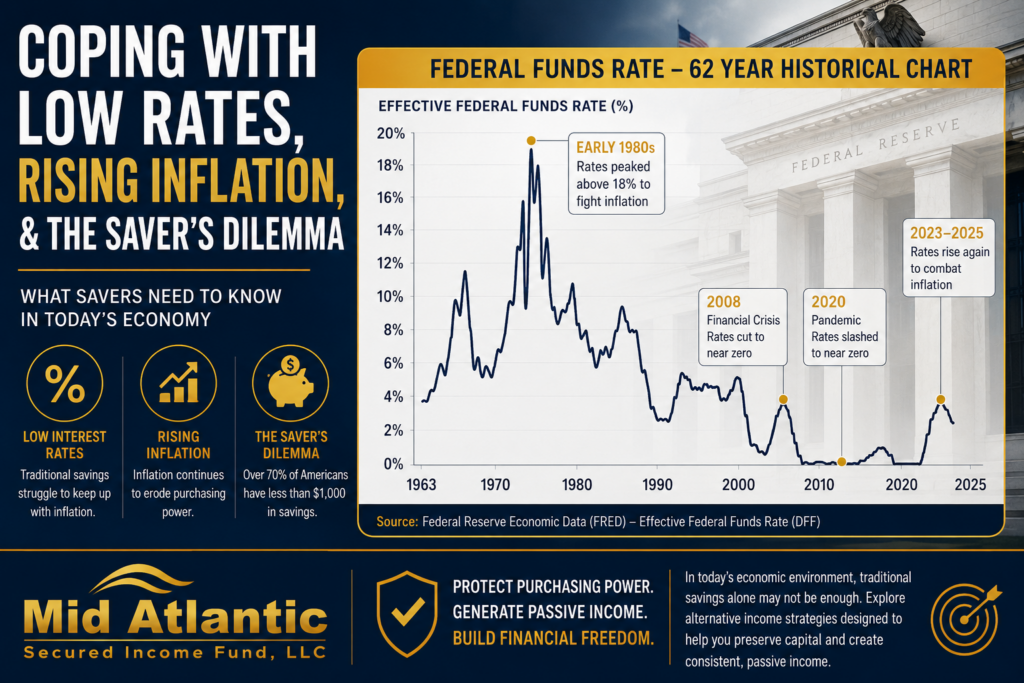
According to the Federal Reserve, interest rates experienced one of the fastest tightening cycles in modern financial history between 2022 and 2025. During that period, many traditional bond portfolios suffered meaningful drawdowns as bond prices declined sharply amid rising yields.
Historically, bonds were expected to act as stabilizers during periods of equity market volatility. Yet in several recent market environments, both stocks and bonds declined simultaneously — exposing structural weaknesses in traditional 60/40 portfolio construction.
As a result, affluent investors, family offices, institutional allocators, and retirement-focused investors are increasingly exploring innovative investment strategies that seek:
- capital preservation,
- recurring income generation,
- inflation resilience,
- lower correlation to public markets,
- and enhanced downside protection.
This shift has accelerated the rise of alternative fixed-income solutions, private credit strategies, secured lending investments, and real estate-backed income opportunities.
The modern conservative investor is no longer simply asking:
“What yields the most?”
Instead, the more sophisticated question has become:
“What produces durable income while preserving capital across multiple economic environments?”
That distinction is reshaping portfolio strategy in 2026 and beyond.
What Are Innovative Investment Strategies for Risk-Averse Investors?
Direct Answer
Innovative investment strategies for risk-averse investors are portfolio approaches designed to generate income and preserve capital while reducing exposure to public market volatility. These strategies often include private credit, real estate-backed lending, secured income funds, structured credit, alternative fixed income, and diversified income-producing assets beyond traditional bonds.
Unlike conventional bond portfolios, many alternative income strategies prioritize:
- collateral-backed lending,
- floating-rate structures,
- shorter-duration exposure,
- contractual cash flows,
- and institutional underwriting standards.
These approaches aim to reduce sensitivity to rising interest rates while potentially enhancing income generation and diversification.
Why Traditional Bonds Face Structural Challenges Today
1. Interest Rate Risk Has Increased
Bond prices typically fall when interest rates rise.
This dynamic became painfully clear during the Federal Reserve’s aggressive tightening cycle beginning in 2022. According to Morningstar and Bloomberg data, portions of the bond market experienced their worst declines in decades.
Long-duration bonds proved particularly vulnerable.
For conservative investors nearing retirement, these drawdowns challenged long-standing assumptions about fixed-income safety.
2. Inflation Reduces Real Returns
Inflation erodes purchasing power.
Even when traditional bonds provide nominal income, real returns may become negative if inflation outpaces yields.
For example:
- A 4% bond yield with 5% inflation results in a negative real return.
- Retirees dependent on portfolio income may experience declining purchasing power despite receiving consistent payments.
This reality has increased investor demand for inflation-resistant income strategies.
3. Public Markets Have Become More Correlated
Traditional diversification models have weakened.
Historically, bonds often moved inversely to equities. But during recent macroeconomic stress periods, both asset classes experienced simultaneous declines.
According to BlackRock research, higher inflation regimes can increase cross-asset correlation — limiting the diversification benefits investors previously relied upon.
The Rise of Alternative Fixed-Income Strategies
Institutional investors have increasingly shifted toward private markets in search of diversification, yield enhancement, and capital stability.
According to Preqin, private credit assets under management surpassed $1.7 trillion globally and continue to expand rapidly as banks reduce portions of traditional lending activity.
This shift has opened opportunities for alternative lenders and secured income strategies.
Key areas attracting capital include:
|
Strategy |
Primary Objective |
Typical Characteristics |
|---|---|---|
|
Private Credit |
Income generation |
Floating-rate loans, contractual payments |
|
Real Estate-Backed Lending |
Asset-backed protection |
Senior lien collateral |
|
Secured Income Funds |
Consistent income |
Diversified loan portfolios |
|
Structured Credit |
Yield enhancement |
Risk-tranched cash flows |
|
Asset-Backed Lending |
Collateral protection |
Receivables, inventory, equipment |
|
Bridge Lending |
Short-duration income |
Transitional financing |
These strategies aim to provide alternative sources of income beyond traditional public fixed income markets.
Why Investors Are Moving Beyond Traditional Bonds
Income Durability
Many alternative income strategies rely on contractual cash flows rather than public market appreciation.
This distinction can help reduce sensitivity to equity market volatility.
Floating-Rate Structures
Unlike fixed-rate bonds, many private credit investments feature floating-rate terms tied to benchmark rates.
This structure may help investors:
- maintain income during rising rate environments,
- reduce duration exposure,
- and better manage inflation risk.
Asset-Backed Collateral
Secured lending investments often involve collateral protections such as:
- real estate,
- receivables,
- inventory,
- equipment,
- or business assets.
This collateral structure can create an additional layer of downside mitigation.
Reduced Public Market Correlation
Private market investments often demonstrate lower correlation to publicly traded stocks and bonds.
This may improve overall portfolio diversification.
Understanding Private Credit Investing
What Is Private Credit?
Private credit refers to non-bank lending provided by private funds, institutional lenders, or specialized investment firms.
Rather than purchasing publicly traded bonds, investors gain exposure to privately negotiated loans.
These loans may include:
- commercial real estate debt,
- bridge loans,
- asset-backed lending,
- middle-market corporate lending,
- structured finance,
- and specialty credit.
Why Private Credit Has Expanded Rapidly
Following the Global Financial Crisis, regulatory changes increased capital requirements for traditional banks.
As banks reduced portions of certain lending activities, private credit managers stepped in to fill the financing gap.
Institutional investors increasingly embraced private credit because of:
- higher yields,
- contractual cash flow,
- floating-rate exposure,
- and enhanced underwriting flexibility.
According to Morgan Stanley research, private credit has become one of the fastest-growing alternative asset classes globally.
How Secured Income Strategies Work
Senior Secured Lending
Many conservative private credit strategies emphasize senior secured loans.
This means investors may occupy a higher repayment priority in the capital structure.
In many cases:
- loans are collateralized,
- repayment obligations are contractually defined,
- and underlying assets provide additional protection mechanisms.
For example, real estate-backed lending may involve:
- first-position liens,
- conservative loan-to-value ratios,
- property-backed collateral,
- and structured underwriting standards.
Real Estate-Backed Lending as an Income Strategy
Why Real Estate Debt Has Attracted Institutional Capital
Real estate debt investing has gained popularity among sophisticated investors seeking:
- recurring income,
- collateral-backed exposure,
- and lower volatility relative to direct equity ownership.
Unlike equity real estate investing, debt-focused strategies emphasize:
- loan repayment,
- contractual interest payments,
- and collateral recovery structures.
This creates a different risk-return profile than speculative property appreciation models.
Benefits of Real Estate-Backed Lending
1. Asset Collateralization
Real estate serves as tangible collateral.
2. Contractual Income
Borrowers typically make scheduled interest payments.
3. Lower Equity Market Correlation
Returns are often driven more by lending structures than stock market movements.
4. Potential Inflation Resilience
Real estate assets historically demonstrate inflation-linked characteristics.
Portfolio Construction for Conservative Investors
The Modern Diversification Framework
Traditional diversification focused heavily on:
- stocks,
- bonds,
- and cash equivalents.
Modern institutional portfolio construction increasingly incorporates:
- private credit,
- alternative income,
- real assets,
- infrastructure,
- and secured lending.
The goal is not simply maximizing returns.
It is building resilient portfolios capable of navigating multiple economic regimes.
How Risk-Averse Investors Evaluate Alternative Investments
Sophisticated investors often analyze:
|
Risk Factor |
Key Consideration |
|---|---|
|
Duration Risk |
Sensitivity to interest rate changes |
|
Credit Quality |
Borrower repayment strength |
|
Collateral Protection |
Asset-backed security |
|
Liquidity |
Access to capital |
|
Cash Flow Stability |
Consistency of income generation |
|
Underwriting Discipline |
Risk management framework |
|
Diversification |
Exposure concentration |
Institutional underwriting standards remain critically important.
Higher yields without disciplined risk management can create elevated downside exposure.
Are Debt Funds Safer Than Stocks?
Direct Answer
Debt funds are generally considered less volatile than equities because they prioritize contractual repayment obligations rather than ownership appreciation. However, all investments involve risk, and safety depends heavily on underwriting quality, diversification, collateral structure, liquidity, and economic conditions.
Public equities may offer greater long-term upside potential, but they also tend to experience higher volatility.
Many conservative investors use income-oriented debt strategies to complement equity exposure rather than replace it entirely.
The Psychology of Conservative Investing
Risk-averse investors are not necessarily return-averse.
In many cases, they prioritize:
- predictability,
- consistency,
- downside mitigation,
- and financial resilience.
Behavioral finance research consistently shows that severe drawdowns can significantly impair long-term investment outcomes because investors may sell during periods of market stress.
As a result, many affluent investors increasingly prefer strategies designed to reduce extreme volatility.
Retirement Investors and Income-Focused Strategies
Why Retirement Planning Is Changing
Retirement investors face several structural challenges:
- longer life expectancies,
- inflation pressures,
- healthcare cost growth,
- and market volatility.
According to the U.S. Census Bureau, Americans over age 65 represent one of the fastest-growing demographic groups.
This has increased demand for:
- income-producing investments,
- diversified cash-flow strategies,
- and alternative fixed-income solutions.
How Accredited Investors Use Private Credit
Direct Answer
Accredited investors often use private credit investments to diversify traditional portfolios, generate recurring income, reduce public market correlation, and access institutional lending opportunities unavailable in public markets.
These strategies may complement:
- traditional equities,
- public fixed income,
- retirement accounts,
- and alternative investments.
The Role of Secured Income Funds
Secured income funds typically invest in diversified pools of asset-backed loans.
Common characteristics may include:
- first-position liens,
- diversified borrower exposure,
- short-to-medium duration structures,
- recurring contractual income,
- and institutional underwriting processes.
Many investors use secured income strategies as part of broader income-focused portfolio construction.
Inflation, Volatility, and the Search for Stability
The post-2020 investment environment fundamentally reshaped investor priorities.
Persistent inflation, geopolitical instability, banking-sector stress, and elevated market volatility accelerated demand for:
- defensive positioning,
- resilient cash flow,
- and alternative income generation.
Institutional allocators increasingly prioritize:
- capital discipline,
- downside protection,
- and diversified income streams.
Why Alternative Investments Continue Gaining Momentum
According to Preqin and BlackRock research, alternative assets continue attracting institutional capital because investors seek:
- non-correlated returns,
- higher income potential,
- inflation resilience,
- and portfolio diversification.
Alternative investments are no longer viewed solely as speculative enhancements.
Increasingly, they serve as core components of institutional portfolio construction.
Key Risks Investors Should Understand
No investment strategy is risk-free.
Alternative income investments may involve:
- illiquidity,
- credit risk,
- borrower defaults,
- economic sensitivity,
- and underwriting complexity.
Investors should carefully evaluate:
- manager experience,
- historical performance,
- collateral structures,
- risk controls,
- and investment transparency.
The Evolution of Conservative Investing
Conservative investing is no longer synonymous with:
- low-yield savings accounts,
- long-duration government bonds,
- or static 60/40 portfolios.
Modern income-focused investing increasingly blends:
- private credit,
- secured lending,
- real estate-backed debt,
- structured income,
- and institutional diversification techniques.
The future of conservative investing appears increasingly centered around resilience rather than simply yield.
Why Sophisticated Investors Focus on Capital Discipline
Institutional investors understand that protecting capital during difficult market environments often matters more than maximizing returns during favorable periods.
Compounding works best when large drawdowns are avoided.
This principle has driven growing interest in:
- secured lending,
- downside-protected strategies,
- diversified income portfolios,
- and disciplined underwriting frameworks.
The Future of Income-Oriented Investing
The investment world continues evolving rapidly.
As traditional bond markets face structural challenges, investors increasingly seek:
- flexible income strategies,
- inflation-aware portfolio construction,
- and diversified alternative investments.
For many sophisticated investors, the objective is no longer merely chasing yield.
Instead, it is constructing resilient portfolios designed to:
- preserve capital,
- generate consistent income,
- and navigate uncertain economic environments with greater stability.
That shift may define the next era of conservative investing.
FAQ Section
What are innovative investment strategies for risk-averse investors?
These strategies seek to preserve capital and generate recurring income while reducing exposure to public market volatility. Common approaches include private credit, secured lending, real estate-backed debt, and diversified income-producing investments.
Why are investors moving beyond traditional bonds?
Many investors are seeking alternatives because traditional bonds have faced increased volatility, inflation pressure, and interest rate sensitivity in recent years.
What is private credit investing?
Private credit involves non-bank lending through privately negotiated loans rather than publicly traded bonds.
Are private credit investments safer than stocks?
Private credit investments are often less volatile than equities, but risks still exist. Safety depends heavily on underwriting quality, diversification, collateral protection, and economic conditions.
What are secured income funds?
Secured income funds typically invest in diversified portfolios of collateral-backed loans designed to generate recurring contractual income.
Why do accredited investors use alternative investments?
Accredited investors often use alternatives to diversify portfolios, access private markets, reduce public market correlation, and potentially enhance income generation.