
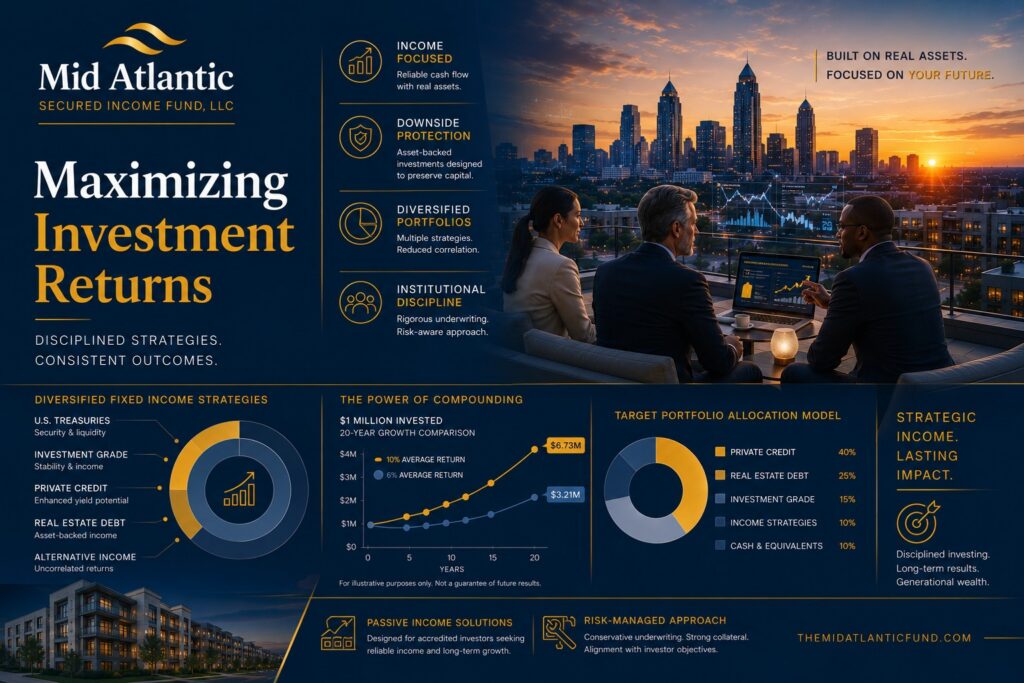
Maximizing Investment Returns: Institutional Strategies for Building Long-Term Wealth
Why Sophisticated Investors Think Differently About Returns For decades, investors were taught that maximizing investment returns primarily meant chasing higher-performing stocks, timing market cycles, or aggressively increasing portfolio risk exposure. Institutional investors rarely approach wealth creation that way. Large pension funds, insurance companies, family offices, endowments, and sophisticated accredited investors often focus less on chasing the single highest-returning asset and more on constructing portfolios capable of producing durable, risk-adjusted returns across multiple market environments. That distinction matters. The difference between speculative returns and sustainable returns is often the difference between temporary gains and long-term wealth preservation. Today’s investment environment presents a unique challenge: Elevated interest rates Persistent inflation concerns Increased stock market concentration Geopolitical volatility Commercial real estate repricing Higher bond market volatility Slowing global economic growth According to the Federal Reserve, U.S. household net worth reached record highs in recent years, yet wealth concentration and market dependency also increased significantly. At the same time, institutional investors have steadily expanded allocations to alternative assets, private credit, infrastructure, and real estate-backed income strategies in pursuit of improved diversification and more stable return streams. The modern conversation around maximizing investment returns is no longer simply about “earning more.” It is increasingly about: Improving risk-adjusted performance Enhancing income consistency Protecting downside exposure Reducing portfolio volatility Increasing diversification Optimizing tax efficiency Preserving purchasing power over decades Investors seeking long-term success increasingly recognize that maximizing returns without understanding risk often leads to avoidable portfolio instability. What Does “Maximizing Investment Returns” Actually Mean? Direct Answer Maximizing investment returns means improving total portfolio performance over time while balancing risk, income generation, diversification, liquidity needs, tax efficiency, and capital preservation. Sophisticated investors evaluate returns using multiple metrics, including: Total return Risk-adjusted return Cash flow consistency Inflation-adjusted return Portfolio drawdown exposure Correlation across assets Tax efficiency Long-term compounding potential The highest-returning asset in one year is not necessarily the best long-term investment. Institutional portfolio construction focuses on achieving sustainable compounded growth while managing downside volatility. The Evolution of Modern Portfolio Construction Traditional portfolio models relied heavily on the classic 60/40 allocation: 60% equities 40% bonds For decades, this structure benefited from falling interest rates, expanding equity multiples, and strong bond diversification. However, market dynamics have changed materially. According to BlackRock and JPMorgan Asset Management research, institutional portfolios have steadily increased allocations to alternative investments over the last two decades due to: Lower expected public market returns Higher stock-bond correlation periods Inflation uncertainty Yield compression in traditional fixed income Desire for uncorrelated return streams Institutional investors now commonly allocate capital across: Asset Class Institutional Purpose Public Equities Long-term growth Fixed Income Stability & income Private Credit Enhanced yield Real Estate Debt Asset-backed income Infrastructure Inflation resilience Private Equity Growth enhancement Cash & Treasuries Liquidity management Structured Credit Yield optimization This shift reflects a broader understanding that maximizing returns often requires broader diversification beyond traditional stock-and-bond portfolios. Why Risk-Adjusted Returns Matter More Than Raw Returns One of the most overlooked concepts in investing is that identical returns can carry vastly different levels of risk. Consider two portfolios: Portfolio Annual Return Max Drawdown Portfolio A 10% -45% Portfolio B 9% -12% Many institutional investors would prefer Portfolio B. Why? Because severe drawdowns can significantly impair long-term compounding. Recovering from losses becomes exponentially harder as drawdowns increase. Loss Gain Needed to Recover -10% +11% -20% +25% -40% +67% -50% +100% Sophisticated wealth management increasingly prioritizes: Volatility management Capital preservation Stable income production Downside protection Portfolio durability Maximizing returns is not simply about upside participation. It is about protecting the compounding engine itself. The Role of Private Credit in Return Optimization What Is Private Credit? Private credit refers to non-bank lending strategies where capital is deployed directly into loans outside traditional public bond markets. Private credit has grown rapidly following the Global Financial Crisis as banks reduced certain lending activities due to regulatory changes. According to Preqin, global private credit assets under management surpassed $1.7 trillion in recent years, making it one of the fastest-growing alternative asset classes. Common private credit strategies include: Senior secured real estate lending Direct lending Asset-backed lending Construction lending Bridge lending Mezzanine financing Specialty finance Why Institutional Investors Use Private Credit Institutional investors often allocate to private credit because it may offer: Higher yields than traditional bonds Floating-rate structures Asset-backed collateral Reduced public market correlation Monthly or quarterly income Senior secured positioning In rising rate environments, floating-rate lending strategies may help preserve income generation more effectively than long-duration fixed-rate bonds. Private credit also allows investors to participate in segments of the market traditionally accessed primarily by banks and institutional capital providers. Real Estate-Backed Investments and Income Stability Real estate-backed lending strategies have become increasingly attractive among income-oriented investors seeking capital preservation characteristics alongside yield generation. Unlike speculative equity investments dependent entirely on asset appreciation, senior secured lending structures often focus on: Collateral protection Loan-to-value discipline borrower underwriting cash flow coverage first-lien security positions This structural focus can help reduce downside exposure compared to unsecured lending or highly volatile growth assets. For many accredited investors, real estate debt strategies serve as a middle ground between: lower-yield traditional bonds and higher-volatility public equities Why Diversification Remains Central to Maximizing Returns Diversification is often misunderstood. It is not merely owning many investments. True diversification means combining assets that respond differently to economic conditions. Institutional portfolios frequently diversify across: Economic Sensitivity Growth-sensitive assets Defensive income assets Inflation-sensitive assets Countercyclical assets Liquidity Profiles Public market liquidity Semi-liquid investments Long-duration private investments Interest Rate Exposure Fixed-rate assets Floating-rate assets Short-duration strategies Income Sources Dividends Bond coupons Rental cash flow Loan interest Structured income The goal is not complexity for complexity’s sake. The goal is portfolio resilience. The Psychology of Return Maximization Behavioral finance research consistently shows that investor behavior often harms long-term performance. According to DALBAR studies, average investor returns frequently trail market benchmarks due to: Emotional trading Panic selling Performance chasing Market timing Recency bias Sophisticated investors often maximize returns not through hyperactivity, but through: discipline consistency diversification risk management long-term focus This
Maximizing Investment Returns: Institutional Strategies for Building Long-Term Wealth Read More »