
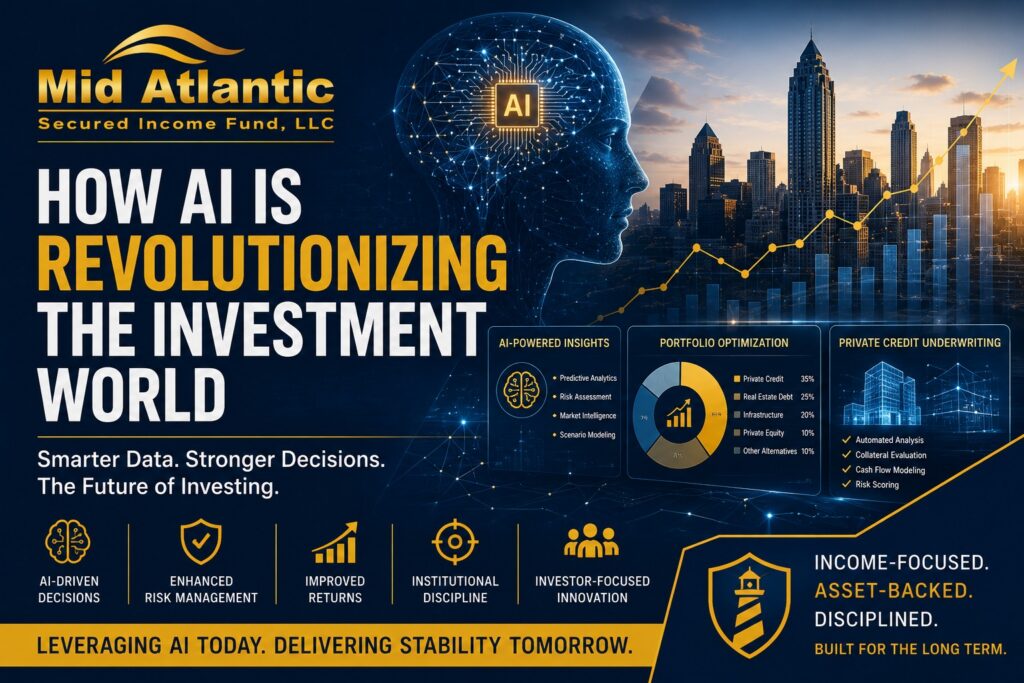
How AI Is Revolutionizing the Investment World
The Most Significant Technological Shift in Modern Finance Artificial intelligence is rapidly reshaping nearly every segment of the global financial system. From institutional portfolio management and algorithmic trading to private credit underwriting, fraud detection, retirement planning, and investor communications, AI is becoming deeply integrated into the infrastructure of modern investing. This transformation extends far beyond automation. Artificial intelligence is fundamentally changing how: investment decisions are made, risk is evaluated, capital is allocated, markets are analyzed, portfolios are managed, and investors interact with financial systems. According to McKinsey & Company, generative AI and machine learning technologies could contribute trillions of dollars in economic productivity globally over the coming decade, with financial services representing one of the industries most heavily impacted. The investment world is entering a new era defined by: data intelligence, predictive analytics, automation, personalization, and computational decision-making at unprecedented scale. For institutional investors, wealth managers, private lenders, and accredited investors, understanding this transformation is increasingly becoming a strategic necessity rather than a technological curiosity. What Is Artificial Intelligence in Investing? Direct Answer Artificial intelligence in investing refers to the use of machine learning, predictive analytics, natural language processing, automation, and advanced computational models to analyze financial data, improve investment decision-making, optimize portfolios, evaluate risk, and automate financial processes. AI systems can process massive volumes of information significantly faster than traditional human analysis alone. These technologies are increasingly used across: portfolio management, private credit underwriting, fraud detection, market forecasting, investor communications, compliance monitoring, and alternative investment analysis. Why AI Is Transforming Financial Markets Financial Markets Produce Massive Amounts of Data Modern capital markets generate extraordinary quantities of information every second. This includes: earnings reports, interest rate data, economic releases, loan performance metrics, real estate valuations, market sentiment, geopolitical developments, and transactional behavior. Traditional financial analysis increasingly struggles to process this volume efficiently. Artificial intelligence addresses this challenge through: AI Capability Financial Application Machine Learning Pattern recognition and forecasting Natural Language Processing Analyzing news, filings, earnings calls Predictive Analytics Risk modeling and scenario analysis Automation Operational efficiency Computer Vision Document processing and fraud detection Neural Networks Complex financial modeling The ability to synthesize enormous data sets rapidly has made AI increasingly valuable across institutional finance. The Evolution of AI in Investing AI in Finance Is Not Entirely New Quantitative investing models have existed for decades. However, recent advances in: cloud computing, large language models, GPU processing, generative AI, and machine learning infrastructure have dramatically expanded AI’s capabilities. The difference today is scale and accessibility. AI is no longer confined to elite quantitative hedge funds. It is increasingly influencing: wealth management firms, private lenders, institutional allocators, fintech platforms, and alternative investment managers. How AI Is Changing Wealth Management Personalized Portfolio Construction Traditional wealth management often relied on broad model portfolios. AI enables increasingly personalized investment strategies based on: risk tolerance, income objectives, tax considerations, behavioral tendencies, liquidity needs, and market conditions. According to Morgan Stanley and BlackRock, AI-driven analytics are becoming increasingly integrated into advisor workflows and institutional portfolio construction. AI-Powered Financial Planning AI systems increasingly assist with: retirement projections, cash flow forecasting, tax optimization, portfolio stress testing, and scenario analysis. These tools help advisors and investors evaluate potential outcomes more efficiently. How AI Is Transforming Private Credit AI and Underwriting One of the most significant areas of AI adoption within alternative investments is private credit underwriting. AI-driven underwriting systems can analyze: borrower financials, property data, construction budgets, payment histories, economic indicators, and market conditions at significantly greater speed than traditional manual processes. This does not replace human judgment. However, it may improve: operational efficiency, risk consistency, and data analysis quality. AI in Real Estate-Backed Lending Data-Driven Lending Decisions Real estate-backed lending increasingly relies on data intelligence. AI systems can assist lenders in evaluating: property valuations, local market trends, zoning patterns, construction risk, borrower history, and collateral quality. Machine learning models may also identify early warning indicators associated with: borrower stress, project delays, liquidity issues, or market deterioration. This is especially important in private credit and bridge lending environments where underwriting precision matters substantially. AI and Portfolio Construction Modern Portfolio Management Is Becoming More Dynamic Traditional portfolio construction often relied on historical averages and static allocation models. AI enables increasingly adaptive portfolio frameworks. Machine learning models can evaluate: volatility, correlations, macroeconomic shifts, inflation trends, liquidity conditions, and market sentiment in near real time. Institutional investors increasingly use AI-driven analytics to improve: scenario modeling, diversification analysis, and risk forecasting. How AI Improves Risk Management Risk Management Is Becoming More Predictive Artificial intelligence is changing how institutions identify and manage risk. AI systems may detect anomalies and emerging risks earlier than traditional methods through: predictive analytics, behavioral pattern recognition, and real-time monitoring. Applications include: Credit Risk Analysis Evaluating borrower default probability. Fraud Detection Identifying suspicious transaction patterns. Liquidity Monitoring Tracking market stress and funding conditions. Portfolio Stress Testing Modeling economic shock scenarios. Compliance Monitoring Reviewing communications and operational activity. According to PwC and Deloitte, financial institutions are significantly increasing investment into AI-powered risk infrastructure. AI and Alternative Investments AI Is Expanding Beyond Public Markets Alternative investment firms increasingly leverage AI to analyze: private credit portfolios, real estate markets, infrastructure investments, and institutional lending data. This is particularly important because private markets historically suffered from fragmented and inconsistent data availability. AI may improve: portfolio visibility, operational scalability, underwriting consistency, and investor reporting transparency. Are AI Investment Strategies Better Than Human Investors? Direct Answer AI investment systems are not inherently superior to human investors, but they may improve efficiency, pattern recognition, data processing, and operational scalability when combined with experienced human oversight and disciplined investment processes. The strongest institutional frameworks increasingly combine: human judgment, domain expertise, and AI-driven analytics. AI remains limited by: data quality, model assumptions, changing market conditions, and unforeseen economic events. Human oversight remains essential. Risks of AI in Investing AI Is Powerful — But Not Infallible Despite its rapid adoption, artificial intelligence introduces important risks. Model Risk AI systems are only as effective as the assumptions and data underlying them. Data
How AI Is Revolutionizing the Investment World Read More »