Artificial intelligence is rapidly transforming the global financial system. What was once considered experimental technology is now becoming foundational infrastructure across investment management, private credit, banking, underwriting, portfolio analytics, wealth management, and institutional finance.
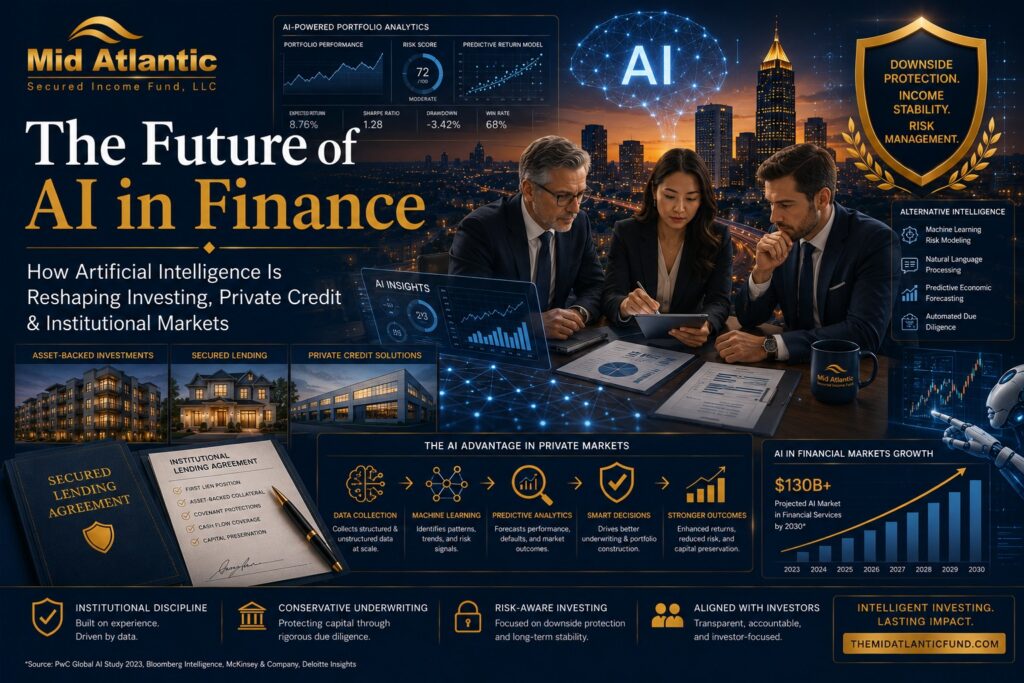
According to McKinsey, generative AI and advanced automation could contribute between $200 billion and $340 billion annually to the banking industry alone through productivity gains, improved risk management, and operational efficiencies. Meanwhile, Bloomberg Intelligence projects the AI market in financial services could exceed $130 billion globally by the end of the decade.
For investors, the implications are enormous.
Artificial intelligence is changing how institutions:
- analyze markets,
- evaluate risk,
- underwrite loans,
- identify investment opportunities,
- forecast macroeconomic trends,
- manage portfolios,
- detect fraud,
- improve operational efficiency,
- and allocate capital.
At the same time, the rapid evolution of AI is also increasing the importance of disciplined investment strategies grounded in tangible collateral, predictable cash flow, and downside protection.
For sophisticated investors evaluating private credit, real estate-backed lending, and alternative investments, understanding how AI is reshaping finance has become increasingly important.
What Is AI in Finance?
Artificial intelligence in finance refers to the use of machine learning, predictive analytics, large language models, automation systems, and data-driven algorithms to improve financial decision-making and operational efficiency.
AI systems can analyze massive amounts of structured and unstructured data far faster than traditional human analysis alone.
Financial institutions increasingly use AI for:
- portfolio optimization,
- risk analysis,
- fraud detection,
- market forecasting,
- underwriting,
- algorithmic trading,
- customer service automation,
- compliance monitoring,
- and macroeconomic analysis.
In simple terms, AI allows financial institutions to make faster, more informed, and more scalable decisions.
Why AI Is Becoming So Important in Finance
The financial industry generates enormous volumes of data.
Markets move continuously. Interest rates fluctuate. Credit risk changes. Consumer behavior evolves. Real estate markets shift. Economic conditions change rapidly.
Traditional analysis methods often struggle to keep pace with the complexity and speed of modern financial systems.
AI changes this dynamic by enabling:
- real-time analysis,
- predictive modeling,
- automated pattern recognition,
- enhanced scenario forecasting,
- and scalable data processing.
According to PwC, AI could contribute approximately $15.7 trillion to the global economy by 2030, with financial services representing one of the largest beneficiaries.
The institutions adopting AI effectively may gain significant advantages in:
- underwriting accuracy,
- operational efficiency,
- investment intelligence,
- and risk-adjusted performance.
How AI Is Transforming Investment Management
Investment firms are increasingly integrating AI into portfolio construction and market analysis.
Large institutional firms including BlackRock, JPMorgan, Goldman Sachs, and Morgan Stanley continue investing heavily in AI infrastructure to improve investment research and portfolio management.
AI systems can process:
- earnings reports,
- macroeconomic indicators,
- bond market activity,
- consumer spending trends,
- real estate performance data,
- central bank commentary,
- and geopolitical developments
at scales impossible for human teams alone.
This allows investors to identify trends earlier and react more efficiently to changing market conditions.
AI and Private Credit Investing
Private credit has emerged as one of the fastest-growing segments of alternative investing.
Preqin projects private credit assets under management could exceed $2.8 trillion globally by 2028 as investors seek yield, diversification, and lower correlation to public markets.
AI is increasingly influencing private credit markets through:
- enhanced underwriting models,
- borrower risk scoring,
- predictive default analysis,
- collateral valuation,
- document automation,
- and portfolio monitoring.
In private lending, AI can help identify patterns that traditional underwriting may miss.
Examples include:
- borrower cash-flow anomalies,
- property market shifts,
- supply chain risks,
- regional economic weakness,
- and changing credit trends.
For disciplined lenders, AI can improve operational efficiency while supporting more informed lending decisions.
However, AI does not eliminate investment risk.
Human judgment, underwriting discipline, legal protections, collateral quality, and conservative structuring remain critically important.
Why Human Oversight Still Matters
Despite the rapid advancement of artificial intelligence, experienced human decision-making remains essential in finance.
AI models are only as reliable as:
- the data they receive,
- the assumptions they are trained on,
- and the risk frameworks guiding their outputs.
Financial history repeatedly demonstrates that models can fail during periods of stress, volatility, or unprecedented economic disruption.
Sophisticated investment management still requires:
- macroeconomic judgment,
- legal review,
- relationship management,
- market experience,
- and disciplined risk controls.
This is particularly important in private credit and real estate-backed lending, where each transaction often involves unique collateral, borrowers, market conditions, and legal considerations.
The future of finance is likely not “AI replacing investors,” but rather:
AI augmenting disciplined institutional decision-making.
How AI Is Changing Risk Management
Risk management is one of the most important applications of AI in finance.
Modern AI systems can continuously analyze:
- portfolio concentration,
- market volatility,
- interest rate exposure,
- borrower performance,
- real estate market conditions,
- and economic indicators.
This allows institutions to identify emerging risks earlier and respond more proactively.
According to Deloitte, financial institutions increasingly view AI-powered risk systems as essential for improving resilience during periods of economic uncertainty.
In private credit investing, advanced analytics may help institutions:
- monitor loan performance,
- identify deteriorating market conditions,
- improve reporting,
- and optimize portfolio diversification.
AI, Interest Rates & Market Volatility
The current economic environment highlights why AI-driven financial analysis is becoming increasingly valuable.
Over the past several years, investors have experienced:
- elevated inflation,
- aggressive Federal Reserve rate hikes,
- regional banking stress,
- bond market volatility,
- and commercial real estate uncertainty.
Traditional fixed-income assets have experienced unusually high volatility in certain periods.
AI systems can help institutions model:
- rate sensitivity,
- refinancing risks,
- borrower stress scenarios,
- and macroeconomic impacts.
However, many sophisticated investors continue emphasizing investment strategies tied to:
- tangible collateral,
- first-lien positions,
- cash-flow generation,
- and conservative underwriting.
These characteristics may help reduce sensitivity to broader market volatility compared to purely speculative investments.
The Rise of AI in Wealth Management
AI is also reshaping wealth management and investor communication.
Modern wealth platforms increasingly use AI for:
- portfolio personalization,
- retirement forecasting,
- tax optimization,
- client communication,
- and financial planning.
According to Capgemini, younger affluent investors increasingly expect digital-first investment experiences enhanced by technology and data-driven insights.
This trend is accelerating demand for:
- transparent reporting,
- institutional-grade analytics,
- and digital investment experiences.
How AI Is Impacting Real Estate Investing
Real estate investing is becoming increasingly data-driven.
AI tools can analyze:
- migration trends,
- housing demand,
- demographic shifts,
- rental growth,
- property values,
- and regional economic activity.
Markets like Atlanta and the Southeast continue attracting attention due to:
- population growth,
- corporate relocation,
- infrastructure investment,
- and long-term housing demand.
These regional economic trends increasingly influence both institutional capital flows and private lending opportunities.
Atlanta’s Growing Role in Financial Innovation
Atlanta has quietly become one of the Southeast’s most important financial and technology hubs.
The region continues benefiting from:
- population migration,
- fintech growth,
- logistics infrastructure,
- corporate expansion,
- and strong real estate development activity.
This geographic growth story creates opportunities across:
- residential housing,
- multifamily development,
- bridge lending,
- construction financing,
- and private credit markets.
As AI adoption expands across finance, regional expertise may become increasingly valuable.
Institutions with strong understanding of local economic conditions, underwriting discipline, and relationship networks may maintain competitive advantages even in increasingly technology-driven markets.
What Are the Risks of AI in Finance?
While AI offers major advantages, investors should also understand the risks.
Potential concerns include:
Model Risk
AI systems can fail if trained on flawed or incomplete data.
Over-Automation
Excessive reliance on algorithms without human oversight may increase systemic vulnerabilities.
Cybersecurity Risk
AI-driven systems increase the importance of cybersecurity and data protection.
Regulatory Uncertainty
Governments and regulators continue developing frameworks for AI governance in financial markets.
Market Crowding
As more institutions adopt similar AI models, market behavior could become increasingly correlated.
Sophisticated investors should evaluate not only whether institutions use AI, but how responsibly and conservatively they implement it.
Why Alternative Investments May Become More Important in an AI-Driven World
As AI accelerates market efficiency and increases competition in public markets, many investors continue seeking:
- differentiated income streams,
- lower market correlation,
- asset-backed investments,
- and alternative sources of yield.
Private credit, real estate-backed lending, and alternative investments may continue attracting capital because they often provide:
- contractual income,
- collateral-backed structures,
- and diversification benefits.
Institutional investors increasingly allocate capital toward private markets for these reasons.
BlackRock estimates alternative assets could grow substantially over the next decade as investors seek diversification beyond traditional stocks and bonds.
How Accredited Investors Are Using AI-Enhanced Investment Strategies
Sophisticated investors increasingly combine technology-driven analysis with conservative investment principles.
Many accredited investors focus on:
- income-oriented investing,
- private credit exposure,
- real estate-backed lending,
- retirement diversification,
- and downside risk management.
AI may improve:
- research efficiency,
- portfolio analytics,
- and market intelligence,
but long-term investment success still depends heavily on:
- discipline,
- diversification,
- asset quality,
- and risk management.
The Future of AI in Private Credit & Alternative Investing
The next decade will likely reshape financial markets dramatically.
AI is expected to influence nearly every aspect of investing, including:
- underwriting,
- portfolio management,
- reporting,
- compliance,
- investor communication,
- and macroeconomic forecasting.
However, the institutions most likely to succeed may be those combining:
- advanced technology,
- disciplined underwriting,
- experienced management,
- and conservative investment structures.
Technology alone is not a substitute for sound investment principles.
Conclusion
Artificial intelligence is transforming the investment landscape at extraordinary speed.
From private credit and wealth management to underwriting and macroeconomic analysis, AI is becoming deeply embedded throughout modern finance.
Yet even in an increasingly digital world, many sophisticated investors continue prioritizing investment strategies grounded in:
- tangible collateral,
- conservative underwriting,
- predictable cash flow,
- and disciplined risk management.
The future of finance may ultimately belong to firms capable of combining:
- institutional expertise,
- advanced analytics,
- and asset-backed investment discipline.
For investors seeking long-term income-oriented strategies, understanding both the opportunities and limitations of AI may become increasingly important in the years ahead.
FAQ Section
What is AI in finance?
AI in finance refers to the use of artificial intelligence, machine learning, and predictive analytics to improve financial decision-making, risk management, portfolio analysis, underwriting, and operational efficiency.
How is AI used in investing?
AI helps investors analyze large data sets, identify market patterns, forecast trends, optimize portfolios, and automate research processes.
Can AI replace financial advisors?
AI can improve efficiency and analytics, but human expertise, judgment, relationship management, and risk oversight remain critically important.
How is AI changing private credit investing?
AI enhances underwriting, borrower analysis, risk monitoring, collateral valuation, and operational efficiency within private lending markets.
Are alternative investments becoming more popular?
Yes. Institutional and accredited investors increasingly allocate capital toward private credit, private equity, and real estate-backed investments for diversification and income generation.