Why Entrepreneurial Migration Is Reshaping the American Economy
Over the last decade, the United States has experienced one of the most significant economic redistributions in modern history.
Entrepreneurs, investors, skilled professionals, and corporations are increasingly relocating away from historically dominant coastal markets toward faster-growing, lower-cost, business-friendly regions across the Southeast, Southwest, and Mountain West.
This migration is not simply demographic. It is structural.
It is reshaping:
- commercial real estate demand,
- infrastructure investment,
- private credit markets,
- multifamily housing,
- regional banking,
- startup ecosystems,
- and long-term economic growth trajectories.
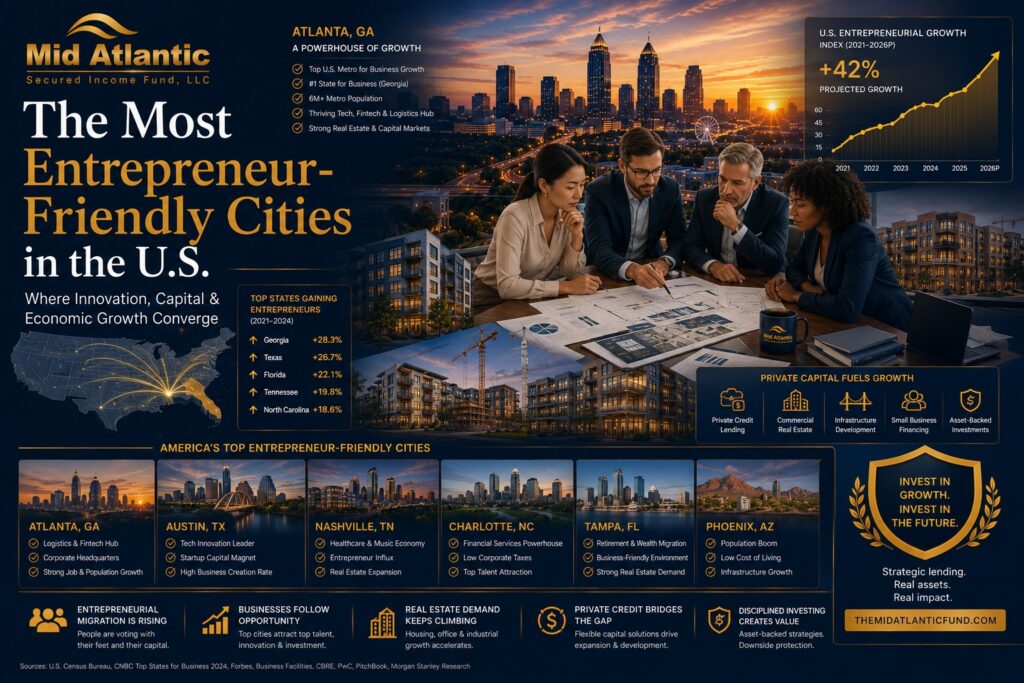
According to U.S. Census Bureau migration data, states including Georgia, Texas, Florida, Tennessee, North Carolina, and Arizona continue to experience outsized population inflows relative to many higher-tax coastal markets.
At the same time, remote work, digital infrastructure, and lower operating costs have fundamentally changed where businesses can thrive.
For investors, these trends matter enormously.
Entrepreneurial growth fuels:
- real estate development,
- job creation,
- private lending demand,
- small business formation,
- and long-duration regional economic expansion.
Few themes are more important in today’s investment landscape.
What Makes a City Entrepreneur-Friendly?
Direct Answer
An entrepreneur-friendly city typically offers:
- strong population growth,
- business-friendly tax structures,
- access to talent,
- affordable commercial real estate,
- access to capital,
- infrastructure investment,
- favorable regulatory environments,
- and long-term economic expansion opportunities.
The strongest entrepreneurial markets tend to attract both startups and institutional capital simultaneously.
Key Characteristics of Entrepreneur-Friendly Cities
1. Population Growth
Population growth creates demand.
More residents mean:
- more housing,
- more services,
- more infrastructure,
- more businesses,
- and more economic activity.
According to the U.S. Census Bureau, many Southeast metropolitan areas continue to rank among the fastest-growing regions in America.
Migration trends increasingly favor:
- Atlanta
- Austin
- Nashville
- Charlotte
- Tampa
- Raleigh
- Phoenix
- Dallas
These markets benefit from long-term demographic momentum.
2. Lower Cost Structures
Entrepreneurs prioritize efficiency.
Cities with:
- lower taxes,
- lower labor costs,
- lower housing costs,
- and lower commercial lease rates
often provide substantially longer operational runways for businesses.
Compared to traditional coastal hubs like San Francisco or New York, many Southeast and Sun Belt cities offer dramatically lower startup costs.
This allows entrepreneurs to preserve capital while scaling operations.
3. Access to Capital
Entrepreneurial ecosystems require financing infrastructure.
This includes:
- banks,
- private lenders,
- venture capital,
- private credit,
- SBA lending,
- commercial real estate financing,
- and alternative investment capital.
Private credit markets have become increasingly important as regional banks tighten lending standards.
According to the Federal Reserve’s Senior Loan Officer Opinion Survey, commercial lending standards have tightened materially in recent years following higher interest rates and regional banking stress.
As a result, private lenders and asset-backed investment strategies are playing an increasingly important role in entrepreneurial growth.
Why Atlanta Has Emerged as a Major Entrepreneurial Hub
Atlanta’s Economic Expansion Is Accelerating
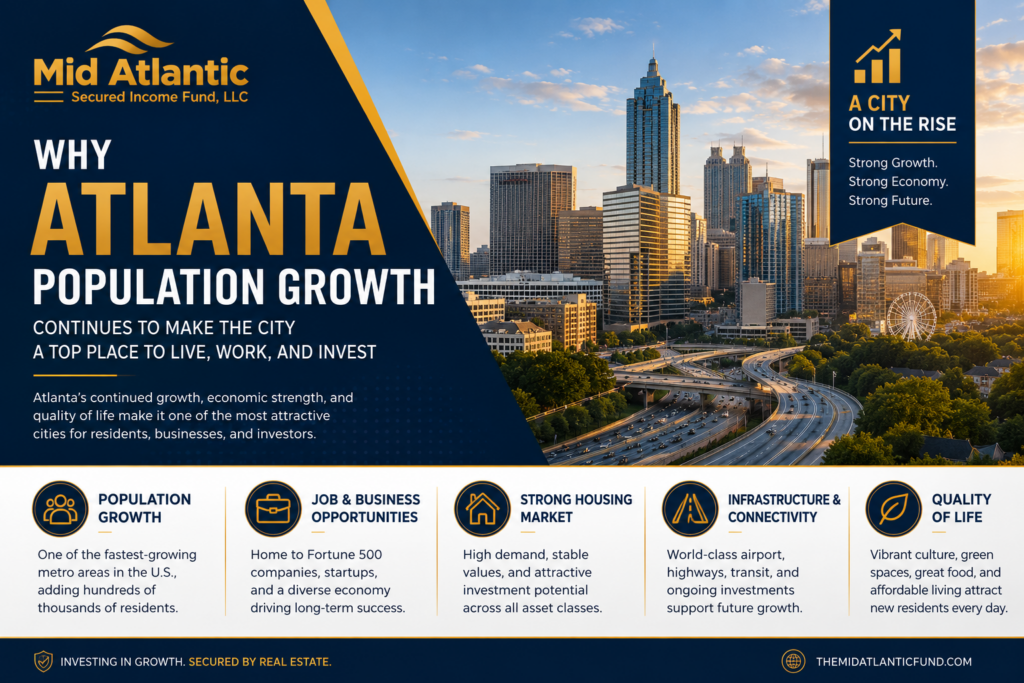
Atlanta has quietly become one of the most important economic growth stories in the United States.
The region benefits from:
- population migration,
- corporate relocations,
- infrastructure investment,
- logistics dominance,
- fintech expansion,
- film/media growth,
- and strong commercial real estate activity.
Atlanta’s metropolitan population now exceeds 6 million residents and continues to grow rapidly.
The city also benefits from:
- Hartsfield-Jackson International Airport,
- extensive logistics infrastructure,
- major banking presence,
- strong university systems,
- and increasing institutional investment.
These factors create a highly attractive environment for entrepreneurs and investors alike.
The Rise of the Southeast Economic Corridor
The Southeast Is Becoming a Capital Magnet
The Southeast United States is increasingly attracting:
- private equity,
- institutional capital,
- commercial real estate investment,
- manufacturing expansion,
- and entrepreneurial migration.
According to Preqin and PwC research, alternative investments and private capital deployment continue shifting toward high-growth secondary markets.
Investors increasingly recognize that:
economic growth often compounds fastest in regions experiencing long-duration demographic expansion.
This includes:
- Georgia
- Florida
- Tennessee
- North Carolina
- South Carolina
- Texas
These regions are benefiting from both domestic migration and corporate expansion.
How Entrepreneurial Growth Impacts Real Estate Markets
Entrepreneurial growth directly influences real estate demand.
Growing businesses require:
- office space,
- industrial facilities,
- multifamily housing,
- distribution infrastructure,
- and retail development.
This creates ripple effects throughout the economy.
For example:
- population growth increases housing demand,
- business formation increases commercial demand,
- infrastructure investment increases property values,
- and labor migration supports long-term occupancy trends.
These dynamics are particularly important for:
- real estate-backed lending,
- private credit investing,
- and income-focused investment strategies.
Why Private Credit Is Benefiting From Entrepreneurial Expansion
Traditional Banks Are No Longer the Only Source of Capital
Over the last several years, higher interest rates and tighter banking regulations have significantly altered lending markets.
As traditional banks reduce exposure to certain forms of commercial lending, private credit firms increasingly fill financing gaps.
This has created opportunities across:
- bridge lending,
- construction financing,
- acquisition lending,
- receivable financing,
- and asset-backed commercial lending.
Private credit strategies are increasingly tied to regional growth economies.
That trend may continue for years.
Entrepreneur-Friendly Cities Driving Economic Growth
Top Entrepreneurial Cities to Watch
Atlanta, Georgia
Strengths:
- population growth,
- logistics dominance,
- fintech ecosystem,
- film/media economy,
- commercial real estate development.
Austin, Texas
Strengths:
- technology expansion,
- startup ecosystems,
- corporate relocations,
- venture capital activity.
Nashville, Tennessee
Strengths:
- healthcare expansion,
- population migration,
- business-friendly climate,
- real estate growth.
Charlotte, North Carolina
Strengths:
- banking infrastructure,
- financial services growth,
- commercial real estate investment.
Tampa, Florida
Strengths:
- retiree migration,
- wealth migration,
- tax advantages,
- healthcare growth.
How Investors Can Benefit From Entrepreneurial Growth Trends
Entrepreneurial migration creates investment opportunities across multiple sectors.
This includes:
- commercial real estate,
- multifamily housing,
- infrastructure,
- logistics,
- private lending,
- and alternative income strategies.
Many investors increasingly seek:
- lower volatility,
- income-focused investments,
- and asset-backed exposure.
As a result, private credit and real estate debt strategies have gained attention among sophisticated investors seeking diversification from traditional public markets.
Why Economic Geography Matters More Than Ever
Geography Is Becoming an Investment Thesis
Modern investing increasingly requires understanding regional economic dynamics.
Certain cities benefit from:
- migration inflows,
- infrastructure spending,
- business formation,
- tax competitiveness,
- and labor market expansion.
Others face:
- population stagnation,
- declining affordability,
- or slower economic growth.
This divergence creates long-term implications for:
- property values,
- commercial activity,
- lending demand,
- and regional investment performance.
The Future of Entrepreneurial America
The next decade will likely be shaped by:
- AI-driven productivity,
- regional migration,
- private capital growth,
- infrastructure modernization,
- and entrepreneurial decentralization.
Markets positioned at the intersection of:
- affordability,
- talent,
- logistics,
- and economic growth
may continue attracting disproportionate investment capital.
Cities like Atlanta increasingly sit at the center of these structural trends.
Conclusion
Entrepreneur-friendly cities are not simply places where startups launch.
They are long-term economic ecosystems.
They attract:
- businesses,
- capital,
- talent,
- infrastructure investment,
- and real estate development.
For investors, understanding these migration and economic trends is becoming increasingly important.
Regions benefiting from entrepreneurial growth may continue generating opportunities across:
- private credit,
- commercial real estate,
- multifamily housing,
- and income-oriented investment strategies.
As economic geography evolves, the relationship between population growth, private capital, and regional expansion may become one of the defining investment themes of the next decade.
FAQ Section
What makes a city entrepreneur-friendly?
Entrepreneur-friendly cities typically offer population growth, affordable operating costs, strong labor markets, access to capital, and favorable business environments.
Why is Atlanta attractive for entrepreneurs?
Atlanta offers strong population growth, logistics infrastructure, fintech expansion, commercial real estate development, and comparatively lower operating costs than many coastal markets.
How do entrepreneurial cities impact real estate investing?
Entrepreneurial growth increases housing demand, office demand, infrastructure investment, and commercial activity, which can support real estate development and lending activity.
Why are private credit markets growing?
Private credit markets have expanded as traditional banks tighten lending standards and businesses seek alternative sources of financing.
How does population migration affect investment opportunities?
Population growth often increases demand for housing, infrastructure, financing, and commercial real estate, creating opportunities across multiple investment sectors.