
The Mid Atlantic Fund

Author name: The Mid Atlantic Fund

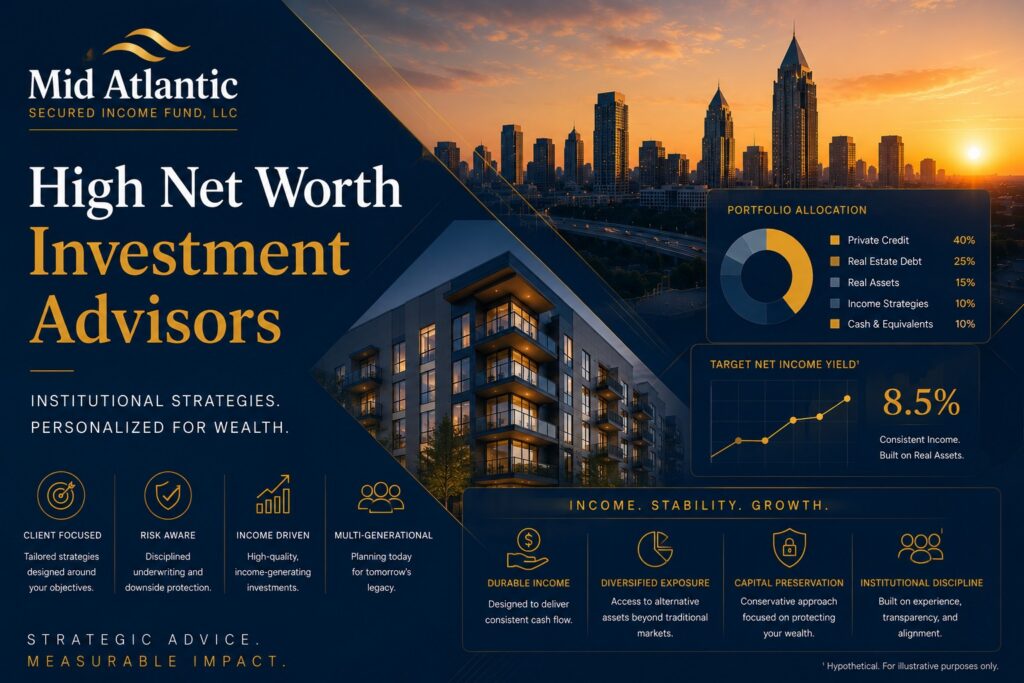
Institutional-style graphic for high net worth investment advisors featuring portfolio analytics, modern architecture, Atlanta skyline imagery, and Mid Atlantic Secured Income Fund branding.

High Net Worth Investment Advisors: How Sophisticated Investors Build Durable Wealth in Modern Markets

Why Wealth Management Is Changing for High Net Worth Investors The traditional wealth management playbook is evolving. For decades, many affluent investors relied heavily on public equities, municipal bonds, and broad market diversification strategies to grow and preserve wealth. While those tools remain important, the modern investment environment has become materially more complex. Persistent inflation, elevated market volatility, higher interest rates, changing tax regimes, demographic shifts, and increasing geopolitical uncertainty have all reshaped how high net worth investment advisors approach portfolio construction. Today’s sophisticated investors are asking fundamentally different questions: How do we preserve wealth across generations? How can portfolios generate durable income without excessive volatility? What role should alternative investments play? How can investors reduce dependency on public market cycles? Where can downside protection be strengthened? How should retirement portfolios adapt to a longer life expectancy environment? As a result, high net worth investment advisors increasingly incorporate institutional investment principles traditionally associated with: pensions, endowments, sovereign wealth funds, and family offices. This evolution has accelerated demand for: private credit, real assets, real estate debt, alternative income strategies, and diversified portfolio construction frameworks. Modern wealth management is no longer solely about maximizing returns. Increasingly, it is about balancing: growth, liquidity, income, tax efficiency, diversification, and long-term capital preservation. What Is a High Net Worth Investment Advisor? Definition A high net worth investment advisor is a financial professional or advisory firm specializing in portfolio management, wealth planning, and investment strategy for affluent individuals, families, business owners, executives, and family offices. These advisors often work with clients who meet or exceed: $1 million in investable assets, accredited investor thresholds, or ultra-high-net-worth classifications. Their role typically extends beyond traditional financial planning into: institutional portfolio construction, tax-aware investing, alternative investment access, estate planning coordination, retirement income strategies, and multi-generational wealth preservation. Why High Net Worth Investors Require Different Portfolio Strategies Affluent investors face unique challenges that differ materially from mass-market investment planning. 1. Capital Preservation Becomes Increasingly Important As wealth grows, preserving capital often becomes as important as growing it. Large portfolio drawdowns may materially impact: retirement sustainability, legacy planning, philanthropic objectives, or family office structures. This frequently shifts portfolio priorities toward: downside mitigation, income durability, and diversification. 2. Public Market Exposure Alone May Be Insufficient Institutional investors have steadily expanded allocations beyond traditional stocks and bonds. According to BlackRock and Preqin research, institutional portfolios increasingly incorporate: private credit, infrastructure, real assets, private real estate, and alternative income-producing strategies. Many high net worth advisors now apply similar frameworks for affluent clients. 3. Tax Efficiency Matters More Higher-net-worth households often face: higher marginal tax rates, estate planning considerations, capital gains management, and retirement account optimization needs. Portfolio construction increasingly incorporates after-tax return considerations rather than headline performance alone. How Institutional Portfolio Construction Influences Wealth Management The Institutionalization of Private Wealth One of the most important trends in modern wealth management is the “institutionalization” of affluent investor portfolios. Historically, many alternative investments were available only to large institutions. Today, accredited investors increasingly gain access to strategies including: private credit, real estate debt, infrastructure, private lending, and alternative income investments. This shift has transformed how high net worth investment advisors allocate capital. What Are Alternative Investments? Direct Answer Alternative investments are non-traditional assets that fall outside standard public stocks, bonds, and cash equivalents. Examples include: Alternative Asset Type Common Objective Private Credit Contractual income Real Estate Debt Asset-backed yield Infrastructure Long-term cash flow Private Equity Growth potential Real Assets Inflation mitigation Hedge Strategies Diversification Structured Credit Income enhancement Alternative investments may offer: diversification, lower correlation to equities, enhanced income potential, and access to private market opportunities. Why High Net Worth Advisors Use Private Credit Private Credit Has Become a Core Institutional Asset Class Private credit has grown significantly over the past decade. According to Preqin, global private credit assets under management exceeded approximately $1.7 trillion in recent years. Several structural trends fueled this growth: post-2008 banking regulation, reduced traditional lending capacity, demand for flexible capital, and investor search for yield. High net worth investment advisors increasingly evaluate private credit because it may offer: contractual income, floating-rate exposure, collateral protection, and diversification beyond public equities. The Appeal of Asset-Backed Investments Asset-backed strategies remain attractive because they may provide structural protections tied to tangible collateral. Examples can include loans secured by: residential real estate, commercial real estate, equipment, receivables, or infrastructure assets. Many advisors view collateralization as an important component of downside risk management. How Family Offices Approach Portfolio Construction Family offices frequently allocate capital using a multi-bucket framework. Typical Allocation Objectives Growth Bucket Focused on long-term appreciation. Income Bucket Focused on stable cash flow generation. Liquidity Bucket Focused on short-term accessibility and flexibility. Alternative Bucket Focused on diversification and non-correlated investments. High net worth advisors increasingly adapt similar frameworks for affluent private clients. Retirement Planning for High Net Worth Investors Retirement Changes as Wealth Grows Affluent retirement planning often extends beyond basic accumulation models. High-net-worth retirement investors typically prioritize: tax efficiency, income durability, estate transfer strategies, charitable planning, and inflation resilience. The Retirement Income Challenge One major issue facing retirees is income sustainability. Longer life expectancy and inflation create pressure on traditional retirement portfolios. This has contributed to growing interest in: alternative income strategies, private credit, and diversified cash-flow investments. Are Alternative Investments Appropriate for Retirement Portfolios? Direct Answer Alternative investments may play a role in retirement portfolios for some accredited investors seeking diversification, income generation, and reduced dependence on traditional public markets. However, suitability depends on: liquidity needs, risk tolerance, investment horizon, and portfolio structure. The Role of Diversification in Wealth Preservation Diversification remains one of the foundational principles of portfolio management. Sophisticated diversification often includes exposure across: public equities, fixed income, private credit, real assets, cash equivalents, and alternative investments. The objective is not simply maximizing returns, but improving portfolio resilience across different market environments. How High Net Worth Advisors Evaluate Risk Modern wealth management increasingly focuses on risk-adjusted returns rather than headline performance alone. Key risks evaluated include: Market Risk Exposure to broad market

High Net Worth Investment Advisors: How Sophisticated Investors Build Durable Wealth in Modern Markets Read More »

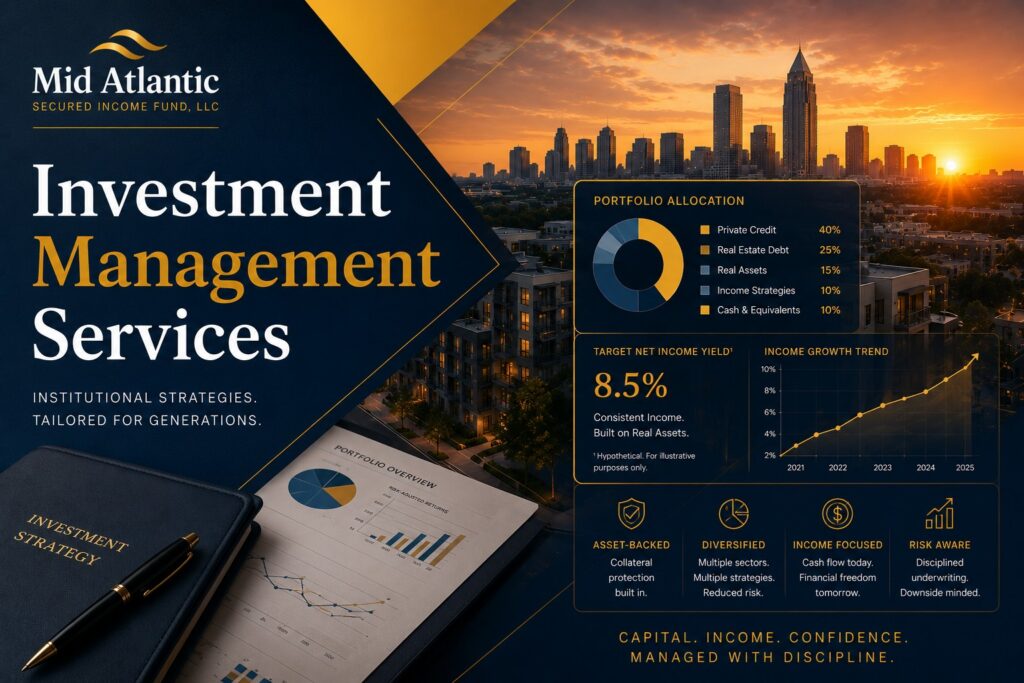
Institutional investment management services illustration featuring alternative investment portfolio analytics, private credit allocation visuals, and modern real estate-backed investment imagery for accredited investors.

Investment Management Services in a Changing Market Environment

How Institutional Portfolio Construction Is Evolving Beyond Traditional Stocks and Bonds For decades, investment management services largely revolved around a familiar formula: public equities for growth, bonds for stability, and broad diversification across traditional asset classes. That framework shaped retirement portfolios, pension funds, family offices, and wealth management strategies for generations. But the modern investment landscape looks materially different. Persistent inflation pressures, higher interest rates, elevated public market volatility, and shifting demographic trends have changed how institutional and high-net-worth investors think about portfolio construction. According to the Federal Reserve’s 2025 Financial Stability Report, investors continue reallocating toward private markets and alternative income-producing assets as traditional diversification models face new challenges. As a result, investment management services today increasingly involve more than selecting mutual funds or rebalancing stock allocations. Institutional portfolio management now incorporates: Alternative investments Private credit Real assets Income-oriented strategies Downside-risk mitigation Tax-aware portfolio construction Liquidity planning Inflation-sensitive allocation models This evolution has accelerated especially among accredited investors, family offices, RIAs, and retirement-focused investors seeking more resilient income streams and lower correlation to public market volatility. The core objective remains unchanged: Preserve capital, generate sustainable long-term returns, and manage risk through disciplined portfolio construction. The methods, however, are becoming far more sophisticated. What Are Investment Management Services? Direct Answer Investment management services involve the professional oversight, allocation, monitoring, and adjustment of investment portfolios to help investors pursue long-term financial objectives such as income generation, capital appreciation, retirement planning, and risk management. These services may include: Portfolio construction Asset allocation Risk management Alternative investment selection Retirement income planning Tax-aware investment strategies Rebalancing and monitoring Private market investment access Capital preservation planning Institutional-quality investment management increasingly combines traditional public market exposure with alternative assets such as private credit, real estate debt, infrastructure, and private equity. Why Investment Management Is Changing The Traditional 60/40 Portfolio Faces New Pressure For years, the traditional “60/40” allocation model — 60% equities and 40% bonds — served as a foundational retirement framework. However, several structural changes have challenged that model: 1. Inflation Volatility The U.S. experienced the highest inflation levels in decades following the pandemic-era economic cycle. Elevated inflation eroded the real purchasing power of fixed-income assets and cash-heavy portfolios. 2. Bond Market Repricing Rising interest rates led to historic bond market drawdowns in 2022 and beyond. Investors who previously relied on fixed income for stability discovered that traditional bonds can experience meaningful volatility during rate-reset cycles. 3. Public Market Concentration Risk Major equity indexes became increasingly concentrated in a small group of mega-cap technology companies. According to S&P Global data, a significant percentage of S&P 500 performance in recent years was driven by a limited number of stocks. 4. Growing Demand for Income An aging population has increased investor demand for: Cash flow Monthly income Inflation-sensitive returns Capital preservation This has contributed to the rapid expansion of private credit and alternative income strategies. Preqin projects global private credit assets under management to continue growing materially through the decade as institutional investors seek yield diversification. The Rise of Alternative Investment Management Why Institutional Investors Are Expanding Beyond Traditional Assets Alternative investments have become a major component of modern investment management services. These may include: Private credit Real estate debt Infrastructure Real assets Private equity Structured income strategies Asset-backed lending Historically, many of these opportunities were accessible primarily to: Pension funds Insurance companies Endowments Sovereign wealth funds Family offices Today, accredited investors increasingly access these strategies through private funds and specialized investment managers. What Is Private Credit? Direct Answer Private credit refers to non-bank lending conducted by private investment firms, debt funds, or institutional lenders rather than traditional banks. These investments may include: Real estate-backed loans Commercial lending Bridge loans Construction financing Asset-backed lending Specialty finance Private credit strategies often focus on contractual income generation rather than relying exclusively on public market appreciation. According to IMF and Preqin research, private credit has become one of the fastest-growing institutional asset classes globally. Why Investors Use Private Credit in Portfolio Construction Many institutional investors incorporate private credit for several reasons: 1. Income Generation Private credit investments may generate contractual interest income that differs structurally from dividend-based equity returns. 2. Lower Correlation to Public Markets Certain private credit strategies may experience lower day-to-day price volatility than publicly traded equities. 3. Asset-Backed Structures Some private lending strategies are secured by real estate or hard assets, creating additional collateral protections. 4. Capital Preservation Orientation Many conservative private credit managers prioritize: Senior secured lending First-lien positioning Conservative underwriting Low loan-to-value structures These factors can influence downside-risk management. How Institutional Portfolio Construction Works Asset Allocation Remains the Core Driver According to BlackRock and Morningstar research, long-term portfolio outcomes are heavily influenced by asset allocation decisions. Institutional portfolio construction typically evaluates: Return objectives Liquidity requirements Risk tolerance Time horizon Tax considerations Income needs Inflation sensitivity Correlation between assets Rather than relying on a single investment category, sophisticated portfolios may combine multiple return drivers. Example Institutional Allocation Framework Asset Class Potential Objective Public Equities Long-term growth Investment-Grade Bonds Stability and liquidity Private Credit Income generation Real Estate Debt Asset-backed exposure Cash Equivalents Liquidity management Alternative Assets Diversification Infrastructure Inflation sensitivity Institutional investors often rebalance these allocations as macroeconomic conditions evolve. The Importance of Risk Management Investment Management Is Not Just About Maximizing Returns Professional investment management increasingly focuses on risk-adjusted returns rather than headline performance alone. Key risk management considerations include: Liquidity Risk Can investments be exited quickly if needed? Interest Rate Risk How sensitive are holdings to changing rates? Credit Risk What is the probability of borrower default? Concentration Risk Is the portfolio overly exposed to a single sector or asset? Market Correlation Do holdings move together during periods of stress? Inflation Risk Can the portfolio maintain real purchasing power? Institutional managers frequently prioritize downside protection during uncertain market environments. Why Accredited Investors Are Expanding Into Alternative Investments Access Is Expanding Historically, institutional-quality private investments were difficult for individual investors to access. However, regulatory frameworks and technology platforms have expanded availability for accredited investors.

Investment Management Services in a Changing Market Environment Read More »

Institutional-style illustration of income-producing investments featuring portfolio analytics, passive income strategies, private credit allocation visuals, and real estate-backed investment concepts.

Income-Producing Investments in Modern Portfolio Construction

Why Institutional Investors Are Prioritizing Durable Cash Flow Strategies For much of the past two decades, investor attention centered heavily on capital appreciation. Low interest rates, expansive monetary policy, and strong public equity market performance rewarded growth-oriented strategies across technology, venture capital, and public equities. Today, the investment landscape looks materially different. Persistent inflation pressures, elevated market volatility, rising interest rates, and growing retirement income demands have fundamentally reshaped how sophisticated investors think about portfolio construction. Increasingly, institutional investors, family offices, RIAs, and accredited investors are shifting focus toward one central objective: Durable, risk-aware income generation. As a result, income-producing investments have moved from a secondary portfolio consideration to a core institutional allocation strategy. This evolution is visible across: Pension funds Insurance companies Endowments Sovereign wealth funds Private wealth platforms High-net-worth portfolios According to Preqin and BlackRock research, alternative income-producing assets — including private credit, infrastructure debt, real estate-backed lending, and other private market strategies — continue attracting significant institutional capital inflows globally. The reasons are increasingly clear: Public market volatility remains elevated Traditional bonds face interest-rate sensitivity Retirees require dependable cash flow Investors seek diversification beyond equities Inflation has increased demand for real asset exposure Income-producing investments now sit at the intersection of: Wealth preservation Retirement planning Alternative investing Portfolio diversification Risk management Long-term capital efficiency What Are Income-Producing Investments? Direct Answer Income-producing investments are assets designed to generate recurring cash flow through interest payments, dividends, rental income, or contractual distributions rather than relying solely on capital appreciation. Examples may include: Private credit investments Real estate debt Dividend-paying equities Bonds Infrastructure investments Asset-backed lending REITs Income-oriented alternative funds Many institutional investors use income-producing investments to support: Retirement income Portfolio stability Diversification Inflation management Long-term wealth preservation Why Income Matters More Today   The Shift From Growth-Only Investing During prolonged bull markets, many investors prioritized appreciation-focused assets. However, recent market cycles demonstrated the importance of diversified return sources. Several structural trends have accelerated interest in income-oriented investing: 1. Higher Interest Rates After years of near-zero rates, the global interest-rate environment changed materially. Investors began reassessing fixed income allocations, credit spreads, and cash-flow-oriented assets. 2. Retirement Demographics According to U.S. Census Bureau projections, the retirement-age population continues expanding significantly. This demographic shift has increased demand for investments capable of generating sustainable cash flow. 3. Market Volatility Higher equity volatility has increased investor focus on downside-risk mitigation and income diversification. 4. Inflation Sensitivity Income-generating real assets may help support purchasing power during inflationary environments. The Evolution of Income-Producing Investments Beyond Traditional Bonds Historically, income investing centered primarily on: Treasury bonds Municipal bonds Corporate bonds Dividend-paying stocks Today, institutional portfolio construction increasingly incorporates alternative income assets such as: Private credit Real estate-backed lending Infrastructure debt Asset-backed finance Specialty lending Senior secured debt These strategies may provide: Enhanced diversification Alternative return drivers Contractual income structures Lower public market correlation What Is Private Credit? Direct Answer Private credit refers to lending conducted by private investment firms or debt funds rather than traditional banks or public bond markets. Private credit strategies may include: Real estate bridge loans Construction lending Asset-backed finance Commercial loans Senior secured lending Specialty finance Institutional investors increasingly use private credit for income generation and diversification. According to Preqin, private credit assets under management have expanded substantially over the past decade as institutional demand for alternative income strategies increased globally. Why Institutional Investors Use Private Credit 1. Contractual Income Streams Unlike equities, which rely heavily on appreciation and earnings growth, private credit often focuses on contractual interest payments. 2. Asset-Backed Structures Many private lending strategies involve collateral protections such as: Real estate Equipment Receivables Other hard assets 3. Senior Positioning Certain private credit strategies emphasize: First-lien structures Senior secured positions Conservative loan-to-value ratios 4. Lower Public Market Correlation Private credit may exhibit different risk and return dynamics than public equities. Income-Producing Investments and Retirement Planning Cash Flow Becomes Increasingly Important As investors approach retirement, priorities often evolve. The emphasis frequently shifts toward: Stable income generation Reduced volatility Capital preservation Portfolio durability Inflation sensitivity This helps explain why many retirement-focused investors explore: Alternative income strategies Passive income investments Real estate-backed lending Diversified credit investments Income-oriented investing may help reduce reliance on forced asset sales during volatile markets. Common Types of Income-Producing Investments Dividend-Paying Equities Dividend stocks distribute a portion of corporate earnings to shareholders. Potential benefits: Long-term growth participation Dividend income Public market liquidity Potential risks: Equity market volatility Dividend reductions Sector concentration Bonds Traditional bonds remain foundational within many portfolios. Potential benefits: Predictable interest payments Liquidity Lower volatility than equities Potential risks: Interest-rate sensitivity Inflation erosion Credit risk Real Estate Debt Real estate-backed lending strategies generate income through interest payments secured by property collateral. Potential benefits: Asset-backed exposure Contractual income Real asset sensitivity Potential risks: Real estate market downturns Borrower defaults Liquidity constraints Private Credit Funds Private credit funds pool investor capital to originate or acquire private loans. Potential benefits: Diversification Higher income potential Institutional underwriting Potential risks: Illiquidity Credit exposure Economic sensitivity REITs Real Estate Investment Trusts provide exposure to income-producing real estate portfolios. Potential benefits: Dividend income Real estate exposure Public market access Potential risks: Equity volatility Interest-rate sensitivity Sector-specific risk How Institutional Investors Build Income Portfolios Diversification Remains Critical Sophisticated income portfolios often combine multiple sources of cash flow rather than relying on a single asset class. Example institutional framework: Asset Class Potential Portfolio Role Investment-Grade Bonds Stability Private Credit Income generation Real Estate Debt Asset-backed exposure Dividend Equities Growth + income Infrastructure Inflation sensitivity Cash Equivalents Liquidity management This multi-source approach may improve resilience across economic cycles. Are Income-Producing Investments Safer? Direct Answer No investment is risk-free. However, certain income-producing investments may prioritize capital preservation, downside-risk management, and contractual cash flow over aggressive appreciation strategies. Risk levels vary significantly depending on: Asset quality Underwriting discipline Leverage Liquidity Economic conditions Manager experience Institutional investors often evaluate risk-adjusted returns rather than pursuing maximum yield alone. The Difference Between Yield and Quality High Yield Alone Is Not a Strategy One of

Income-Producing Investments in Modern Portfolio Construction Read More »

High net worth investors reviewing retirement planning and portfolio diversification strategies with alternative investments and private credit allocations overlooking the Atlanta skyline.

Retirement Planning for High Net Worth Individuals

Advanced Strategies for Long-Term Wealth Preservation, Income Stability, and Portfolio Resilience Retirement planning changes dramatically once wealth reaches a certain level. For high net worth individuals, retirement is rarely defined by a single question like, “Will I have enough to retire?” Instead, the conversation becomes significantly more nuanced: How should wealth be structured for tax efficiency? How can portfolios generate durable income without excessive volatility? How should concentrated equity exposure be managed? What role should alternative investments play? How can families preserve purchasing power across decades? How can retirement income remain resilient during inflationary or recessionary cycles? These are institutional portfolio construction questions — not simply retail investing concerns. As global markets evolve, many affluent investors are increasingly reassessing the traditional 60/40 portfolio framework and exploring broader allocations across private credit, real assets, infrastructure, private real estate debt, and other income-oriented alternative investments. The result is a more sophisticated retirement planning environment — one that increasingly resembles institutional capital management rather than conventional retirement investing. What Is Retirement Planning for High Net Worth Individuals? Direct Answer Retirement planning for high net worth individuals is the process of structuring investment portfolios, income strategies, tax planning, estate planning, and alternative asset allocations to preserve wealth, generate sustainable income, and manage long-term financial risk throughout retirement. Unlike traditional retirement planning, high net worth retirement planning typically focuses on: wealth preservation, tax efficiency, income durability, portfolio diversification, legacy planning, private market exposure, downside mitigation, and intergenerational wealth transfer. Why Retirement Planning Looks Different for Affluent Investors According to the Federal Reserve’s 2022 Survey of Consumer Finances, the top 10% of U.S. households control roughly 67% of total household wealth. That concentration of wealth fundamentally changes retirement planning priorities. For many affluent households: Social Security represents only a negligible portion of retirement income. Market volatility can materially impact long-term estate value. Taxes become one of the largest portfolio drags. Sequence-of-return risk becomes increasingly important. Capital preservation often becomes more important than maximizing speculative growth. This creates a major shift in mindset. Accumulation gradually transitions toward strategic wealth management. The Evolution of Retirement Portfolio Construction Traditional Retirement Models Historically, retirement portfolios centered around: public equities, investment-grade bonds, municipal bonds, dividend-paying stocks, and mutual funds. While these strategies still play an important role, institutional investors increasingly recognize several modern challenges: 1. Higher Interest Rate Volatility After years of near-zero rates, bond markets experienced historic repricing between 2022 and 2024. Many investors discovered that traditional fixed income allocations may not always provide the downside protection they historically expected. 2. Persistent Inflation Concerns Inflation remains one of the greatest long-term threats to retirement purchasing power. According to the Bureau of Labor Statistics, cumulative inflation between 2021 and 2024 materially impacted consumer purchasing power across housing, healthcare, insurance, and services. 3. Elevated Equity Market Concentration A significant percentage of S&P 500 performance has increasingly been driven by a small number of mega-cap technology companies. This creates concentration risk that many retirees underestimate. 4. Longevity Risk Affluent retirees are living longer. According to actuarial estimates and wealth management research from firms like Morgan Stanley and BlackRock, retirement planning horizons increasingly extend 25–35 years. That requires portfolios designed for both growth and durability. Why High Net Worth Investors Are Increasingly Exploring Alternative Investments Institutional Capital Has Already Shifted Over the last two decades, institutional investors such as pension funds, sovereign wealth funds, endowments, and family offices have steadily increased allocations to alternatives. Preqin estimates global alternative assets under management surpassed $16 trillion and continue growing. Why? Because alternatives may offer: diversification benefits, lower correlation to public markets, enhanced income potential, inflation sensitivity, and asset-backed structures. What Are Alternative Investments? Direct Answer Alternative investments are assets outside traditional publicly traded stocks and bonds. Examples include: private credit, real estate debt, infrastructure, private equity, hedge funds, commodities, real assets, and structured income investments. The Growing Role of Private Credit in Retirement Planning One of the most significant shifts in modern portfolio construction has been the rise of private credit. What Is Private Credit? Private credit refers to non-bank lending strategies where investors provide capital directly to businesses, real estate operators, or borrowers through privately structured debt investments. Private credit has grown rapidly as banks face tighter regulatory capital requirements. According to BlackRock and Preqin research: private credit AUM has expanded significantly over the past decade, institutional demand remains strong, and many investors seek income-focused alternatives outside traditional bond markets. Why Affluent Retirees Are Interested in Income-Producing Investments High net worth retirement planning increasingly focuses on cash flow durability. Rather than relying exclusively on market appreciation, many investors prioritize: contractual income, recurring cash distributions, lower volatility, and asset-backed investment structures. This is particularly important during retirement distribution phases. What Are Income-Producing Investments? Direct Answer Income-producing investments are assets designed to generate recurring cash flow through interest payments, distributions, dividends, or contractual income streams. Examples include: bonds, private credit, real estate debt, dividend-paying equities, infrastructure assets, REITs, and structured lending strategies. The Importance of Portfolio Diversification in Retirement Diversification Is Not Just About Asset Count True diversification is about exposure differentiation. Many investors believe they are diversified simply because they own: multiple mutual funds, several ETFs, or numerous stocks. However, during periods of market stress, correlations often increase. Institutional diversification instead focuses on: income source diversification, duration diversification, liquidity diversification, sector diversification, and correlation management. How Institutional Investors Build Retirement Resilience Sophisticated portfolio construction often incorporates multiple “return drivers” rather than relying solely on equity appreciation. Examples include: Asset Category Primary Objective Public Equities Long-term growth Investment-Grade Bonds Stability Private Credit Income generation Real Estate Debt Asset-backed yield Infrastructure Inflation sensitivity Cash & Treasuries Liquidity Alternatives Diversification This approach helps reduce dependency on any single market outcome. Why Capital Preservation Matters More During Retirement One of the biggest risks retirees face is permanent capital impairment. Recovering from major drawdowns becomes increasingly difficult once portfolios enter the distribution phase. This is why many affluent investors gradually prioritize: downside mitigation, lower volatility, asset-backed investments, and consistent income

Retirement Planning for High Net Worth Individuals Read More »

High net worth investment strategies featured image showing institutional portfolio analytics, Atlanta skyline, alternative investment visuals, and Mid Atlantic Secured Income Fund branding.

High Net Worth Investment Strategies: Building Durable Wealth Through Institutional Portfolio Construction

Wealth Management Has Changed For decades, many affluent investors relied heavily on public equities, municipal bonds, and traditional retirement portfolios to build and preserve wealth. That framework worked well during an era defined by declining interest rates, expanding equity multiples, and relatively stable inflation. Today’s environment is fundamentally different. Persistent inflationary pressures, elevated market volatility, rising geopolitical uncertainty, banking system stress, and tighter monetary policy have caused many high net worth investors to rethink traditional portfolio construction. Increasingly, affluent investors, family offices, RIAs, and institutional allocators are moving beyond the classic 60/40 portfolio model in search of: More durable income generation Lower correlation to public equities Inflation resilience Capital preservation Asset-backed investment structures Enhanced diversification Greater downside protection This shift has accelerated interest in private credit, alternative investments, real estate-backed debt, infrastructure, and institutional-style income strategies historically reserved for pension funds and large institutions. According to BlackRock’s 2025 Global Family Office Survey, private markets now represent one of the fastest-growing allocations among sophisticated investors seeking long-term diversification and income stability. The modern high net worth portfolio increasingly resembles an institutional balance sheet rather than a traditional retail investment account. What Are High Net Worth Investment Strategies? Direct Answer High net worth investment strategies are advanced portfolio management approaches designed to help affluent investors preserve capital, generate income, optimize taxes, diversify risk, and pursue long-term wealth accumulation using a combination of traditional and alternative investments. These strategies often include: Public equities Fixed income Private credit Real estate investments Alternative assets Tax-efficient structures Estate planning Income-focused portfolio construction Risk-managed diversification Unlike conventional investing, high net worth investing typically prioritizes total portfolio resilience rather than simply maximizing returns. Why High Net Worth Investors Allocate Differently Affluent investors face unique financial realities. As wealth grows, the primary objective often shifts from aggressive accumulation toward: Maintaining purchasing power Producing reliable income Protecting principal Managing taxes Preserving generational wealth Reducing volatility exposure Structuring liquidity efficiently Large investors also gain access to investments unavailable to the average retail investor, including: Private credit funds Direct lending Institutional real estate debt Private equity Structured income products Alternative income vehicles Private placements Self-directed IRA investments This broader opportunity set enables more customized portfolio construction. The Evolution of Portfolio Construction The Decline of the Traditional 60/40 Model The traditional 60/40 portfolio—60% stocks and 40% bonds—was built during a multi-decade decline in interest rates. From the early 1980s through 2021, falling rates supported: Rising bond prices Higher equity valuations Lower borrowing costs Strong asset appreciation However, inflation and rising rates have challenged that framework. In 2022, both stocks and bonds experienced simultaneous declines, exposing a structural weakness in portfolios overly dependent on public markets. According to Morgan Stanley Wealth Management research, investors are increasingly incorporating private market strategies to improve diversification and income consistency. This has fueled demand for: Private credit Real estate-backed lending Infrastructure investments Floating-rate debt Asset-backed income strategies Institutional Investors Have Already Shifted Many pension funds, endowments, and sovereign wealth funds have been allocating heavily to private markets for years. According to Preqin: Private credit assets under management surpassed $1.7 trillion globally in recent years Institutional allocations to alternatives continue rising Family offices increasingly prioritize income-oriented alternatives The reason is simple: Institutional allocators seek investments with: Lower public market correlation Contractual income Floating-rate structures Hard asset backing Inflation resilience Risk-adjusted returns High net worth investors are now increasingly adopting these same principles. Core Components of High Net Worth Investment Strategies 1. Diversification Across Asset Classes Diversification remains foundational. But sophisticated diversification goes beyond owning multiple stocks. Institutional portfolio diversification often spans: Asset Class Purpose Public Equities Long-term growth Fixed Income Stability and income Private Credit Contractual yield Real Estate Debt Asset-backed income Alternatives Non-correlated returns Cash Equivalents Liquidity management Infrastructure Inflation protection Precious Metals Macro hedge The objective is reducing concentration risk while improving portfolio durability. 2. Income-Producing Investments Income has become increasingly important for affluent investors. Many high net worth portfolios now emphasize: Monthly cash flow Yield stability Contractual income Predictable distributions Examples include: Private credit funds Real estate-backed debt investments Senior secured lending Commercial mortgage debt Dividend-producing assets Infrastructure income Private real estate income strategies This shift reflects growing investor preference for cash-flow-producing assets rather than relying entirely on capital appreciation. 3. Private Credit and Direct Lending Private credit has emerged as one of the fastest-growing alternative asset classes globally. What Is Private Credit? Private credit involves non-bank lending arrangements where capital is deployed directly to borrowers through privately negotiated loans. These loans may include: Real estate bridge loans Construction financing commercial lending asset-backed lending senior secured debt specialty finance Unlike traditional fixed income, private credit often offers: Floating-rate structures Enhanced yields Collateral protection Lower public market correlation Direct underwriting oversight Why High Net Worth Investors Use Private Credit Sophisticated investors often allocate to private credit because it may provide: Higher income potential than traditional bonds Asset-backed downside protection Diversification away from public markets Reduced duration sensitivity Stronger structural protections Many institutional private credit strategies emphasize first-position liens and senior-secured collateral structures to prioritize capital preservation. 4. Real Estate-Backed Investments Real estate remains central to many affluent portfolios. However, sophisticated investors increasingly distinguish between: Equity real estate ownership Real estate debt investing Equity vs Debt Exposure Structure Primary Return Driver Real Estate Equity Appreciation Real Estate Debt Contractual income Debt-focused strategies often appeal to income-oriented investors because they may sit higher in the capital stack. This means lenders may have greater downside protection than equity owners in distressed environments. Why Senior Secured Lending Matters Many institutional debt funds focus on: First-lien positions Conservative loan-to-value ratios Asset-backed collateral contractual interest payments shorter-duration lending These characteristics may appeal to investors focused on: Income consistency principal protection lower volatility exposure 5. Tax Optimization Strategies Taxes play a critical role in high net worth portfolio construction. Common strategies include: Tax-advantaged retirement accounts Self-directed IRAs Roth conversion planning Tax-loss harvesting Estate planning structures Charitable trusts Asset location optimization Affluent investors often seek investments that align with broader tax planning objectives. How

High Net Worth Investment Strategies: Building Durable Wealth Through Institutional Portfolio Construction Read More »

Real estate investment funds featured image showing institutional portfolio analytics, real estate-backed investments, Atlanta skyline, and Mid Atlantic Secured Income Fund branding.

Real Estate Investment Funds: Institutional Strategies for Income, Diversification, and Long-Term Wealth Preservation

Real Estate Investing Has Evolved Beyond Property Ownership For decades, real estate investing was commonly associated with direct property ownership — buying rental homes, commercial buildings, or development projects in pursuit of appreciation and cash flow. Today, sophisticated investors increasingly view real estate through a broader institutional lens. Rather than simply purchasing physical property, many accredited investors, family offices, RIAs, and institutional allocators now utilize real estate investment funds to gain exposure to: Income-producing real estate debt Senior secured lending Diversified private credit Commercial real estate financing Transitional lending opportunities Asset-backed investment strategies Institutional portfolio diversification This shift reflects a larger transformation occurring across global capital markets. Institutional investors are increasingly prioritizing: Predictable income Lower public market correlation Asset-backed structures Inflation resilience Diversified alternative investments Capital preservation strategies According to Preqin, private real estate and private credit remain among the fastest-growing alternative asset classes globally, fueled by increasing demand for income-oriented investments in a volatile macroeconomic environment. Modern real estate investment funds now occupy an increasingly important role in diversified portfolios seeking durable long-term wealth management. What Are Real Estate Investment Funds? Direct Answer Real estate investment funds are pooled investment vehicles that deploy capital into real estate-related assets such as properties, mortgages, private loans, commercial real estate debt, or development financing. These funds may focus on: Real estate equity ownership Real estate debt lending Income-producing properties Commercial lending Bridge financing Construction lending Diversified private real estate strategies Real estate investment funds allow investors to gain exposure to real estate markets without directly managing physical properties. Why Investors Are Increasing Real Estate Allocations Several macroeconomic trends are driving increased interest in real estate-related investments: Persistent inflation concerns Higher public market volatility Demand for contractual income Diversification away from traditional equities Institutionalization of private markets Search for lower-correlation assets Rising interest in passive income strategies According to BlackRock Investment Institute, investors are increasingly emphasizing private markets and real assets as part of long-term portfolio construction. Real estate remains attractive because it often combines: Tangible collateral Income generation Inflation-linked economics Diversification benefits However, sophisticated investors increasingly distinguish between real estate equity and real estate debt exposure. Real Estate Equity vs Real Estate Debt Understanding this distinction is critical. Structure Primary Objective Risk Exposure Real Estate Equity Appreciation and rental growth Higher Real Estate Debt Contractual income and principal protection Lower relative position   Equity investors typically participate in property upside but also absorb more downside risk during market stress. Debt investors, particularly senior secured lenders, may occupy a higher position within the capital stack. This structural priority often appeals to income-focused and preservation-oriented investors. The Rise of Real Estate Debt Funds One of the fastest-growing sectors within alternative investments is real estate debt. These strategies typically involve: Bridge lending Construction financing Transitional lending Commercial mortgage lending Senior secured loans Asset-backed financing Rather than relying primarily on property appreciation, debt-focused strategies often emphasize: Contractual interest income Defined repayment structures Collateral-backed lending Shorter duration exposure Downside-aware underwriting This shift reflects broader institutional demand for income-generating investments. Why Institutional Investors Favor Private Credit According to Morgan Stanley Wealth Management and Goldman Sachs research, institutional allocators increasingly utilize private credit because it may offer: Enhanced yield potential Floating-rate structures Diversification benefits Lower public market correlation Contractual cash flow Collateral protection Private credit has grown significantly since the Global Financial Crisis as banks reduced lending exposure due to regulatory constraints. This created substantial opportunities for private lenders and alternative investment funds. Understanding the Capital Stack Real estate investment funds vary significantly depending on where they operate within the capital stack. Capital Stack Hierarchy Position Relative Risk Profile Senior Secured Debt Lower relative risk Mezzanine Debt Moderate risk Preferred Equity Higher risk Common Equity Highest risk Senior secured debt strategies often appeal to investors focused on: Income consistency Principal preservation Reduced volatility Collateral-backed structures The position within the capital stack can significantly impact downside protection during distressed environments. How Real Estate Investment Funds Generate Returns Different strategies produce returns differently. Equity-Based Funds Typically generate returns through: Property appreciation Rental income Asset repositioning Development profits Returns may fluctuate more significantly with market cycles. Debt-Based Funds Typically generate returns through: Interest payments Loan origination fees Structured financing spreads Contractual repayment terms These strategies may prioritize cash-flow consistency over speculative upside. Why Accredited Investors Are Exploring Alternative Real Estate Strategies Traditional stock-and-bond portfolios face increasing challenges in volatile economic environments. Many accredited investors now seek: Alternative income streams Lower public market correlation Real asset exposure Institutional diversification Inflation-sensitive investments Private real estate investment funds increasingly provide access to institutional-style opportunities previously dominated by: Pension funds Insurance companies Endowments Sovereign wealth funds Family offices This democratization of private markets has accelerated dramatically over the past decade. Diversification Benefits of Real Estate Investment Funds Diversification remains one of the core reasons investors allocate to real estate-related strategies. Real estate investments may help diversify exposure away from: Public equities Traditional fixed income Technology concentration Consumer-driven sectors Private market investments may behave differently than publicly traded assets during periods of volatility. This lower correlation can improve portfolio resilience. Income-Producing Investments in Modern Portfolios Many affluent investors increasingly prioritize: Monthly cash flow Predictable distributions Reduced volatility Long-term income durability This has increased interest in: Senior secured lending Real estate debt Private credit Infrastructure income Contractual cash-flow investments Institutional investors often focus less on speculative upside and more on sustainable long-term portfolio outcomes. Inflation and Real Asset Investing Inflation has reshaped portfolio construction. Real assets historically attract attention during inflationary environments because they may: Maintain intrinsic value Generate income tied to real-world assets Benefit from rising replacement costs Provide contractual yield structures Real estate-backed lending strategies may offer additional protection through collateral coverage. Risks of Real Estate Investment Funds No investment strategy is risk-free. Investors should carefully evaluate: Credit Risk Borrowers may fail to repay obligations. Market Risk Real estate markets may experience pricing declines. Liquidity Risk Private investments may have limited redemption flexibility. Interest Rate Risk Higher borrowing costs can pressure valuations and refinancing conditions.

Real Estate Investment Funds: Institutional Strategies for Income, Diversification, and Long-Term Wealth Preservation Read More »

Fixed income investment options featured image showing institutional portfolio analytics, alternative income strategies, and real estate-backed investment concepts for accredited investors.

Fixed Income Investment Options: Building Durable Income in an Uncertain Market Environment

The Return of Income-Focused Investing For much of the decade following the Global Financial Crisis, investors operated in a low-interest-rate environment where traditional fixed income struggled to provide meaningful income. U.S. Treasury yields remained historically compressed, investment-grade bonds often failed to keep pace with inflation, and many retirees were pushed further out on the risk spectrum in search of yield. That environment has changed materially. Rising interest rates, persistent inflation concerns, higher market volatility, and shifting macroeconomic conditions have brought fixed income investing back into focus—not merely as a defensive allocation, but as a core portfolio construction strategy. Today’s investors are increasingly evaluating a broader universe of fixed income investment options, including: Treasury securities Municipal bonds Corporate credit Private credit Real estate debt funds Structured income strategies Asset-backed lending Alternative income-producing investments At the same time, institutional investors, family offices, and accredited investors are rethinking what fixed income means in a modern portfolio. Increasingly, the conversation is no longer simply about “bonds.” It is about: income durability, downside management, portfolio diversification, inflation resilience, and risk-adjusted returns. This evolution has contributed to rapid growth across alternative credit markets and private lending strategies. According to Preqin, global private debt assets under management surpassed approximately $1.6 trillion in recent years, reflecting institutional demand for floating-rate, collateral-backed, and income-oriented investment structures. For investors seeking dependable income streams while balancing portfolio risk, understanding the full spectrum of fixed income investment options has become increasingly important. What Are Fixed Income Investment Options? Direct Answer Fixed income investment options are investments designed primarily to generate predictable income payments through interest, distributions, or contractual cash flow obligations. These investments typically prioritize income generation, capital preservation, and lower volatility relative to growth-oriented equities. Common fixed income investment options include: Treasury bonds Municipal bonds Corporate bonds Certificates of deposit (CDs) Preferred securities Private credit funds Mortgage-backed securities Real estate debt funds Asset-backed lending strategies Unlike stocks, which represent equity ownership and depend heavily on appreciation, fixed income investments are generally contractual obligations where investors receive scheduled payments over time. Why Investors Allocate to Fixed Income Fixed income serves multiple strategic purposes inside diversified portfolios. 1. Income Generation The most obvious function is consistent income. Many investors—particularly retirees and income-focused households—seek investments capable of generating: monthly income, quarterly distributions, predictable cash flow, or interest payments. This can help support: retirement spending, reinvestment strategies, philanthropic goals, or wealth preservation planning. 2. Portfolio Diversification Historically, fixed income has provided diversification benefits relative to equities. While correlations vary depending on the macroeconomic environment, fixed income investments have traditionally helped: reduce overall portfolio volatility, cushion equity drawdowns, stabilize portfolio performance during recessions, and improve risk-adjusted returns. This is particularly relevant for investors approaching retirement or managing substantial wealth. 3. Capital Preservation Many fixed income investors prioritize: lower volatility, contractual repayment structures, seniority in capital stacks, and asset-backed collateral. While no investment is risk-free, certain fixed income structures may offer stronger downside protections than pure equity investments. For example: senior secured debt often has repayment priority ahead of common equity, collateral-backed lending may provide recovery support, and shorter-duration instruments may reduce interest-rate sensitivity. Major Categories of Fixed Income Investments U.S. Treasury Securities Treasuries remain one of the most recognized fixed income investments globally. Issued by the U.S. government, Treasury securities include: Treasury bills, Treasury notes, Treasury bonds, and Treasury Inflation-Protected Securities (TIPS). Advantages High liquidity Strong credit quality Government backing Transparent pricing Risks Inflation risk Interest-rate risk Lower yields relative to alternative credit During periods of elevated inflation, real returns on Treasuries can become challenged. Corporate Bonds Corporate bonds allow investors to lend capital to businesses in exchange for interest payments. These range across: investment-grade bonds, high-yield bonds, floating-rate credit, and subordinated debt. Investment-Grade Bonds Issued by financially strong companies with relatively lower default risk. Generally: lower yields, lower volatility, stronger credit ratings. High-Yield Bonds Higher yields compensate investors for elevated credit risk. These may experience: greater price volatility, higher default probabilities, increased recession sensitivity. According to Moody’s and S&P Global, default cycles can accelerate meaningfully during economic contractions. Municipal Bonds Municipal bonds are debt obligations issued by states, cities, or municipalities. They are often attractive to high-income investors because: interest income may be federally tax-exempt, some bonds may also offer state tax advantages. Municipal bonds are commonly used by: retirees, high-net-worth households, tax-sensitive investors. However, investors must still evaluate: issuer quality, pension liabilities, local economic conditions, and duration risk. Certificates of Deposit (CDs) CDs are deposit products issued by banks. They offer: fixed interest rates, defined maturity dates, FDIC insurance within applicable limits. While CDs may offer capital stability, they often provide limited growth potential after inflation and taxes. Preferred Securities Preferred securities occupy a hybrid position between debt and equity. They often: pay higher yields, rank above common stock, but below senior debt obligations. These instruments may be sensitive to: interest rates, issuer health, banking sector conditions. What Is Private Credit? Direct Answer Private credit refers to non-bank lending strategies where capital is provided directly to borrowers outside traditional public bond markets. Private credit may include: real estate lending, middle-market corporate lending, asset-backed lending, bridge financing, specialty finance, and senior secured debt strategies. Institutional investors increasingly allocate to private credit because it may provide: enhanced yields, floating-rate exposure, reduced public market correlation, and collateral-backed structures. The Growth of Private Credit Markets Private credit has expanded significantly since the 2008 financial crisis. As regulatory capital requirements tightened for traditional banks, non-bank lenders filled financing gaps across commercial real estate, middle-market lending, and specialty finance sectors. According to Preqin and BlackRock research: private credit assets under management have grown rapidly over the past decade, institutional allocations continue increasing, and private wealth platforms are expanding access to alternative credit strategies. Key drivers include: higher yields, customized lending structures, floating-rate characteristics, and diversification benefits. Real Estate Debt Funds as Fixed Income Investments Real estate debt funds have become increasingly important within alternative fixed income allocations. Unlike equity real estate investing, debt-focused real estate strategies prioritize: loan income,

Fixed Income Investment Options: Building Durable Income in an Uncertain Market Environment Read More »

Affluent investors reviewing long-term portfolio allocation strategies with institutional analytics overlays and Atlanta skyline background representing maximizing investment returns through private credit and real estate-backed investments.

Maximizing Investment Returns: Institutional Strategies for Building Long-Term Wealth

Why Sophisticated Investors Think Differently About Returns For decades, investors were taught that maximizing investment returns primarily meant chasing higher-performing stocks, timing market cycles, or aggressively increasing portfolio risk exposure. Institutional investors rarely approach wealth creation that way. Large pension funds, insurance companies, family offices, endowments, and sophisticated accredited investors often focus less on chasing the single highest-returning asset and more on constructing portfolios capable of producing durable, risk-adjusted returns across multiple market environments. That distinction matters. The difference between speculative returns and sustainable returns is often the difference between temporary gains and long-term wealth preservation. Today’s investment environment presents a unique challenge: Elevated interest rates Persistent inflation concerns Increased stock market concentration Geopolitical volatility Commercial real estate repricing Higher bond market volatility Slowing global economic growth According to the Federal Reserve, U.S. household net worth reached record highs in recent years, yet wealth concentration and market dependency also increased significantly. At the same time, institutional investors have steadily expanded allocations to alternative assets, private credit, infrastructure, and real estate-backed income strategies in pursuit of improved diversification and more stable return streams. The modern conversation around maximizing investment returns is no longer simply about “earning more.” It is increasingly about: Improving risk-adjusted performance Enhancing income consistency Protecting downside exposure Reducing portfolio volatility Increasing diversification Optimizing tax efficiency Preserving purchasing power over decades Investors seeking long-term success increasingly recognize that maximizing returns without understanding risk often leads to avoidable portfolio instability. What Does “Maximizing Investment Returns” Actually Mean? Direct Answer Maximizing investment returns means improving total portfolio performance over time while balancing risk, income generation, diversification, liquidity needs, tax efficiency, and capital preservation. Sophisticated investors evaluate returns using multiple metrics, including: Total return Risk-adjusted return Cash flow consistency Inflation-adjusted return Portfolio drawdown exposure Correlation across assets Tax efficiency Long-term compounding potential The highest-returning asset in one year is not necessarily the best long-term investment. Institutional portfolio construction focuses on achieving sustainable compounded growth while managing downside volatility. The Evolution of Modern Portfolio Construction Traditional portfolio models relied heavily on the classic 60/40 allocation: 60% equities 40% bonds For decades, this structure benefited from falling interest rates, expanding equity multiples, and strong bond diversification. However, market dynamics have changed materially. According to BlackRock and JPMorgan Asset Management research, institutional portfolios have steadily increased allocations to alternative investments over the last two decades due to: Lower expected public market returns Higher stock-bond correlation periods Inflation uncertainty Yield compression in traditional fixed income Desire for uncorrelated return streams Institutional investors now commonly allocate capital across: Asset Class Institutional Purpose Public Equities Long-term growth Fixed Income Stability & income Private Credit Enhanced yield Real Estate Debt Asset-backed income Infrastructure Inflation resilience Private Equity Growth enhancement Cash & Treasuries Liquidity management Structured Credit Yield optimization This shift reflects a broader understanding that maximizing returns often requires broader diversification beyond traditional stock-and-bond portfolios. Why Risk-Adjusted Returns Matter More Than Raw Returns One of the most overlooked concepts in investing is that identical returns can carry vastly different levels of risk. Consider two portfolios: Portfolio Annual Return Max Drawdown Portfolio A 10% -45% Portfolio B 9% -12% Many institutional investors would prefer Portfolio B. Why? Because severe drawdowns can significantly impair long-term compounding. Recovering from losses becomes exponentially harder as drawdowns increase. Loss Gain Needed to Recover -10% +11% -20% +25% -40% +67% -50% +100% Sophisticated wealth management increasingly prioritizes: Volatility management Capital preservation Stable income production Downside protection Portfolio durability Maximizing returns is not simply about upside participation. It is about protecting the compounding engine itself. The Role of Private Credit in Return Optimization What Is Private Credit? Private credit refers to non-bank lending strategies where capital is deployed directly into loans outside traditional public bond markets. Private credit has grown rapidly following the Global Financial Crisis as banks reduced certain lending activities due to regulatory changes. According to Preqin, global private credit assets under management surpassed $1.7 trillion in recent years, making it one of the fastest-growing alternative asset classes. Common private credit strategies include: Senior secured real estate lending Direct lending Asset-backed lending Construction lending Bridge lending Mezzanine financing Specialty finance Why Institutional Investors Use Private Credit Institutional investors often allocate to private credit because it may offer: Higher yields than traditional bonds Floating-rate structures Asset-backed collateral Reduced public market correlation Monthly or quarterly income Senior secured positioning In rising rate environments, floating-rate lending strategies may help preserve income generation more effectively than long-duration fixed-rate bonds. Private credit also allows investors to participate in segments of the market traditionally accessed primarily by banks and institutional capital providers. Real Estate-Backed Investments and Income Stability Real estate-backed lending strategies have become increasingly attractive among income-oriented investors seeking capital preservation characteristics alongside yield generation. Unlike speculative equity investments dependent entirely on asset appreciation, senior secured lending structures often focus on: Collateral protection Loan-to-value discipline borrower underwriting cash flow coverage first-lien security positions This structural focus can help reduce downside exposure compared to unsecured lending or highly volatile growth assets. For many accredited investors, real estate debt strategies serve as a middle ground between: lower-yield traditional bonds and higher-volatility public equities Why Diversification Remains Central to Maximizing Returns Diversification is often misunderstood. It is not merely owning many investments. True diversification means combining assets that respond differently to economic conditions. Institutional portfolios frequently diversify across: Economic Sensitivity Growth-sensitive assets Defensive income assets Inflation-sensitive assets Countercyclical assets Liquidity Profiles Public market liquidity Semi-liquid investments Long-duration private investments Interest Rate Exposure Fixed-rate assets Floating-rate assets Short-duration strategies Income Sources Dividends Bond coupons Rental cash flow Loan interest Structured income The goal is not complexity for complexity’s sake. The goal is portfolio resilience. The Psychology of Return Maximization Behavioral finance research consistently shows that investor behavior often harms long-term performance. According to DALBAR studies, average investor returns frequently trail market benchmarks due to: Emotional trading Panic selling Performance chasing Market timing Recency bias Sophisticated investors often maximize returns not through hyperactivity, but through: discipline consistency diversification risk management long-term focus This

Maximizing Investment Returns: Institutional Strategies for Building Long-Term Wealth Read More »

Institutional graphic showing retirement investment plans, private credit, real estate-backed income strategies, and portfolio diversification with Mid Atlantic Secured Income Fund branding.

Retirement Investment Plans: Building Durable Income, Diversification, and Long-Term Portfolio Resilience

Why Retirement Investment Planning Has Changed Retirement investing is no longer a simple matter of saving steadily, buying a balanced portfolio, and slowly shifting from stocks to bonds. For today’s investors, retirement planning must account for longer lifespans, inflation, public market volatility, changing interest rates, tax efficiency, and the need for reliable income. J.P. Morgan Asset Management’s 2026 Guide to Retirement emphasizes that retirement planning increasingly depends on income replacement needs, life expectancy, savings checkpoints, and the ability to adapt across market environments. At the same time, institutional investors have broadened their portfolios beyond traditional stocks and bonds. Private markets are increasingly used for diversification, income generation, and long-term portfolio construction; BlackRock’s 2026 private markets outlook notes that private markets are reshaping how businesses finance growth and how investors pursue diversification. For accredited investors and high-net-worth retirees, this has created a more sophisticated conversation around retirement investment plans. The question is no longer simply, “How much do I need to retire?” It is now: How can my portfolio generate income without relying entirely on selling assets? How do I protect against inflation and market drawdowns? What role should private credit, real estate debt, and alternative investments play? How can retirement assets be structured for long-term durability? What Is a Retirement Investment Plan? A retirement investment plan is a coordinated investment strategy designed to help an investor accumulate, preserve, and distribute wealth throughout retirement. It typically includes asset allocation, income planning, risk management, tax strategy, liquidity planning, and estate considerations. A strong retirement investment plan should answer four core questions: How will the portfolio grow before retirement? How will it generate income during retirement? How will it manage volatility, inflation, and taxes? How will it preserve capital for long-term needs or legacy goals? Core Components of a Modern Retirement Investment Plan 1. Growth Assets Growth assets are designed to increase portfolio value over time. These often include public equities, private equity, growth-oriented funds, and certain real estate investments. Growth remains important because retirement can last decades. A portfolio that becomes too conservative too early may struggle to keep pace with inflation. 2. Income-Producing Assets Income-producing investments are assets designed to generate recurring cash flow through interest, dividends, rental income, or distributions. Common examples include: Investment Type Potential Role Bonds Traditional income and stability Dividend stocks Growth plus income Private credit Contractual income potential Real estate debt Asset-backed income REITs Public real estate income CDs and Treasuries Liquidity and principal stability Infrastructure Long-term cash flow Income-producing investments are especially important for retirees who want to reduce dependence on selling portfolio assets during market downturns. 3. Fixed Income and Fixed Income Alternatives Traditional fixed income includes Treasuries, municipal bonds, corporate bonds, and CDs. These can still play an important role in retirement portfolios. However, the definition of fixed income has expanded. Many institutional investors now consider private credit, real estate debt, asset-backed lending, and floating-rate strategies as part of a broader income allocation. Private credit has grown significantly, with Preqin estimating private credit AUM at $2.28 trillion in 2025 and projecting growth to $4.5 trillion by 2030. 4. Alternative Investments Alternative investments include assets outside traditional public stocks, bonds, and cash. Examples include private credit, real estate debt, private equity, infrastructure, and certain real asset strategies. BlackRock has argued that private markets may improve retirement outcomes by expanding diversification and return potential within retirement portfolios, while also noting the importance of liquidity and risk considerations. Why Private Credit Is Becoming More Important in Retirement Planning Private credit refers to lending outside traditional public bond markets. Instead of buying publicly traded bonds, investors may participate in privately originated loans or debt funds. Common private credit strategies include: senior secured lending, real estate-backed lending, bridge loans, construction lending, asset-backed finance, middle-market direct lending. Many investors consider private credit because it may offer income potential, floating-rate exposure, and diversification from public market volatility. However, private credit also carries risks, including borrower default, illiquidity, valuation complexity, and manager execution risk. How Real Estate Debt Fits Into Retirement Investment Plans Real estate debt funds focus on lending against real estate collateral rather than owning property equity. This distinction matters. Equity real estate investors participate in upside appreciation but absorb more downside risk. Debt investors generally focus on contractual income, collateral coverage, and repayment priority. For retirement investors, real estate-backed debt may be attractive because it can combine: income generation, asset-backed collateral, shorter-duration lending, senior secured positioning, lower reliance on public stock market performance. The Mid Atlantic Secured Income Fund’s strategy is built around professionally managed, real estate-backed secured lending with an emphasis on disciplined underwriting, income generation, and capital preservation principles. Are Debt Funds Safer Than Stocks? Debt funds are not automatically “safe,” but they are structurally different from stocks. Stocks represent ownership and typically rely on appreciation, earnings growth, and market sentiment. Debt funds generally focus on repayment obligations, interest income, collateral, and capital stack seniority. A senior secured real estate debt strategy may have downside protections that common equity does not, but it still carries risk. Investors should evaluate: collateral quality, loan-to-value ratios, borrower strength, liquidity terms, portfolio diversification, manager experience, underwriting discipline. The Role of SDIRAs in Retirement Investment Plans A Self-Directed IRA allows qualified investors to hold a broader range of assets than many traditional brokerage IRAs. Depending on custodian rules, this may include private credit, real estate debt, private placements, and other alternative investments. For accredited investors, SDIRAs can be useful when they want retirement capital exposed to private market income strategies rather than only public securities. Mid Atlantic’s IRA investing page can serve as the natural internal link for investors exploring SDIRA-compatible private credit strategies. Risk Management: The Center of Retirement Planning A retirement investment plan should not be built around return targets alone. It should be built around risk-adjusted outcomes. Key risks include: Risk Why It Matters Market risk Public markets can decline sharply Inflation risk Purchasing power can erode over time Longevity risk Retirement may last 25–35 years Liquidity

Retirement Investment Plans: Building Durable Income, Diversification, and Long-Term Portfolio Resilience Read More »

Affluent accredited investor reviewing alternative investment portfolio analytics overlooking the Atlanta skyline with institutional private credit and real estate debt fund visuals.

Accredited Investor Opportunities: Navigating Private Markets in a Changing Investment Landscape

Why Accredited Investors Are Looking Beyond Traditional Portfolios Over the last decade, the investment landscape for high-net-worth individuals has changed dramatically. Public equity markets have become increasingly concentrated, traditional fixed income has faced prolonged periods of yield compression, and inflation-adjusted returns have become more difficult to preserve through conventional 60/40 portfolio construction alone. As a result, accredited investors are increasingly allocating capital toward private market opportunities, including private credit, real estate-backed lending, infrastructure, private equity, and income-producing alternative assets. This shift is not simply about chasing higher returns. It reflects a broader evolution in portfolio construction: greater emphasis on downside protection, demand for durable cash flow, reduced correlation to public markets, inflation resilience, and broader diversification across asset classes. Institutional investors have been pursuing these strategies for decades. According to Preqin and BlackRock research, alternative assets under management globally exceeded $16 trillion in recent years and are projected to continue growing as investors seek differentiated return streams outside traditional equities and bonds. For accredited investors, the expansion of private market access has created opportunities that historically were limited primarily to pensions, endowments, sovereign wealth funds, and institutional asset managers. Understanding how these opportunities work — and where they fit within a broader portfolio strategy — has become increasingly important for long-term capital preservation and income-focused investing. What Is an Accredited Investor? Direct Answer An accredited investor is an individual or entity that meets financial criteria established by the SEC, allowing access to private investment opportunities not generally available to the public. Under current SEC rules, individuals typically qualify if they have: annual income exceeding $200,000 individually ($300,000 jointly with a spouse or partner) for the last two years with expectation of continuation, or net worth exceeding $1 million excluding their primary residence. Entities, trusts, family offices, and certain financial professionals may also qualify under expanded SEC definitions. Why Accredited Investor Status Matters Accredited investor status provides access to private capital markets that operate outside the structure of publicly traded securities. These may include: Investment Category Typical Characteristics Private Credit Funds Income-focused lending strategies Real Estate Debt Funds Asset-backed lending secured by property Private Equity Ownership stakes in private businesses Venture Capital Early-stage growth investing Infrastructure Funds Long-duration real asset exposure Private REITs Non-public real estate investment structures Structured Credit Institutional credit strategies These investments often offer: reduced public market correlation, access to niche opportunities, differentiated risk-return profiles, and potential income advantages compared to traditional fixed income. However, they also involve important tradeoffs including reduced liquidity, increased complexity, longer holding periods, and varying risk structures. The Rise of Private Credit Among Accredited Investors Institutional Capital Has Shifted Toward Private Credit One of the most significant structural trends in modern investing has been the rapid growth of private credit markets. Private credit refers broadly to non-bank lending strategies where capital is provided directly to borrowers outside traditional public bond markets. According to Preqin, the private credit industry has grown from approximately $500 billion in 2015 to well over $1.5 trillion globally in recent years. Several macroeconomic forces contributed to this expansion: tighter post-2008 banking regulations, reduced regional bank lending capacity, institutional demand for yield, rising interest rate environments, and increased investor demand for floating-rate or income-producing assets. For accredited investors, private credit can provide access to: monthly or quarterly cash flow, senior-secured lending structures, collateral-backed investments, and portfolio diversification beyond public stocks and bonds. What Makes Real Estate-Backed Credit Different? Understanding Asset-Backed Lending Real estate debt funds differ significantly from equity real estate investing. Instead of owning properties directly, debt-oriented funds typically act as lenders secured by real estate collateral. This distinction materially changes the risk profile. Equity Real Estate Investors Typically: participate in upside appreciation, absorb first-loss risk, depend on operational performance, and may experience higher volatility. Real Estate Debt Investors Typically: sit higher in the capital stack, receive contractual interest payments, rely on collateral protection, and prioritize income consistency and capital preservation. This is one reason many institutional investors allocate substantial portions of portfolios to private credit and real estate-backed lending. Why Investors Are Reassessing Traditional Fixed Income The Bond Market Challenge For decades, traditional bonds provided investors with: portfolio stability, income generation, and diversification relative to equities. However, the prolonged low-rate environment following the Global Financial Crisis significantly compressed yields. At various points: Treasury yields fell below inflation, investment-grade corporate bonds offered historically low real returns, and retirees faced increasing challenges generating portfolio income. Although rates have risen recently, many investors continue exploring alternative fixed income strategies due to concerns around: inflation persistence, duration risk, banking sector instability, and public market volatility. This environment has accelerated interest in: private credit, floating-rate lending, short-duration debt, and income-oriented real asset strategies. How Accredited Investors Use Alternative Investments Portfolio Construction Has Evolved Modern portfolio construction increasingly extends beyond traditional stocks and bonds. Institutional allocators often divide portfolios across multiple risk and return drivers, including: Strategy Type Primary Objective Public Equities Growth Investment-Grade Bonds Stability Private Credit Income Real Estate Debt Asset-backed yield Infrastructure Inflation protection Alternatives Diversification Cash Equivalents Liquidity Accredited investors increasingly adopt similar frameworks. The objective is not necessarily maximizing return at all costs. In many cases, the focus shifts toward: risk-adjusted returns, cash flow durability, lower volatility, and downside resilience. Are Debt Funds Safer Than Stocks? Direct Answer Debt funds and stocks carry different risk profiles and serve different purposes within a portfolio. Debt funds focused on senior-secured lending may offer: contractual income, collateral backing, and lower volatility compared to equities. However, they are not risk-free. Potential risks include: borrower defaults, real estate market downturns, liquidity limitations, interest rate fluctuations, and operational or underwriting risk. Stocks, meanwhile, may provide greater long-term growth potential but typically experience higher volatility and market sensitivity. The appropriate allocation depends on: investment goals, liquidity needs, time horizon, and risk tolerance. Income-Producing Investments and Retirement Planning Why Cash Flow Matters One of the most important shifts occurring among affluent investors is the increasing emphasis on income generation rather than purely appreciation-focused investing. This is

Accredited Investor Opportunities: Navigating Private Markets in a Changing Investment Landscape Read More »

Scroll to Top