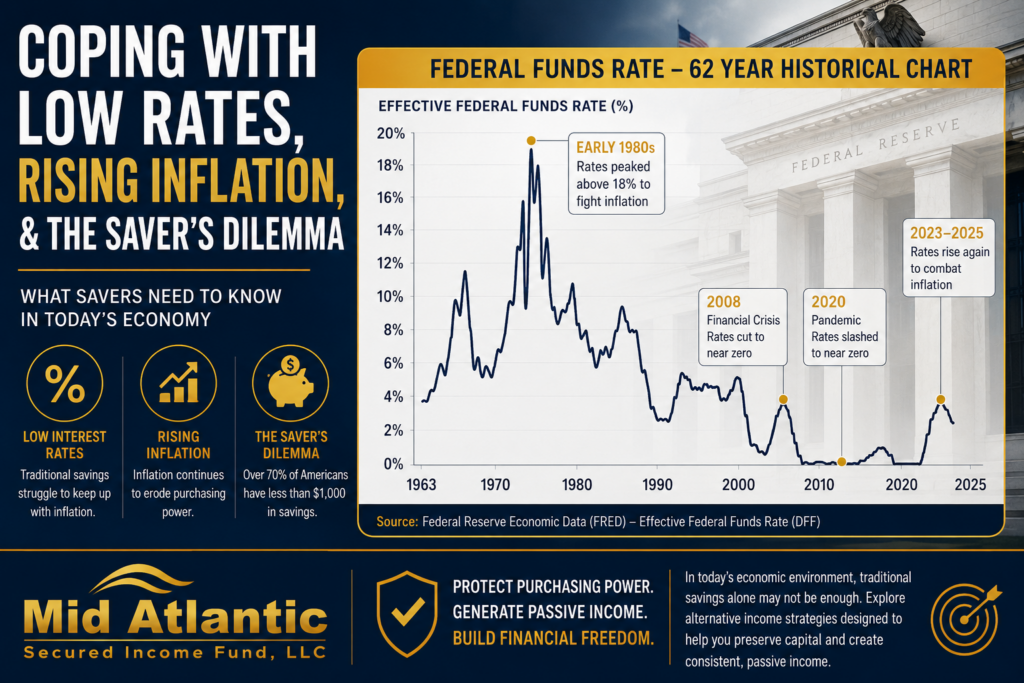

Over the last decade, the investment landscape for high-net-worth individuals has changed dramatically. Public equity markets have become increasingly concentrated, traditional fixed income has faced prolonged periods of yield compression, and inflation-adjusted returns have become more difficult to preserve through conventional 60/40 portfolio construction alone.
As a result, accredited investors are increasingly allocating capital toward private market opportunities, including private credit, real estate-backed lending, infrastructure, private equity, and income-producing alternative assets.
This shift is not simply about chasing higher returns. It reflects a broader evolution in portfolio construction:
- greater emphasis on downside protection,
- demand for durable cash flow,
- reduced correlation to public markets,
- inflation resilience,
- and broader diversification across asset classes.
Institutional investors have been pursuing these strategies for decades. According to Preqin and BlackRock research, alternative assets under management globally exceeded $16 trillion in recent years and are projected to continue growing as investors seek differentiated return streams outside traditional equities and bonds.
For accredited investors, the expansion of private market access has created opportunities that historically were limited primarily to pensions, endowments, sovereign wealth funds, and institutional asset managers.
Understanding how these opportunities work — and where they fit within a broader portfolio strategy — has become increasingly important for long-term capital preservation and income-focused investing.
What Is an Accredited Investor?
Direct Answer
An accredited investor is an individual or entity that meets financial criteria established by the SEC, allowing access to private investment opportunities not generally available to the public.
Under current SEC rules, individuals typically qualify if they have:
- annual income exceeding $200,000 individually ($300,000 jointly with a spouse or partner) for the last two years with expectation of continuation, or
- net worth exceeding $1 million excluding their primary residence.
Entities, trusts, family offices, and certain financial professionals may also qualify under expanded SEC definitions.
Why Accredited Investor Status Matters
Accredited investor status provides access to private capital markets that operate outside the structure of publicly traded securities.
These may include:
|
Investment Category |
Typical Characteristics |
|---|---|
|
Private Credit Funds |
Income-focused lending strategies |
|
Real Estate Debt Funds |
Asset-backed lending secured by property |
|
Private Equity |
Ownership stakes in private businesses |
|
Venture Capital |
Early-stage growth investing |
|
Infrastructure Funds |
Long-duration real asset exposure |
|
Private REITs |
Non-public real estate investment structures |
|
Structured Credit |
Institutional credit strategies |
These investments often offer:
- reduced public market correlation,
- access to niche opportunities,
- differentiated risk-return profiles,
- and potential income advantages compared to traditional fixed income.
However, they also involve important tradeoffs including reduced liquidity, increased complexity, longer holding periods, and varying risk structures.
The Rise of Private Credit Among Accredited Investors
Institutional Capital Has Shifted Toward Private Credit
One of the most significant structural trends in modern investing has been the rapid growth of private credit markets.
Private credit refers broadly to non-bank lending strategies where capital is provided directly to borrowers outside traditional public bond markets.
According to Preqin, the private credit industry has grown from approximately $500 billion in 2015 to well over $1.5 trillion globally in recent years.
Several macroeconomic forces contributed to this expansion:
- tighter post-2008 banking regulations,
- reduced regional bank lending capacity,
- institutional demand for yield,
- rising interest rate environments,
- and increased investor demand for floating-rate or income-producing assets.
For accredited investors, private credit can provide access to:
- monthly or quarterly cash flow,
- senior-secured lending structures,
- collateral-backed investments,
- and portfolio diversification beyond public stocks and bonds.
What Makes Real Estate-Backed Credit Different?
Understanding Asset-Backed Lending
Real estate debt funds differ significantly from equity real estate investing.
Instead of owning properties directly, debt-oriented funds typically act as lenders secured by real estate collateral.
This distinction materially changes the risk profile.
Equity Real Estate Investors Typically:
- participate in upside appreciation,
- absorb first-loss risk,
- depend on operational performance,
- and may experience higher volatility.
Real Estate Debt Investors Typically:
- sit higher in the capital stack,
- receive contractual interest payments,
- rely on collateral protection,
- and prioritize income consistency and capital preservation.
This is one reason many institutional investors allocate substantial portions of portfolios to private credit and real estate-backed lending.
Why Investors Are Reassessing Traditional Fixed Income
The Bond Market Challenge
For decades, traditional bonds provided investors with:
- portfolio stability,
- income generation,
- and diversification relative to equities.
However, the prolonged low-rate environment following the Global Financial Crisis significantly compressed yields.
At various points:
- Treasury yields fell below inflation,
- investment-grade corporate bonds offered historically low real returns,
- and retirees faced increasing challenges generating portfolio income.
Although rates have risen recently, many investors continue exploring alternative fixed income strategies due to concerns around:
- inflation persistence,
- duration risk,
- banking sector instability,
- and public market volatility.
This environment has accelerated interest in:
- private credit,
- floating-rate lending,
- short-duration debt,
- and income-oriented real asset strategies.
How Accredited Investors Use Alternative Investments
Portfolio Construction Has Evolved
Modern portfolio construction increasingly extends beyond traditional stocks and bonds.
Institutional allocators often divide portfolios across multiple risk and return drivers, including:
|
Strategy Type |
Primary Objective |
|---|---|
|
Public Equities |
Growth |
|
Investment-Grade Bonds |
Stability |
|
Private Credit |
Income |
|
Real Estate Debt |
Asset-backed yield |
|
Infrastructure |
Inflation protection |
|
Alternatives |
Diversification |
|
Cash Equivalents |
Liquidity |
Accredited investors increasingly adopt similar frameworks.
The objective is not necessarily maximizing return at all costs. In many cases, the focus shifts toward:
- risk-adjusted returns,
- cash flow durability,
- lower volatility,
- and downside resilience.
Are Debt Funds Safer Than Stocks?
Direct Answer
Debt funds and stocks carry different risk profiles and serve different purposes within a portfolio.
Debt funds focused on senior-secured lending may offer:
- contractual income,
- collateral backing,
- and lower volatility compared to equities.
However, they are not risk-free.
Potential risks include:
- borrower defaults,
- real estate market downturns,
- liquidity limitations,
- interest rate fluctuations,
- and operational or underwriting risk.
Stocks, meanwhile, may provide greater long-term growth potential but typically experience higher volatility and market sensitivity.
The appropriate allocation depends on:
- investment goals,
- liquidity needs,
- time horizon,
- and risk tolerance.
Income-Producing Investments and Retirement Planning
Why Cash Flow Matters
One of the most important shifts occurring among affluent investors is the increasing emphasis on income generation rather than purely appreciation-focused investing.
This is particularly relevant for:
- retirees,
- near-retirees,
- family offices,
- and investors prioritizing capital preservation.
Income-producing investments may help support:
- retirement distributions,
- portfolio sustainability,
- inflation-adjusted living expenses,
- and reduced dependence on asset liquidation during volatile markets.
Common income-oriented strategies include:
- dividend equities,
- municipal bonds,
- private credit,
- real estate debt funds,
- infrastructure investments,
- and structured lending vehicles.
How Accredited Investors Evaluate Private Investment Opportunities
Key Due Diligence Areas
Sophisticated investors often evaluate private investments across several dimensions.
1. Collateral Quality
What secures the investment?
In real estate-backed lending:
- property type,
- geographic concentration,
- borrower equity,
- and loan-to-value ratios matter significantly.
2. Capital Stack Position
Senior-secured positions typically receive repayment priority before subordinate equity holders.
3. Underwriting Discipline
Institutional underwriting processes are critical in assessing borrower quality, collateral strength, and risk mitigation.
4. Liquidity Profile
Private investments often involve lock-up periods or reduced liquidity relative to public securities.
5. Manager Experience
Track record, operational systems, servicing capabilities, and portfolio management experience remain critical factors.
6. Income Stability
Investors often analyze:
- distribution history,
- loan diversification,
- borrower concentration,
- and portfolio duration characteristics.
Why Diversification Still Matters in Private Markets
Concentration Risk Exists Everywhere
Even within alternative investments, diversification remains essential.
Investors should evaluate exposure across:
- property types,
- geographies,
- industries,
- borrower profiles,
- duration structures,
- and macroeconomic sensitivities.
Institutional investors rarely rely on a single strategy.
Instead, portfolios are often built using layered diversification approaches designed to:
- reduce volatility,
- improve resilience,
- and mitigate concentration risk.
The Behavioral Finance Side of Alternative Investing
Why Investors Often Overreact During Market Volatility
Behavioral finance research consistently shows that emotional decision-making can damage long-term investment outcomes.
Public markets often amplify:
- panic selling,
- momentum chasing,
- and short-term thinking.
Private market investments may reduce some behavioral pressures because:
- valuations update less frequently,
- strategies tend to be longer-term,
- and investment structures often emphasize income over daily price fluctuations.
This does not eliminate risk, but it can influence investor behavior positively when paired with disciplined allocation frameworks.
The Growing Role of Self-Directed IRAs
Alternative Investments Inside Retirement Accounts
Self-directed IRAs have become increasingly popular among accredited investors seeking broader investment flexibility.
These structures may allow exposure to:
- private credit,
- real estate debt,
- private funds,
- and alternative assets within tax-advantaged retirement accounts.
According to various industry estimates, trillions of dollars remain concentrated in traditional retirement vehicles heavily allocated to public markets.
As investors seek diversification and income alternatives, self-directed IRA adoption continues expanding.
Relevant internal resource:
Why Institutional Investors Continue Expanding Alternative Allocations
Structural Trends Supporting Alternatives
Several long-term trends continue supporting private market growth:
Persistent Demand for Yield
Institutional investors still require income-producing assets despite changing rate cycles.
Reduced Bank Lending Capacity
Regional banking constraints continue creating opportunities for private lenders.
Inflation Concerns
Real assets and floating-rate lending strategies may provide partial inflation resilience.
Portfolio Diversification
Alternatives may reduce public market concentration risk.
Demographic Shifts
Retiring populations increasingly prioritize stable cash flow and wealth preservation.
Risks of Accredited Investor Opportunities
Important Considerations
While alternative investments offer meaningful opportunities, investors should understand associated risks.
Potential risks may include:
- illiquidity,
- borrower defaults,
- economic downturns,
- property value declines,
- operational risks,
- leverage exposure,
- interest rate sensitivity,
- and manager execution risk.
Private investments are not suitable for all investors.
Comprehensive due diligence remains essential.
How The Mid Atlantic Secured Income Fund Approaches Investment Strategy
The Mid Atlantic Secured Income Fund focuses on:
- real estate-backed lending,
- income-oriented investment strategies,
- disciplined underwriting,
- and institutional operational processes.
The broader objective centers around:
- capital preservation,
- consistent income generation,
- collateral-backed structures,
- and long-term portfolio discipline.
Rather than emphasizing speculative growth, the strategy focuses on structured lending supported by tangible real estate assets.
Additional resources:
- https://themidatlanticfund.com/why-invest-in-mid-atlantic-fund/
- https://themidatlanticfund.com/private-credit-products/
- https://themidatlanticfund.com/passive-income-investment-calculator/
Conclusion: The Evolution of Modern Accredited Investor Portfolios
Accredited investor opportunities continue evolving alongside broader changes in global capital markets.
As public market volatility, inflation concerns, and yield challenges persist, many investors are increasingly incorporating:
- private credit,
- real estate-backed lending,
- alternative income strategies,
- and institutional-style diversification frameworks into long-term portfolio construction.
The objective is rarely about replacing traditional investments entirely.
Instead, sophisticated portfolio construction often focuses on balance:
- growth and income,
- liquidity and stability,
- appreciation and downside protection,
- public and private market exposure.
For accredited investors seeking broader diversification and income-focused strategies, understanding how private market opportunities function — and how they fit within a disciplined long-term allocation framework — has become increasingly important.
FAQ Section
What qualifies someone as an accredited investor?
An accredited investor typically meets SEC income or net worth requirements allowing access to private investment opportunities not available to the general public.
What are accredited investor opportunities?
These are private investment opportunities available only to accredited investors, including private credit funds, real estate debt funds, private equity, venture capital, and alternative investment vehicles.
Are private credit investments risky?
Yes. Private credit investments carry risks including borrower default, illiquidity, economic downturns, and collateral impairment. However, some strategies emphasize senior-secured lending and asset-backed structures designed to mitigate downside exposure.
Why are high-net-worth investors using alternative investments?
Many investors seek:
- diversification,
- income generation,
- inflation resilience,
- reduced public market correlation,
- and institutional-style portfolio construction.
Can alternative investments be held inside retirement accounts?
In many cases, yes. Self-directed IRAs may allow qualified investors to hold alternative assets including private credit and real estate-backed investments.
Are real estate debt funds safer than owning real estate directly?
They involve different risk profiles. Debt funds typically prioritize income and collateral protection, while direct ownership focuses more heavily on appreciation and operational performance.