
The Mid Atlantic Fund

Author name: The Mid Atlantic Fund

Real estate investments through a self-directed IRA featuring institutional retirement portfolio planning and alternative investment strategies.

Real Estate Investments Through an SDIRA: How Sophisticated Investors Are Expanding Retirement Portfolios Beyond Traditional Markets

The Evolution of Retirement Investing For decades, retirement investing in the United States largely revolved around a familiar framework: publicly traded stocks, mutual funds, index funds, ETFs, and traditional bond allocations. While these strategies remain foundational for many investors, the retirement landscape has changed substantially over the last twenty years. Persistent inflation pressures, market volatility, demographic shifts, and concerns surrounding long-term purchasing power have pushed many high-net-worth investors to explore alternative retirement investment strategies. One of the fastest-growing approaches among sophisticated investors is the use of Self-Directed IRAs (SDIRAs) to access alternative assets — particularly real estate investments and private credit opportunities. Today, investors increasingly seek retirement portfolios that prioritize: diversification beyond public markets, inflation resilience, asset-backed income generation, lower correlation to equities, and long-term capital preservation. As institutional investors and family offices continue increasing allocations to private markets, accredited investors are increasingly adopting similar strategies within tax-advantaged retirement structures. What Is a Self-Directed IRA (SDIRA)? Direct Answer A Self-Directed IRA (SDIRA) is a retirement account that allows investors to hold alternative assets beyond traditional stocks, bonds, and mutual funds. Depending on IRS guidelines and custodian capabilities, SDIRAs may invest in: real estate, private credit, private funds, real estate debt, private lending, syndications, tax liens, and other alternative investments. Unlike conventional brokerage IRAs, SDIRAs provide broader investment flexibility. Why Investors Are Turning to SDIRAs The growth of SDIRA investing reflects broader macroeconomic trends. According to Federal Reserve data, retirement investors increasingly face concerns regarding: inflation-adjusted retirement income, equity market volatility, concentration risk, and longevity planning. At the same time, institutional capital continues flowing into alternative investments. According to Preqin, global alternative assets under management are projected to exceed $24 trillion by 2028, driven heavily by: private credit, real estate, infrastructure, and alternative income-producing investments. Many retirement-focused investors increasingly want access to these same categories inside tax-advantaged accounts. What Types of Real Estate Investments Can Be Held in an SDIRA? Common SDIRA Real Estate Investments Self-Directed IRAs may hold a wide range of real estate-related investments depending on custodian policies and IRS regulations. Direct Real Estate Ownership Examples include: single-family rental homes, multifamily properties, commercial real estate, industrial assets, land investments, and vacation rental properties. Real Estate Debt Investments Many investors prefer real estate debt over direct ownership due to: potentially reduced operational complexity, contractual income streams, and senior collateral positions. Examples include: bridge loans, private lending, mortgage notes, real estate debt funds, and secured lending investments. Real Estate Syndications SDIRAs may also participate in private real estate syndications involving: apartment communities, self-storage, industrial logistics, student housing, and mixed-use developments. Private Credit Funds Many accredited investors increasingly use SDIRAs to gain exposure to: senior secured private credit, asset-backed lending, and real estate-secured income strategies. Why Real Estate Investments Remain Attractive for Retirement Portfolios Inflation Protection Real estate has historically been viewed as a potential hedge against inflation. As inflation rises: replacement costs increase, rents may rise, and underlying asset values can adjust over time. According to the Federal Reserve and NAREIT research, commercial and residential real estate often demonstrate inflation-sensitive characteristics over longer investment cycles. Income Generation Many retirement investors increasingly prioritize income-producing investments. Real estate-related strategies may generate: rental cash flow, interest income, or contractual loan payments. This becomes particularly important for retirees seeking portfolio cash flow rather than purely appreciation-focused investing. Diversification Beyond Public Markets Real estate investments often behave differently than publicly traded equities. This lower correlation may improve portfolio diversification. Sophisticated investors increasingly recognize diversification as: Diversifying economic drivers — not simply owning more securities. Why Many Investors Prefer Real Estate Debt Over Direct Ownership While direct property ownership can offer appreciation potential, many investors increasingly prefer debt-oriented real estate strategies. Key Advantages of Real Estate Debt Strategies 1. Senior Positioning Debt investors often occupy a senior position within the capital stack. This may provide additional downside protection compared to equity ownership. 2. Contractual Income Debt structures typically involve contractual repayment schedules. This may create more predictable income streams than property appreciation strategies. 3. Lower Operational Burden Direct ownership may involve: maintenance, tenant management, leasing risk, and operational complexity. Debt-focused strategies may reduce these responsibilities. 4. Defined Investment Horizons Many private credit investments operate with defined maturities and repayment structures. How Accredited Investors Use SDIRAs for Alternative Investments The Institutional Shift Into Private Markets Family offices, pension funds, and institutional investors have substantially increased allocations to private markets over the last decade. According to BlackRock and McKinsey research: private credit has become one of the fastest-growing institutional asset classes, alternative investments continue gaining share within diversified portfolios, and income-focused private lending strategies remain in high demand. Accredited investors increasingly seek similar access through SDIRAs. Tax Advantages of SDIRA Investing Tax-Deferred or Tax-Free Growth Depending on account structure: Traditional SDIRAs may allow tax-deferred growth Roth SDIRAs may allow tax-free qualified distributions This can create meaningful long-term compounding advantages. Why Retirement Investors Are Seeking Alternative Income The Retirement Income Challenge Traditional retirement planning increasingly faces structural pressure from: longer life expectancy, inflation, lower historical bond yields, and market volatility. Many retirees now seek: diversified income streams, asset-backed investments, and alternative cash-flow-producing assets. Private credit and real estate-backed lending strategies have increasingly emerged within this conversation. Understanding the Risks of SDIRA Real Estate Investing All investments involve risk. Alternative investments may carry unique considerations. Key SDIRA Investment Risks Illiquidity Risk Private investments are typically less liquid than publicly traded securities. Real Estate Market Risk Property values may fluctuate based on: interest rates, economic conditions, demographic shifts, and regional market dynamics. Credit Risk Borrowers may default on loans or obligations. Regulatory & IRS Compliance Risk SDIRAs must follow IRS rules regarding: prohibited transactions, disqualified persons, and operational compliance. Investors should work closely with qualified custodians and tax professionals. What Sophisticated Investors Look for in SDIRA Custodians Choosing the right custodian is critical. Common Factors Investors Evaluate Alternative Asset Experience Not all custodians specialize in alternative investments. Sophisticated investors often prioritize custodians experienced with: real estate, private lending, private placements, and
Real Estate Investments Through an SDIRA: How Sophisticated Investors Are Expanding Retirement Portfolios Beyond Traditional Markets Read More »

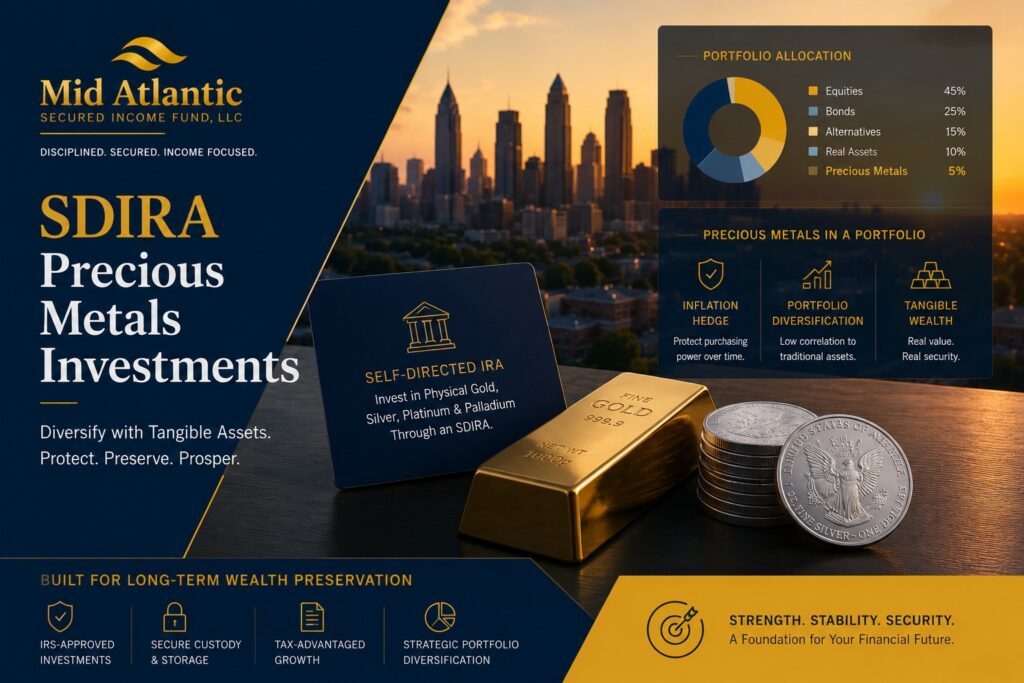
Gold and silver precious metals displayed beside institutional portfolio analytics representing SDIRA precious metals investments and retirement diversification strategies.

SDIRA Precious Metals Investments

Why Gold, Silver & Alternative Hard Assets Continue to Attract Retirement Investors For decades, retirement portfolios in the United States have largely revolved around traditional equities, bonds, and mutual funds. Yet macroeconomic instability, inflation volatility, elevated government debt levels, geopolitical fragmentation, and changing monetary policy regimes are reshaping how investors think about long-term wealth preservation. Increasingly, sophisticated investors are exploring alternative assets inside tax-advantaged retirement structures — particularly Self-Directed IRAs (SDIRAs). Among the most recognized alternative retirement assets are precious metals investments, including physical gold, silver, platinum, and palladium held through IRS-compliant custodial arrangements. While precious metals do not generate cash flow in the same way dividend-paying equities, real estate debt funds, or private credit investments can, many investors view them as strategic portfolio stabilizers designed to hedge against inflation, currency debasement, systemic risk, and market uncertainty. For accredited investors and retirement-focused allocators, SDIRA precious metals investments are often not about speculation. Instead, they are frequently used as a component of broader portfolio diversification and long-term capital preservation strategies. What Are SDIRA Precious Metals Investments? Direct Answer SDIRA precious metals investments involve holding IRS-approved physical gold, silver, platinum, or palladium within a Self-Directed IRA through an approved custodian and qualified depository. Unlike traditional brokerage IRAs that typically limit investors to stocks, ETFs, mutual funds, and bonds, a Self-Directed IRA allows investors to access a broader universe of alternative assets, including: Precious metals Real estate Private credit Private equity Tax liens Limited partnerships Secured debt investments The IRS imposes specific requirements regarding: metal purity, eligible products, approved custodians, and storage procedures. Investors cannot personally store IRA-owned precious metals at home without risking prohibited transaction violations. Why Investors Are Reconsidering Traditional Retirement Allocations The traditional 60/40 portfolio model has faced increasing scrutiny in recent years. Historically, investors relied on diversification between equities and fixed income. However, rising inflation and changing interest rate environments exposed weaknesses in portfolios heavily concentrated in publicly traded assets. According to Federal Reserve data, U.S. household net worth remains highly concentrated in equities and retirement accounts tied to public markets. Meanwhile, inflation-adjusted purchasing power concerns continue to drive interest in alternative stores of value. Several macroeconomic trends have accelerated interest in alternative retirement investments: 1. Persistent Inflation Concerns Following the post-pandemic inflation surge, investors became increasingly aware of inflation’s long-term impact on retirement purchasing power. Even moderate inflation can materially reduce future retirement income capacity over decades. According to Bureau of Labor Statistics data, cumulative inflation since 2020 materially increased costs across: housing, healthcare, insurance, utilities, food, and retirement living expenses. Many investors use precious metals as part of an inflation-hedging framework. 2. Elevated Market Volatility Public markets have experienced higher volatility amid: interest rate uncertainty, geopolitical tensions, banking sector instability, and global economic deceleration. Alternative assets often provide diversification benefits because they may behave differently than publicly traded securities. 3. Growing Interest in Hard Assets Institutional investors increasingly allocate capital toward real assets and alternatives. According to Preqin and BlackRock alternative investment research, institutional allocations to private markets and alternative assets have grown substantially over the past decade. This includes increased exposure to: infrastructure, real estate, private credit, commodities, and precious metals. How Precious Metals Work Inside an SDIRA The Basic Structure A Self-Directed IRA precious metals investment generally involves four components: Component Role Investor Owns the retirement account SDIRA Custodian Administers the IRA Precious Metals Dealer Facilitates asset acquisition Approved Depository Stores the metals The investor directs the investment decisions while the custodian handles reporting and compliance administration. IRS Rules for Precious Metals IRAs Not all metals qualify for IRA ownership. The IRS establishes specific standards under Internal Revenue Code Section 408(m). Eligible Precious Metals Generally Include: Gold Minimum purity: 99.5% Silver Minimum purity: 99.9% Platinum Minimum purity: 99.95% Palladium Minimum purity: 99.95% Examples of commonly eligible products may include: American Gold Eagles Canadian Maple Leafs Gold bars from approved refiners Silver bullion products Certain platinum and palladium coins Collectible coins are generally prohibited. Can You Store IRA Gold at Home? Direct Answer Generally, no. IRS rules require IRA-owned precious metals to be held by an approved trustee or qualified depository. Improper storage arrangements may create: prohibited transactions, early distribution events, penalties, and tax consequences. This is one reason experienced custodians and compliance-focused administrators are critical in SDIRA investing. Why Investors Use Precious Metals in Retirement Portfolios 1. Inflation Hedging Gold has historically been viewed as a long-term hedge against currency debasement and inflationary pressure. Although gold prices can fluctuate significantly over shorter periods, many investors view precious metals as a purchasing power preservation asset over long time horizons. 2. Portfolio Diversification Precious metals may exhibit lower correlation to traditional equities during periods of market stress. Diversification is one of the primary reasons institutional investors include alternative assets in portfolio construction. A diversified retirement allocation may include exposure across: equities, fixed income, real estate, private credit, infrastructure, commodities, and precious metals. 3. Geopolitical Risk Mitigation Periods of geopolitical instability often increase demand for perceived safe-haven assets. Precious metals have historically attracted investor attention during: banking crises, sovereign debt concerns, inflation shocks, military conflicts, and currency instability. 4. Long-Term Wealth Preservation For some investors, precious metals are less about maximizing returns and more about preserving purchasing power over multi-decade retirement horizons. This is particularly relevant for: retirees, family offices, conservative allocators, and multi-generational wealth planning strategies. Are Precious Metals Better Than Stocks? Direct Answer Precious metals and stocks serve different portfolio functions. Asset Type Primary Purpose Stocks Long-term growth Bonds Income and stability Precious Metals Diversification and inflation hedging Private Credit Income generation Real Estate Cash flow and appreciation Most sophisticated portfolios use multiple asset classes rather than relying exclusively on one. Precious metals typically complement diversified retirement strategies rather than replace growth-oriented assets entirely. Gold vs Silver in Retirement Accounts Gold Gold is generally viewed as: a monetary hedge, wealth preservation asset, and institutional reserve asset. Central banks globally continue holding substantial gold reserves. Silver Silver often carries both: industrial demand exposure, and monetary characteristics.

SDIRA Precious Metals Investments Read More »

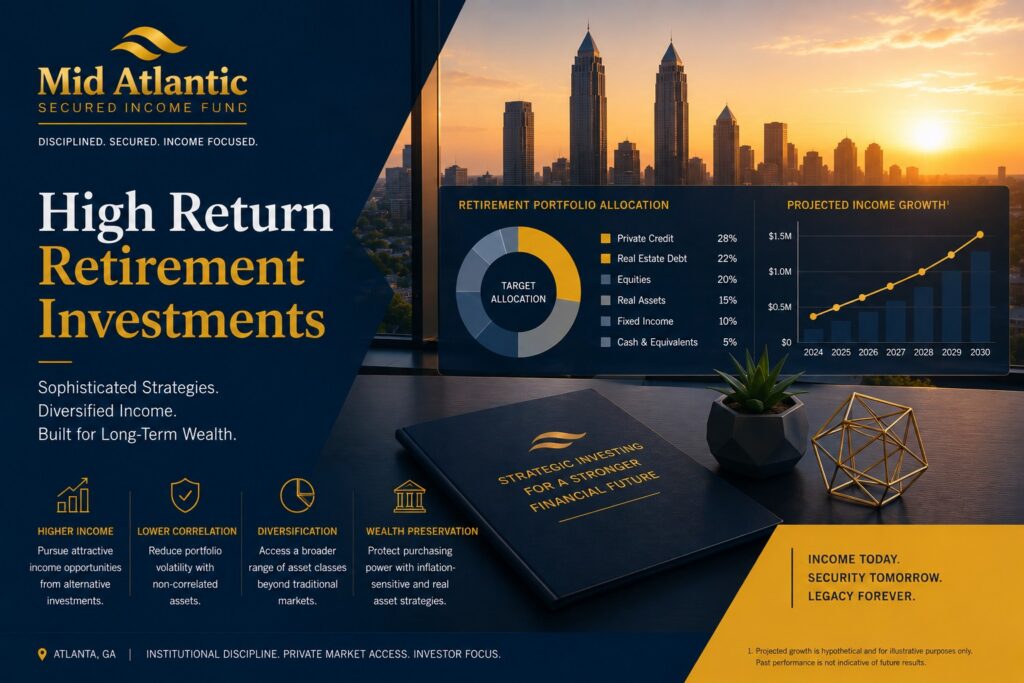
Institutional retirement investment portfolio displaying diversified high return retirement investment strategies and alternative asset allocations.

High Return Retirement Investments

How Sophisticated Investors Are Redefining Retirement Portfolio Construction For decades, retirement investing in the United States centered around a relatively straightforward formula: maximize contributions to traditional retirement accounts, maintain broad stock market exposure, gradually shift toward bonds over time, and rely on long-term market appreciation. That framework worked reasonably well during prolonged periods of falling interest rates, strong equity performance, and stable inflation. Today’s environment is different. Persistent inflation pressures, elevated market volatility, rising geopolitical uncertainty, changing monetary policy cycles, and concerns surrounding retirement income sustainability are forcing investors to rethink traditional retirement portfolio construction. Increasingly, affluent investors, accredited investors, family offices, and retirement-focused allocators are seeking higher-quality diversification and alternative sources of return beyond conventional stock-and-bond allocations. This shift has accelerated interest in what many investors broadly describe as “high return retirement investments.” However, the most sophisticated retirement investors understand that pursuing higher returns is not simply about chasing yield. Instead, it involves balancing: capital appreciation, downside risk management, inflation resilience, income consistency, liquidity needs, tax efficiency, and long-term portfolio durability. The modern retirement portfolio is becoming increasingly multi-dimensional. What Are High Return Retirement Investments? Direct Answer High return retirement investments are assets or investment strategies designed to generate above-average long-term returns, enhanced retirement income, or stronger inflation-adjusted growth relative to traditional low-yield savings or conservative bond allocations. These investments may include: private credit, real estate debt funds, dividend-focused equities, infrastructure, alternative investments, private real estate, secured lending, REITs, self-directed IRA investments, and select private market opportunities. The objective is not merely maximizing raw returns. Rather, sophisticated retirement investing focuses on optimizing risk-adjusted returns over long time horizons. Why Traditional Retirement Strategies Are Under Pressure Several structural economic trends are reshaping retirement planning. 1. Longer Retirement Horizons Americans are living longer than previous generations. According to U.S. Census Bureau and Social Security Administration data, many retirees may need portfolios capable of supporting income needs for 25–35 years or more. This increases pressure on portfolio growth and sustainable income generation. 2. Inflation Risk Inflation remains one of the most significant long-term threats to retirement purchasing power. Even moderate inflation materially impacts retirees over multi-decade periods. According to Bureau of Labor Statistics data, cumulative inflation since 2020 has meaningfully increased costs across: housing, healthcare, insurance, utilities, food, and retirement living expenses. Portfolios heavily concentrated in low-yield fixed income may struggle to preserve purchasing power over time. 3. Bond Market Challenges Traditional retirement allocations historically relied heavily on bonds for income and stability. However, changing interest rate environments exposed weaknesses in conventional fixed-income assumptions. Many investors now seek alternative income-producing assets capable of generating potentially higher yields with differentiated risk characteristics. 4. Market Volatility Public equities remain critical to long-term growth portfolios, but market concentration and elevated volatility have increased interest in alternative diversification strategies. Investors increasingly recognize that relying exclusively on public markets may create concentration risk. The Evolution of Retirement Portfolio Construction Institutional investors and family offices have spent decades expanding beyond the traditional 60/40 stock-and-bond model. Alternative assets now play a substantially larger role in sophisticated portfolio construction. According to BlackRock, Preqin, and McKinsey research, institutional allocations to alternatives have grown steadily over the last two decades. These allocations frequently include: private credit, infrastructure, real estate, commodities, private equity, and secured lending. Retail retirement investors are increasingly adopting similar diversification frameworks. Categories of High Return Retirement Investments 1. Private Credit Investments Private credit has become one of the fastest-growing alternative asset classes globally. What Is Private Credit? Private credit generally refers to non-bank lending strategies where investors provide capital directly to borrowers outside traditional public bond markets. Examples may include: senior secured real estate loans, bridge lending, construction lending, asset-backed lending, and private debt funds. According to Preqin, private credit assets under management have grown dramatically over the past decade as banks reduced certain lending exposures following post-2008 regulatory changes. Why Retirement Investors Explore Private Credit Sophisticated investors often view private credit favorably because it may provide: income generation, floating-rate exposure, lower correlation to equities, collateral-backed structures, and enhanced yield potential. Many private credit investments prioritize downside protection through senior secured lending structures. 2. Real Estate Debt Funds Unlike traditional equity real estate investing, real estate debt investing focuses on lending against real estate collateral. Key Characteristics Real estate debt funds may offer: income-oriented strategies, monthly distributions, asset-backed exposure, and reduced volatility compared to certain equity investments. Senior secured lending structures place lenders higher in the capital stack than equity investors. This distinction matters significantly during market downturns. 3. Dividend Growth Investing Dividend-paying equities remain foundational components of many retirement portfolios. However, sophisticated retirement investors increasingly focus on: dividend sustainability, free cash flow quality, balance sheet strength, and inflation-adjusted growth potential. Dividend growth investing attempts to combine: current income, long-term appreciation, and compounding reinvestment effects. 4. Self-Directed IRA Investments (SDIRAs) Self-Directed IRAs allow retirement investors to access broader alternative investment opportunities beyond traditional brokerage assets. SDIRAs may hold: private credit, real estate, precious metals, secured lending investments, private funds, and other alternative assets. Many sophisticated investors use SDIRAs to diversify retirement exposure beyond public markets. 5. Real Estate Investments Real estate continues to play a major role in retirement diversification strategies. Investors may gain exposure through: direct ownership, REITs, private real estate funds, real estate debt, and income-producing commercial assets. Real estate may provide: inflation sensitivity, cash flow, tax advantages, and long-term appreciation potential. Are High Return Retirement Investments Riskier? Direct Answer Higher potential returns generally involve higher levels of risk, complexity, or reduced liquidity. However, not all “high return” investments carry identical risk characteristics. For example: Investment Type Primary Risk Growth Stocks Market volatility Private Credit Credit/default risk Real Estate Market & liquidity risk Bonds Interest rate risk Precious Metals Price volatility Private Equity Illiquidity & execution risk Sophisticated retirement investing focuses on balancing multiple forms of risk rather than simply maximizing returns. The Importance of Diversification Diversification remains one of the most important principles in retirement investing. Institutional portfolio construction generally avoids excessive concentration in any

High Return Retirement Investments Read More »

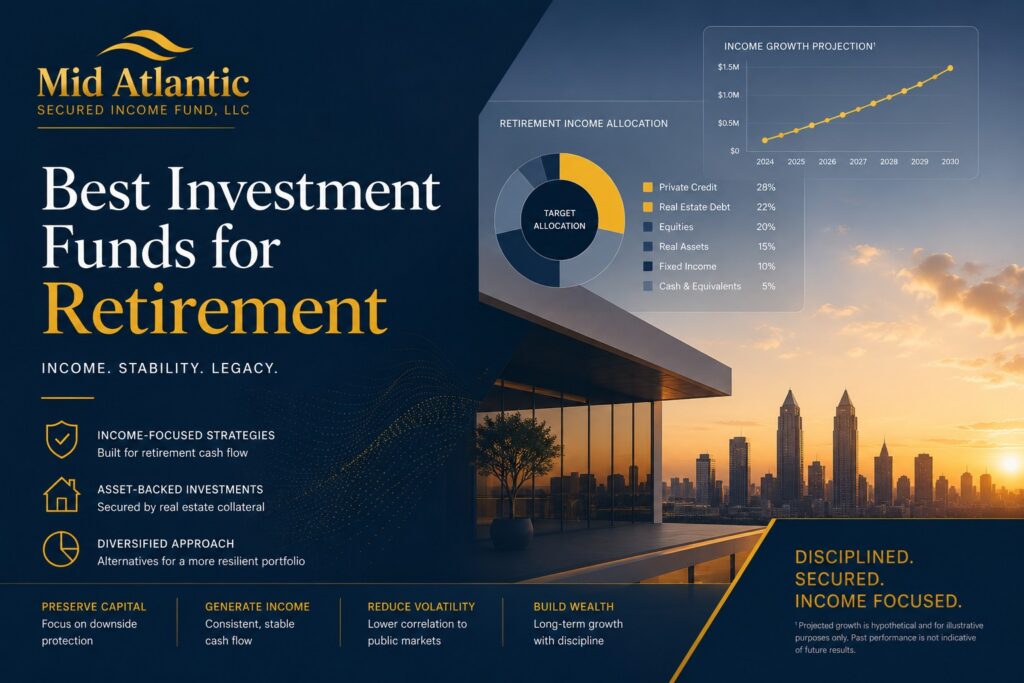
Best investment funds for retirement featuring institutional portfolio planning, alternative investments, and retirement income strategies by Mid Atlantic Secured Income Fund

Best Investment Funds for Retirement in 2026: Institutional Portfolio Strategies Beyond Traditional Stocks and Bonds

Retirement Investing Is Undergoing a Structural Shift For decades, retirement investing in the United States largely followed a familiar formula: stocks for growth, bonds for stability, and mutual funds as the default allocation vehicle. That framework is increasingly being challenged. Persistent inflation pressures, elevated market volatility, longer retirements, shifting interest rate environments, and declining confidence in traditional 60/40 portfolios are causing retirees and pre-retirees to rethink how retirement capital should be managed. Institutional investors have already adapted. According to BlackRock, Apollo, Goldman Sachs, and Preqin research, pension funds, endowments, family offices, and insurance companies have steadily increased allocations to alternative income-oriented investments over the last decade. Private credit, infrastructure, real estate-backed debt, and non-correlated income strategies are now core components of institutional retirement portfolios. Individual accredited investors are beginning to follow the same trend. The modern retirement portfolio is no longer built solely around maximizing returns. Instead, sophisticated investors increasingly focus on: durable income generation, downside mitigation, inflation resilience, tax efficiency, diversification beyond public markets, and capital preservation across market cycles. This evolution has fundamentally changed the conversation around the best investment funds for retirement. What Are the Best Investment Funds for Retirement? Direct Answer The best investment funds for retirement are those that align with an investor’s: income needs, risk tolerance, liquidity requirements, time horizon, and long-term wealth preservation objectives. For many investors, a diversified retirement portfolio may include: dividend equity funds, bond funds, private credit funds, real estate debt funds, REITs, infrastructure investments, and alternative income-focused strategies. Increasingly, institutional investors and accredited individuals are incorporating private credit and asset-backed income funds to complement traditional stock and bond allocations. Why Retirement Investors Are Expanding Beyond Traditional Portfolios The Traditional 60/40 Portfolio Faces New Challenges For decades, retirement portfolios often relied on: 60% equities 40% fixed income The assumption was straightforward: equities drove growth, bonds provided stability. However, recent macroeconomic conditions exposed vulnerabilities in this approach. In 2022, both stocks and bonds declined simultaneously — a historically uncommon event that challenged assumptions around diversification. Meanwhile: inflation remained elevated, bond purchasing power deteriorated, and retirees faced increased sequence-of-return risk. According to Morningstar and BlackRock research: retirees are increasingly prioritizing income stability over pure appreciation, especially in the years immediately before and after retirement. Understanding Sequence-of-Return Risk Why Early Retirement Losses Matter More Than Many Investors Realize Sequence-of-return risk refers to the danger of experiencing significant portfolio losses early in retirement while simultaneously withdrawing income. Even if long-term market averages eventually recover, early losses combined with withdrawals can permanently impair retirement sustainability. This is one reason many institutional retirement frameworks now emphasize: diversified income streams, lower volatility assets, and non-correlated investments. Categories of Retirement Investment Funds 1. Dividend Equity Funds Dividend-focused funds invest in companies that distribute regular cash dividends. These funds are commonly used for: income generation, inflation participation, and long-term equity exposure. Advantages Potential dividend growth Public market liquidity Exposure to blue-chip companies Risks Equity market volatility Dividend reductions during recessions Correlation to broader markets 2. Bond Funds Bond funds remain foundational components of many retirement portfolios. They typically include: Treasury bonds, municipal bonds, investment-grade corporate debt, and government-backed securities. Advantages Historically lower volatility than equities Income generation Capital preservation characteristics Risks Interest rate sensitivity Inflation erosion Lower yields during certain economic cycles 3. Real Estate Investment Trusts (REITs) REITs provide exposure to income-producing real estate assets. Examples include: apartment portfolios, industrial warehouses, data centers, medical office buildings, and commercial real estate. NAREIT data has historically shown that REITs can provide: income, inflation sensitivity, and diversification benefits. Risks Public market volatility Commercial real estate downturns Interest rate exposure 4. Private Credit Funds One of the Fastest Growing Institutional Asset Classes Private credit has emerged as one of the most significant institutional investment trends of the past decade. According to Preqin: global private credit assets under management surpassed $1.7 trillion in recent years, with continued projected growth through the decade. Private credit funds generally provide financing outside traditional banking channels. These may include: senior secured loans, real estate-backed lending, bridge lending, asset-backed financing, and specialty finance strategies. Why Institutional Investors Use Private Credit Institutional allocators often utilize private credit because it may offer: income potential, floating-rate structures, collateral-backed lending, lower public market correlation, and downside-focused underwriting. Unlike traditional equity investments, many private credit structures prioritize: contractual cash flow, asset security, and capital stack positioning. What Is a Real Estate Debt Fund? Direct Answer A real estate debt fund pools investor capital to originate or acquire loans secured by real estate collateral. Unlike equity real estate investing, debt funds generally focus on: loan income, interest payments, and collateral-backed lending structures. Some funds specialize in: first-lien positions, bridge lending, construction financing, or stabilized real estate loans. Why Real Estate-Backed Income Strategies Appeal to Retirees Retirement investors increasingly seek investments tied to: tangible assets, contractual income, and collateral-backed structures. Real estate-backed lending strategies may provide: monthly or periodic distributions, lower volatility than equities, and defensive portfolio characteristics. Sophisticated retirement investors often value: asset security, disciplined underwriting, and income consistency over speculative appreciation. Accredited Investors and Alternative Retirement Strategies Why High-Net-Worth Investors Often Allocate Differently Accredited investors frequently have access to investments unavailable in traditional brokerage accounts. These may include: private credit funds, institutional debt strategies, private real estate vehicles, and specialty income funds. According to numerous family office studies, high-net-worth portfolios often allocate meaningfully to: alternatives, real assets, and private markets. The rationale is typically centered on: diversification, inflation mitigation, and non-correlated income generation. How SDIRAs Expand Retirement Investment Flexibility What Is an SDIRA? A Self-Directed IRA (SDIRA) allows investors to hold a broader range of investments inside retirement accounts. These may include: private credit, private real estate, real estate debt funds, precious metals, private equity, and alternative assets. SDIRAs are commonly used by investors seeking: diversification beyond public markets, tax-advantaged alternative investments, and greater portfolio flexibility. Related Internal Resource: https://themidatlanticfund.com/ira-investing-with-mid-atlantic-fund/ Retirement Income Versus Retirement Growth The Psychological Shift Many Investors Experience During accumulation years, investors often focus primarily on: maximizing growth, increasing

Best Investment Funds for Retirement in 2026: Institutional Portfolio Strategies Beyond Traditional Stocks and Bonds Read More »

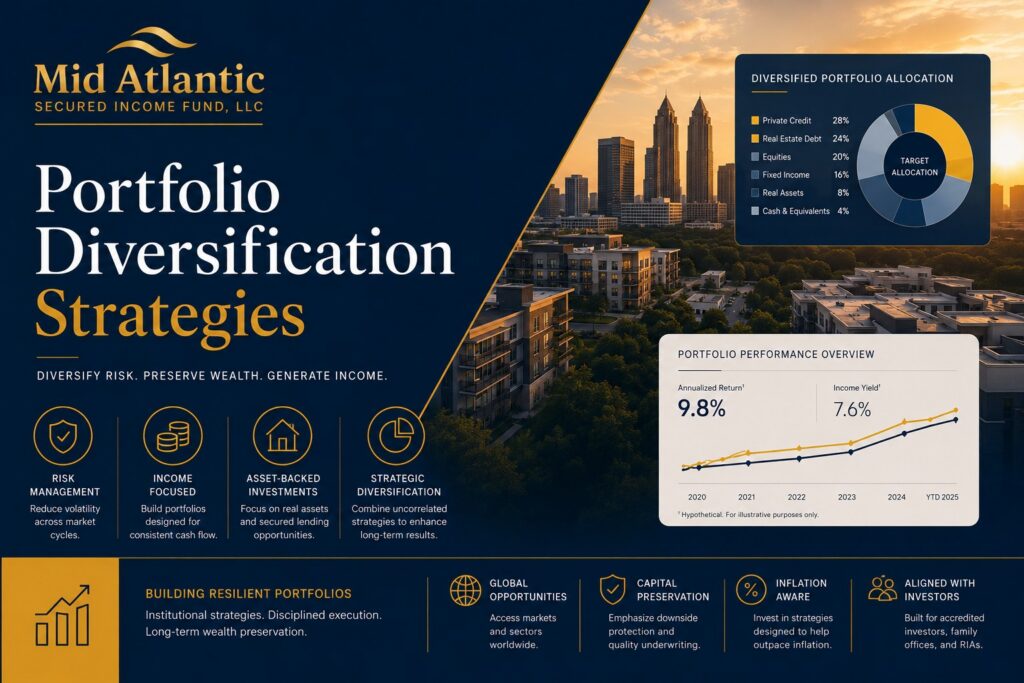
Portfolio Diversification Strategies

Portfolio Diversification Strategies

Effective Portfolio Diversification Strategies is a cornerstone of sound investing, designed to manage risk and improve returns. By spreading investments across various asset classes, sectors, and geographic regions, investors can reduce the impact of any single asset’s poor performance on their overall portfolio. This article explores key diversification strategies to help investors achieve a balanced and resilient portfolio. Understanding Portfolio Diversification Strategies Portfolio Diversification Strategies involves allocating investments among different types of assets to minimize risk. The underlying principle is that various asset classes often perform differently under the same market conditions. For example, while stocks might be soaring, bonds could be experiencing a downturn, and real estate might be steady. Portfolio Diversification Strategies aims to smooth out returns over time by balancing these fluctuations. 1. Asset Class Portfolio Diversification Strategies One of the fundamental strategies for diversification is to invest across different asset classes. These typically include: Equities (Stocks): Represent ownership in companies and offer growth potential. Stocks can be further diversified by investing in various sectors, such as technology, healthcare, and finance. Fixed Income (Bonds): Provide steady interest income and are generally less volatile than stocks. Diversifying within bonds can involve government, corporate, and municipal bonds. Real Estate: Investing in property or real estate investment trusts (REITs) can add another layer of diversification, as real estate often behaves differently from stocks and bonds. Commodities: Includes physical assets like gold, silver, or oil. Commodities can act as a hedge against inflation and currency risk. Cash and Cash Equivalents: Such as money market funds and certificates of deposit (CDs). These offer stability and liquidity, although with lower returns. 2. Sector Portfolio Diversification Strategies Within equities, it’s crucial to diversify across various sectors to reduce the impact of a downturn in any single industry. For example: Technology: Includes software, hardware, and emerging technologies. Healthcare: Covers pharmaceuticals, biotechnology, and healthcare services. Finance: Encompasses banks, insurance companies, and investment firms. Consumer Goods: Ranges from essentials like food and beverages to discretionary items like luxury goods. By investing across multiple sectors, investors can mitigate risks associated with sector-specific downturns and benefit from growth in different areas of the economy. 3. Geographic Portfolio Diversification Strategies Geographic diversification involves spreading investments across different countries and regions. This strategy can help reduce exposure to economic or political instability in any single country. Key regions to consider include: Domestic Markets: Investing in a mix of large-cap, mid-cap, and small-cap companies within your home country. International Developed Markets: Countries like Japan, Germany, and the United Kingdom, which have stable economies and established financial systems. Emerging Markets: Includes countries with faster-growing economies, such as China, India, and Brazil. While riskier, emerging markets can offer high growth potential. Geographic diversification can also involve international bonds, global real estate, and foreign currency investments. 4. Investment Vehicles Diversification can also be achieved through various investment vehicles, each offering unique characteristics: Mutual Funds: Pool money from multiple investors to invest in a diversified portfolio of stocks, bonds, or other assets. Exchange-Traded Funds (ETFs): Trade like stocks but offer exposure to a broad range of assets, such as indices, sectors, or commodities. Index Funds: Track specific market indices and offer broad diversification within a particular asset class, such as the S&P 500. 5. Alternative Investments Including alternative assets can further diversify a portfolio beyond traditional stocks and bonds: Real Estate: Direct property ownership or REITs. Private Equity: Investments in private companies or startups. Hedge Funds: Utilize various strategies to achieve high returns, though they may come with higher fees and risks. Cryptocurrencies: Digital currencies like Bitcoin and Ethereum offer exposure to a new and emerging market, though they are highly volatile. Conclusion Portfolio Diversification Strategies is a critical strategy for managing risk and optimizing returns. By spreading investments across different asset classes, sectors, and geographic regions, investors can reduce the impact of market volatility and enhance their chances of achieving long-term financial goals. While diversification cannot eliminate risk entirely, it is a powerful tool in building a resilient investment portfolio. As always, investors should tailor their diversification strategies to their individual risk tolerance, investment horizon, and financial objectives, potentially with the guidance of a financial. Visit  our website for more informationhttps://themidatlanticfund.com/retirement-planning-for-high-net-worth/

Portfolio Diversification Strategies Read More »

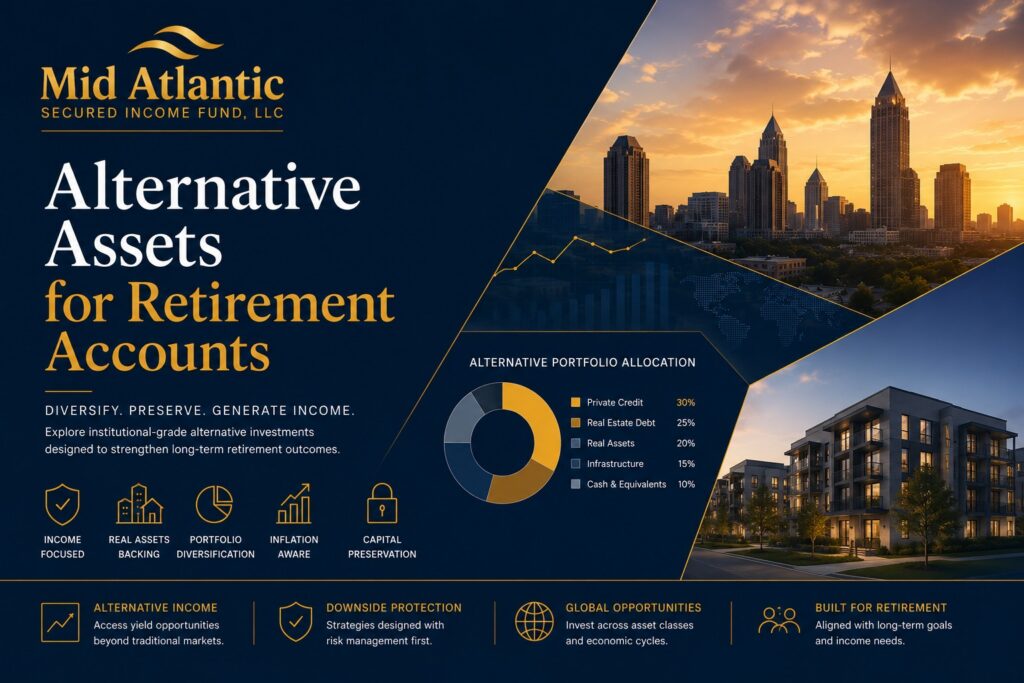
Alternative Assets for Retirement Accounts

Alternative Assets for Retirement Accounts

When planning for retirement, the traditional route often involves investing in stocks, bonds, and mutual funds. However, for those looking to diversify and potentially enhance their retirement portfolios, alternative assets can offer promising opportunities. These unconventional investments can include everything from real estate to cryptocurrencies, each with its unique benefits and risks. In this article, we’ll explore various alternative assets suitable for retirement accounts, specifically focusing on their potential advantages and considerations. What Are Alternative Assets? Alternative assets are investments that fall outside the traditional categories of stocks, bonds, and cash. They include a broad range of options, such as real estate, private equity, commodities, hedge funds, and more. These assets are often less liquid and can have higher risks, but they may also offer significant rewards and diversification benefits. Real Estate Real estate is one of the most popular alternative assets for retirement accounts. Through a Self-Directed IRA (SDIRA) or a Solo 401(k), investors can invest in rental properties, commercial real estate, or real estate investment trusts (REITs). Real estate can provide regular income through rent and potential appreciation over time. Advantages: Income Generation: Rental properties can offer steady cash flow. Diversification: Real estate is a tangible asset that often behaves differently from stocks and bonds. Tax Benefits: Real estate investments within a retirement account can grow tax-deferred or tax-free, depending on the account type. Considerations: Liquidity: Real estate is not as liquid as stocks, making it harder to sell quickly. Management: Properties require ongoing management and maintenance, which can be time-consuming and costly. Private Equity Private equity involves investing in privately held companies, which are not listed on public exchanges. Investors can access these opportunities through funds or direct investments. Advantages: High Returns: Private equity has the potential for high returns, particularly in emerging or growth sectors. Diversification: Provides exposure to companies outside of the public market. Considerations: Risk: Investing in startups or private firms can be high-risk, with the potential for significant losses. Liquidity: Private equity investments typically have longer holding periods and less liquidity. Commodities Commodities include physical assets like gold, silver, oil, and agricultural products. Investors can gain exposure to commodities through futures contracts, ETFs, or commodity-focused mutual funds. Advantages: Inflation Hedge: Commodities often serve as a hedge against inflation. Diversification: They can reduce portfolio volatility when traditional asset classes are underperforming. Considerations: Volatility: Commodities can be highly volatile and influenced by global economic conditions. Complexity: Investing in commodities can be complex and may require a good understanding of the market. Cryptocurrencies Cryptocurrencies, like Bitcoin and Ethereum, are a new and emerging asset class. Some SDIRAs and other retirement accounts now allow for cryptocurrency investments. Advantages: Growth Potential: Cryptocurrencies have shown significant growth and innovation potential. Diversification: They offer exposure to a new and evolving market. Considerations: Volatility: Cryptocurrencies are extremely volatile and can experience rapid price fluctuations. Regulatory Risks: The regulatory environment is still evolving, which can impact the market. Hedge Funds Hedge funds are pooled investment funds that use various strategies to achieve high returns. They can invest in multiple asset classes and employ techniques like leverage and short selling. Advantages: Advanced Strategies: Hedge funds use sophisticated investment strategies that can potentially deliver high returns. Diversification: They provide exposure to alternative investment strategies. Considerations: Fees: Hedge funds often charge high management and performance fees. Accessibility: Many hedge funds require substantial minimum investments and are not always available to retail investors. Conclusion Alternative assets offer a range of opportunities for those looking to diversify their retirement portfolios beyond traditional investments. While they come with unique advantages, such as potential high returns and added diversification, they also carry risks, including volatility and liquidity issues. It’s crucial for investors to conduct thorough research and consider their risk tolerance, investment horizon, and financial goals before incorporating alternative assets into their retirement strategy. Consulting with a financial advisor can also provide valuable insights and help tailor an investment approach that aligns with your retirement objectives. Visit our website for more informationhttps://themidatlanticfund.com/real-estate-investment-funds/

Alternative Assets for Retirement Accounts Read More »

Customized Investment Solutions

Customized Investment Solutions

In an increasingly complex financial landscape, one-size-fits-all investment strategies often fall short of meeting individual goals and risk tolerances. Customized investment solutions have emerged as a compelling alternative, offering tailored financial strategies designed to address the unique needs and aspirations of each investor. This approach allows for a more personalized and strategic path to achieving financial objectives, whether they involve retirement planning, wealth accumulation, or specific investment goals. The Essence of Customized Investment Solutions Customized investment solutions are financial strategies specifically designed to meet the unique requirements of an individual or entity. Unlike standard investment plans, which often rely on generic asset allocation models and pre-defined risk profiles, customized solutions take a deeper dive into an investor’s personal financial situation. This includes factors such as income, expenses, investment time horizon, risk tolerance, and long-term goals. Benefits of Customized Investment Solutions Personalized Approach: One of the primary advantages of customized investment solutions is their personalized nature. Financial advisors or investment managers work closely with clients to understand their individual needs and preferences. This tailored approach ensures that the investment strategy aligns with the client’s specific objectives, whether they are planning for retirement, saving for a major purchase, or seeking growth opportunities. Optimal Risk Management: Customized solutions allow for precise risk management. By assessing an investor’s risk tolerance, a customized strategy can balance high-risk and low-risk investments to achieve a suitable level of risk exposure. This ensures that investors are neither overexposed to potential losses nor underexposed to opportunities for growth. Alignment with Financial Goals: Every investor has different goals, whether it’s accumulating wealth, funding education, or generating income. Customized investment solutions ensure that the investment strategy is designed to meet these specific goals. This may involve selecting particular asset classes, investment vehicles, or strategies that align with the investor’s long-term vision. Flexibility and Adaptability: The financial markets are dynamic, and an investor’s situation can change over time. Customized investment solutions offer flexibility and adaptability, allowing adjustments to be made as circumstances evolve. Whether it’s a change in financial goals, risk tolerance, or market conditions, a customized strategy can be adjusted to stay on track. Tax Efficiency: Tailoring investments also allows for greater tax efficiency. Customized strategies can incorporate tax-advantaged accounts, consider tax implications of different investments, and employ strategies to minimize tax liabilities. This aspect of customization helps investors retain more of their earnings and achieve better net returns. Implementing Customized Investment Solutions Assessment and Planning: The process begins with a comprehensive assessment of the investor’s financial situation. This includes evaluating current assets, liabilities, income, expenses, and future goals. Financial advisors or investment managers use this information to develop a customized investment plan. Strategy Development: Based on the assessment, a tailored investment strategy is developed. This may involve asset allocation decisions, investment selection, and risk management techniques. The strategy is designed to meet the specific objectives and preferences of the investor. Ongoing Monitoring and Adjustment: Implementing a customized investment solution is not a one-time event but an ongoing process. Regular monitoring of the investment portfolio ensures that it remains aligned with the investor’s goals and risk tolerance. Adjustments are made as needed to respond to market changes or shifts in personal circumstances. Client Communication: Effective communication between the investor and the advisor is crucial. Regular updates, reviews, and discussions help ensure that the investment strategy continues to meet the investor’s needs and expectations. This collaborative approach fosters a stronger understanding of the investment plan and enhances its effectiveness. Conclusion Customized investment solutions represent a significant advancement in financial planning, offering a tailored approach that aligns with an investor’s unique needs and goals. By focusing on personalization, optimal risk management, goal alignment, flexibility, and tax efficiency, these solutions provide a more nuanced and effective strategy compared to generic investment plans. For individuals seeking to navigate the complexities of investing and achieve their financial objectives, customized investment solutions offer a compelling and strategic path forward. Whether you’re planning for retirement, accumulating wealth, or pursuing specific financial goals, working with a financial advisor to develop a customized investment strategy can be a transformative step towards achieving financial success. Visit our website for more information https://themidatlanticfund.com/investment-management-services/

Customized Investment Solutions Read More »

Retirement Savings Optimization

Retirement Savings Optimization

As retirement looms on the horizon, ensuring that your savings are retirement Savings optimized is crucial for a comfortable and secure future. The task of optimizing retirement savings involves more than just stashing away money; it requires a strategic approach to managing investments, minimizing taxes, and adapting to changing financial conditions. Here’s a comprehensive guide to help you navigate the path to an optimized retirement plan. 1. Start Early and Be Consistent One of the most effective ways to optimize your retirement savings is to start early. The earlier you begin saving, the more time your money has to grow, thanks to the power of compound interest. Even small, consistent contributions can accumulate significantly over time. For example, starting to invest in your 20s can lead to a much larger nest egg by retirement compared to starting in your 40s, due to the compounding effect. 2. Maximize Contributions to Retirement Accounts Make the most of retirement Savings accounts such as 401(k)s, IRAs, and Roth IRAs. Each of these accounts offers different tax advantages: 401(k): Contributions are made pre-tax, which reduces your taxable income for the year. Many employers offer matching contributions, which is essentially free money. Aim to contribute at least enough to get the full match. IRA (Traditional and Roth): Contributions to a Traditional IRA may be tax-deductible, while Roth IRA contributions are made with after-tax dollars but offer tax-free withdrawals in retirement. The choice between these accounts depends on your current tax situation and anticipated tax bracket in retirement. 3. Diversify Your Investments Diversification is a key principle of investing that can help manage risk and improve returns. A well-diversified portfolio typically includes a mix of asset classes such as stocks, bonds, and real estate. The allocation should align with your risk tolerance, investment horizon, and retirement Savings goals. Regularly review and rebalance your portfolio to maintain your desired asset allocation and adjust to market conditions. 4. Consider Professional Advice Financial advisors can provide personalized strategies based on your unique financial situation and goals. They can help with asset allocation, tax planning, and retirement income strategies. It’s important to choose a reputable advisor who understands your needs and has a transparent fee structure. 5. Plan for Healthcare Costs Healthcare is a significant expense in retirement, and planning for these costs is essential. Consider opening a Health Savings Account (HSA) if eligible, which offers tax advantages and can be used to cover medical expenses. Additionally, understand how Medicare works and what gaps in coverage might exist. Planning for potential long-term care needs is also crucial. 6. Optimize Social Security Benefits Deciding when to begin Social Security benefits can impact your overall retirement income. Benefits can be claimed as early as age 62, but doing so reduces your monthly payment. Waiting until your full retirement age, or even age 70, can increase your benefit amount. Analyze your situation, considering factors such as health, life expectancy, and financial needs, to determine the optimal time to start claiming benefits. 7. Utilize Tax-Efficient Withdrawal Strategies Once retired, the way you withdraw money from your retirement accounts can impact your tax liability. Using a mix of taxable, tax-deferred, and tax-free accounts for withdrawals can help manage your tax bracket. For example, withdrawing from a Roth IRA first can minimize taxable income, while deferring withdrawals from a Traditional IRA until necessary can potentially reduce taxes over time. 8. Adjust for Inflation Inflation can erode the purchasing power of your savings over time. To combat this, invest in assets that historically outpace inflation, such as stocks and real estate. Additionally, consider inflation-protected securities like Treasury Inflation-Protected Securities (TIPS) or annuities with inflation protection features. 9. Maintain an Emergency Fund An emergency fund is crucial for covering unexpected expenses without derailing your retirement savings. Ideally, this fund should cover three to six months of living expenses and be kept in a liquid, easily accessible account. 10. Review and Adjust Regularly Retirement planning is not a one-time event but an ongoing process. Regularly review your financial plan and retirement savings strategy to ensure it remains aligned with your goals. Adjust for changes in your financial situation, market conditions, and retirement goals to stay on track. In conclusion, optimizing retirement savings involves a combination of early and consistent saving, strategic investing, and careful planning. By leveraging these strategies, you can build a robust retirement portfolio that provides financial security and peace of mind for your golden years. Visit our website for information https://themidatlanticfund.com/investment-management-services/

Retirement Savings Optimization Read More »

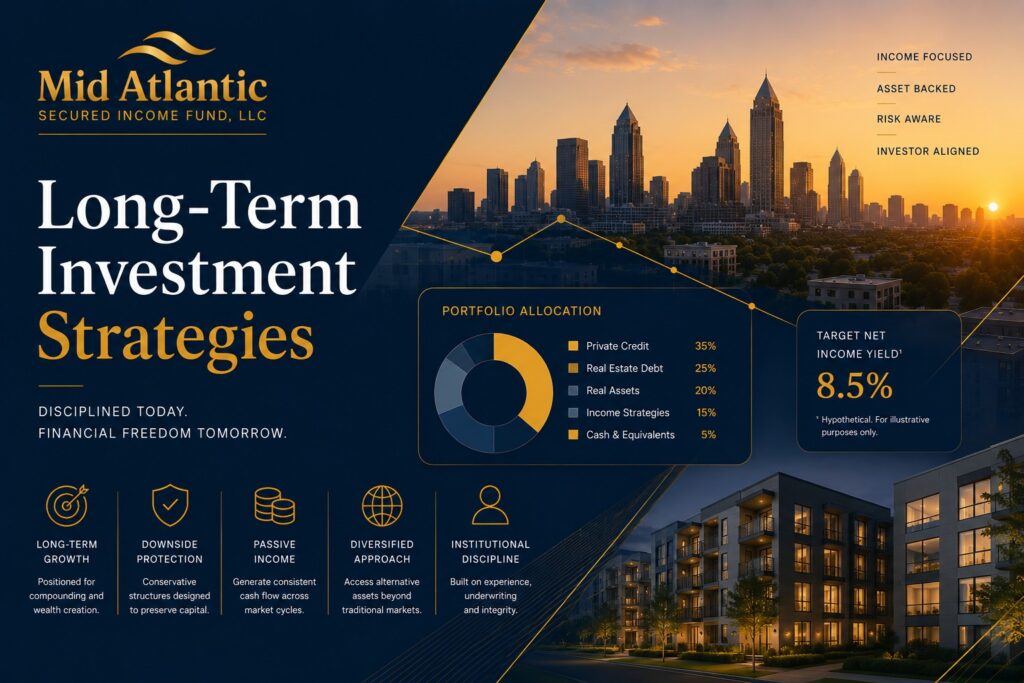
Long-Term Investment Strategies

Long-Term Investment Strategies

When it comes to investing, many people focus on short-term gains, often driven by market volatility and immediate gratification. However, long-term investment strategies are crucial for building substantial wealth and achieving financial security over time. This article explores key long-term investment strategies that can help investors achieve their financial goals. Understanding Long-Term Investing Long-term investing involves committing capital to investments for extended periods, typically five years or more. The primary goal is to benefit from the compounding growth of investments, allowing them to appreciate significantly over time. Unlike short-term trading, which requires constant monitoring and quick decisions, long-term investing emphasizes patience and discipline. Diversification: The Foundation of Stability One of the cornerstones of a successful long-term investment strategy is diversification. By spreading investments across various asset classes, such as stocks, bonds, real estate, and commodities, investors can reduce risk and enhance the potential for returns. Diversification helps mitigate the impact of poor performance in any single investment, providing a more stable overall portfolio. Dollar-Cost Averaging: Mitigating Market Volatility Dollar-cost averaging (DCA) is a strategy where investors regularly invest a fixed amount of money into a particular investment, regardless of its price. This approach reduces the risk of investing a large sum at an inopportune time and helps smooth out the effects of market volatility. Over time, DCA can result in buying more shares when prices are low and fewer shares when prices are high, potentially lowering the average cost per share. Long-Term Investment in Index Funds and ETFs Index funds and exchange-traded funds (ETFs) are popular choices for long-term investors due to their low costs and broad market exposure. These funds track specific indices, such as the S&P 500 or the Dow Jones Industrial Average, and offer a diversified portfolio with minimal management fees. By investing in index funds or ETFs, investors can benefit from the overall growth of the market without the need for extensive research or active management. The Power of Compounding Compounding is often referred to as the “eighth wonder of the world” for a reason. It occurs when the returns on an investment generate their own returns, leading to exponential growth over time. By reinvesting dividends and interest, investors can accelerate the growth of their portfolio. The longer the investment horizon, the more pronounced the effects of compounding, making it a vital aspect of long-term investment success. Regular Portfolio Rebalancing While a long-term investment strategy focuses on buy-and-hold, regular portfolio rebalancing is essential to maintaining the desired asset allocation. Over time, some investments may outperform others, causing the portfolio to become skewed. Rebalancing involves adjusting the portfolio to restore the original asset allocation, ensuring that risk levels remain in line with the investor’s goals and risk tolerance. Investing in Growth Stocks Growth stocks, which represent companies expected to grow at an above-average rate compared to their peers, can be a valuable component of a long-term investment strategy. These stocks typically reinvest earnings into expansion rather than paying dividends, offering significant potential for capital appreciation. While they may be more volatile than value stocks, their long-term growth potential can make them a strong choice for investors with a longer time horizon. Consideration of Tax-Advantaged Accounts Tax-advantaged accounts, such as Individual Retirement Accounts (IRAs) and 401(k) plans, offer benefits for long-term investors by providing tax deferrals or exemptions on investment earnings. Contributions to these accounts can reduce taxable income, and the growth within the accounts is either tax-deferred or tax-free, depending on the type of account. Utilizing these accounts can enhance the overall return on investments and aid in long-term wealth accumulation. Staying Informed and Avoiding Emotional Decisions Long-term investing requires a steadfast approach and the ability to remain focused on long-term goals despite short-term market fluctuations. Staying informed about market trends and economic developments is important, but it is equally crucial to avoid making emotional decisions based on market noise. Adhering to a well-thought-out Long-Term Investment Strategies plan and maintaining a disciplined approach can help investors navigate market volatility and stay on track to achieve their financial objectives. Conclusion Long-term investment strategies are designed to build wealth and achieve financial goals through patience, discipline, and strategic planning. By diversifying investments, employing dollar-cost averaging, utilizing index funds, harnessing the power of compounding, and making informed decisions, investors can position themselves for long-term success. Whether you are saving for retirement, a major purchase, or financial independence, adopting a long-term perspective can help you navigate the complexities of investing and achieve your desired outcomes. Visit our website for more information https://themidatlanticfund.com/high-net-worth-investment-strategies/

Long-Term Investment Strategies Read More »

Secure Investment Funds

secure investment funds

In today’s unpredictable financial climate, investors are increasingly seeking secure investment funds to protect their capital while aiming for steady returns. Secure investment funds are designed to offer lower risk compared to traditional investments, making them ideal for individuals who prioritize safety and stability over high returns. Understanding these funds can help investors make informed decisions to safeguard their assets. What Are Secure Investment Funds? Secure investment funds are financial products designed to minimize risk and preserve capital while providing a modest return. These funds typically invest in assets that are considered low risk, such as government bonds, high-quality corporate bonds, and other stable securities. The goal is to offer investors a safe haven for their money, ensuring that their capital is protected from significant losses. Types of Secure Investment Funds Money Market Funds: Money market funds invest in short-term, high-quality debt securities like Treasury bills and commercial paper. They aim to provide liquidity, safety, and a modest return. These funds are highly liquid, meaning investors can access their money quickly, making them a popular choice for conservative investors. Government Bond Funds: These funds invest primarily in government-issued securities, such as U.S. Treasury bonds or municipal bonds. Government bonds are backed by the full faith and credit of the issuing government, making them a low-risk investment option. Government bond funds provide regular income through interest payments and are relatively stable compared to other types of bonds. High-Quality Corporate Bond Funds: These funds invest in bonds issued by financially stable and reputable corporations. While slightly riskier than government bonds, high-quality corporate bonds are still considered relatively safe. These funds can offer higher yields compared to government bond funds, providing a balance between safety and income. Certificates of Deposit (CDs): Certificates of Deposit are time deposits offered by banks with a fixed interest rate and maturity date. They are insured up to a certain amount by the Federal Deposit Insurance Corporation (FDIC), making them a very secure investment option. CDs offer a guaranteed return, though early withdrawal may result in penalties. Stable Value Funds: Typically found in retirement plans, stable value funds invest in high-quality, short- to intermediate-term bonds and insurance contracts. These funds aim to provide capital preservation while offering a stable return, making them a suitable option for risk-averse investors. Advantages of Secure Investment Funds Capital Preservation: The primary advantage of secure investment funds is their focus on preserving capital. They are designed to protect investors’ principal from significant losses, making them ideal for those who prioritize safety. Steady Income: Many secure investment funds offer regular income through interest payments or dividends. This steady stream of income can be particularly appealing to retirees or those looking for a reliable cash flow. Lower Volatility: Compared to equities and other high-risk investments, secure investment funds generally experience lower volatility. This means that their value does not fluctuate as dramatically, providing a more stable investment experience. Liquidity: Certain secure investment funds, like money market funds, offer high liquidity, allowing investors to access their funds quickly. This feature is advantageous for those who need to maintain flexibility and access to their capital. Considerations When Choosing Secure Investment Funds Return vs. Risk: While secure investment funds offer lower risk, they also typically provide lower returns compared to higher-risk investments. Investors should assess their risk tolerance and return expectations to ensure the chosen fund aligns with their financial goals. Inflation Risk: The returns from secure investment funds may not always keep pace with inflation. Over time, the purchasing power of the income generated by these funds might diminish, which is a factor to consider for long-term investment planning. Fund Fees: It’s important to review the fees associated with secure investment funds. Management fees and other costs can impact overall returns, so understanding these expenses is crucial for evaluating the fund’s effectiveness. Conclusion Secure investment funds provide a safe and stable investment option for those who prioritize capital preservation and steady income over high returns. By investing in low-risk assets such as government bonds, high-quality corporate bonds, and money market instruments, these funds offer a reliable way to safeguard assets in uncertain financial times. When selecting secure investment funds, investors should consider factors such as return expectations, inflation risk, and associated fees to make informed decisions that align with their financial goals. Visit our website for more information https://themidatlanticfund.com/high-net-worth-investment-advisors/

secure investment funds Read More »

Scroll to Top