Why Institutional Investors Are Prioritizing Durable Cash Flow Strategies
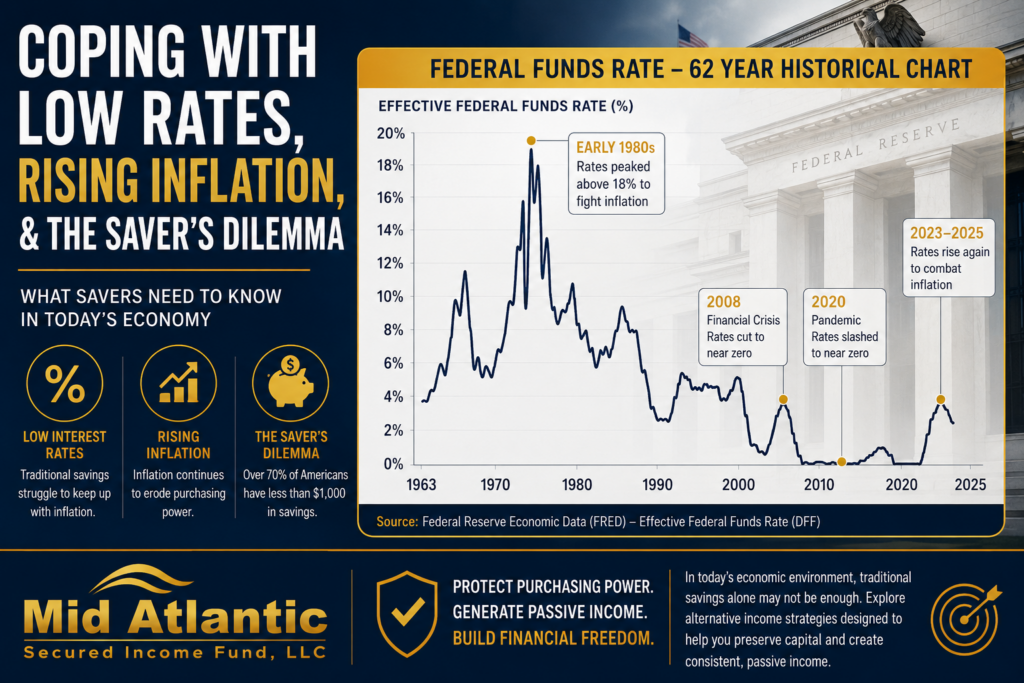
For much of the past two decades, investor attention centered heavily on capital appreciation. Low interest rates, expansive monetary policy, and strong public equity market performance rewarded growth-oriented strategies across technology, venture capital, and public equities.
Today, the investment landscape looks materially different.
Persistent inflation pressures, elevated market volatility, rising interest rates, and growing retirement income demands have fundamentally reshaped how sophisticated investors think about portfolio construction. Increasingly, institutional investors, family offices, RIAs, and accredited investors are shifting focus toward one central objective:
Durable, risk-aware income generation.
As a result, income-producing investments have moved from a secondary portfolio consideration to a core institutional allocation strategy.
This evolution is visible across:
- Pension funds
- Insurance companies
- Endowments
- Sovereign wealth funds
- Private wealth platforms
- High-net-worth portfolios
According to Preqin and BlackRock research, alternative income-producing assets — including private credit, infrastructure debt, real estate-backed lending, and other private market strategies — continue attracting significant institutional capital inflows globally.
The reasons are increasingly clear:
- Public market volatility remains elevated
- Traditional bonds face interest-rate sensitivity
- Retirees require dependable cash flow
- Investors seek diversification beyond equities
- Inflation has increased demand for real asset exposure
Income-producing investments now sit at the intersection of:
- Wealth preservation
- Retirement planning
- Alternative investing
- Portfolio diversification
- Risk management
- Long-term capital efficiency
What Are Income-Producing Investments?
Direct Answer
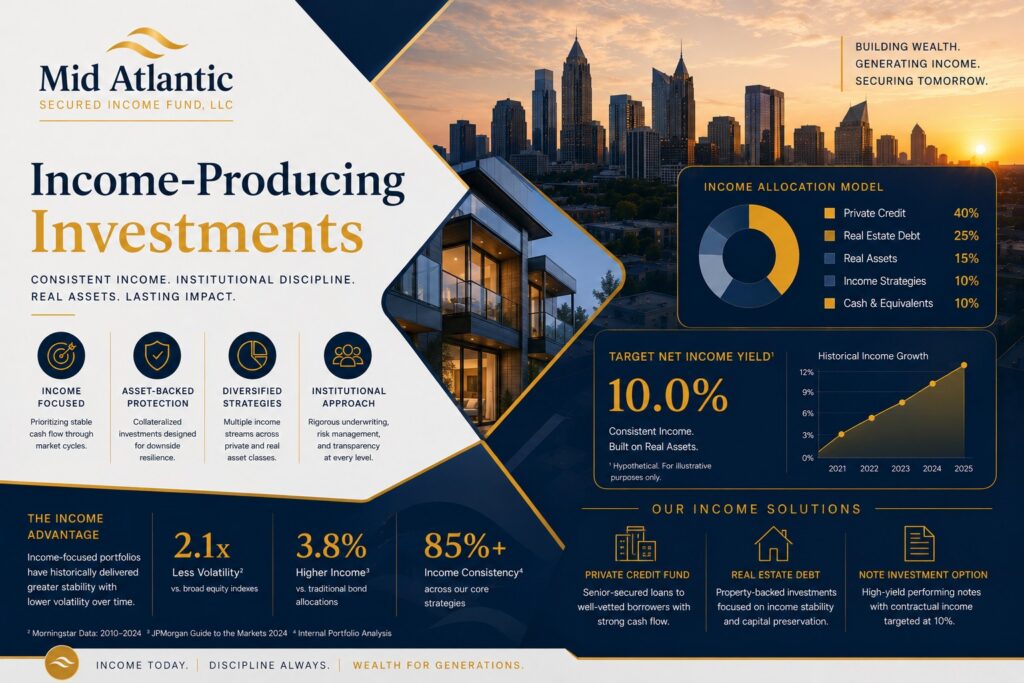
Income-producing investments are assets designed to generate recurring cash flow through interest payments, dividends, rental income, or contractual distributions rather than relying solely on capital appreciation.
Examples may include:
- Private credit investments
- Real estate debt
- Dividend-paying equities
- Bonds
- Infrastructure investments
- Asset-backed lending
- REITs
- Income-oriented alternative funds
Many institutional investors use income-producing investments to support:
- Retirement income
- Portfolio stability
- Diversification
- Inflation management
- Long-term wealth preservation
Why Income Matters More Today
The Shift From Growth-Only Investing
During prolonged bull markets, many investors prioritized appreciation-focused assets. However, recent market cycles demonstrated the importance of diversified return sources.
Several structural trends have accelerated interest in income-oriented investing:
1. Higher Interest Rates
After years of near-zero rates, the global interest-rate environment changed materially. Investors began reassessing fixed income allocations, credit spreads, and cash-flow-oriented assets.
2. Retirement Demographics
According to U.S. Census Bureau projections, the retirement-age population continues expanding significantly. This demographic shift has increased demand for investments capable of generating sustainable cash flow.
3. Market Volatility
Higher equity volatility has increased investor focus on downside-risk mitigation and income diversification.
4. Inflation Sensitivity
Income-generating real assets may help support purchasing power during inflationary environments.
The Evolution of Income-Producing Investments
Beyond Traditional Bonds
Historically, income investing centered primarily on:
- Treasury bonds
- Municipal bonds
- Corporate bonds
- Dividend-paying stocks
Today, institutional portfolio construction increasingly incorporates alternative income assets such as:
- Private credit
- Real estate-backed lending
- Infrastructure debt
- Asset-backed finance
- Specialty lending
- Senior secured debt
These strategies may provide:
- Enhanced diversification
- Alternative return drivers
- Contractual income structures
- Lower public market correlation
What Is Private Credit?
Direct Answer
Private credit refers to lending conducted by private investment firms or debt funds rather than traditional banks or public bond markets.
Private credit strategies may include:
- Real estate bridge loans
- Construction lending
- Asset-backed finance
- Commercial loans
- Senior secured lending
- Specialty finance
Institutional investors increasingly use private credit for income generation and diversification.
According to Preqin, private credit assets under management have expanded substantially over the past decade as institutional demand for alternative income strategies increased globally.
Why Institutional Investors Use Private Credit
1. Contractual Income Streams
Unlike equities, which rely heavily on appreciation and earnings growth, private credit often focuses on contractual interest payments.
2. Asset-Backed Structures
Many private lending strategies involve collateral protections such as:
- Real estate
- Equipment
- Receivables
- Other hard assets
3. Senior Positioning
Certain private credit strategies emphasize:
- First-lien structures
- Senior secured positions
- Conservative loan-to-value ratios
4. Lower Public Market Correlation
Private credit may exhibit different risk and return dynamics than public equities.
Income-Producing Investments and Retirement Planning
Cash Flow Becomes Increasingly Important
As investors approach retirement, priorities often evolve.
The emphasis frequently shifts toward:
- Stable income generation
- Reduced volatility
- Capital preservation
- Portfolio durability
- Inflation sensitivity
This helps explain why many retirement-focused investors explore:
- Alternative income strategies
- Passive income investments
- Real estate-backed lending
- Diversified credit investments
Income-oriented investing may help reduce reliance on forced asset sales during volatile markets.
Common Types of Income-Producing Investments
Dividend-Paying Equities
Dividend stocks distribute a portion of corporate earnings to shareholders.
Potential benefits:
- Long-term growth participation
- Dividend income
- Public market liquidity
Potential risks:
- Equity market volatility
- Dividend reductions
- Sector concentration
Bonds
Traditional bonds remain foundational within many portfolios.
Potential benefits:
- Predictable interest payments
- Liquidity
- Lower volatility than equities
Potential risks:
- Interest-rate sensitivity
- Inflation erosion
- Credit risk
Real Estate Debt
Real estate-backed lending strategies generate income through interest payments secured by property collateral.
Potential benefits:
- Asset-backed exposure
- Contractual income
- Real asset sensitivity
Potential risks:
- Real estate market downturns
- Borrower defaults
- Liquidity constraints
Private Credit Funds
Private credit funds pool investor capital to originate or acquire private loans.
Potential benefits:
- Diversification
- Higher income potential
- Institutional underwriting
Potential risks:
- Illiquidity
- Credit exposure
- Economic sensitivity
REITs
Real Estate Investment Trusts provide exposure to income-producing real estate portfolios.
Potential benefits:
- Dividend income
- Real estate exposure
- Public market access
Potential risks:
- Equity volatility
- Interest-rate sensitivity
- Sector-specific risk
How Institutional Investors Build Income Portfolios
Diversification Remains Critical
Sophisticated income portfolios often combine multiple sources of cash flow rather than relying on a single asset class.
Example institutional framework:
|
Asset Class |
Potential Portfolio Role |
|---|---|
|
Investment-Grade Bonds |
Stability |
|
Private Credit |
Income generation |
|
Real Estate Debt |
Asset-backed exposure |
|
Dividend Equities |
Growth + income |
|
Infrastructure |
Inflation sensitivity |
|
Cash Equivalents |
Liquidity management |
This multi-source approach may improve resilience across economic cycles.
Are Income-Producing Investments Safer?
Direct Answer
No investment is risk-free. However, certain income-producing investments may prioritize capital preservation, downside-risk management, and contractual cash flow over aggressive appreciation strategies.
Risk levels vary significantly depending on:
- Asset quality
- Underwriting discipline
- Leverage
- Liquidity
- Economic conditions
- Manager experience
Institutional investors often evaluate risk-adjusted returns rather than pursuing maximum yield alone.
The Difference Between Yield and Quality
High Yield Alone Is Not a Strategy
One of the most important lessons institutional investors understand is that:
Higher yield does not automatically equal better investment quality.
Sophisticated income investing typically focuses on:
- Underwriting standards
- Collateral quality
- Manager discipline
- Diversification
- Liquidity planning
- Structural protections
Many experienced investors prioritize:
- Sustainability of income
- Downside mitigation
- Portfolio durability
rather than simply maximizing yield.
Why Real Assets Matter
Inflation Sensitivity and Tangible Collateral
Real assets increasingly play an important role in institutional portfolio construction.
Examples include:
- Real estate-backed lending
- Infrastructure debt
- Asset-backed finance
Potential benefits may include:
- Inflation sensitivity
- Collateral support
- Alternative return drivers
- Diversification
According to BlackRock and McKinsey research, institutional allocations toward private markets and real assets continue expanding globally.
Behavioral Finance and Income Investing
Emotional Stability Matters
Income-producing investments may also influence investor behavior.
Portfolios designed around:
- Cash flow
- Diversification
- Lower volatility
can sometimes reduce emotional reactions during market downturns.
Behavioral finance research consistently shows that:
- Panic selling
- Performance chasing
- Short-term decision-making
often harm long-term investment outcomes.
Institutional investment frameworks typically emphasize:
- Discipline
- Process consistency
- Long-duration thinking
How Technology Is Changing Income Investing
Modern investment management increasingly incorporates:
- Real-time reporting
- Investor dashboards
- Portfolio analytics
- AI-assisted monitoring
- Automated servicing systems
Sophisticated investors increasingly expect:
- Transparency
- Institutional reporting
- Operational efficiency
- Digital access
This evolution has transformed both public and private market investing.
The Role of SDIRAs in Income Investing
Self-Directed IRAs (SDIRAs) allow eligible investors to allocate retirement capital into certain alternative investments beyond traditional public securities.
Depending on custodian rules and IRS guidelines, investors may explore:
- Private credit
- Real estate debt
- Alternative income investments
- Certain private funds
This flexibility has increased interest among accredited investors seeking diversified retirement income strategies.
What Investors Should Evaluate Before Investing
Key Due Diligence Considerations
Sophisticated investors often evaluate:
Investment Strategy
What generates the income?
Risk Management
How are downside risks managed?
Underwriting Standards
How conservative is the lending process?
Liquidity
How accessible is investor capital?
Transparency
What reporting systems exist?
Manager Experience
Has the manager navigated multiple market cycles?
Alignment of Interests
How are incentives structured?
Why Income-Producing Investments Continue Growing
Several long-term trends continue supporting institutional demand:
1. Aging Population
Growing retirement income needs.
2. Higher Market Volatility
Demand for diversification.
3. Alternative Investment Expansion
Institutional adoption of private markets.
4. Inflation Concerns
Need for real asset exposure.
5. Portfolio Customization
More personalized wealth strategies.
The Future of Income-Oriented Investing
The next decade will likely continue reshaping investment management.
Institutional portfolios increasingly emphasize:
- Diversification
- Alternative income sources
- Real assets
- Private markets
- Risk-adjusted returns
- Long-term durability
Rather than relying exclusively on appreciation-focused strategies, sophisticated investors are increasingly building portfolios designed to:
- Generate sustainable income
- Preserve purchasing power
- Navigate volatility
- Support multi-generational wealth objectives
This shift is becoming one of the defining themes in modern portfolio construction.
FAQ Section
What are income-producing investments?
Income-producing investments are assets that generate recurring cash flow through interest payments, dividends, rental income, or contractual distributions rather than relying solely on appreciation.
What are examples of income-producing investments?
Examples include bonds, dividend stocks, private credit, real estate debt, REITs, infrastructure investments, and certain alternative investment funds.
Why are investors using private credit?
Many investors use private credit for income generation, diversification, lower public market correlation, and exposure to asset-backed lending opportunities.
Are income-producing investments safe?
All investments involve risk. Some income-producing strategies may emphasize downside protection and capital preservation, but risks such as borrower default, liquidity constraints, and economic downturns remain important considerations.
What is real estate debt investing?
Real estate debt investing involves lending capital secured by property collateral. Investors may earn interest income through bridge loans, construction financing, or commercial lending structures.
Can retirement accounts invest in alternative income assets?
Certain self-directed retirement accounts (SDIRAs) may allow investments in alternative assets such as private credit or real estate-related investments, subject to IRS and custodian rules.
Why do institutional investors diversify income sources?
Institutional investors diversify income sources to reduce concentration risk, improve portfolio resilience, and create multiple return drivers across varying market environments.