Why Sophisticated Investors Think Differently About Returns
For decades, investors were taught that maximizing investment returns primarily meant chasing higher-performing stocks, timing market cycles, or aggressively increasing portfolio risk exposure.
Institutional investors rarely approach wealth creation that way.
Large pension funds, insurance companies, family offices, endowments, and sophisticated accredited investors often focus less on chasing the single highest-returning asset and more on constructing portfolios capable of producing durable, risk-adjusted returns across multiple market environments.
That distinction matters.
The difference between speculative returns and sustainable returns is often the difference between temporary gains and long-term wealth preservation.
Today’s investment environment presents a unique challenge:
- Elevated interest rates
- Persistent inflation concerns
- Increased stock market concentration
- Geopolitical volatility
- Commercial real estate repricing
- Higher bond market volatility
- Slowing global economic growth
According to the Federal Reserve, U.S. household net worth reached record highs in recent years, yet wealth concentration and market dependency also increased significantly. At the same time, institutional investors have steadily expanded allocations to alternative assets, private credit, infrastructure, and real estate-backed income strategies in pursuit of improved diversification and more stable return streams.
The modern conversation around maximizing investment returns is no longer simply about “earning more.”
It is increasingly about:
- Improving risk-adjusted performance
- Enhancing income consistency
- Protecting downside exposure
- Reducing portfolio volatility
- Increasing diversification
- Optimizing tax efficiency
- Preserving purchasing power over decades
Investors seeking long-term success increasingly recognize that maximizing returns without understanding risk often leads to avoidable portfolio instability.
What Does “Maximizing Investment Returns” Actually Mean?
Direct Answer
Maximizing investment returns means improving total portfolio performance over time while balancing risk, income generation, diversification, liquidity needs, tax efficiency, and capital preservation.
Sophisticated investors evaluate returns using multiple metrics, including:
- Total return
- Risk-adjusted return
- Cash flow consistency
- Inflation-adjusted return
- Portfolio drawdown exposure
- Correlation across assets
- Tax efficiency
- Long-term compounding potential
The highest-returning asset in one year is not necessarily the best long-term investment.
Institutional portfolio construction focuses on achieving sustainable compounded growth while managing downside volatility.
The Evolution of Modern Portfolio Construction
Traditional portfolio models relied heavily on the classic 60/40 allocation:
- 60% equities
- 40% bonds
For decades, this structure benefited from falling interest rates, expanding equity multiples, and strong bond diversification.
However, market dynamics have changed materially.
According to BlackRock and JPMorgan Asset Management research, institutional portfolios have steadily increased allocations to alternative investments over the last two decades due to:
- Lower expected public market returns
- Higher stock-bond correlation periods
- Inflation uncertainty
- Yield compression in traditional fixed income
- Desire for uncorrelated return streams
Institutional investors now commonly allocate capital across:
|
Asset Class |
Institutional Purpose |
|---|---|
|
Public Equities |
Long-term growth |
|
Fixed Income |
Stability & income |
|
Private Credit |
Enhanced yield |
|
Real Estate Debt |
Asset-backed income |
|
Infrastructure |
Inflation resilience |
|
Private Equity |
Growth enhancement |
|
Cash & Treasuries |
Liquidity management |
|
Structured Credit |
Yield optimization |
This shift reflects a broader understanding that maximizing returns often requires broader diversification beyond traditional stock-and-bond portfolios.
Why Risk-Adjusted Returns Matter More Than Raw Returns
One of the most overlooked concepts in investing is that identical returns can carry vastly different levels of risk.
Consider two portfolios:
|
Portfolio |
Annual Return |
Max Drawdown |
|---|---|---|
|
Portfolio A |
10% |
-45% |
|
Portfolio B |
9% |
-12% |
Many institutional investors would prefer Portfolio B.
Why?
Because severe drawdowns can significantly impair long-term compounding.
Recovering from losses becomes exponentially harder as drawdowns increase.
|
Loss |
Gain Needed to Recover |
|---|---|
|
-10% |
+11% |
|
-20% |
+25% |
|
-40% |
+67% |
|
-50% |
+100% |
Sophisticated wealth management increasingly prioritizes:
- Volatility management
- Capital preservation
- Stable income production
- Downside protection
- Portfolio durability
Maximizing returns is not simply about upside participation.
It is about protecting the compounding engine itself.
The Role of Private Credit in Return Optimization
What Is Private Credit?
Private credit refers to non-bank lending strategies where capital is deployed directly into loans outside traditional public bond markets.
Private credit has grown rapidly following the Global Financial Crisis as banks reduced certain lending activities due to regulatory changes.
According to Preqin, global private credit assets under management surpassed $1.7 trillion in recent years, making it one of the fastest-growing alternative asset classes.
Common private credit strategies include:
- Senior secured real estate lending
- Direct lending
- Asset-backed lending
- Construction lending
- Bridge lending
- Mezzanine financing
- Specialty finance
Why Institutional Investors Use Private Credit
Institutional investors often allocate to private credit because it may offer:
- Higher yields than traditional bonds
- Floating-rate structures
- Asset-backed collateral
- Reduced public market correlation
- Monthly or quarterly income
- Senior secured positioning
In rising rate environments, floating-rate lending strategies may help preserve income generation more effectively than long-duration fixed-rate bonds.
Private credit also allows investors to participate in segments of the market traditionally accessed primarily by banks and institutional capital providers.
Real Estate-Backed Investments and Income Stability
Real estate-backed lending strategies have become increasingly attractive among income-oriented investors seeking capital preservation characteristics alongside yield generation.
Unlike speculative equity investments dependent entirely on asset appreciation, senior secured lending structures often focus on:
- Collateral protection
- Loan-to-value discipline
- borrower underwriting
- cash flow coverage
- first-lien security positions
This structural focus can help reduce downside exposure compared to unsecured lending or highly volatile growth assets.
For many accredited investors, real estate debt strategies serve as a middle ground between:
- lower-yield traditional bonds
- and higher-volatility public equities
Why Diversification Remains Central to Maximizing Returns
Diversification is often misunderstood.
It is not merely owning many investments.
True diversification means combining assets that respond differently to economic conditions.
Institutional portfolios frequently diversify across:
Economic Sensitivity
- Growth-sensitive assets
- Defensive income assets
- Inflation-sensitive assets
- Countercyclical assets
Liquidity Profiles
- Public market liquidity
- Semi-liquid investments
- Long-duration private investments
Interest Rate Exposure
- Fixed-rate assets
- Floating-rate assets
- Short-duration strategies
Income Sources
- Dividends
- Bond coupons
- Rental cash flow
- Loan interest
- Structured income
The goal is not complexity for complexity’s sake.
The goal is portfolio resilience.
The Psychology of Return Maximization
Behavioral finance research consistently shows that investor behavior often harms long-term performance.
According to DALBAR studies, average investor returns frequently trail market benchmarks due to:
- Emotional trading
- Panic selling
- Performance chasing
- Market timing
- Recency bias
Sophisticated investors often maximize returns not through hyperactivity, but through:
- discipline
- consistency
- diversification
- risk management
- long-term focus
This is especially important during periods of elevated volatility.
The strongest long-term portfolios are often built through patience rather than prediction.
Inflation and the Hidden Risk to Investment Returns
Inflation materially impacts long-term purchasing power.
A portfolio generating 5% annually during 2% inflation produces very different real returns than the same portfolio during 6% inflation.
Real return formula:
Real Return ~ Nominal Return – Inflation Rate
This explains why many institutional investors seek:
- income-producing assets
- floating-rate investments
- real assets
- infrastructure
- private credit
- real estate exposure
These strategies may offer greater inflation resilience compared to certain traditional fixed-income instruments.
How Accredited Investors Use Alternative Investments
Accredited investors increasingly incorporate alternatives into portfolios to improve diversification and enhance return potential.
Common alternative allocations include:
|
Alternative Asset |
Strategic Goal |
|---|---|
|
Private Credit |
Yield enhancement |
|
Real Estate Debt |
Asset-backed income |
|
Infrastructure |
Inflation protection |
|
Private Equity |
Growth exposure |
|
Structured Income |
Consistent cash flow |
|
Real Assets |
Diversification |
Many institutional portfolios now allocate 20–50% or more to alternative investments depending on mandate and liquidity requirements.
Are Debt Funds Safer Than Stocks?
Direct Answer
Debt funds and private credit strategies are generally designed to prioritize income generation and downside protection rather than equity-like growth.
However, all investments carry risk.
Senior secured debt investments may offer:
- higher position in the capital stack
- collateral backing
- contractual payment structures
- reduced volatility relative to equities
Stocks, by contrast, typically offer:
- higher long-term appreciation potential
- greater volatility
- subordinate claim structures
- higher sensitivity to market sentiment
Neither structure is universally “better.”
Sophisticated portfolio construction often incorporates both.
How Institutional Investors Evaluate Risk
Institutional risk analysis extends beyond volatility alone.
Key metrics include:
Default Risk
Probability borrowers fail to repay obligations.
Duration Risk
Sensitivity to interest rate movements.
Correlation Risk
Likelihood assets decline simultaneously.
Liquidity Risk
Ability to exit positions efficiently.
Credit Risk
Borrower financial deterioration risk.
Concentration Risk
Overexposure to specific sectors or counterparties.
Inflation Risk
Loss of purchasing power over time.
The objective is balancing return generation with acceptable risk exposure.
The Importance of Income-Producing Investments
One of the largest shifts in modern wealth management is renewed focus on cash-flow-generating assets.
During prolonged periods of market uncertainty, investors increasingly value:
- predictable distributions
- income visibility
- lower volatility
- contractual cash flows
Income-producing investments may include:
- Treasury securities
- municipal bonds
- corporate bonds
- dividend equities
- REITs
- private credit
- real estate debt funds
- infrastructure investments
The appeal of income-oriented investing increases significantly during retirement planning and capital preservation phases.
Tax Efficiency and Return Optimization
Maximizing returns also requires understanding after-tax outcomes.
Sophisticated investors frequently evaluate:
- tax-deferred accounts
- Roth structures
- capital gains treatment
- income tax exposure
- depreciation benefits
- estate planning considerations
Self-directed IRAs have become increasingly popular among accredited investors seeking access to alternative assets such as:
- private credit
- real estate debt
- private placements
- real estate-backed lending
This allows certain investors to potentially defer or reduce tax friction while expanding portfolio diversification.
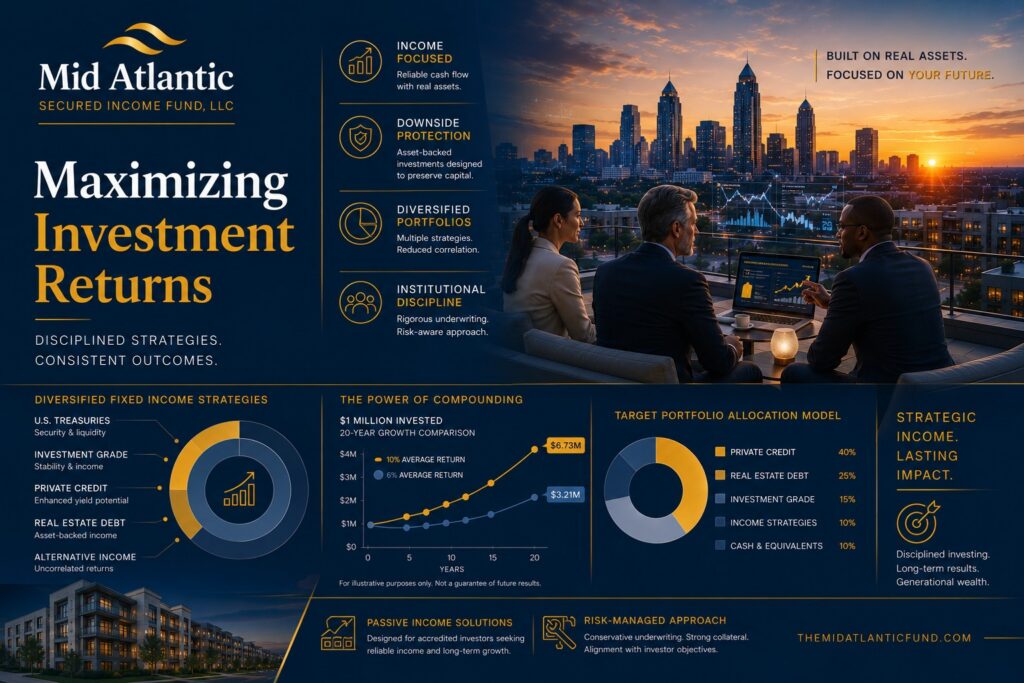
The Role of Compounding in Long-Term Wealth Creation
Compounding remains one of the most powerful drivers of wealth accumulation.
Small differences in annual return rates create enormous differences over time.
Where:
- A = future value
- P = principal
- r = annual return
- n = compounding frequency
- t = time
Long-term investing success often depends less on short-term performance spikes and more on sustained compounding over decades.
Why Market Cycles Matter
Maximizing returns requires recognizing that markets operate cyclically.
Different asset classes perform differently depending on:
- interest rates
- inflation
- economic growth
- credit conditions
- liquidity availability
Institutional investors frequently rebalance allocations based on macroeconomic conditions rather than relying exclusively on static models.
This does not necessarily mean market timing.
It means strategic adaptation.
Portfolio Construction for Different Investor Objectives
Conservative Income-Oriented Investors
Typically prioritize:
- capital preservation
- income stability
- downside protection
- lower volatility
May allocate more heavily toward:
- senior secured credit
- fixed income
- cash equivalents
- real estate-backed lending
Growth-Oriented Investors
Typically prioritize:
- capital appreciation
- equity exposure
- long-duration growth themes
May tolerate greater volatility.
Balanced Investors
Often seek:
- diversified growth
- income generation
- inflation protection
- moderate risk exposure
Institutional portfolios frequently blend these approaches.
Common Mistakes That Hurt Long-Term Returns
Chasing Yield Without Understanding Risk
Higher yields often reflect higher risk exposure.
Over-concentration
Too much exposure to one asset class or sector increases portfolio vulnerability.
Emotional Investing
Fear and greed often lead to poor timing decisions.
Ignoring Liquidity Needs
Illiquid investments can create financial strain if improperly allocated.
Lack of Diversification
Correlation spikes during stress periods can expose concentrated portfolios.
Why Sophisticated Investors Focus on Process
Institutional investors rarely rely solely on “hot picks.”
Instead, they emphasize:
- underwriting discipline
- portfolio management
- asset selection
- diversification
- risk controls
- long-term strategy
This process-driven approach often creates more durable outcomes across market cycles.
How The Mid Atlantic Secured Income Fund Approaches Income-Focused Investing
The Mid Atlantic Secured Income Fund focuses on real estate-backed lending strategies designed around:
- senior secured positioning
- disciplined underwriting
- income-oriented investing
- asset-backed structures
- conservative lending practices
Rather than emphasizing speculative appreciation, the strategy centers on generating consistent income through secured lending opportunities.
This aligns with broader institutional trends toward private credit and income-producing alternatives.
Investors seeking to learn more can explore:
- the Knowledge Hub
- private credit education resources
- IRA investing strategies
- passive income planning tools
The Future of Return Optimization
The future of investing is likely to become increasingly institutionalized.
Investors are gaining access to strategies once largely limited to:
- pension funds
- insurance companies
- endowments
- family offices
This includes:
- private credit
- real estate debt
- alternative income strategies
- structured investments
- institutional diversification frameworks
The next decade may reward investors who prioritize:
- adaptability
- diversification
- income durability
- downside awareness
- inflation resilience
- disciplined portfolio construction
rather than simply pursuing speculative growth alone.
Conclusion
Maximizing investment returns is no longer simply about finding the highest-returning asset.
Sophisticated investors increasingly understand that durable wealth creation depends on:
- disciplined portfolio construction
- diversification
- risk management
- income consistency
- inflation awareness
- long-term compounding
- capital preservation
Institutional investing frameworks continue evolving toward broader alternative allocations, private credit exposure, and income-producing strategies designed to improve portfolio resilience across changing economic environments.
For many accredited investors, the future of wealth management may depend less on speculation and more on disciplined access to real assets, private markets, and thoughtfully constructed income strategies.
FAQ Section
What is the best way to maximize investment returns?
The best way to maximize investment returns is through diversified portfolio construction, disciplined risk management, long-term investing, tax efficiency, and strategic allocation across growth and income-producing assets.
Are alternative investments good for diversification?
Alternative investments may improve diversification because they often have lower correlation to traditional stock and bond markets.
What are income-producing investments?
Income-producing investments generate recurring cash flow through interest, dividends, rent, or distributions.
Why are institutional investors using private credit?
Institutional investors increasingly use private credit for yield enhancement, floating-rate exposure, diversification, and asset-backed lending opportunities.
Are real estate debt funds safer than stocks?
Real estate debt funds may provide lower volatility and stronger collateral positioning than equities, though all investments involve risk.
How do accredited investors build diversified portfolios?
Many accredited investors combine public equities, fixed income, private credit, real estate-backed investments, and alternative assets to improve diversification and risk-adjusted returns.