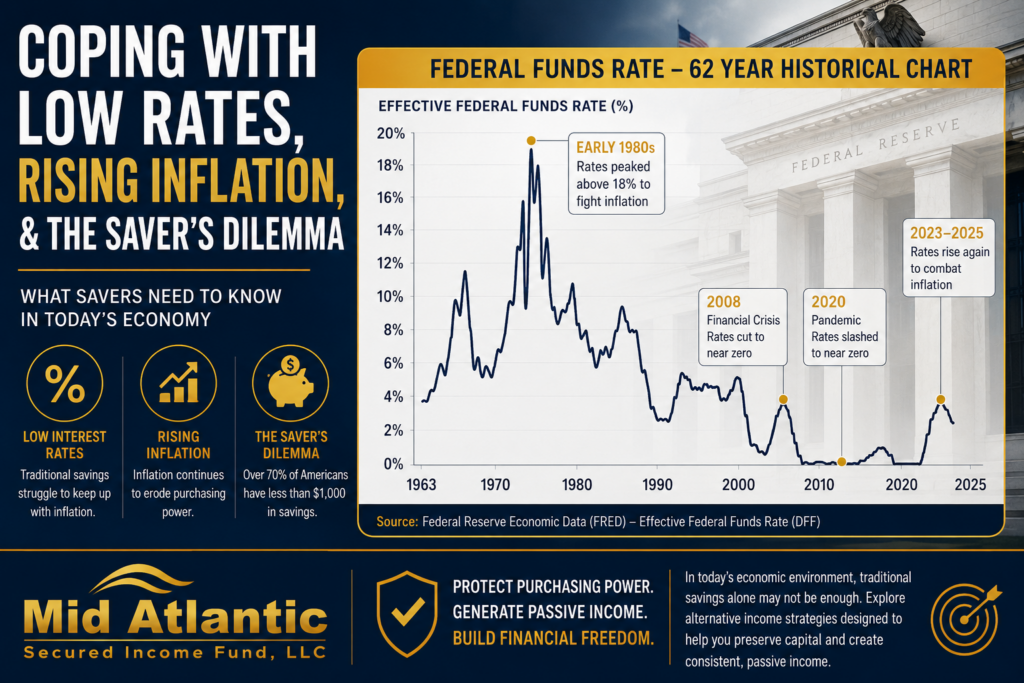

Why Investors Are Re-Evaluating Traditional Income Strategies
For decades, traditional portfolio construction centered around a familiar framework: equities for growth and bonds for income.
However, evolving market conditions have forced investors to reconsider how dependable income is generated.
Persistent inflation, elevated market volatility, compressed public bond yields, and tighter banking conditions have accelerated institutional demand for alternative income-producing assets — particularly secured income funds.
Increasingly, sophisticated investors are searching for strategies capable of delivering:
- predictable cash flow,
- downside protection,
- portfolio diversification,
- inflation resilience,
- and reduced reliance on public market performance.
This shift has fueled substantial growth across private credit, real estate-backed lending, and asset-backed income strategies.
Today, secured income funds have emerged as a significant component of institutional portfolio construction among:
- accredited investors,
- family offices,
- RIAs,
- pension allocators,
- and high-net-worth retirees seeking durable income streams.
What Are Secured Income Funds?
Direct Answer
Secured income funds are investment vehicles designed to generate recurring income through collateral-backed lending strategies. These funds often invest in private credit, real estate-backed loans, senior secured debt, or other asset-backed income opportunities where investors may benefit from contractual interest payments and underlying collateral protection.
Unlike traditional equity-focused strategies, secured income funds emphasize:
- capital preservation,
- income generation,
- underwriting discipline,
- and downside mitigation.
How Secured Income Funds Work
Most secured income funds operate by deploying investor capital into loans or credit instruments backed by tangible assets or contractual collateral structures.
Common examples include:
- residential real estate bridge loans,
- commercial real estate debt,
- senior secured business loans,
- asset-backed specialty finance,
- construction lending,
- and private mortgage financing.
The fund earns interest income from borrowers and distributes a portion of that income to investors.
Because these strategies are often privately negotiated rather than publicly traded, they may offer enhanced yield opportunities compared to traditional investment-grade bonds.
Why Secured Income Funds Have Grown in Popularity
Institutional Capital Is Moving Toward Private Credit
According to Preqin and BlackRock research, private credit has become one of the fastest-growing alternative asset classes globally.
Institutional investors increasingly allocate toward private lending strategies due to:
- higher yield potential,
- lower correlation to public markets,
- floating-rate structures,
- and collateral-backed protections.
As traditional banks reduce certain lending activities due to regulatory capital requirements, private lenders have expanded their role across commercial and residential financing markets.
Income Has Become More Important Than Speculation
Following years dominated by growth-oriented investing, many investors are now prioritizing:
- cash flow consistency,
- defensive positioning,
- and portfolio resilience.
This trend has become especially important among retirees and high-net-worth investors focused on preserving wealth through uncertain economic cycles.
The Difference Between Secured and Unsecured Investments
Secured Investments
Secured investments involve loans backed by collateral.
Examples include:
- real estate,
- equipment,
- receivables,
- or other pledged assets.
If a borrower defaults, the lender may have legal rights to pursue the underlying collateral.
Unsecured Investments
Unsecured investments rely primarily on the borrower’s promise to repay.
Examples include:
- unsecured corporate debt,
- many consumer loans,
- and certain high-yield bond structures.
These investments generally carry higher recovery risk during borrower distress.
Why Collateral Matters
Collateral plays a critical role in risk mitigation.
Institutional investors frequently prioritize strategies with:
- conservative loan-to-value ratios,
- strong borrower underwriting,
- tangible asset backing,
- and senior lien positioning.
In many secured income strategies, the lender occupies a higher position in the capital stack than equity investors.
This structure may provide:
- enhanced recovery potential,
- stronger downside protection,
- and more stable income generation.
Types of Secured Income Funds
Real Estate Debt Funds
Real estate debt funds focus on lending against real property collateral.
These strategies may include:
- bridge loans,
- multifamily lending,
- residential transition loans,
- commercial real estate financing,
- and construction loans.
Investors often favor real estate debt because the underlying collateral is tangible and may provide stronger recovery dynamics compared to unsecured credit.
Private Credit Funds
Private credit funds provide non-bank financing to businesses and real estate sponsors.
These structures frequently involve:
- floating interest rates,
- negotiated covenants,
- customized underwriting,
- and senior secured positions.
Private credit has become increasingly important as regional banks tighten lending standards.
Asset-Backed Lending Strategies
Asset-backed strategies lend against:
- receivables,
- inventory,
- equipment,
- transportation assets,
- or contractual cash flows.
Institutional investors may utilize these strategies to diversify beyond traditional corporate bonds.
Are Secured Income Funds Safer Than Stocks?
Direct Answer
Secured income funds are not risk-free, but many secured lending strategies may exhibit lower volatility than equities because lenders often benefit from contractual cash flows, collateral backing, and senior capital stack positioning.
However, risks remain and vary significantly based on:
- underwriting quality,
- leverage,
- market conditions,
- borrower strength,
- and portfolio diversification.
Key Risks Investors Should Understand
Credit Risk
Borrowers may fail to repay loans.
Strong underwriting standards are critical.
Liquidity Risk
Many private investments are less liquid than publicly traded securities.
Investors should maintain adequate liquidity planning.
Real Estate Market Risk
Property-backed lending strategies remain exposed to changing real estate conditions, valuation pressures, and refinancing environments.
Interest Rate Risk
Traditional fixed-rate bonds may suffer during rising rate periods.
Many private credit structures utilize floating-rate terms designed to reduce duration sensitivity.
Why Institutional Investors Use Secured Income Strategies
Institutional investors frequently allocate toward secured income strategies because they may offer:
- predictable income streams,
- diversification benefits,
- reduced public equity correlation,
- and risk-adjusted yield enhancement.
Large pension plans, endowments, and family offices increasingly treat private credit and real estate-backed lending as core strategic allocations.
The Rise of Alternative Fixed Income
Traditional fixed income markets experienced substantial disruption during periods of rapidly rising interest rates.
This accelerated demand for:
- floating-rate debt,
- shorter-duration income strategies,
- and private market alternatives.
Alternative fixed income now represents a major institutional theme.
How Secured Income Funds Fit Into Diversified Portfolios
Sophisticated portfolio construction typically balances multiple objectives:
|
Objective |
Potential Strategy |
|---|---|
|
Income Generation |
Private Credit |
|
Stability |
Treasuries |
|
Inflation Protection |
Real Assets |
|
Diversification |
Alternative Investments |
|
Liquidity |
Cash Equivalents |
Secured income funds may complement traditional allocations by providing:
- contractual cash flow,
- lower equity correlation,
- and exposure to private lending markets.
Why Accredited Investors Are Exploring Private Credit
Accredited investors often seek exposure to investments unavailable in public retail markets.
Private credit and secured income strategies may appeal because they can offer:
- enhanced yield opportunities,
- income consistency,
- collateral-backed structures,
- and institutional underwriting.
Many investors increasingly view alternative credit allocations as a strategic long-term portfolio component.
The Importance of Underwriting Discipline
Not all income strategies are created equally.
Institutional due diligence often evaluates:
- borrower quality,
- collateral value,
- loan-to-value ratios,
- geographic exposure,
- market fundamentals,
- and manager track record.
Sophisticated investors prioritize risk-adjusted returns rather than simply pursuing the highest available yield.
Behavioral Finance and Yield Chasing
One of the largest mistakes income investors make is chasing unsustainably high returns without understanding underlying risk.
Institutional investing emphasizes:
- discipline,
- diversification,
- collateral protection,
- and downside management.
Long-term wealth preservation often depends more on avoiding large losses than maximizing short-term gains.
Inflation and the Search for Real Income
Inflation materially impacts purchasing power over time.
Income-focused investors increasingly seek strategies capable of generating returns above inflation while maintaining portfolio durability.
Floating-rate credit and real asset-backed lending structures may provide advantages in inflationary environments.
Retirement Planning and Secured Income
Retirees increasingly face challenges balancing:
- longevity risk,
- inflation risk,
- market volatility,
- and income sustainability.
Secured income funds may help supplement retirement cash flow while diversifying beyond traditional stock and bond allocations.
Many investors also explore self-directed IRA structures to access private credit and alternative income investments.
The Future of Secured Income Investing
Several structural forces continue supporting growth across secured lending markets:
- aging demographics,
- institutional adoption of private credit,
- tighter banking regulations,
- elevated interest rates,
- and investor demand for diversification.
As capital markets evolve, income-producing alternative investments are likely to remain increasingly important in sophisticated portfolio construction.
Final Thoughts
Secured income funds represent a growing segment of modern alternative investing.
For accredited investors seeking:
- recurring income,
- downside mitigation,
- diversification,
- and long-term portfolio resilience,
secured lending strategies may offer compelling opportunities.
The most durable investment approaches typically prioritize:
- underwriting quality,
- collateral protection,
- risk management,
- and disciplined portfolio construction.
In uncertain market environments, these principles become increasingly important.
Rather than chasing speculative growth alone, many institutional investors are increasingly focused on building resilient portfolios capable of generating dependable income across economic cycles.
FAQ SECTION
What is a secured income fund?
A secured income fund is an investment vehicle that generates income through collateral-backed lending strategies such as private credit or real estate-backed loans.
Are secured income funds safe?
Secured income funds are not risk-free, but collateral-backed lending structures may provide stronger downside protection than unsecured investments.
How do secured income funds generate returns?
These funds generally earn returns through contractual interest payments from borrowers.
What types of collateral are commonly used?
Collateral may include residential real estate, commercial properties, equipment, receivables, or other pledged assets.
Why are institutional investors allocating toward private credit?
Institutional investors increasingly favor private credit because it may offer enhanced yields, diversification benefits, and lower correlation to public markets.