For decades, Americans were told to follow a simple financial formula: work hard, save consistently, and allow compound interest to build wealth over time. But in today’s economic environment, many savers are discovering a frustrating reality — traditional savings vehicles often struggle to keep pace with inflation, taxes, and the rising cost of living.
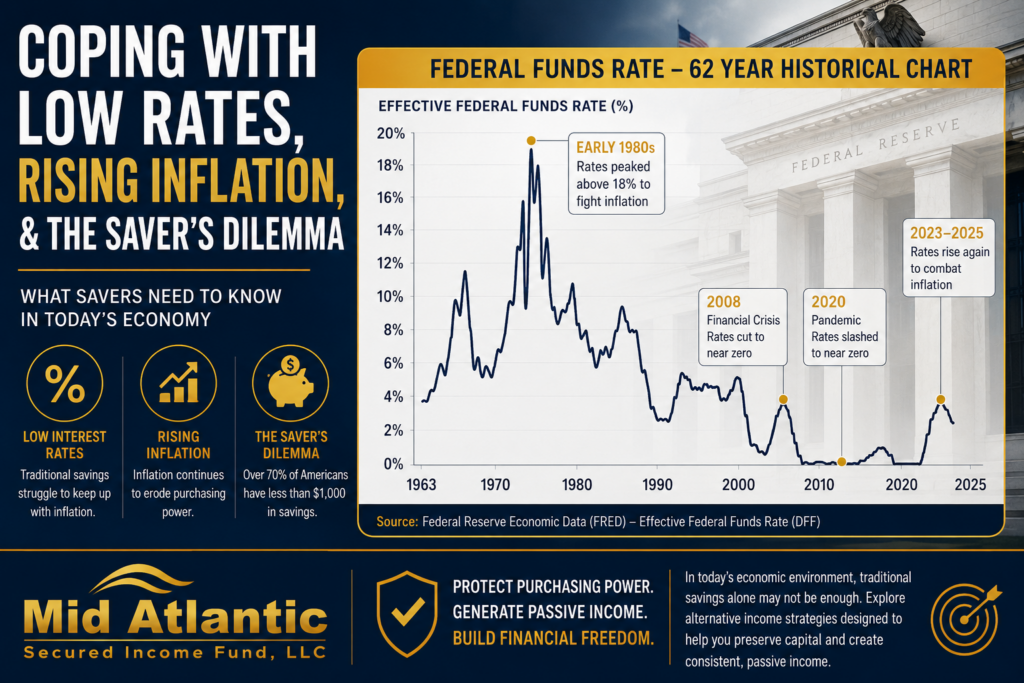
This challenge has created what many investors now call “The Saver’s Dilemma”: how do you preserve purchasing power and grow long-term wealth when traditional savings strategies may no longer be enough?
As inflation pressures persist and interest rates fluctuate, more investors are rethinking where they hold capital and how they generate income from their portfolios.
Why Traditional Saving Feels More Difficult Today
The U.S. personal savings rate has remained historically low compared to long-term averages. As of early 2026, the personal savings rate sits near 4%–4.5%, well below the historical average of roughly 8% over the past several decades.
At the same time:
- inflation has continued pressuring household budgets,
- housing and insurance costs remain elevated,
- and many Americans still lack sufficient emergency savings.
According to the Federal Reserve’s 2025 Economic Well-Being Report:
- only 55% of U.S. adults reported having enough emergency savings to cover three months of expenses,
- while 30% reported they could not cover three months of expenses by any means.
This environment has made traditional “save and wait” strategies increasingly frustrating for many households.
Inflation Quietly Reduces Purchasing Power
One of the biggest risks savers face is not market volatility — it is the gradual erosion of purchasing power.
Even moderate inflation compounds over time.
When inflation consistently outpaces the yield earned on idle cash or low-interest accounts, purchasing power declines over time.
Historically, many traditional savings accounts have offered rates below inflation. Even in today’s higher-rate environment, average traditional savings account yields remain relatively low compared to inflation-adjusted returns.
This is why investors increasingly focus on:
- income-producing assets,
- inflation-aware portfolio construction,
- and diversified alternative investments.
The Difference Between Saving and Investing
Saving and investing serve different purposes.
Savings Accounts
Best suited for:
- emergency reserves,
- short-term liquidity,
- cash management,
- near-term expenses.
Investing
Designed for:
- long-term growth,
- passive income,
- inflation mitigation,
- wealth accumulation,
- retirement planning.
The challenge many savers encounter is relying too heavily on short-term savings vehicles for long-term wealth-building goals.
The Power of Compound Growth
Long-term investing works because of compounding.
Small differences in annualized return can create dramatically different outcomes over decades.
For example:
- a portfolio compounding at 4% annually behaves very differently from one compounding at 8% annually over a 20–30 year period,
- especially when reinvesting income distributions consistently.
This is one reason investors increasingly seek diversified income-generating investments beyond traditional savings products alone.
Why Investors Are Exploring Alternative Income Strategies
In recent years, many investors have looked beyond conventional savings accounts and CDs toward:
- private credit,
- real estate-backed lending,
- alternative investments,
- dividend-producing assets,
- and income-oriented portfolios.
Private credit and senior secured lending strategies have gained significant institutional attention because they may offer:
- contractual income streams,
- collateral-backed structures,
- shorter-duration investments,
- and lower correlation to traditional public markets.
Of course, all investments carry risk, and alternative investments are not suitable for every investor. But many income-focused investors are increasingly prioritizing:
- downside protection,
- cash flow,
- and diversification.
Understanding the Appeal of Asset-Backed Investments
One reason investors explore asset-backed lending strategies is the emphasis on collateral and capital structure.
For example, in senior secured lending structures:
- loans may be backed by real estate or other collateral,
- lenders may sit higher in the capital stack,
- and income is often generated through contractual interest payments rather than speculative appreciation alone.
This differs significantly from purely equity-based investments where returns may depend more heavily on market appreciation.
A Growing Shift Toward Passive Income
Many investors today are less focused on speculative growth and more focused on:
- reliable cash flow,
- monthly income,
- and portfolio stability.
That shift has accelerated amid:
- market volatility,
- inflation uncertainty,
- and changing retirement expectations.
Investors nearing retirement, self-directed IRA holders, and income-focused households increasingly prioritize investments designed to generate recurring income rather than relying entirely on future asset appreciation.
Building a More Resilient Financial Strategy
There is no universal investment strategy that fits everyone.
However, many financial professionals agree on several core principles:
- maintain emergency liquidity,
- diversify across asset classes,
- think long term,
- understand risk,
- and focus on preserving purchasing power over time.
For many investors, the solution to the modern Saver’s Dilemma is not abandoning savings altogether — but complementing traditional savings with thoughtfully diversified investment strategies designed for long-term income and growth.
Final Thoughts
The economic landscape has changed significantly over the last several decades. Traditional savings vehicles still serve an important purpose, but many investors are realizing they may not be sufficient alone for long-term wealth creation and inflation protection.
As investors evaluate their financial goals, many are increasingly exploring strategies focused on:
- passive income,
- alternative investments,
- private credit,
- and asset-backed lending opportunities.
The key is building a disciplined, diversified strategy aligned with your risk tolerance, time horizon, and long-term financial objectives.
Frequently Asked Questions
What is the Saver’s Dilemma?
The Saver’s Dilemma refers to the challenge savers face when inflation and rising costs reduce the real purchasing power of money held in traditional low-yield savings vehicles.
Why is inflation important for investors?
Inflation reduces the purchasing power of money over time. Investors often seek investments capable of generating returns above inflation to preserve long-term wealth.
What is private credit?
Private credit generally refers to loans made outside traditional public banking markets, often involving direct lending or asset-backed financing structures.
Are alternative investments risky?
Yes. Alternative investments can involve unique risks, reduced liquidity, and different regulatory considerations compared to traditional investments. Investors should carefully evaluate all risks before investing.
Why do investors seek passive income investments?
Passive income strategies may help provide recurring cash flow, portfolio diversification, and long-term financial stability depending on an investor’s objectives.