
The New Era of Income Investing
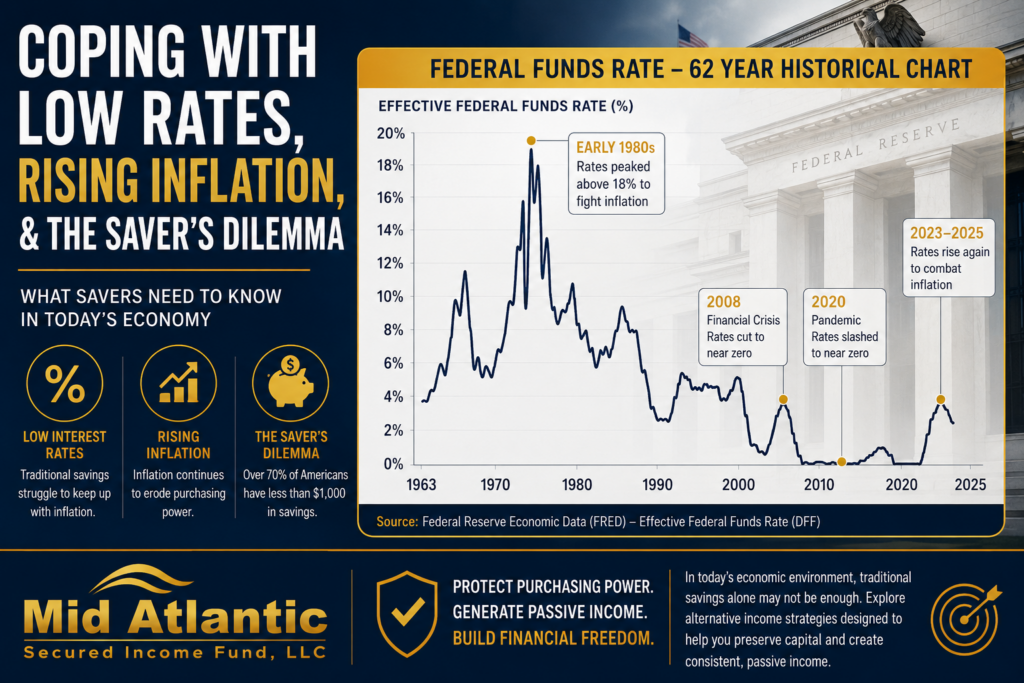
For much of the last decade, investors operated in an environment shaped by historically low interest rates, compressed yields, and elevated equity valuations. Traditional fixed income allocations often struggled to provide meaningful income after inflation, forcing many investors further out on the risk spectrum in pursuit of returns.
That landscape has shifted materially.
Higher benchmark interest rates, tighter credit conditions, and evolving capital markets have created a renewed focus on high-yield investment opportunities — particularly among accredited investors, family offices, retirees, and institutional allocators seeking durable income and downside protection.
Today, investors are increasingly evaluating alternatives beyond traditional stocks and bonds, including:
- Private credit
- Real estate-backed debt funds
- Senior secured lending
- Alternative fixed income strategies
- Structured income products
- Infrastructure income investments
- Asset-backed lending
- Cash-flow-oriented real estate strategies
The objective is no longer simply maximizing returns. Increasingly, sophisticated investors are prioritizing:
- Predictable income generation
- Capital preservation
- Inflation resilience
- Reduced volatility
- Diversification away from public markets
- Risk-adjusted performance
- Long-term portfolio durability
In this environment, high-yield investing has evolved from a niche allocation into a core strategic component of institutional portfolio construction.
What Are High-Yield Investment Opportunities?
Direct Answer
High-yield investment opportunities are investments designed to generate income returns above traditional savings accounts, Treasury securities, or investment-grade bonds. These opportunities often include private credit, real estate debt, corporate bonds, dividend-focused assets, and alternative investments that compensate investors with higher yields in exchange for additional complexity, illiquidity, or risk.
Why High-Yield Investing Has Re-Emerged
Several macroeconomic forces have contributed to renewed investor demand for income-focused alternatives.
1. Persistent Inflation Pressures
Even as inflation moderated from post-pandemic peaks, elevated living costs continue to impact retirement planning and portfolio sustainability.
According to the U.S. Bureau of Labor Statistics, cumulative inflation between 2020 and 2024 materially reduced purchasing power across households, increasing the importance of investments capable of generating real income after inflation.
For investors relying on portfolio distributions, stagnant yield environments can significantly erode long-term purchasing power.
2. Public Market Volatility
The traditional 60/40 portfolio has faced increasing scrutiny.
During periods of rising rates, both equities and traditional bonds experienced simultaneous drawdowns — challenging assumptions around diversification.
Institutional investors increasingly sought alternatives with:
- lower correlation to public equities,
- shorter duration exposure,
- collateral-backed structures,
- and contractual income streams.
This accelerated interest in private credit and alternative income investments.
3. Growth of Private Credit Markets
Private credit has emerged as one of the fastest-growing institutional asset classes globally.
Preqin projects global private debt assets under management could exceed $3 trillion by the end of the decade as institutional investors continue reallocating capital toward yield-focused alternatives.
The appeal is straightforward:
- higher yields relative to traditional fixed income,
- floating-rate structures,
- negotiated covenants,
- and collateral-backed lending.
Types of High-Yield Investment Opportunities
Private Credit
Private credit refers to non-bank lending strategies where investors provide capital directly to borrowers.
This category includes:
- bridge lending,
- real estate-backed lending,
- mezzanine debt,
- specialty finance,
- direct lending,
- and asset-backed credit.
Private credit often attracts accredited investors because of:
- elevated yields,
- lower public market correlation,
- contractual income,
- and stronger structural protections.
Real Estate Debt Funds
Real estate debt funds focus on lending against real estate collateral rather than owning properties directly.
These structures may include:
- first-position mortgages,
- bridge loans,
- construction lending,
- residential transition loans,
- and commercial real estate financing.
Many investors prefer debt-oriented real estate strategies because lenders generally sit higher in the capital stack than equity investors.
This can provide:
- downside protection,
- contractual repayment structures,
- recurring income,
- and collateral-backed security interests.
High-Yield Corporate Bonds
High-yield bonds — sometimes called “junk bonds” — are corporate bonds issued by companies with lower credit ratings.
These securities typically offer higher yields to compensate investors for increased default risk.
While high-yield bonds remain widely used in institutional portfolios, investors must carefully evaluate:
- issuer leverage,
- sector concentration,
- duration exposure,
- refinancing risk,
- and economic sensitivity.
Dividend-Focused Equity Strategies
Some investors pursue income through dividend-paying equities.
These strategies may include:
- utilities,
- pipelines,
- REITs,
- telecom companies,
- and dividend-growth portfolios.
Although dividend strategies can generate meaningful income, they remain exposed to broader equity market volatility.
Why Accredited Investors Use Alternative Income Strategies
Accredited investors often have access to investments unavailable in traditional retail brokerage accounts.
These opportunities may include:
- private debt funds,
- institutional lending vehicles,
- direct real estate lending,
- private equity credit structures,
- and specialty finance products.
Sophisticated investors frequently allocate toward these opportunities because they may offer:
- enhanced yield potential,
- diversification benefits,
- reduced public market sensitivity,
- and institutional underwriting standards.
Many family offices and high-net-worth investors now view alternative credit allocations as a strategic complement to traditional equities and bonds.
Are Debt Funds Safer Than Stocks?
Direct Answer
Debt funds are not inherently “safe,” but many debt-oriented strategies may exhibit lower volatility and more predictable cash flows than equities because lenders typically occupy senior positions in the capital structure and may benefit from collateral protection.
However, risk levels vary significantly depending on:
- underwriting quality,
- leverage,
- borrower profile,
- loan structure,
- asset type,
- and economic conditions.
Understanding Risk in High-Yield Investing
Higher yield almost always reflects some combination of:
- credit risk,
- liquidity risk,
- duration risk,
- complexity,
- or market uncertainty.
Sophisticated investors evaluate risk through multiple dimensions.
Credit Risk
Credit risk refers to the possibility that a borrower fails to repay obligations.
Institutional managers mitigate this through:
- borrower underwriting,
- collateral evaluation,
- cash flow analysis,
- loan covenants,
- and conservative loan-to-value ratios.
Liquidity Risk
Many alternative investments are less liquid than publicly traded securities.
This illiquidity may contribute to higher yields but requires investors to maintain appropriate liquidity planning.
Interest Rate Risk
Traditional bonds may decline in value as interest rates rise.
Many private credit strategies utilize floating-rate structures designed to reduce duration sensitivity.
Real Estate Market Risk
Real estate-backed investments remain influenced by:
- property valuations,
- local market conditions,
- vacancy rates,
- refinancing environments,
- and broader economic cycles.
Disciplined underwriting becomes critical.
The Role of Diversification in High-Yield Portfolios
Institutional investors rarely rely on a single income source.
Instead, diversified portfolios may include exposure across:
|
Asset Class |
Portfolio Objective |
|---|---|
|
Private Credit |
Enhanced yield |
|
Treasury Securities |
Stability |
|
Real Estate Debt |
Collateral-backed income |
|
Dividend Equities |
Long-term growth + income |
|
Cash Equivalents |
Liquidity |
|
Infrastructure Assets |
Inflation resistance |
Diversification can help:
- smooth portfolio volatility,
- reduce concentration risk,
- preserve income consistency,
- and improve long-term resilience.
How Institutional Investors Evaluate High-Yield Opportunities
Sophisticated investors rarely chase yield in isolation.
Institutional due diligence often evaluates:
Underwriting Discipline
- Loan-to-value ratios
- Borrower experience
- Market fundamentals
- Exit strategy viability
Alignment of Interests
- Manager co-investment
- Incentive structures
- Transparency standards
Historical Performance
- Default rates
- Loss history
- Recovery performance
- Risk-adjusted returns
Portfolio Construction
- Sector diversification
- Geographic diversification
- Concentration limits
The Rise of Real Estate-Backed Income Strategies
Real estate-backed lending strategies have become increasingly attractive because they combine:
- contractual income,
- tangible collateral,
- and relatively short-duration structures.
According to Freddie Mac and Mortgage Bankers Association data, private lenders have continued expanding market share as traditional banks tighten lending standards.
This has created opportunities for disciplined private credit managers to originate loans at attractive spreads.
Income Investing in a Higher-Rate Environment
Rising interest rates have materially changed portfolio construction.
Historically low-rate periods forced investors into:
- speculative growth equities,
- extended duration bonds,
- and compressed-yield environments.
Today, investors can often achieve stronger income profiles without assuming equivalent equity risk exposure.
This dynamic has reshaped institutional allocation models.
Behavioral Finance and Yield Chasing
One of the greatest risks in income investing is indiscriminately chasing the highest available yield.
Sophisticated investors understand that unsustainably high yields may reflect:
- distressed borrowers,
- weak collateral,
- excessive leverage,
- or elevated default probabilities.
Institutional investing emphasizes:
- risk-adjusted returns,
- underwriting quality,
- and capital preservation.
The Importance of Capital Preservation
Long-term wealth creation depends not only on returns, but on avoiding catastrophic losses.
This principle is especially important for retirees and income-focused investors.
Conservative income strategies often emphasize:
- downside mitigation,
- collateral protection,
- diversified exposure,
- and disciplined risk management.
How High-Yield Investments Fit into Retirement Planning
Income-focused investments can play an important role in retirement planning by helping investors generate recurring cash flow.
Potential objectives include:
- supplementing retirement income,
- reducing reliance on asset liquidation,
- diversifying beyond public markets,
- and preserving purchasing power.
Many investors increasingly explore self-directed IRA structures to access alternative investments including private credit and real estate debt.
High-Yield Investing and Inflation Protection
Inflation remains a central concern for long-term investors.
Strategies capable of generating strong recurring income may help offset inflationary pressures more effectively than low-yield cash equivalents.
Floating-rate credit structures may also provide advantages in rising-rate environments.
What Sophisticated Investors Look for in a Debt Fund
Experienced investors frequently evaluate:
- senior secured positioning,
- underwriting rigor,
- manager experience,
- transparency,
- historical loss mitigation,
- collateral coverage,
- and portfolio diversification.
Funds emphasizing conservative structures and income consistency often appeal to investors prioritizing capital preservation.
Why Private Credit Has Become a Core Institutional Allocation
Private credit is no longer viewed as a niche asset class.
Large pension funds, sovereign wealth funds, and insurance companies increasingly allocate capital toward alternative credit strategies due to:
- attractive yield spreads,
- lower public market correlation,
- and growing demand for non-bank financing.
This institutional adoption has accelerated dramatically over the last decade.
The Future of High-Yield Investing
Several structural trends are likely to shape the future of income-oriented investing:
- continued expansion of private credit markets,
- demographic demand for retirement income,
- evolving bank lending regulations,
- persistent inflation concerns,
- and increasing institutional adoption of alternatives.
Investors increasingly recognize that portfolio resilience depends on more than equity appreciation alone.
Income generation, diversification, and downside management are becoming central pillars of modern wealth preservation strategies.
Final Thoughts
High-yield investment opportunities continue evolving alongside broader economic and capital market shifts.
For accredited investors and income-focused allocators, alternative investments such as private credit, real estate-backed lending, and diversified income strategies may offer compelling ways to pursue:
- consistent cash flow,
- diversification,
- inflation resilience,
- and long-term portfolio durability.
The most successful long-term investors typically prioritize discipline over speculation, focusing on underwriting quality, risk management, and sustainable income generation rather than chasing unsustainable returns.
In an increasingly uncertain market environment, institutional portfolio construction principles — including diversification, collateral protection, and income consistency — may become even more important in the years ahead.
FAQ SECTION
What are high-yield investment opportunities?
High-yield investment opportunities are investments designed to generate income returns above traditional savings accounts or investment-grade bonds. Examples include private credit, real estate debt funds, high-yield corporate bonds, and alternative income investments.
Are high-yield investments risky?
Higher yields generally involve additional risk, including credit risk, liquidity risk, or market volatility. Investors should evaluate underwriting quality, diversification, collateral protection, and portfolio construction.
What is private credit?
Private credit refers to non-bank lending strategies where investors provide capital directly to businesses or real estate borrowers in exchange for interest income.
Why are accredited investors interested in private credit?
Many accredited investors seek private credit exposure because it may provide enhanced yield potential, contractual cash flow, diversification benefits, and lower correlation to public equity markets.
Are real estate debt funds safer than stocks?
Real estate debt funds are not risk-free, but debt-oriented strategies may offer lower volatility and stronger downside protection than equities because lenders typically occupy senior positions in the capital structure.