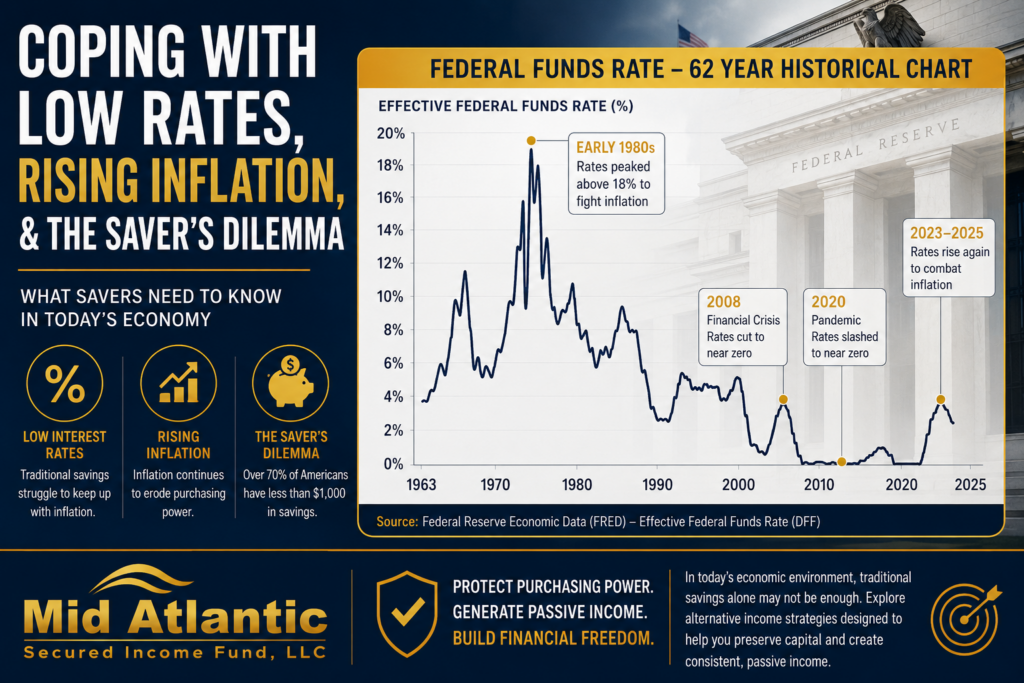

Why Investors Are Re-Evaluating “Safety” in Modern Portfolios
For decades, many investors associated “secure investments” almost exclusively with traditional bonds, savings accounts, and blue-chip dividend equities. Yet the investment landscape has changed materially over the past several years.
Persistent inflation, higher interest rates, elevated public market volatility, regional banking stress, and changing retirement demographics have forced both institutional and individual investors to reconsider what true portfolio security actually means.
Today, secure investment funds are increasingly defined not simply by low volatility, but by a combination of:
- capital preservation,
- income consistency,
- asset backing,
- downside mitigation,
- diversification,
- and risk-adjusted returns.
This shift has contributed to significant growth across alternative income-oriented investment strategies, particularly private credit, real estate-backed lending, infrastructure debt, and other contractual cash flow investments.
According to Preqin, private credit assets under management surpassed approximately $1.7 trillion globally in recent years, while institutional allocations to alternative investments continue expanding among pensions, endowments, RIAs, and family offices.
The reason is straightforward: investors are seeking investments that may offer greater stability and predictable income potential outside of traditional public market volatility.
Secure investment funds sit at the intersection of:
- portfolio resilience,
- income generation,
- and disciplined risk management.
Understanding how these funds work — and where they fit within a diversified allocation strategy — has become increasingly important for long-term investors.
What Are Secure Investment Funds?
Definition
Secure investment funds are professionally managed investment vehicles designed to prioritize capital preservation, income stability, downside protection, and risk-adjusted returns over speculative growth.
While no investment is entirely risk free, secure investment strategies generally emphasize:
- lower volatility,
- contractual cash flows,
- collateral protection,
- diversification,
- conservative underwriting,
- and income-producing assets.
Secure investment funds can include:
|
Investment Type |
Primary Objective |
|---|---|
|
Treasury & Government Bond Funds |
Principal stability |
|
Investment Grade Bond Funds |
Income + lower credit risk |
|
Money Market Funds |
Liquidity preservation |
|
Private Credit Funds |
Contractual income |
|
Real Estate Debt Funds |
Asset-backed yield |
|
Infrastructure Debt Funds |
Stable cash flow |
|
Dividend Income Funds |
Long-term income |
|
Multi-Asset Income Funds |
Diversified income |
Modern portfolio construction increasingly combines traditional and alternative secure investment approaches rather than relying exclusively on one asset class.
Why Secure Investment Funds Have Gained Attention
The Retirement Income Challenge
One of the largest structural issues facing investors today is retirement income sustainability.
According to the Federal Reserve’s Survey of Consumer Finances, retirement savings remain insufficient for many households relative to projected longevity and inflation-adjusted living costs.
Simultaneously:
- life expectancy has increased,
- pension availability has declined,
- market volatility remains elevated,
- and inflation has materially impacted purchasing power.
This has created demand for investments capable of producing:
- durable income,
- lower correlation to equities,
- and more stable return characteristics.
The Limitations of Traditional 60/40 Portfolios
For years, the traditional 60/40 stock-bond allocation model served as the standard retirement framework.
However, during periods of synchronized equity and bond declines, many investors discovered that diversification alone does not always guarantee downside protection.
Institutional investors increasingly expanded allocations toward:
- private credit,
- infrastructure,
- real estate debt,
- private real assets,
- and alternative income strategies.
These allocations are often designed to reduce dependency on public market behavior.
How Secure Investment Funds Typically Generate Returns
Secure investment funds generally derive returns from one or more of the following sources:
1. Contractual Income
Many secure investment funds emphasize contractual payments rather than speculative appreciation.
Examples include:
- loan interest,
- lease payments,
- infrastructure cash flows,
- and structured financing arrangements.
Private credit funds often rely heavily on this framework.
2. Asset-Backed Lending
Some funds focus on loans secured by hard collateral, such as:
- residential real estate,
- commercial real estate,
- equipment,
- receivables,
- or infrastructure assets.
The objective is to create an additional layer of downside protection if market conditions deteriorate.
3. Diversified Income Streams
Secure investment funds often seek multiple independent income drivers.
These may include:
- interest income,
- servicing income,
- structured fees,
- real estate cash flow,
- and portfolio-level diversification.
Diversification reduces concentration risk and can stabilize portfolio performance over time.
What Makes an Investment Fund “Secure”?
Security Is Relative — Not Absolute
One of the most important distinctions investors should understand is that “secure” does not mean guaranteed.
Instead, secure investment funds are typically characterized by:
- disciplined risk controls,
- lower volatility targets,
- conservative underwriting,
- diversified holdings,
- and risk mitigation strategies.
Professional investors generally evaluate security through multiple dimensions.
Key Characteristics of Secure Investment Funds
Conservative Underwriting
Strong underwriting standards often include:
- lower loan-to-value ratios,
- borrower due diligence,
- cash flow analysis,
- stress testing,
- and collateral valuation.
In real estate-backed lending, conservative underwriting may provide a buffer during periods of declining property values.
Diversification
Diversification remains one of the foundational principles of risk management.
Secure investment funds often diversify across:
- geography,
- borrower types,
- industries,
- maturities,
- and asset classes.
Income Focus
Income-producing assets can reduce reliance on speculative price appreciation.
This becomes especially important for:
- retirees,
- income-oriented investors,
- and capital preservation strategies.
Lower Correlation to Public Markets
Alternative income strategies sometimes exhibit lower correlation to equity market volatility.
While correlations can change during periods of market stress, diversification beyond public equities may improve portfolio resilience.
The Rise of Private Credit as a Secure Investment Strategy
Why Institutional Investors Increased Private Credit Allocations
Private credit has become one of the fastest-growing institutional asset classes globally.
Several macroeconomic trends contributed to this growth:
- post-2008 banking regulation,
- reduced traditional bank lending,
- increased demand for alternative financing,
- and institutional search for yield.
Private credit strategies often emphasize:
- floating-rate structures,
- collateral protection,
- contractual income,
- and negotiated deal terms.
How Real Estate-Backed Debt Fits Into Secure Investing
Real estate-backed debt strategies focus primarily on lending rather than property ownership speculation.
This distinction matters.
Equity real estate investors rely heavily on appreciation and operational performance.
Debt-focused investors may instead prioritize:
- senior lien position,
- borrower repayment,
- collateral value,
- and income generation.
Many income-focused private credit funds operate within this framework.
Why Senior Secured Lending Matters
In capital structures, senior secured debt generally receives repayment priority over subordinate claims.
This “top of the capital stack” positioning is often viewed as an important risk mitigation characteristic.
While risks still exist, senior positioning may offer:
- improved recovery potential,
- enhanced collateral rights,
- and stronger structural protections.
Secure Investment Funds vs Traditional Bonds
|
Factor |
Traditional Bonds |
Secure Alternative Funds |
|---|---|---|
|
Liquidity |
High |
Lower |
|
Volatility |
Lower |
Moderate |
|
Yield Potential |
Lower |
Potentially higher |
|
Asset Backing |
Sometimes |
Often |
|
Correlation to Stocks |
Moderate |
Potentially lower |
|
Inflation Protection |
Limited |
Depends on structure |
|
Income Type |
Fixed coupons |
Contractual/private income |
Investors increasingly blend both approaches rather than choosing one exclusively.
Secure Investment Funds for Retirement Portfolios
Why Retirees Prioritize Stability
Retirement portfolios generally shift priorities over time.
Accumulation-focused investors may emphasize growth.
Retirement-focused investors often prioritize:
- income durability,
- reduced drawdown risk,
- and portfolio sustainability.
This is one reason many retirees explore diversified income-producing investments beyond traditional public equities.
The Sequence of Returns Problem
One major retirement risk is sequence risk.
Poor market performance early in retirement can materially impact long-term portfolio sustainability.
Income-oriented investments may help reduce dependency on forced equity sales during downturns.
Are Secure Investment Funds Safer Than Stocks?
Direct Answer
Secure investment funds are not inherently safer than all stocks, but many are specifically designed to prioritize lower volatility, income consistency, and downside protection relative to growth-oriented equities.
Risk depends on:
- fund structure,
- leverage,
- underwriting quality,
- liquidity,
- diversification,
- and manager discipline.
What Are the Risks of Secure Investment Funds?
No investment strategy is without risk.
Key risks can include:
Credit Risk
Borrowers may default.
Liquidity Risk
Private investments may have longer holding periods.
Interest Rate Risk
Certain fixed-income investments can decline as rates rise.
Real Estate Market Risk
Collateral values may fluctuate.
Manager Risk
Execution quality matters significantly.
Investors should carefully evaluate management experience, underwriting discipline, and operational infrastructure.
How Accredited Investors Use Secure Investment Funds
Accredited investors frequently use secure investment funds to pursue:
- income diversification,
- alternative yield generation,
- retirement portfolio enhancement,
- and reduced public market dependence.
These investors often allocate selectively across:
- private credit,
- real estate debt,
- infrastructure,
- and institutional alternative income strategies.
The Importance of Operational Infrastructure
As alternative investment strategies grow, operational quality becomes increasingly important.
Institutional investors often evaluate:
- servicing systems,
- reporting transparency,
- investor communications,
- portfolio monitoring,
- and compliance processes.
Sophisticated operational infrastructure may improve transparency and investor confidence.
Evaluating Secure Investment Funds: Key Questions Investors Ask
What assets back the investment?
Understanding collateral and structure is critical.
How is income generated?
Investors should distinguish between:
- contractual income,
- appreciation assumptions,
- and speculative growth.
What risk management processes exist?
Key considerations include:
- underwriting,
- diversification,
- reserves,
- servicing,
- and monitoring systems.
How experienced is management?
Track record, discipline, and operational maturity matter significantly.
Secure Investment Funds in a Higher-Rate Environment
Higher interest rates changed the investment landscape materially.
Some alternative income strategies benefited from:
- higher lending yields,
- floating-rate structures,
- and increased demand for non-bank capital.
However, disciplined underwriting remains critical during economic slowdowns.
The Role of Diversification in Secure Investing
Diversification Remains Essential
No single investment strategy should dominate a portfolio.
Institutional portfolio construction generally focuses on balancing:
- growth,
- income,
- liquidity,
- inflation sensitivity,
- and risk mitigation.
Secure investment funds often serve as one component within broader diversified allocations.
Behavioral Finance and Secure Investing
Investor behavior plays a major role in long-term outcomes.
Large portfolio drawdowns can lead to emotional decision-making.
Income-oriented and lower-volatility strategies may help some investors remain disciplined during periods of market stress.
How Technology Is Changing Private Investment Access
Technology platforms increasingly provide:
- investor reporting,
- subscription automation,
- portfolio dashboards,
- and digital onboarding.
This operational modernization has improved accessibility and transparency across alternative investment markets.
Why Alternative Investments Continue Expanding
Institutional capital continues flowing toward alternative investments due to several structural trends:
- demographic shifts,
- persistent income demand,
- diversification needs,
- banking system changes,
- and public market volatility.
Preqin projects continued long-term growth across private market allocations globally.
Where Secure Investment Funds Fit Within Modern Portfolio Construction
Secure investment funds are increasingly used to complement:
- traditional fixed income,
- public equities,
- retirement accounts,
- and passive income strategies.
Many investors seek a balance between:
- growth,
- income,
- liquidity,
- and capital preservation.
This has expanded interest in professionally managed alternative income-oriented investments.
Mid Atlantic Secured Income Fund’s Investment Philosophy
The Mid Atlantic Secured Income Fund operates with a focus on:
- secured lending,
- income-oriented investing,
- conservative underwriting,
- and asset-backed private credit strategies.
The fund emphasizes institutional-style discipline, operational infrastructure, and real estate-backed lending approaches designed to support long-term income generation and capital preservation objectives.
Additional educational resources can be explored through:
- Mid Atlantic Knowledge Hub
- IRA Investing With Mid Atlantic Fund
- Private Credit Products
- Passive Income Investment Calculator
- Why Invest in Mid Atlantic Fund
FAQ Section
What are secure investment funds?
Secure investment funds are professionally managed investments designed to emphasize capital preservation, income consistency, diversification, and lower volatility relative to more speculative growth investments.
Are secure investment funds risk free?
No. All investments involve risk, including potential loss of principal. Secure investment funds aim to reduce risk through diversification, underwriting, collateral protection, and disciplined management.
What types of assets are commonly used in secure investment funds?
Common assets include:
- government bonds,
- investment-grade credit,
- private credit,
- infrastructure debt,
- real estate-backed loans,
- and diversified income-producing investments.
Why are investors allocating more capital to private credit?
Private credit has grown rapidly because many investors seek:
- higher income potential,
- diversification,
- floating-rate exposure,
- and lower dependence on public equity markets.
Can secure investment funds help retirement portfolios?
Many investors use income-focused and diversified secure investment strategies to support retirement income goals and reduce portfolio volatility.
Are debt funds safer than stocks?
Debt-focused investments generally prioritize contractual income and capital structure protection, while stocks rely more heavily on company growth and market appreciation. Risk varies by strategy and manager.
What should investors evaluate before investing?
Key factors include:
- underwriting discipline,
- asset quality,
- diversification,
- liquidity,
- manager experience,
- reporting transparency,
- and fee structure.