
Why Fixed Income Investing Is Evolving
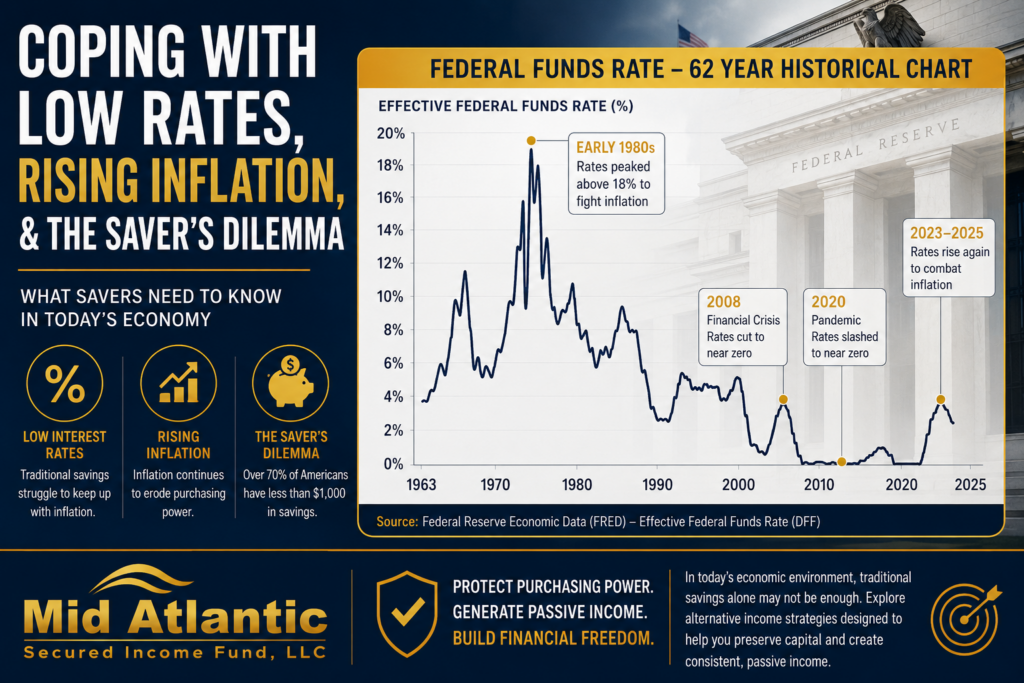
For much of the last decade, traditional fixed income investing faced significant challenges.
Historically low interest rates compressed yields across:
- Treasury bonds,
- investment-grade debt,
- municipal bonds,
- and traditional income-oriented securities.
At the same time, investors increasingly faced:
- elevated inflation,
- rising equity market concentration,
- economic uncertainty,
- and heightened portfolio volatility.
As a result, sophisticated investors began rethinking what fixed income should accomplish within modern portfolio construction.
Today, fixed income is no longer viewed solely as a defensive allocation.
Increasingly, institutional investors evaluate fixed income strategies based on their ability to provide:
- recurring passive income,
- portfolio diversification,
- capital preservation,
- inflation resilience,
- and downside awareness.
This evolution has contributed to the rapid expansion of:
- private credit,
- alternative fixed income,
- asset-backed lending,
- and real estate-backed investment strategies.
Particularly along the East Coast of the United States, investors have increasingly focused on regional lending markets tied to:
- population growth,
- housing demand,
- commercial development,
- and long-term economic expansion.
What Are East Coast Fixed Income Investment Funds?
Direct Answer
East Coast fixed income investment funds are investment strategies focused on generating income through debt-oriented investments tied to borrowers, real estate assets, or lending opportunities located throughout the Eastern United States.
These investment strategies may include:
- private credit,
- real estate-backed lending,
- bridge lending,
- construction financing,
- asset-backed loans,
- and diversified income-producing investments.
Sophisticated investors often evaluate these funds based on:
- underwriting discipline,
- collateral quality,
- income consistency,
- geographic diversification,
- and long-term portfolio resilience.
Why the East Coast Remains Attractive for Income-Oriented Investments
Regional Economic Strength Matters
The East Coast remains one of the most economically significant regions in the United States.
It contains:
- major financial centers,
- rapidly growing metropolitan areas,
- transportation infrastructure,
- population migration corridors,
- and substantial real estate development activity.
Several East Coast regions continue experiencing long-term demographic and economic expansion:
|
Region |
Key Drivers |
|---|---|
|
Southeast |
Population growth & business migration |
|
Florida |
Retirement migration & housing demand |
|
Carolinas |
Manufacturing & financial expansion |
|
Mid-Atlantic |
Infrastructure & commercial growth |
|
Northeast metros |
Financial services concentration |
According to the U.S. Census Bureau, migration trends over the last several years have increasingly favored portions of the Southeast and broader East Coast growth corridors.
These dynamics have created substantial demand for:
- real estate financing,
- construction lending,
- bridge capital,
- and private credit solutions.
The Rise of Private Credit
Private Credit Has Become Institutional Mainstream
Private credit has rapidly emerged as one of the fastest-growing institutional asset classes globally.
According to BlackRock, Apollo Global Management, and Preqin, institutional allocations to private credit have expanded significantly over the last decade.
Several structural forces contributed to this growth:
- reduced bank lending,
- higher interest rates,
- increased demand for income,
- public market volatility,
- and institutional diversification strategies.
Private credit increasingly serves as both:
- an income-producing allocation,
- and a portfolio diversification tool.
What Is Private Credit?
Direct Answer
Private credit refers to non-bank lending where investors provide capital directly to borrowers through privately negotiated debt investments outside traditional public bond markets or bank financing.
Private credit strategies may include:
- bridge lending,
- commercial real estate lending,
- construction financing,
- asset-backed lending,
- and specialty finance.
Private credit often emphasizes:
- recurring contractual income,
- underwriting discipline,
- collateral awareness,
- and long-term portfolio durability.
Why Investors Are Moving Beyond Traditional Bonds
Traditional Fixed Income Has Changed
The traditional role of bonds within portfolios has evolved materially.
Several factors have challenged traditional fixed income allocations:
- historically low yields during the 2010s,
- inflation-driven purchasing power erosion,
- interest-rate sensitivity,
- and elevated public market correlations.
As a result, many institutional investors increasingly evaluate alternative fixed income strategies capable of offering:
- enhanced income potential,
- diversification,
- and real asset exposure.
This has increased interest in:
- private credit,
- secured lending,
- real estate debt,
- and asset-backed investments.
Understanding Secured Investments
What Are Secured Investments?
Secured investments are investments backed by collateral or underlying assets that may provide additional structural protections compared to unsecured investments.
Examples may include:
- senior secured loans,
- real estate-backed lending,
- asset-backed credit investments,
- and collateralized income-producing strategies.
Collateral structures do not eliminate risk.
However, they may improve downside positioning during periods of economic stress.
Real Estate-Backed Lending Along the East Coast
Why Real Assets Continue Attracting Institutional Capital
Real estate-backed lending remains a major component of East Coast private credit activity.
Several East Coast markets continue benefiting from:
- population migration,
- housing demand,
- infrastructure investment,
- and commercial expansion.
Debt-oriented real estate strategies often emphasize:
- contractual repayment,
- collateral backing,
- underwriting discipline,
- and recurring income generation.
Institutional investors frequently evaluate:
- loan-to-value ratios,
- borrower quality,
- geographic diversification,
- and local market fundamentals
when assessing real estate-backed lending opportunities.
Are Debt Funds Safer Than Stocks?
Direct Answer
Debt-oriented investments are not risk-free, but certain fixed income and private credit strategies may provide:
- contractual income,
- collateral backing,
- lower volatility characteristics,
- or senior repayment positioning
relative to traditional public equities.
All investments carry risk.
Sophisticated investors evaluate investments based on:
- underwriting quality,
- diversification,
- economic conditions,
- liquidity,
- and portfolio objectives.
Why Passive Income Matters More Today
Investors Increasingly Prioritize Cash Flow
Modern investors increasingly emphasize recurring income generation within portfolio construction.
Several factors explain this shift:
- inflation uncertainty,
- retirement sustainability concerns,
- public market volatility,
- and longer life expectancy.
Income-producing investments may help:
- improve liquidity flexibility,
- support reinvestment compounding,
- reduce dependence on market timing,
- and enhance portfolio durability.
Institutional investors frequently balance:
- growth,
- passive income,
- and downside awareness.
Inflation and Fixed Income Investing
Inflation Changes the Fixed Income Equation
Inflation materially affects fixed income investing.
According to the U.S. Bureau of Labor Statistics, inflation surged to multi-decade highs following pandemic-era monetary expansion and supply chain disruptions.
This created new challenges for traditional fixed income investors.
Purchasing power erosion has increased institutional focus on:
- higher-yielding income strategies,
- real assets,
- private credit,
- and diversified alternative investments.
Institutional Portfolio Construction Principles
Institutions Focus on Durability
Institutional investors rarely evaluate investments solely on headline yield.
Instead, sophisticated portfolio construction emphasizes:
- risk-adjusted returns,
- diversification,
- income sustainability,
- and downside management.
Several institutional principles increasingly influence modern fixed income allocation:
|
Institutional Principle |
Objective |
|---|---|
|
Diversification |
Reduce concentration risk |
|
Income Stability |
Improve portfolio durability |
|
Collateral Awareness |
Strengthen downside positioning |
|
Risk Budgeting |
Balance growth and stability |
|
Long-Term Allocation |
Improve resilience across cycles |
Behavioral Finance and Income Investing
Emotional Investing Can Damage Long-Term Results
Behavioral finance research consistently demonstrates that emotional decision-making may negatively affect long-term investment outcomes.
Periods of market volatility often trigger:
- panic selling,
- reactionary portfolio changes,
- and speculative repositioning.
Income-producing investments may help improve investor discipline by emphasizing:
- recurring cash flow,
- portfolio balance,
- and long-term investment frameworks.
Institutional investors frequently structure portfolios specifically to reduce emotionally reactive decision-making.
Retirement Planning and Fixed Income
Retirement Investing Is Becoming More Complex
Longer retirements and rising living costs have increased investor focus on:
- diversified income streams,
- passive cash flow,
- and long-term portfolio sustainability.
Modern retirement planning increasingly balances:
- appreciation,
- inflation resilience,
- recurring income,
- and capital preservation.
This has contributed to growing institutional interest in alternative fixed income strategies.
Self-Directed IRAs and Alternative Fixed Income
Diversification Beyond Traditional Markets
Self-directed IRAs allow eligible investors to hold certain alternative investments beyond traditional public securities.
Depending on custodial structures and regulations, these may include:
- private credit,
- real estate-backed investments,
- and alternative income-producing assets
- Investors exploring diversified retirement strategies may also review:
How The Mid Atlantic Fund Reflects Broader Institutional Trends
The Mid Atlantic Secured Income Fund operates within the broader institutional movement toward:
- diversified fixed income investing,
- private credit,
- secured lending,
- and asset-backed portfolio construction.
The broader educational framework surrounding the fund emphasizes:
- underwriting discipline,
- passive income education,
- diversified portfolio construction,
- and long-term investing principles.
Additional educational resources:
- Knowledge Hub
- Private Credit Products
- Passive Income Investment Calculator
- Why Invest in Mid Atlantic Fund
The Future of East Coast Fixed Income Investing
Several structural trends are likely to continue influencing East Coast fixed income investment strategies:
1. Continued Private Credit Expansion
Private credit continues growing institutionally.
2. Population Migration Toward Growth Corridors
Southeast and East Coast migration trends remain significant.
3. Increased Demand for Passive Income
Investors increasingly prioritize recurring cash flow.
4. Inflation-Aware Portfolio Construction
Purchasing power preservation remains central.
5. Institutional Principles Moving Downstream
Individual accredited investors increasingly adopt institutional allocation frameworks.
Final Thoughts
East Coast fixed income investment funds increasingly reflect broader changes occurring throughout institutional investing.
Modern portfolio construction now extends beyond traditional stock-and-bond allocation models.
As investors seek:
- passive income,
- diversification,
- capital preservation,
- and long-term resilience,
many portfolios increasingly incorporate:
- private credit,
- real estate-backed lending,
- secured investments,
- and diversified income-producing strategies.
The objective is not simply maximizing yield.
It is constructing portfolios capable of performing across multiple economic cycles while balancing:
- recurring income,
- downside awareness,
- diversification,
- and long-term financial durability.
Frequently Asked Questions (FAQ)
What are East Coast fixed income investment funds?
East Coast fixed income investment funds are investment strategies focused on generating income through lending and debt-oriented investments tied to borrowers or assets located throughout the Eastern United States.
What is private credit investing?
Private credit investing involves directly lending capital through privately negotiated debt investments outside traditional public bond and banking markets.
Why are investors moving beyond traditional bonds?
Many investors seek alternative fixed income strategies because of inflation concerns, interest-rate sensitivity, public market volatility, and demand for higher recurring income.
What are secured investments?
Secured investments are investments backed by collateral or underlying assets that may provide additional structural protections compared to unsecured investments.
Are debt funds safer than stocks?
Certain debt-oriented investments may provide contractual income and collateral-backed structures, but all investments carry risk.
Why does diversification matter in fixed income investing?
Diversification may reduce concentration risk while improving long-term portfolio resilience across changing economic environments.
Why are investors interested in passive income today?
Passive income may improve liquidity flexibility, reinvestment opportunities, and portfolio sustainability during volatile economic conditions.