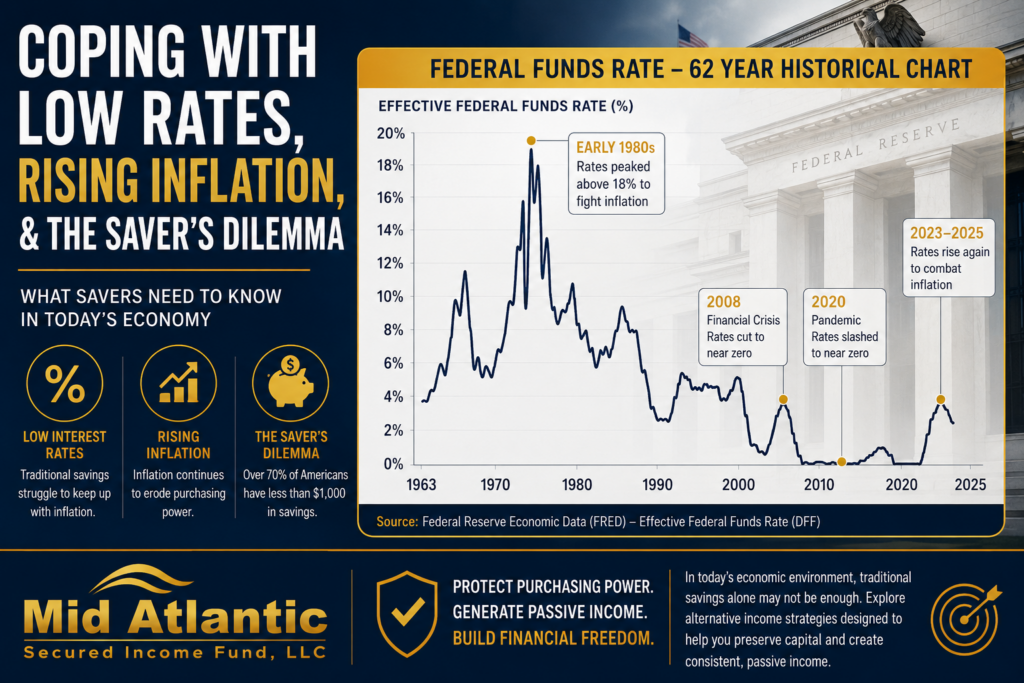

Why Financial Stability Has Become a Primary Investor Objective
For much of the last decade, financial markets were dominated by a growth-oriented investing environment.
Ultra-low interest rates, expansive monetary policy, and strong public equity performance encouraged investors to prioritize appreciation and aggressive growth strategies.
That environment has shifted materially.
Persistent inflation pressures, higher interest rates, banking instability, geopolitical uncertainty, elevated public market volatility, and concerns surrounding long-term retirement sustainability have caused many investors to reevaluate what financial security truly means.
Increasingly, investors are asking different questions:
- How can portfolios generate more reliable income?
- How can downside exposure be managed more effectively?
- How can wealth be preserved during uncertain economic cycles?
- What role should secured investments play in long-term financial planning?
As a result, secured investment strategies have become increasingly important within modern portfolio construction.
This shift is not simply about conservative investing.
It reflects a broader movement toward:
- financial resilience,
- income consistency,
- risk-adjusted portfolio construction,
- and long-term capital stewardship.
Institutional investors, pension funds, family offices, and accredited investors are increasingly emphasizing stability-oriented investments that prioritize:
- collateral protection,
- contractual cash flow,
- diversification,
- and disciplined underwriting.
What Are Secured Investments?
Direct Answer
Secured investments are investments backed by collateral or underlying assets that may provide additional layers of investor protection compared to unsecured investments.
Examples of secured investments may include:
- real estate-backed loans,
- senior secured private credit,
- asset-backed lending,
- collateralized debt structures,
- and certain income-producing alternative investments.
Secured investments are often structured to prioritize repayment rights and capital preservation considerations.
Why Investors Are Prioritizing Stability Over Speculation
Investor Psychology Is Changing
After years of market volatility and economic uncertainty, many investors are increasingly focused on stability rather than purely maximizing growth.
Several structural forces are driving this trend:
|
Economic Factor |
Investor Response |
|---|---|
|
Inflation volatility |
Greater focus on income-producing assets |
|
Higher interest rates |
Renewed interest in fixed-income alternatives |
|
Equity market concentration |
Increased diversification demand |
|
Retirement longevity concerns |
Need for sustainable cash flow |
|
Banking instability concerns |
Preference for collateral-backed structures |
|
Economic uncertainty |
Emphasis on downside awareness |
According to BlackRock and Morgan Stanley, institutional investors are increasingly prioritizing portfolio resilience and income consistency rather than relying exclusively on public market appreciation.
Understanding Financial Stability in Investing
Financial Stability Means More Than Avoiding Risk
Financial stability is often misunderstood as simply avoiding volatility.
In reality, sophisticated portfolio stability involves balancing:
- income generation,
- inflation resilience,
- diversification,
- liquidity management,
- and capital preservation.
A stable portfolio is not necessarily risk-free.
Rather, it is structured to better withstand:
- economic downturns,
- inflationary periods,
- interest rate changes,
- and market dislocations.
Institutional portfolio construction increasingly focuses on creating portfolios capable of navigating multiple economic environments rather than maximizing short-term returns during a single market cycle.
The Role of Income in Financial Stability
Cash Flow Matters More Than Many Investors Realize
One of the defining characteristics of financially stable portfolios is recurring cash flow generation.
Income-producing investments may help reduce dependence on:
- market timing,
- asset liquidation,
- and speculative appreciation.
This becomes especially important during:
- retirement,
- volatile market conditions,
- and uncertain economic periods.
Many investors increasingly prioritize investments capable of generating:
- monthly income,
- quarterly distributions,
- or contractual interest payments.
This shift has contributed to the rapid growth of:
- private credit,
- real estate-backed lending,
- and alternative income strategies.
What Is Private Credit?
Direct Answer
Private credit is a form of non-bank lending where investors provide capital directly to borrowers through privately structured debt investments instead of traditional bank financing or public bond markets.
Private credit strategies may include:
- bridge lending,
- construction lending,
- commercial real estate lending,
- asset-backed lending,
- and specialty finance.
Private credit has become one of the fastest-growing segments of alternative investing due to investor demand for income generation and diversification.
Why Private Credit Has Expanded Rapidly
Structural Changes in Banking Created Opportunity
Following the 2008 financial crisis, regulatory changes significantly altered the lending environment.
Traditional banks became more constrained in certain lending categories.
Private lenders increasingly stepped in to fill financing gaps.
According to Apollo Global Management and Preqin, private credit has evolved into a major institutional asset class with continued growth expected over the coming decade.
Several dynamics continue supporting growth:
Higher Interest Rates
Private credit yields generally increased alongside rising rates.
Demand for Passive Income
Investors increasingly seek recurring income streams.
Diversification Beyond Public Markets
Private lending may offer reduced correlation to equities.
Asset-Backed Structures
Collateralized investments appeal to stability-oriented investors.
Real Estate-Backed Investments and Portfolio Stability
Why Real Estate Debt Matters
Real estate-backed investments occupy a unique position within modern income-oriented portfolios.
Unlike speculative equity investments, debt-oriented real estate strategies often emphasize:
- contractual repayment structures,
- collateral backing,
- seniority within the capital stack,
- and underwriting discipline.
These characteristics have attracted growing institutional interest.
Senior secured lending structures are generally designed to prioritize repayment rights ahead of subordinate capital layers.
This does not eliminate risk.
However, collateral-backed structures may provide additional downside considerations relative to unsecured investments.
Are Secured Investments Safer Than Stocks?
Direct Answer
Secured investments are not risk-free, but certain secured investment structures may provide lower volatility, contractual income, collateral backing, or repayment priority compared to traditional public equities.
Risk depends heavily on:
- underwriting quality,
- collateral value,
- diversification,
- leverage levels,
- manager experience,
- and broader economic conditions.
Secured investments still carry risks including:
- borrower default,
- illiquidity,
- economic downturns,
- and operational risk.
Understanding Risk in Secured Investments
Every Investment Carries Risk
Sophisticated investors understand that no investment is completely risk-free.
The objective is not eliminating risk entirely.
It is understanding:
- how risk is structured,
- where risk exists,
- and how portfolios respond during economic stress.
Key risks investors evaluate include:
|
Risk Type |
Description |
|---|---|
|
Credit Risk |
Borrower repayment risk |
|
Liquidity Risk |
Limited exit flexibility |
|
Market Risk |
Economic and asset value changes |
|
Interest Rate Risk |
Rate-driven pricing shifts |
|
Operational Risk |
Execution and management quality |
|
Concentration Risk |
Excessive exposure to one sector |
Institutional-quality underwriting and diversification remain critical.
Why Diversification Still Matters
Stability Requires Diversification
Financial stability does not come from relying on a single investment category.
Sophisticated portfolio construction often incorporates exposure across:
- public equities,
- private credit,
- real assets,
- cash equivalents,
- and alternative income strategies.
This broader diversification framework may help reduce excessive exposure to:
- equity volatility,
- inflation shocks,
- and concentrated market risk.
Inflation and Wealth Preservation
Inflation Is One of the Greatest Long-Term Threats to Stability
According to the U.S. Bureau of Labor Statistics, inflation surged to multi-decade highs during the post-pandemic period.
Inflation erodes purchasing power gradually but significantly over time.
For example:
- 3% annual inflation reduces purchasing power by approximately 26% over 10 years.
- 5% inflation cuts purchasing power nearly in half over roughly 14 years.
This has increased investor interest in:
- income-producing investments,
- real assets,
- floating-rate credit,
- and inflation-sensitive portfolio strategies.
Retirement Planning and Stable Income
Retirement Portfolios Require Different Priorities
Retirement investing increasingly emphasizes:
- cash flow sustainability,
- downside protection,
- inflation resilience,
- and sequence-of-returns risk management.
According to the Federal Reserve, many Americans remain concerned about retirement preparedness despite strong historical equity returns.
This has contributed to growing interest in:
- passive income strategies,
- alternative fixed income,
- and secured investment structures.
How Accredited Investors Use Secured Investments
Accredited investors increasingly integrate secured investments into portfolios for several reasons:
Common Investor Objectives
Passive Income Generation
Many secured investments are structured around recurring interest payments.
Capital Preservation
Collateral-backed structures may provide additional downside considerations.
Portfolio Diversification
Private credit may diversify public market exposure.
Reduced Volatility
Certain secured investments may experience less daily price volatility than equities.
Long-Term Portfolio Stability
Income-focused investing may support long-term financial planning goals.
Institutional Portfolio Construction Principles
Institutions Think Differently About Stability
Institutional investors often focus less on maximizing speculative upside and more on:
- durability,
- risk-adjusted returns,
- cash flow reliability,
- and long-term portfolio consistency.
Several institutional principles increasingly influence individual investor portfolios:
|
Institutional Principle |
Objective |
|---|---|
|
Diversification |
Reduce concentration risk |
|
Collateral Awareness |
Improve downside protection |
|
Cash Flow Stability |
Support predictable income |
|
Risk Budgeting |
Align risk with objectives |
|
Long-Term Allocation |
Reduce emotional investing |
Behavioral Finance and Financial Stability
Emotional Investing Can Destabilize Portfolios
Behavioral finance research consistently shows that emotional investing often damages long-term performance.
During periods of volatility, investors frequently make decisions driven by:
- fear,
- greed,
- panic,
- and short-term market sentiment.
Structured income-oriented portfolios may help reduce reactionary behavior by emphasizing:
- long-term planning,
- diversification,
- and recurring cash flow generation.
Self-Directed IRAs and Secured Investments
Retirement Diversification Beyond Traditional Markets
Self-directed IRAs allow eligible investors to hold certain alternative assets beyond traditional stocks and bonds.
Depending on custodial structures and regulations, this may include:
- private credit,
- real estate-backed investments,
- and alternative income-producing assets.
Investors researching retirement diversification may also explore:
Modern Portfolio Construction Is Evolving
The Traditional 60/40 Portfolio Is Being Reevaluated
For decades, many portfolios relied heavily on the traditional:
- 60% equities,
- 40% bonds
allocation framework.
However, inflation shocks and rising interest rates exposed vulnerabilities in traditional diversification assumptions.
As correlations between stocks and bonds shifted, investors increasingly explored:
- private credit,
- alternative income strategies,
- and asset-backed investments.
Modern portfolio construction increasingly emphasizes resilience rather than dependence on a single asset class.
How The Mid Atlantic Fund Reflects Broader Industry Trends
The Mid Atlantic Secured Income Fund operates within the growing institutional trend toward:
- asset-backed investing,
- private credit,
- income-focused portfolio construction,
- and disciplined underwriting frameworks.
The broader educational resources surrounding the fund focus on:
- passive income education,
- private lending fundamentals,
- retirement diversification,
- and long-term capital stewardship.
Additional educational resources:
- Knowledge Hub
- Private Credit Products
- Passive Income Investment Calculator
- Why Invest in Mid Atlantic Fund
Final Thoughts
Financial stability is increasingly becoming one of the defining objectives of modern investing.
As economic uncertainty, inflation volatility, and public market concentration risks continue shaping investor behavior, many portfolios are evolving toward:
- income-oriented investing,
- secured investments,
- private credit,
- and institutional-style diversification frameworks.
The future of investing may rely less on speculative growth alone and more on building resilient portfolios capable of generating sustainable income while navigating multiple economic environments over time.
Long-term financial stability rarely comes from chasing short-term market trends.
It is more often built through:
- disciplined portfolio construction,
- diversification,
- underwriting quality,
- risk management,
- and strategic patience.
Frequently Asked Questions (FAQ)
What are secured investments?
Secured investments are investments backed by collateral or underlying assets that may provide additional investor protection compared to unsecured investments.
How do secured investments work?
Secured investments generally involve loans or financial structures backed by assets such as real estate or collateralized cash flows.
Are secured investments safer than stocks?
Certain secured investments may experience lower volatility and provide contractual income structures, but all investments carry risk.
What is private credit investing?
Private credit investing involves directly lending capital to borrowers outside traditional bank and public bond markets.
Why are investors interested in asset-backed investments?
Investors often seek asset-backed investments for diversification, income generation, and potential downside protection through collateral structures.
Can secured investments generate passive income?
Many secured investment strategies are designed to generate recurring interest income or periodic distributions.
What role does diversification play in financial stability?
Diversification may help reduce concentration risk and improve portfolio resilience across changing economic conditions.