Why Long-Term Investing Still Matters in a Short-Term World
Modern financial markets increasingly reward short-term thinking.
Investors are bombarded with daily headlines, interest-rate speculation, geopolitical uncertainty, election cycles, recession fears, AI-driven market volatility, and social media commentary that encourages constant portfolio reactions. Yet historically, some of the most successful investors, institutions, pension funds, and family offices have generated durable wealth not through constant trading, but through disciplined long-term investment strategies.
Long-term investing is not simply about holding assets for extended periods of time. It is a framework for capital allocation built around:
- compounding,
- risk management,
- income generation,
- portfolio resilience,
- diversification,
- and capital preservation.
For retirement-focused investors, the objective is rarely maximizing short-term gains. More often, it is creating sustainable income streams and preserving purchasing power across decades.
That distinction matters.
According to Federal Reserve Survey of Consumer Finances data, retirement accounts now represent one of the largest components of household wealth in the United States. Meanwhile, longer life expectancies, inflation pressures, and persistent market volatility have increased investor interest in alternative assets, private credit, and income-oriented strategies that may provide diversification beyond traditional stocks and bonds.
Institutional investors have increasingly embraced private markets for precisely these reasons.
BlackRock, Apollo, KKR, and Goldman Sachs have all published extensive research in recent years discussing the expanding role of private credit, infrastructure, real assets, and alternative income strategies within long-term portfolio construction.
For retirement investors, the central question is no longer simply:
“How do I grow wealth?”
Increasingly, the question is:
“How do I build a resilient portfolio capable of producing income and stability across changing economic environments?”
This article explores the principles, frameworks, and portfolio construction concepts behind effective long-term investment strategies.
What Are Long-Term Investment Strategies?
Definition
Long-term investment strategies are disciplined approaches to capital allocation designed to grow and preserve wealth over extended time horizons, typically spanning 10 years or more.
These strategies emphasize:
- compounding returns,
- diversification,
- risk-adjusted performance,
- income generation,
- and reduced sensitivity to short-term market fluctuations.
Long-term investing generally prioritizes portfolio durability over speculative trading.
Why Long-Term Investing Historically Outperforms Reactive Investing
One of the most overlooked realities in investing is that timing markets consistently is extraordinarily difficult.
Research from Morningstar and DALBAR has repeatedly shown that individual investors often underperform broader markets due to emotional decision-making, panic selling, and performance chasing.
Long-term strategies attempt to reduce these behavioral errors by focusing on:
- allocation discipline,
- asset quality,
- diversification,
- and time in the market rather than timing the market.
Historically, markets have rewarded patient capital allocation.
For example:
- The S&P 500 has historically generated long-term annualized returns near 10% before inflation over multi-decade periods.
- Private credit markets expanded from roughly $500 billion in assets under management in 2010 to over $1.7 trillion globally by 2024 according to Preqin.
- Institutional allocations to alternative assets continue rising among pensions and endowments seeking diversification and income generation.
Long-term investing recognizes that volatility is often unavoidable, but permanent impairment of capital can sometimes be mitigated through disciplined portfolio construction.
The Core Pillars of Long-Term Portfolio Construction
1. Diversification
Diversification remains one of the foundational principles of long-term investing.
A diversified portfolio attempts to reduce concentration risk by spreading exposure across multiple asset classes, sectors, geographies, and investment structures.
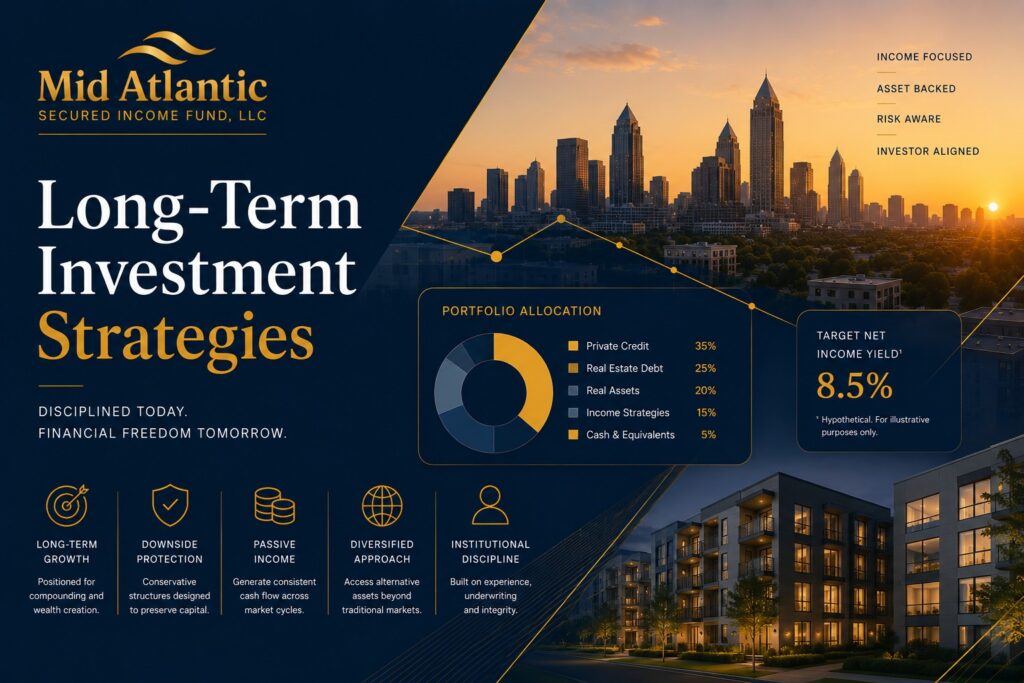
A modern diversified retirement portfolio may include:
|
Asset Type |
Potential Role |
|---|---|
|
Public Equities |
Long-term growth |
|
Investment-Grade Bonds |
Stability & liquidity |
|
Private Credit |
Income generation |
|
Real Estate Debt |
Asset-backed yield |
|
Cash Equivalents |
Liquidity management |
|
Infrastructure |
Inflation sensitivity |
|
REITs |
Real estate exposure |
|
Alternative Investments |
Non-correlated returns |
Diversification does not eliminate risk. However, it may reduce the impact of any single asset class underperforming.
2. Income Generation
For many retirement-focused investors, long-term investing increasingly centers around cash flow generation rather than pure appreciation.
Income-oriented strategies may include:
- dividend-paying equities,
- bonds,
- private lending,
- real estate-backed debt,
- infrastructure investments,
- and alternative income-producing assets.
This shift has become more prominent as retirees seek to supplement traditional retirement income sources.
Private credit has attracted growing institutional attention partly because many structures prioritize contractual cash flow generation.
3. Capital Preservation
Protecting capital becomes increasingly important as investors approach retirement or enter distribution phases.
Long-term strategies often emphasize:
- downside mitigation,
- collateral-backed investments,
- conservative underwriting,
- lower leverage,
- and diversified exposure.
Institutional investors frequently evaluate investments not only on return potential, but also on loss severity during economic downturns.
4. Inflation Protection
Inflation can materially erode purchasing power over time.
Long-term portfolios increasingly incorporate assets historically viewed as more inflation-sensitive, including:
- real estate,
- infrastructure,
- commodities,
- floating-rate debt,
- and private credit.
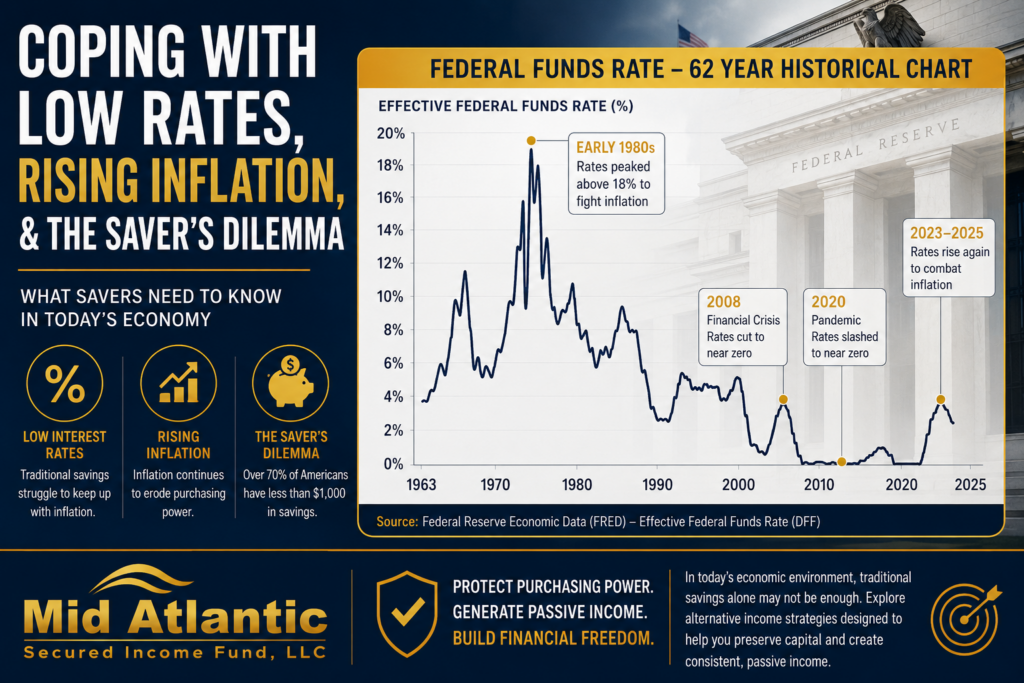
The inflationary period following 2021 renewed investor focus on real assets and income-producing investments capable of adapting to changing rate environments.
Why Alternative Investments Are Becoming More Relevant in Retirement Portfolios
Historically, many retirement portfolios relied heavily on a traditional 60/40 stock-and-bond allocation model.
However, institutional investors have increasingly expanded beyond this framework.
Several factors contributed to this shift:
- lower bond yields during the 2010s,
- equity market concentration risk,
- inflation uncertainty,
- increased volatility,
- and demand for differentiated income streams.
Alternative investments now represent a significant component of institutional portfolios.
These may include:
- private credit,
- real estate debt,
- infrastructure,
- hedge strategies,
- direct lending,
- and private equity.
For accredited investors, access to alternative assets has become increasingly mainstream through private funds and self-directed retirement accounts.
What Is Private Credit?
Definition
Private credit refers to non-bank lending structures where capital is provided directly to borrowers outside traditional public debt markets.
Private credit strategies may include:
- real estate bridge lending,
- construction lending,
- commercial lending,
- asset-backed lending,
- direct corporate lending,
- and specialty finance.
Private credit has grown rapidly following tighter banking regulations introduced after the 2008 financial crisis.
Institutional investors increasingly allocate capital toward private credit because it may offer:
- contractual income,
- floating-rate structures,
- diversification benefits,
- and collateral-backed risk frameworks.
Why Investors Use Private Credit in Long-Term Strategies
Income Potential
Private credit structures often generate recurring income distributions through interest payments.
This can appeal to retirement-focused investors seeking cash flow consistency.
Lower Correlation
Private credit may behave differently than public equities during certain market environments.
This diversification characteristic has contributed to growing institutional adoption.
Asset-Backed Structures
Many private lending investments involve collateralized loans secured by real estate or other assets.
This collateral framework is often viewed as an important component of downside risk management.
Are Debt Funds Safer Than Stocks?
Direct Answer
Debt funds and private credit investments are not inherently “safer” than stocks, but they often involve different risk-return characteristics.
Equities typically prioritize growth and ownership participation.
Debt investments generally prioritize:
- contractual income,
- capital structure seniority,
- and repayment obligations.
Senior secured debt structures may occupy higher positions within the capital stack than equity investments.
However, all investments involve risk, including:
- default risk,
- liquidity risk,
- market risk,
- and economic risk.
Investors should evaluate each opportunity based on:
- underwriting standards,
- collateral quality,
- manager experience,
- leverage,
- diversification,
- and portfolio construction objectives.
Long-Term Investment Strategies for Retirement Investors
1. Income Layering
Many sophisticated retirement portfolios now utilize multiple income layers rather than relying on a single source.
Examples may include:
- dividends,
- bond income,
- private credit distributions,
- rental income,
- and alternative yield strategies.
This layered approach may help reduce dependence on any single market driver.
2. Time Horizon Segmentation
Institutional wealth managers often segment capital based on expected time horizons.
For example:
|
Time Horizon |
Potential Objective |
|---|---|
|
0–3 Years |
Liquidity & stability |
|
3–7 Years |
Moderate income & preservation |
|
7–15+ Years |
Growth & long-term compounding |
This framework may help align asset selection with anticipated cash flow needs.
3. Alternative Asset Allocation
Many long-term investors now allocate portions of retirement portfolios toward alternative investments.
This may include:
- private credit,
- real estate debt,
- infrastructure,
- and other non-public market assets.
Alternative allocations are often designed to complement rather than replace traditional investments.
The Growing Role of Self-Directed IRAs (SDIRAs)
Self-directed IRAs allow investors to hold certain alternative assets within retirement accounts.
Depending on custodial structures and IRS rules, SDIRAs may allow exposure to:
- private funds,
- private lending,
- real estate,
- precious metals,
- and alternative investment strategies.
Many accredited investors use SDIRAs to diversify retirement holdings beyond traditional brokerage account investments.
The Mid Atlantic Secured Income Fund works alongside a network of SDIRA custodians and retirement account providers to help investors explore alternative investment opportunities within retirement structures.
Additional information can be found here:
Risks of Long-Term Investing
No investment strategy is risk-free.
Long-term investors should understand several key risk categories.
Market Risk
Asset values can decline due to economic conditions, interest rates, or market volatility.
Inflation Risk
Inflation may reduce real purchasing power over time.
Liquidity Risk
Certain alternative investments may involve limited liquidity compared to public securities.
Credit Risk
Borrowers may default on obligations.
Manager Risk
Investment outcomes depend significantly on underwriting quality, operational discipline, and portfolio management.
Behavioral Finance and Long-Term Investing
One of the largest threats to long-term investing is often emotional decision-making.
Behavioral finance research has identified recurring investor tendencies including:
- panic selling,
- recency bias,
- performance chasing,
- and overreaction to short-term volatility.
Institutional investors often rely on formal investment frameworks specifically to reduce emotional decision-making.
Long-term discipline historically has been a critical component of successful investing.
Why Institutional Investors Continue Expanding Into Private Markets
According to Preqin, alternative assets under management globally are projected to continue expanding significantly through the coming decade.
Several structural trends are driving this growth:
- demographic retirement shifts,
- institutional demand for yield,
- banking system changes,
- inflation sensitivity,
- and diversification needs.
Large institutions increasingly view private markets as core components of modern portfolio construction rather than niche allocations.
Long-Term Wealth Building Is Increasingly About Portfolio Resilience
Historically, many investors focused almost entirely on maximizing returns.
Today, institutional portfolio construction increasingly emphasizes:
- durability,
- downside management,
- income consistency,
- and risk-adjusted outcomes.
This shift reflects changing market conditions and evolving retirement realities.
Long-term investing is increasingly about maintaining optionality and financial resilience across multiple economic environments.
How Accredited Investors Use Alternative Investments
Accredited investors often utilize alternative investments to:
- diversify beyond public markets,
- seek differentiated income streams,
- access private market opportunities,
- reduce public market concentration,
- and potentially improve portfolio efficiency.
Alternative investments are not suitable for every investor.
However, they increasingly play a role in institutional-style portfolio construction frameworks.
The Importance of Manager Selection
In private markets, manager quality matters significantly.
Investors often evaluate:
- underwriting standards,
- historical experience,
- portfolio diversification,
- operational systems,
- risk management practices,
- and alignment of interests.
Disciplined operational infrastructure can be particularly important in private lending and credit strategies.
Why Portfolio Construction Matters More Than Individual Investment Selection
Sophisticated investors increasingly focus on total portfolio architecture rather than isolated investments.
Strong long-term investing often involves balancing:
- growth,
- income,
- liquidity,
- diversification,
- and risk management.
No single investment typically solves every objective.
Portfolio construction attempts to integrate multiple components into a cohesive long-term strategy.
Institutional Trends Reshaping Retirement Investing
Several macroeconomic trends are reshaping retirement portfolio construction:
Higher Interest Rate Environments
Interest rate normalization has increased investor focus on income-generating assets.
Aging Demographics
Retirement populations continue expanding globally.
Increased Market Volatility
Higher volatility has increased diversification demand.
Growth of Private Markets
Institutional capital continues flowing toward alternative assets.
Technology & Operational Infrastructure
Advanced reporting, servicing, and portfolio management systems have improved accessibility to private market investing.
Final Thoughts
Long-term investing is not about predicting short-term headlines.
It is about building resilient portfolios capable of navigating uncertainty while supporting long-duration financial objectives.
Institutional investors increasingly recognize that modern portfolio construction may require exposure beyond traditional stocks and bonds alone.
Private credit, alternative income strategies, real assets, and diversified portfolio frameworks have become increasingly important components of sophisticated long-term investment strategies.
For retirement-focused investors, the objective is rarely simply achieving maximum returns in a single year.
More often, it is:
- generating sustainable income,
- preserving capital,
- managing downside risk,
- and creating durable long-term financial stability.
The Mid Atlantic Secured Income Fund focuses on income-oriented, asset-backed investment strategies designed with long-term portfolio discipline in mind.
Investors interested in learning more about private credit, alternative investments, and retirement-focused portfolio strategies can explore additional educational resources within the Knowledge Hub.
FAQ Section
What are long-term investment strategies?
Long-term investment strategies are approaches designed to build and preserve wealth over extended periods through disciplined portfolio construction, diversification, compounding, and risk management.
Why do investors diversify portfolios?
Diversification may reduce concentration risk by spreading investments across multiple asset classes and investment structures.
What is private credit investing?
Private credit investing involves non-bank lending strategies where investors provide capital directly to borrowers through private market structures.
Are alternative investments good for retirement portfolios?
Alternative investments may help diversify retirement portfolios and provide differentiated income streams, though they also involve unique risks and liquidity considerations.
What is an SDIRA?
A Self-Directed IRA (SDIRA) is a retirement account structure that may allow investors to hold certain alternative investments beyond traditional public securities.
Why are institutional investors increasing allocations to private markets?
Institutional investors often pursue private markets for diversification, income generation, inflation sensitivity, and differentiated return characteristics.