
The Shift Toward Personalized Portfolio Construction
For decades, retirement investing followed a relatively standardized formula. Investors accumulated capital through employer-sponsored retirement plans, diversified across stocks and bonds, and gradually reduced risk exposure nearing retirement. The traditional “60/40 portfolio” became a cornerstone of modern portfolio management.
Today, however, investors are operating in a fundamentally different environment.
Persistent inflation pressures, elevated interest rate volatility, longer life expectancy, demographic shifts, and increasingly uncertain equity market cycles are reshaping how sophisticated investors approach retirement planning. According to the Federal Reserve’s 2025 Survey of Consumer Finances, affluent households are allocating increasing portions of their portfolios toward alternative assets, income-producing investments, and customized allocation strategies designed to reduce correlation risk while improving income durability.
As a result, customized investment solutions have emerged as one of the defining trends in modern wealth management.
Rather than relying exclusively on generalized public-market allocations, investors are increasingly seeking portfolio structures aligned with:
- Individual risk tolerances
- Liquidity preferences
- Tax objectives
- Income requirements
- Retirement timelines
- Macroeconomic outlooks
- Inflation sensitivity
- Estate planning goals
- Alternative asset exposure preferences
Institutional investors, family offices, pension funds, and accredited investors have long utilized customized portfolio structures. Increasingly, individual retirement investors are adopting similar approaches.
The evolution reflects a broader realization: retirement planning is no longer simply about accumulation. It is increasingly about resilience, income stability, risk management, and capital efficiency.
What Are Customized Investment Solutions?
Direct Answer
Customized investment solutions are portfolio strategies specifically tailored to an investor’s financial objectives, risk profile, income needs, liquidity requirements, tax considerations, and long-term retirement goals rather than relying on standardized investment models.
These strategies may incorporate:
- Public equities
- Fixed income
- Private credit
- Real estate-backed debt
- Alternative investments
- SDIRA allocations
- Cash-flow-oriented assets
- Inflation-sensitive investments
- Tax-advantaged structures
The objective is not merely diversification for its own sake, but purposeful portfolio construction designed to improve long-term outcomes under varying economic conditions.
Why Investors Are Moving Beyond Traditional Portfolio Models
The Traditional 60/40 Portfolio Faces Structural Challenges
Historically, balanced portfolios relied on stocks for growth and bonds for stability. However, several structural shifts have complicated that framework.
1. Interest Rate Volatility
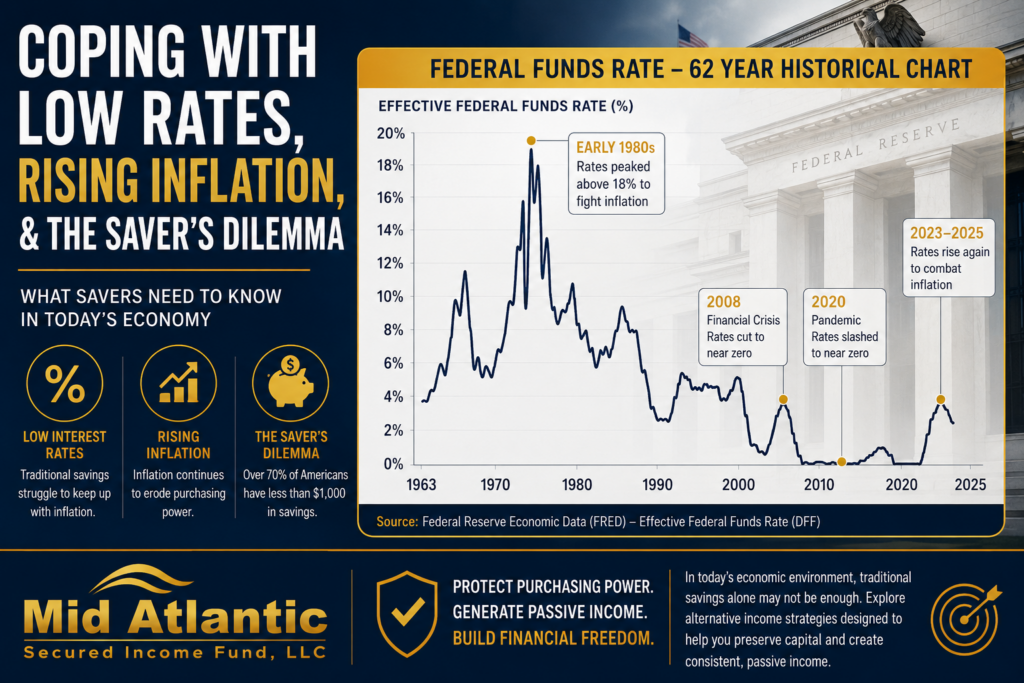
From 2022 through 2025, bond markets experienced some of the most volatile periods in modern history. Rising interest rates pressured traditional fixed-income assets while equity markets simultaneously faced valuation compression.
This challenged the historical assumption that bonds would always provide reliable downside protection.
2. Inflation Risk
According to the U.S. Bureau of Labor Statistics, inflation remained materially above long-term historical averages during several recent periods, reducing the real purchasing power of traditional retirement portfolios.
Retirees face unique inflation sensitivity because portfolio withdrawals occur precisely when preserving purchasing power matters most.
3. Longevity Risk
The average retirement horizon continues expanding. Many affluent investors must now structure portfolios designed to potentially support 25–35 years of retirement income.
This creates tension between:
- preserving capital,
- generating income,
- and maintaining growth exposure.
4. Equity Market Concentration
Large-cap technology companies now represent historically elevated portions of major indexes like the S&P 500. Concentration risk has become a growing concern among institutional allocators.
Customized investment strategies help mitigate dependence on narrow areas of market performance.
The Institutionalization of Alternative Investments
Alternative Assets Are Becoming Core Portfolio Components
Alternative investments were once largely reserved for institutions and ultra-high-net-worth investors. That landscape has changed considerably.
According to Preqin, global alternative assets under management surpassed $16 trillion in recent years, with continued growth expected across:
- private credit,
- private real estate,
- infrastructure,
- private equity,
- and alternative income strategies.
Institutional investors increasingly allocate substantial capital toward alternatives because these investments may offer:
- differentiated return drivers,
- lower public-market correlation,
- income generation,
- downside mitigation,
- inflation sensitivity,
- and broader diversification.
How Customized Investment Solutions Work
Customized portfolios begin with investor-specific variables rather than standardized models.
Core Inputs Typically Include
Risk Tolerance
Investors differ dramatically in their tolerance for volatility, illiquidity, and drawdowns.
Some prioritize:
- capital preservation,
- stable income,
- and lower volatility.
Others emphasize:
- long-term growth,
- opportunistic allocations,
- or inflation hedging.
Income Requirements
Retirement investors increasingly focus on:
- monthly income consistency,
- cash-flow predictability,
- and withdrawal sustainability.
This often drives interest toward:
- private credit,
- secured lending,
- real estate-backed income strategies,
- and alternative yield-oriented investments.
Liquidity Needs
Customized solutions account for:
- emergency liquidity,
- expected withdrawals,
- tax payments,
- healthcare costs,
- and legacy planning.
Tax Considerations
Tax-sensitive investing has become increasingly important.
Strategies may involve:
- Roth conversions,
- SDIRAs,
- tax-efficient income structures,
- or asset location optimization.
Macroeconomic Outlook
Sophisticated investors increasingly incorporate:
- inflation expectations,
- rate cycles,
- recession probabilities,
- and demographic trends
into portfolio construction.
The Growing Role of Private Credit in Customized Portfolios
Why Private Credit Has Expanded Rapidly
Private credit has emerged as one of the fastest-growing segments of institutional investing.
According to IMF and Preqin research, private credit growth accelerated substantially following the Global Financial Crisis as banks reduced certain forms of direct lending exposure.
Private credit strategies may include:
- senior secured lending,
- real estate-backed loans,
- bridge lending,
- construction financing,
- specialty finance,
- and asset-backed lending.
Many investors are drawn to private credit because of its:
- income orientation,
- contractual cash flows,
- floating-rate structures,
- collateralization,
- and reduced correlation to public equity markets.
Are Debt Funds Safer Than Stocks?
Direct Answer
Debt funds and private credit investments are not risk-free, but many investors view certain secured debt strategies as structurally different from equities because debt investors typically sit higher in the capital stack and may benefit from contractual repayment terms and collateral backing.
However, risk varies significantly depending on:
- underwriting quality,
- leverage,
- asset selection,
- collateral coverage,
- liquidity structure,
- and economic conditions.
No investment strategy eliminates risk entirely.
Why Accredited Investors Pursue Customized Investment Strategies
Accredited investors often seek customized investment solutions because they provide access to broader portfolio construction opportunities beyond traditional public securities.
These may include:
- private credit,
- private real estate,
- alternative income funds,
- direct lending,
- structured debt,
- and institutional-grade alternative investments.
Many affluent investors increasingly prioritize:
- diversification,
- income consistency,
- inflation resilience,
- and reduced dependence on public market performance.
Customized Retirement Portfolios and SDIRAs
The Expansion of Self-Directed Retirement Investing
Self-Directed IRAs (SDIRAs) allow eligible investors to allocate retirement capital into alternative assets beyond traditional stocks and mutual funds.
Depending on the custodian and structure, investors may gain exposure to:
- private credit,
- real estate debt,
- private placements,
- precious metals,
- private real estate,
- and alternative investment funds.
This has become increasingly attractive for investors seeking:
- broader diversification,
- passive income opportunities,
- and inflation-sensitive investments.
The Mid Atlantic Secured Income Fund maintains relationships with several SDIRA custodial partners and preferred providers supporting investors exploring alternative retirement allocations.
Related internal resources:
- https://themidatlanticfund.com/private-credit-products/
- https://themidatlanticfund.com/ira-investing-with-mid-atlantic-fund/
- https://themidatlanticfund.com/knowledge-hub/
Portfolio Diversification Beyond Traditional Asset Classes
Diversification Is About Return Drivers — Not Asset Count
True diversification involves exposure to different economic drivers, not simply owning more securities.
For example:
- Public equities may depend heavily on corporate earnings growth.
- Bonds may depend on interest rate conditions.
- Real estate debt may depend on collateral performance and borrower cash flow.
- Private credit may generate returns from contractual lending spreads.
Institutional investors increasingly diversify across:
- asset classes,
- income sources,
- liquidity structures,
- duration exposure,
- and economic sensitivities.
The Psychology Behind Customized Investment Solutions
Investors Increasingly Want Control and Transparency
Modern investors increasingly value:
- portfolio transparency,
- customization,
- downside awareness,
- and alignment with personal objectives.
Behavioral finance research from firms like Morningstar and BlackRock suggests investors often experience greater confidence when they understand:
- why assets are allocated,
- how risks are managed,
- and how investments support long-term goals.
Customization can improve investor discipline by aligning portfolios with real-world objectives rather than abstract benchmarks.
How Institutional Investors Build Customized Portfolios
Large institutions rarely rely solely on static public-market allocations.
Instead, institutional portfolios often incorporate:
- layered diversification,
- income-producing assets,
- alternative investments,
- tactical rebalancing,
- liquidity segmentation,
- and scenario-based risk analysis.
Many retirement investors are now adapting similar frameworks on a smaller scale.
Risks of Customized Investment Solutions
No Portfolio Structure Eliminates Risk
While customized strategies may improve alignment and diversification, they also introduce considerations including:
Illiquidity Risk
Some alternative investments have limited redemption flexibility.
Credit Risk
Private lending strategies depend on borrower repayment and collateral quality.
Valuation Risk
Alternative assets may not have daily market pricing.
Operational Risk
Private investments require strong underwriting and servicing infrastructure.
Manager Risk
Execution quality varies significantly across investment managers.
Proper due diligence remains essential.
How Investors Evaluate Customized Investment Strategies
Sophisticated investors often evaluate:
- underwriting discipline,
- historical risk management,
- collateral quality,
- portfolio construction,
- liquidity terms,
- operational systems,
- reporting transparency,
- and management alignment.
Institutional-quality reporting and operational infrastructure increasingly matter alongside investment performance.
The Future of Retirement Investing Is Increasingly Customized
Several long-term trends continue supporting the growth of customized investment solutions:
- demographic aging,
- retirement income demand,
- higher expected volatility,
- alternative asset accessibility,
- technological improvements,
- and institutionalization of private markets.
Investors increasingly recognize that retirement portfolios may require:
- multiple income sources,
- broader diversification,
- and strategies designed for resilience rather than simply maximizing short-term returns.
Conclusion
Customized investment solutions represent a broader evolution in modern retirement planning.
Rather than relying exclusively on generalized portfolio templates, investors increasingly seek strategies aligned with:
- personal objectives,
- income needs,
- macroeconomic realities,
- and long-term capital preservation goals.
Institutional investors have long embraced diversified, multi-asset portfolio construction approaches incorporating private markets and alternative income strategies. Increasingly, accredited investors and retirement-focused investors are exploring similar frameworks through customized portfolio solutions.
As market complexity continues evolving, portfolio construction itself is becoming one of the most important investment decisions investors make.
FAQ Section
What are customized investment solutions?
Customized investment solutions are personalized portfolio strategies tailored to an investor’s objectives, risk tolerance, income needs, liquidity preferences, and retirement goals.
Why are investors using alternative investments in retirement portfolios?
Many investors use alternative investments to improve diversification, generate income, reduce public-market dependence, and potentially enhance risk-adjusted returns.
What is private credit?
Private credit refers to non-bank lending strategies including real estate-backed lending, direct lending, specialty finance, and other privately originated debt investments.
Are alternative investments appropriate for retirement accounts?
Some investors use alternative investments within SDIRAs and other retirement structures to diversify beyond traditional stocks and bonds. Suitability depends on individual objectives, liquidity needs, and risk tolerance.
What are the risks of customized investment solutions?
Risks may include illiquidity, credit losses, market volatility, valuation uncertainty, operational risk, and manager execution risk.
How do accredited investors use customized portfolios?
Accredited investors often use customized portfolios to gain exposure to alternative assets, private credit, income-producing investments, and institutional-style diversification strategies.