
Stability Has Become the New Alpha
For decades, investment conversations were dominated by a singular obsession: maximizing returns.
But today’s economic environment has fundamentally changed the priorities of investors, retirees, business owners, and affluent families.
In a world shaped by:
- elevated inflation,
- volatile interest rates,
- rising living costs,
- banking instability concerns,
- geopolitical fragmentation,
- technological disruption,
- and growing market concentration risk,
financial stability has emerged as one of the most valuable financial assets an investor can possess.
Not because investors suddenly stopped pursuing growth.
But because many investors are beginning to recognize a deeper truth:
The ability to remain financially resilient during uncertainty often determines long-term wealth outcomes more than short-term performance chasing.
This shift is reshaping modern portfolio construction.
Institutional investors, family offices, pension funds, and accredited investors are increasingly prioritizing:
- recurring income,
- downside protection,
- diversified cash flow,
- inflation resilience,
- and asset-backed investment structures.
The era of blindly relying on traditional stock-and-bond allocations is evolving into something far more sophisticated.
And at the center of that transformation is the growing emphasis on financial stability.
What Does Financial Stability Actually Mean?
Direct Answer
Financial stability refers to the ability to maintain consistent financial health through changing economic environments by balancing income generation, liquidity, risk management, diversification, and long-term purchasing power preservation.
For sophisticated investors, financial stability is not merely about saving money or reducing expenses.
It is about constructing a financial framework capable of:
- enduring economic volatility,
- generating recurring income,
- protecting against inflation,
- preserving capital,
- and adapting through multiple market cycles.
True financial stability is both defensive and opportunistic.
It protects wealth during instability while maintaining the flexibility to capitalize on long-term investment opportunities.
Why Investors Are Reframing the Definition of Wealth
Historically, wealth was often measured through:
- portfolio size,
- equity appreciation,
- or speculative growth.
Today, many investors increasingly define wealth differently.
Modern affluent investors often prioritize:
|
Traditional Wealth Thinking |
Modern Stability-Oriented Thinking |
|---|---|
|
Maximum growth |
Sustainable income |
|
Market speculation |
Risk-adjusted returns |
|
Short-term gains |
Long-term resilience |
|
Aggressive leverage |
Strategic diversification |
|
Asset accumulation |
Cash-flow durability |
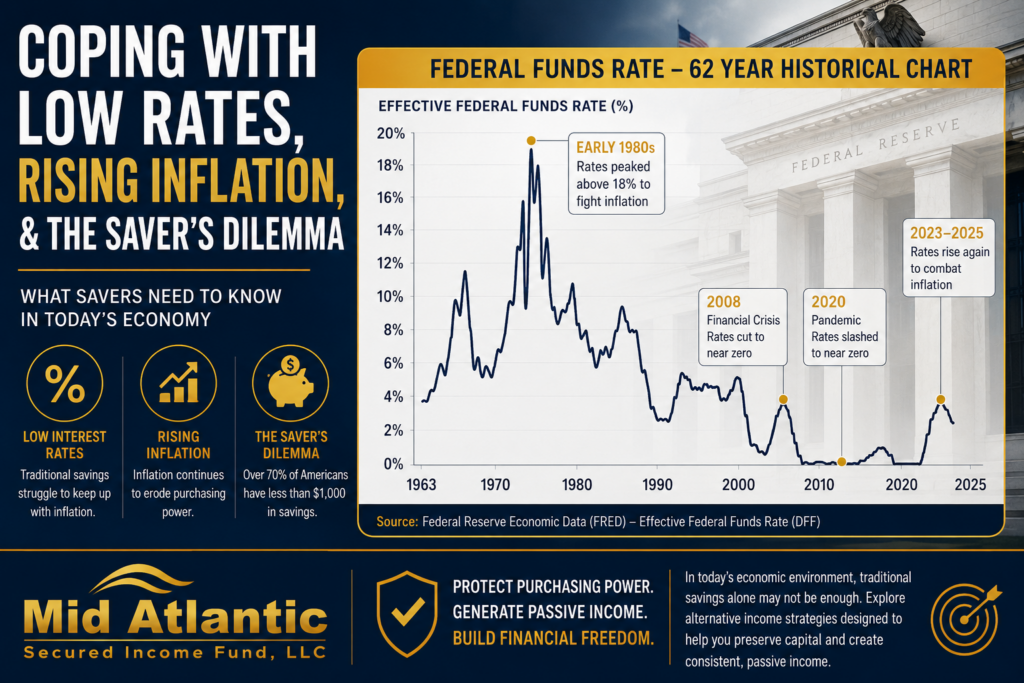
This philosophical shift has accelerated since the inflationary pressures and rate volatility that emerged globally after 2020.
The Economic Forces Driving Financial Anxiety
Inflation Is Reshaping Retirement and Wealth Planning
According to the U.S. Bureau of Labor Statistics, cumulative inflation since 2020 materially increased the cost of:
- housing,
- food,
- healthcare,
- insurance,
- utilities,
- and transportation.
For retirees and fixed-income households, this creates significant pressure.
A portfolio generating insufficient income may gradually lose real purchasing power over time.
Even moderate inflation can dramatically impact long-term wealth sustainability over 20–30 year retirement horizons.
This is one reason investors increasingly seek investments capable of producing stronger recurring cash flows.
Why Public Market Volatility Has Changed Investor Behavior
Modern investors have lived through multiple major disruptions:
- the Dot-Com crash,
- the Global Financial Crisis,
- COVID-era volatility,
- banking instability,
- inflation spikes,
- and aggressive Federal Reserve tightening cycles.
This has changed investor psychology.
Many investors are no longer solely asking:
“How high can returns go?”
They are increasingly asking:
“How resilient is this strategy during uncertainty?”
That subtle difference is transforming institutional capital allocation decisions worldwide.
The Rise of Stability-Focused Portfolio Construction
Institutional Investors Are Rebuilding Portfolio Frameworks
According to research from BlackRock, Goldman Sachs, and JPMorgan Asset Management, institutional investors are increasingly allocating toward:
- private credit,
- infrastructure,
- real estate debt,
- floating-rate strategies,
- and alternative income investments.
The rationale is increasingly clear:
Traditional portfolios may struggle during periods where:
- inflation remains elevated,
- bond volatility increases,
- and equity concentration risk intensifies.
Alternative income strategies have therefore become increasingly important components of modern portfolio construction.
What Is Financial Resilience?
Direct Answer
Financial resilience refers to the ability to withstand economic disruptions without compromising long-term financial goals or lifestyle stability.
Financial resilience often includes:
- diversified income sources,
- manageable debt,
- liquidity reserves,
- inflation-resistant investments,
- and disciplined portfolio construction.
Resilience is not about eliminating risk.
It is about reducing vulnerability.
Why Passive Income Matters More Than Ever
Passive Income Is Becoming a Core Stability Strategy
Passive income refers to recurring earnings generated from investments or assets requiring limited ongoing active labor.
Examples include:
- private credit interest income,
- rental cash flow,
- dividends,
- royalties,
- and alternative income distributions.
For affluent investors and retirees, passive income can provide:
- increased financial flexibility,
- reduced reliance on employment,
- portfolio stability,
- and greater confidence during uncertain markets.
This is one reason passive-income-oriented strategies continue gaining popularity among sophisticated investors.
The Psychology of Financial Stability
One of the least discussed aspects of wealth management is emotional resilience.
Financial instability creates stress.
And stress often drives poor financial decisions.
According to research from the American Psychological Association, financial anxiety remains one of the leading sources of long-term stress among Americans.
During volatile periods, emotionally reactive investors often:
- sell during downturns,
- chase speculative trends,
- or abandon long-term strategies.
Financial stability helps reduce emotional decision-making.
That psychological benefit can be enormously valuable over time.
How Sophisticated Investors Think Differently About Risk
Institutional investors frequently define risk differently than retail investors.
Retail investors often equate risk with:
- short-term price volatility.
Sophisticated investors often focus on:
- permanent capital impairment,
- purchasing power erosion,
- income instability,
- and concentration risk.
This distinction matters.
A portfolio may appear “safe” based on volatility metrics while still exposing investors to:
- inflation risk,
- income insufficiency,
- or overconcentration.
Why Diversification Still Matters in 2026
Diversification Has Evolved Beyond Stocks and Bonds
The traditional 60/40 portfolio framework faced meaningful challenges during recent inflation and interest-rate cycles.
Simultaneous declines in equities and bonds forced many investors to reconsider traditional diversification assumptions.
As a result, investors increasingly explore:
- private credit,
- alternative income strategies,
- real assets,
- and asset-backed lending structures.
Modern diversification increasingly includes:
- public equities,
- fixed income,
- private lending,
- real estate exposure,
- and alternative investments.
The Role of Private Credit in Stability-Focused Portfolios
What Is Private Credit?
Private credit refers to non-bank lending strategies where capital is directly provided to borrowers through privately negotiated loans.
Private credit may include:
- real estate bridge lending,
- senior secured lending,
- asset-backed lending,
- construction financing,
- receivables financing,
- and commercial lending.
According to Preqin research, private credit has become one of the fastest-growing alternative asset classes globally.
Why Investors Are Turning Toward Private Credit
1. Income Generation
Private credit often produces contractual interest income.
2. Asset-Backed Structures
Many private loans are secured by collateral such as:
- real estate,
- receivables,
- inventory,
- or equipment.
3. Reduced Public Market Correlation
Private credit may experience lower day-to-day market volatility compared to publicly traded securities.
4. Floating-Rate Potential
Certain structures may benefit during higher-rate environments.
Are Debt Funds Safer Than Stocks?
Direct Answer
Debt funds and private credit strategies are not risk-free, but certain asset-backed lending structures may provide lower volatility and enhanced downside protections compared to equities when conservatively underwritten.
Risk varies significantly depending on:
- leverage,
- collateral quality,
- underwriting standards,
- loan structure,
- borrower strength,
- and diversification.
Senior secured structures generally hold a higher position in the capital stack than equity investments.
This positioning may improve recovery potential during distress scenarios.
Why Real Estate Continues to Matter
Real estate remains one of the foundational components of long-term wealth preservation strategies.
Reasons include:
- inflation sensitivity,
- income generation,
- demographic demand,
- and collateral value.
Markets throughout the Southeast — particularly Atlanta — continue benefiting from:
- population migration,
- corporate relocations,
- infrastructure investment,
- and long-term economic growth trends.
According to U.S. Census Bureau and Freddie Mac data, demographic shifts continue supporting housing demand across many Sun Belt markets.
Financial Stability Is Built Through Systems, Not Predictions
One of the most overlooked truths in investing is that stability rarely comes from accurately predicting markets.
Instead, it often comes from:
- disciplined systems,
- diversification,
- risk management,
- recurring income,
- and long-term thinking.
Sophisticated investors increasingly focus less on forecasting short-term market direction and more on building durable financial structures.
The Hidden Risk of Chasing Returns
During speculative cycles, investors often become overly focused on maximizing upside.
But history repeatedly demonstrates that:
- excessive leverage,
- concentrated bets,
- and speculative behavior
can significantly impair long-term wealth creation.
Institutional-quality investing often prioritizes:
- consistency,
- resilience,
- and disciplined underwriting.
Avoiding catastrophic losses can materially improve long-term compounding outcomes.
How Inflation Quietly Destroys Wealth
Inflation remains one of the most underestimated threats to long-term financial stability.
A portfolio generating insufficient income growth may gradually lose purchasing power even if nominal balances appear stable.
This is especially important for retirees.
Healthcare, housing, and insurance costs frequently rise faster than headline inflation averages.
As a result, investors increasingly seek:
- inflation-sensitive assets,
- alternative income strategies,
- and recurring cash-flow investments.
Financial Stability and Retirement Planning
Retirement Has Become a Cash-Flow Challenge
Modern retirement planning increasingly centers around sustainable income generation rather than simple accumulation.
Retirees face:
- longevity risk,
- inflation risk,
- healthcare cost escalation,
- and market volatility.
This has increased interest in:
- passive income,
- real estate-backed investments,
- private credit,
- and diversified income strategies.
Why Accredited Investors Are Expanding Beyond Traditional Markets
Direct Answer
Accredited investors increasingly allocate toward alternative investments and private credit to pursue diversification, recurring income, inflation protection, and reduced dependence on public market volatility.
Alternative investments may include:
- private credit,
- real estate debt,
- infrastructure,
- private equity,
- and structured income strategies.
These investments are often used to complement traditional stock-and-bond exposure.
Stability Does Not Mean Avoiding Growth
One of the most important misconceptions about financial stability is that it requires sacrificing growth entirely.
Sophisticated portfolio construction often balances:
- growth,
- income,
- diversification,
- and downside management.
The objective is not simply maximizing returns during bull markets.
It is building wealth capable of enduring multiple economic environments.
The Mid Atlantic Secured Income Fund Philosophy
The Mid Atlantic Secured Income Fund emphasizes:
- asset-backed lending,
- senior secured structures,
- income-focused investing,
- and conservative underwriting principles.
The broader philosophy prioritizes:
- capital discipline,
- recurring income generation,
- downside awareness,
- and long-term portfolio resilience.
Rather than relying heavily on speculative growth narratives, the focus remains centered around real-asset-backed lending and structured income strategies.
Final Thoughts
The definition of financial success is evolving.
For many sophisticated investors, the ultimate objective is no longer simply maximizing returns.
It is achieving stability.
That means:
- preserving purchasing power,
- generating durable income,
- navigating volatility,
- and maintaining financial flexibility through uncertainty.
In today’s environment, financial stability has become one of the most valuable forms of wealth.
And increasingly, investors are recognizing that resilient portfolios are often built through:
- diversification,
- disciplined underwriting,
- passive income generation,
- and long-term strategic thinking.
FAQ Section
What is financial stability?
Financial stability refers to the ability to maintain consistent financial health, withstand economic disruptions, preserve purchasing power, and sustain long-term financial obligations through diversified income and disciplined investing.
Why is financial stability important?
Financial stability helps individuals and families manage uncertainty, reduce financial stress, preserve long-term wealth, and maintain flexibility during economic downturns.
How do investors pursue financial stability?
Investors often pursue financial stability through diversification, passive income generation, conservative risk management, and asset-backed investment strategies.
What role does passive income play in financial stability?
Passive income may help create recurring cash flow, reduce dependence on employment income, and improve long-term financial resilience.
What is private credit investing?
Private credit investing involves directly lending capital to borrowers through structured loans outside traditional public bond markets.
Are alternative investments risky?
Yes. Alternative investments involve risks including illiquidity, credit risk, valuation risk, and market uncertainty. Risk levels vary significantly by strategy and structure.
Why are investors interested in private credit?
Many investors seek private credit for diversification, income generation, floating-rate exposure, and asset-backed lending structures.
How can investors protect against inflation?
Strategies may include diversification, inflation-sensitive assets, recurring income investments, real assets, and disciplined long-term portfolio management.