
Why Retirement Planning Has Become One of the Most Important Financial Priorities of the Modern Era
Retirement planning has fundamentally changed.
For previous generations, retirement often relied on a combination of employer pensions, Social Security benefits, and conservative savings accounts. Today, the financial landscape looks dramatically different.
Rising inflation, increased life expectancy, market volatility, healthcare costs, and shifting retirement systems have made retirement investing significantly more complex. Individuals are increasingly responsible for building, managing, and sustaining their own retirement portfolios over multi-decade time horizons.
As a result, retirement funds have become one of the most important pillars of long-term financial planning.
But many investors still misunderstand what retirement funds actually are, how they function, and how modern retirement portfolios are evolving beyond traditional stock-and-bond allocations.
In today’s economic environment, retirement planning is no longer simply about accumulating assets.
It is increasingly about:
- generating sustainable income,
- preserving purchasing power,
- managing downside risk,
- diversifying across asset classes,
- and building long-term financial resilience.
Sophisticated investors are increasingly exploring alternative investments, private credit, real estate-backed income strategies, and passive cash-flow investments as part of broader retirement planning frameworks.
This guide explains how retirement funds work, why diversification matters, how inflation impacts retirement outcomes, and why income-focused investing has become increasingly relevant in the modern retirement landscape.
What Are Retirement Funds?
Direct Answer
Retirement funds are investment accounts or pooled investment vehicles designed to help individuals accumulate and manage assets for retirement.
Common retirement funds include:
- 401(k) plans,
- IRAs,
- Roth IRAs,
- pension funds,
- mutual funds,
- target-date funds,
- private retirement strategies,
- and diversified investment portfolios.
Retirement funds are generally structured to pursue long-term growth, income generation, capital preservation, or a combination of all three depending on an investor’s retirement timeline and risk tolerance.
Why Retirement Planning Matters More Than Ever
Americans Are Living Longer
One of the biggest challenges facing retirement investors is longevity.
According to data from the Social Security Administration and healthcare research institutions, life expectancy has increased substantially over the past century.
While longer life expectancy is positive, it also means retirement portfolios may need to support income needs for 20–30 years or more after active employment ends.
This dramatically increases:
- inflation exposure,
- healthcare cost risk,
- sequence-of-return risk,
- and portfolio sustainability challenges.
Retirement is no longer a short-term phase.
For many investors, it may represent one-third of their adult life.
The Decline of Traditional Pensions
The Retirement Burden Has Shifted to Individuals
Defined-benefit pension plans once played a major role in retirement security for American workers.
Today, many private-sector pensions have disappeared or become increasingly rare.
Responsibility has shifted toward:
- 401(k) plans,
- IRAs,
- brokerage accounts,
- and self-directed retirement investing.
This shift means individuals now bear significantly greater responsibility for:
- asset allocation,
- investment selection,
- income planning,
- tax efficiency,
- and retirement sustainability.
Financial literacy and investment discipline have therefore become increasingly important.
Understanding Different Types of Retirement Funds
1. 401(k) Plans
401(k) plans are employer-sponsored retirement accounts that allow employees to contribute pre-tax income into investment portfolios.
Benefits often include:
- tax-deferred growth,
- employer matching contributions,
- and long-term compounding potential.
Challenges may include:
- limited investment options,
- public market concentration,
- and market volatility exposure.
2. Traditional IRAs
Traditional IRAs allow individuals to contribute pre-tax income, with investments growing tax-deferred until withdrawals occur during retirement.
These accounts can provide flexibility and long-term compounding benefits.
3. Roth IRAs
Roth IRAs are funded with after-tax contributions, but qualified withdrawals during retirement are generally tax-free.
This structure may provide tax advantages for investors expecting higher future tax rates.
4. Self-Directed IRAs (SDIRAs)
Self-directed IRAs allow investors to access broader alternative investment categories beyond traditional stocks and mutual funds.
Potential SDIRA investments may include:
- real estate,
- private credit,
- private equity,
- secured lending,
- and alternative assets.
Many sophisticated investors use SDIRAs to diversify retirement exposure beyond public markets.
5. Pension Funds
Pension funds are institutional retirement investment pools designed to provide defined retirement income to beneficiaries.
Institutional pension managers often allocate capital across:
- public equities,
- fixed income,
- infrastructure,
- private credit,
- private equity,
- and real assets.
Notably, many institutional pension funds have increased allocations to private markets over the past decade.
Inflation: One of the Greatest Retirement Risks
Why Purchasing Power Matters
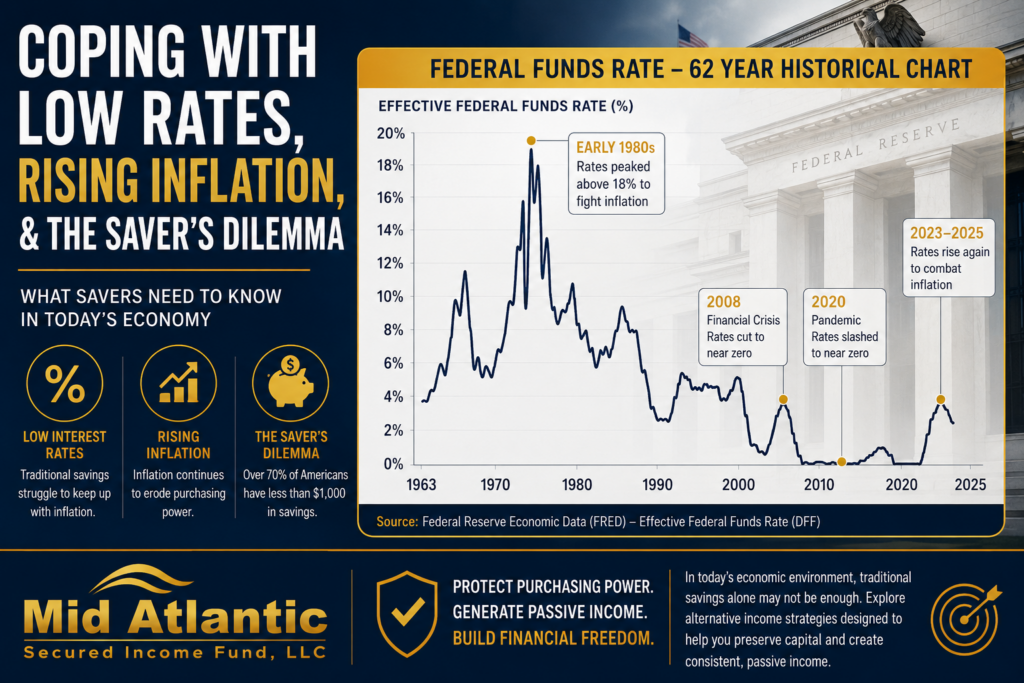
Inflation quietly erodes retirement income over time.
Even moderate inflation can significantly reduce purchasing power across decades.
For example:
At 3% annual inflation, purchasing power may decline by nearly 50% over approximately 24 years.
This creates a critical retirement planning challenge:
A portfolio must not only preserve principal — it must potentially generate returns and income capable of helping offset inflationary pressures over long time horizons.
This is one reason many investors increasingly focus on:
- income-producing assets,
- real assets,
- alternative investments,
- and diversified income strategies.
The Importance of Passive Income in Retirement
Retirement Often Requires Sustainable Cash Flow
Many retirement investors prioritize:
- recurring income,
- portfolio stability,
- and predictable cash flow.
Passive income strategies may include:
- dividend-paying investments,
- real estate income,
- private credit,
- bond income,
- REIT distributions,
- and asset-backed lending strategies.
The objective is often to create investment structures capable of generating ongoing income rather than relying exclusively on asset liquidation.
What Is Private Credit?
Direct Answer
Private credit refers to non-bank lending investments in which investors provide capital to businesses or real estate projects in exchange for interest income.
Private credit strategies may include:
- real estate-backed loans,
- bridge financing,
- senior secured lending,
- direct lending,
- and specialty finance investments.
Many private credit investments are collateral-backed, which may provide structural protections relative to unsecured lending structures.
Why Institutional Investors Are Increasingly Using Alternative Investments
Retirement Portfolios Are Evolving
Institutional investors including pension funds, endowments, and family offices have steadily increased allocations to alternative investments over the past decade.
According to research from BlackRock, Preqin, and McKinsey, institutional portfolios increasingly allocate capital toward:
- private credit,
- infrastructure,
- real estate,
- private equity,
- and alternative income strategies.
Why?
Because many investors seek:
- diversification,
- reduced public market correlation,
- inflation resilience,
- and stable income generation.
Alternative investments are not risk-free.
However, they may provide portfolio diversification benefits when properly structured within broader asset allocation strategies.
Are Retirement Funds Safer Than Individual Investments?
Direct Answer
Retirement funds may provide diversification, professional management, and long-term investment structures that can reduce concentration risk compared to holding individual investments alone.
However, all investments carry risk.
Retirement funds may still be exposed to:
- market volatility,
- inflation,
- interest rate changes,
- credit risk,
- liquidity risk,
- and economic downturns.
The effectiveness of a retirement strategy depends heavily on:
- diversification,
- time horizon,
- asset allocation,
- risk tolerance,
- and investment discipline.
Why Diversification Matters in Retirement
Concentration Can Increase Retirement Risk
Diversification remains one of the foundational principles of long-term investing.
Diversified retirement portfolios may include exposure to:
- stocks,
- bonds,
- private credit,
- real estate,
- cash reserves,
- alternative investments,
- and income-focused assets.
Diversification does not eliminate losses.
But it may help reduce overall portfolio volatility and improve long-term resilience across varying market environments.
Sequence-of-Return Risk Explained
Market Timing Can Matter During Retirement
One of the most overlooked retirement risks is sequence-of-return risk.
This occurs when large market declines happen early in retirement while investors are simultaneously withdrawing income.
Even if average long-term returns appear reasonable, poor timing can significantly reduce portfolio sustainability.
This is one reason many retirees prioritize:
- income-producing assets,
- downside protection strategies,
- diversification,
- and lower-volatility investment approaches.
The Psychology of Retirement Investing
Emotional Decision-Making Can Damage Long-Term Outcomes
Behavioral finance research consistently shows that emotional reactions often drive poor investment decisions.
Common retirement mistakes include:
- panic selling during downturns,
- excessive risk-taking,
- lack of diversification,
- insufficient cash reserves,
- and unrealistic return expectations.
Financial literacy and disciplined planning may help investors navigate volatility more effectively.
Real Estate & Retirement Investing
Why Real Assets Matter
Real estate has historically played a major role in wealth preservation and income generation.
Many retirement investors seek exposure to:
- multifamily housing,
- commercial real estate,
- real estate debt,
- and income-producing properties.
Real estate-backed investments may provide:
- recurring cash flow,
- collateral-backed exposure,
- and potential inflation sensitivity.
Real estate investments still involve risks including:
- market cycles,
- liquidity constraints,
- leverage exposure,
- and economic downturns.
However, many sophisticated investors continue using real assets as part of diversified retirement strategies.
How Accredited Investors Use Retirement Structures
Sophisticated Investors Often Expand Beyond Traditional Portfolios
Accredited investors frequently explore:
- private credit,
- real estate debt funds,
- private equity,
- structured income strategies,
- and alternative investments within retirement planning frameworks.
Many investors seek:
- diversification,
- passive income,
- and exposure to private markets.
Alternative investments may involve:
- reduced liquidity,
- more complex underwriting,
- and higher due diligence requirements.
Financial education becomes essential in evaluating these opportunities responsibly.
Financial Freedom and Retirement
Retirement Planning Is Ultimately About Optionality
Financial freedom does not necessarily mean unlimited wealth.
For many investors, financial freedom means:
- reduced financial stress,
- stable income,
- flexibility,
- and greater control over time and lifestyle decisions.
Retirement funds are not simply accumulation vehicles.
They are tools designed to support long-term financial independence and resilience.
The Future of Retirement Investing
Technology, AI & Alternative Assets Are Reshaping Retirement Portfolios
The retirement landscape is evolving rapidly.
Emerging trends include:
- AI-powered portfolio management,
- digital retirement planning tools,
- increased alternative investment access,
- private market democratization,
- and greater emphasis on income-oriented investing.
At the same time, investors face growing complexity surrounding:
- inflation,
- longevity,
- healthcare costs,
- and market uncertainty.
This makes financial literacy increasingly important for long-term retirement success.
Conclusion
Retirement Funds Are About More Than Saving
Retirement investing is no longer simply about accumulating assets in a traditional stock-and-bond portfolio.
Modern retirement planning increasingly involves:
- income generation,
- diversification,
- inflation awareness,
- downside protection,
- and long-term wealth preservation.
Sophisticated investors increasingly recognize that resilient retirement portfolios often combine:
- growth,
- income,
- diversification,
- and disciplined risk management.
No investment strategy eliminates risk.
But financial education, thoughtful planning, and diversified investing frameworks may help individuals pursue greater financial resilience and long-term retirement stability.
As private markets, alternative investments, and income-focused strategies continue evolving, retirement investing will likely become increasingly dynamic in the years ahead.
FAQ Section
What are retirement funds?
Retirement funds are investment accounts or pooled investment vehicles designed to help individuals save and invest for retirement.
What is the difference between a 401(k) and an IRA?
A 401(k) is typically employer-sponsored, while an IRA is individually established. Both offer tax advantages for retirement investing.
What is a self-directed IRA?
A self-directed IRA allows investors to access broader alternative investments including real estate, private credit, and other private market opportunities.
Why does inflation matter in retirement?
Inflation reduces purchasing power over time, which means retirees may require investment growth and income capable of helping offset rising living costs.
What is passive income in retirement?
Passive income refers to recurring income generated from investments such as dividends, rental income, private credit, or asset-backed lending strategies.
Are alternative investments risky?
Yes. Alternative investments involve risks including illiquidity, market risk, leverage exposure, and underwriting risk. Investors should perform thorough due diligence.