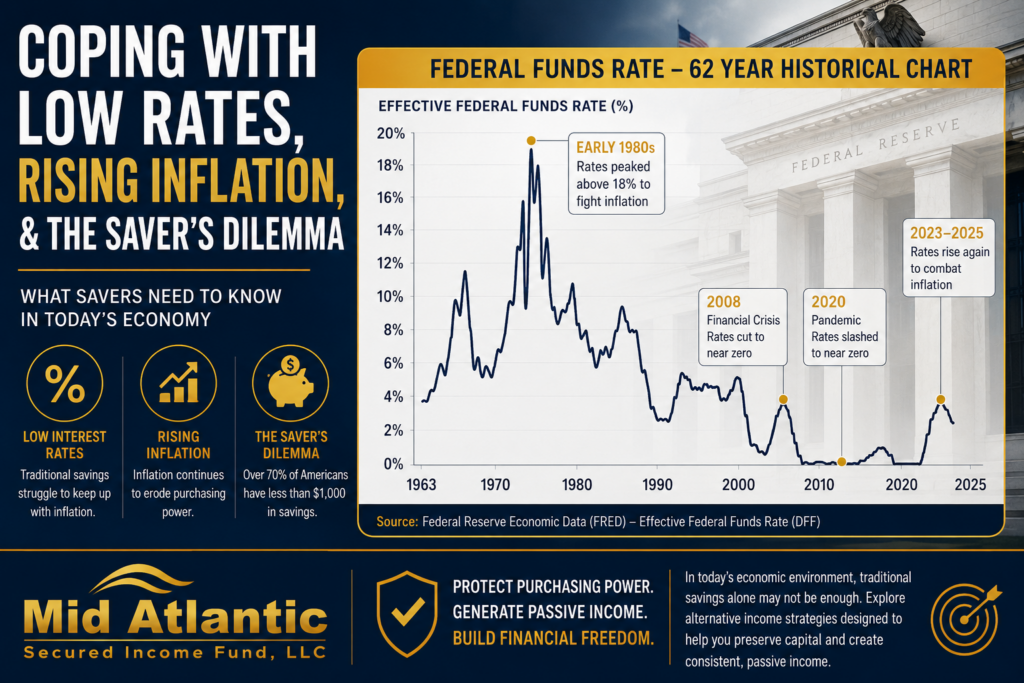

When public markets are repricing by the hour and short-term rates no longer compensate for inflation or reinvestment risk, many accredited investors start asking a more useful question than what pays the most. They ask which low volatility income investments can deliver consistent cash flow without exposing principal to unnecessary market swings.
That distinction matters. High income alone is not a durable strategy if it comes with mark-to-market volatility, long duration risk, weak underwriting, or dependence on optimistic exit assumptions. For investors focused on capital preservation and dependable distributions, the quality of the income stream matters as much as the stated yield.
What low volatility income investments actually mean
In practice, low volatility income investments are not simply assets with lower headline price movement. They are income-producing structures designed to reduce sensitivity to public market sentiment, interest rate shocks, or operational surprises. The best candidates typically share a few traits: contractual cash flow, strong collateral or asset coverage, conservative leverage, and a clear path to repayment.
That is why investors often separate public fixed income from private, asset-backed credit when evaluating volatility. A publicly traded bond fund may hold investment-grade securities, yet its net asset value can still move sharply as rates rise or spreads widen. The Federal Reserve’s tightening cycle made that clear. Even high-quality bonds experienced meaningful drawdowns because duration and pricing mechanics matter.
By contrast, certain private credit strategies seek to reduce that mark-to-market effect by emphasizing shorter durations, direct underwriting, and collateral protection. Volatility does not disappear. It is managed differently.
Why traditional income vehicles often fall short
For years, investors relied on a familiar mix of CDs, Treasuries, municipal bonds, and public bond funds for income. Each still has a role, but each comes with trade-offs that matter more in a less predictable rate environment.
Bank products insured by the FDIC offer principal protection within program limits, but yields may not remain attractive after taxes and inflation. Longer-dated bonds may offer higher stated income, yet they can be highly sensitive to rate moves. Public REITs can produce income, but because they trade like equities, they may carry equity-like volatility at exactly the wrong time.
This is where many sophisticated investors begin looking outside traditional allocations. They are not necessarily seeking maximum return. They are seeking a structure that aligns income generation with downside discipline.
Where private real estate credit fits
Among low volatility income investments, private real estate-backed credit deserves attention because it is built around lending rather than property appreciation. That distinction is central. In an equity real estate investment, the investor often depends on occupancy growth, cap rate compression, or a profitable sale. In a secured lending strategy, the focus is instead on borrower repayment, collateral value, loan structure, and legal position.
First-position mortgage lending can be especially relevant for investors prioritizing capital preservation. A lender in first position has a senior claim against the underlying property, and repayment is defined by the loan agreement rather than by a future sale at a favorable valuation. If underwriting is conservative and the loan-to-value ratio is disciplined, the asset can provide a meaningful collateral cushion.
This is why underwriting standards matter more than broad real estate narratives. A short-term first mortgage at 65 to 75 percent loan-to-value, supported by verified borrower equity and a practical exit strategy, is a different risk profile from an equity stake in a speculative development project.
The risk controls that separate disciplined strategies from weak ones
Not all private credit belongs in the same category. Some funds stretch duration, loosen covenants, or rely on aggressive valuations to maintain yield. Others are more disciplined, and that discipline is where lower-volatility characteristics begin.
The first control is collateral quality. Real estate-backed lending only protects investors if the property value is real, current, and supported by sensible underwriting. That means independent valuation work, local market knowledge, and conservative assumptions around construction timelines, sale velocity, and refinance options.
The second is loan position. Senior secured debt generally offers stronger downside protection than subordinate debt or preferred equity. In stressed environments, where repayment timing may shift, position in the capital stack matters.
The third is duration. Shorter-duration loans can reduce exposure to long interest rate cycles and changing market conditions. According to Mortgage Bankers Association data and broader credit market trends, refinancing conditions can tighten quickly. A lender making shorter-term loans with multiple viable exit paths is usually in a better position than one tied to a long-duration commitment made under very different assumptions.
The fourth is manager discipline. Investors should ask whether the fund originates its own loans, services them internally, and maintains control over borrower communication, draws, inspections, and workouts. A manager that is close to the collateral often has more tools to manage risk before a problem becomes a loss.
How to evaluate low volatility income investments like an allocator
Accredited investors should look beyond yield and ask what is driving the income stream. Start with the source of return. Is the cash flow generated by contractual interest payments, or does it depend on appreciation, refinancing, or an eventual sale?
Next, examine how principal is protected. In a secured private credit fund, that means understanding loan-to-value ranges, average duration, property types, geographic concentration, borrower selection, and historical loss experience. CoreLogic and Federal Reserve research have consistently shown that real estate performance is local and credit conditions can shift faster than broad property narratives suggest. Broad diversification is useful, but underwriting remains the first line of defense.
Then assess liquidity honestly. Lower volatility does not mean daily liquidity. In fact, many private investments reduce visible volatility partly because they are not traded continuously in public markets. That can be a strength for investors seeking income stability, but it requires matching the investment to actual time horizon and cash needs.
Finally, review operational evidence. A manager’s track record in originations, repayments, loss management, and distribution continuity says more than a marketing claim ever will. For a firm such as Mid Atlantic Secured Income Fund, the relevant questions would be straightforward: how loans are sourced, how collateral is evaluated, how servicing is handled, and what controls support uninterrupted income distributions over time.
What investors often misunderstand about volatility
One common mistake is assuming that an investment is low risk because its price does not move daily. The absence of a quoted market price is not the same as safety. Credit risk, collateral risk, and manager risk still exist. That is why due diligence is essential.
A second mistake is focusing on nominal yield without considering loss severity. A strategy producing high current income can still be unattractive if one weakly underwritten loan erases years of distributions. For income investors, avoiding severe losses often matters more than capturing an extra percentage point of yield.
A third mistake is treating all real estate exposure as equivalent. Public REIT shares, private equity real estate funds, and first-lien bridge lending may all involve real estate, but their return drivers are fundamentally different. One may behave like an equity security, another like a long-term development bet, and another like a short-duration, collateralized credit instrument.
A disciplined way to think about portfolio fit
For many accredited investors, low volatility income investments are not meant to replace every traditional holding. They are meant to solve a specific portfolio problem: how to generate attractive current income with more insulation from daily market repricing.
That makes private real estate credit particularly useful in a barbell approach. Investors may keep a portion of capital in highly liquid instruments for near-term needs and place another portion in secured, income-oriented private credit for yield and stability. The right allocation depends on liquidity preferences, tax considerations, overall net worth, and tolerance for illiquidity, but the core objective stays the same – preserve capital while maintaining dependable cash flow.
In that context, the appeal of conservative, asset-backed lending is easy to understand. The investor is not paying for growth stories or hoping multiple expansion rescues the thesis. The emphasis is on collateral, loan structure, borrower execution, and disciplined servicing.
The most useful question is not whether an investment claims to be low volatility. It is whether the underlying structure gives it a credible reason to be. When income is generated by short-duration, first-position loans secured by real assets and underwritten with conservative loan-to-value standards, the answer is often more compelling than what investors will find in many traditional income categories.
For accredited investors who value consistency over excitement, that is usually where durable income starts – with a manager whose first priority is not chasing the highest possible return, but protecting principal well enough for income to keep arriving on schedule.