
Volatility has become one of the defining characteristics of modern investing.
From inflation shocks and rising interest rates to geopolitical instability, regional banking disruptions, and commercial real estate repricing, investors are navigating an environment where preserving capital has become just as important as generating returns.
For decades, many investors relied heavily on traditional stock-and-bond portfolios built during a period of declining interest rates and extraordinary monetary accommodation. That environment has changed materially.
Today’s markets increasingly reward disciplined portfolio construction, downside-aware investing, and risk mitigation strategies designed to endure economic uncertainty.
Institutional investors—including pension funds, insurance companies, endowments, and family offices—have long understood this reality. Increasingly, accredited investors and high-net-worth individuals are adopting similar approaches through diversified allocations, alternative investments, private credit, and asset-backed income strategies.
The objective is not merely to “avoid risk.” That is impossible in investing.
The objective is to manage risk intelligently.
What Is Risk Mitigation in Investing?
Direct Answer
Risk mitigation in investing refers to strategies designed to reduce the probability or severity of financial losses while preserving long-term capital growth and income generation potential.
Risk mitigation may include:
- diversification,
- asset allocation,
- downside protection,
- private credit exposure,
- defensive investment positioning,
- inflation hedging,
- liquidity management,
- income-focused investing,
- and disciplined underwriting standards.
Sophisticated investors understand that successful investing is often less about maximizing short-term gains and more about surviving volatility while compounding wealth consistently over time.
Why Risk Mitigation Matters More Than Ever
The global investment landscape has fundamentally shifted.
Several structural trends are reshaping portfolio construction:
Persistent Inflation Risk
After decades of relatively stable inflation, the post-pandemic economy demonstrated how quickly purchasing power can erode.
According to the U.S. Bureau of Labor Statistics, inflation reached levels not seen in over 40 years during 2022, forcing central banks to tighten monetary policy aggressively.
Higher inflation impacts:
- retirement income,
- bond valuations,
- equity multiples,
- consumer spending,
- borrowing costs,
- and real estate pricing.
Investors increasingly seek income-generating assets capable of providing resilience during inflationary environments.
Interest Rate Volatility
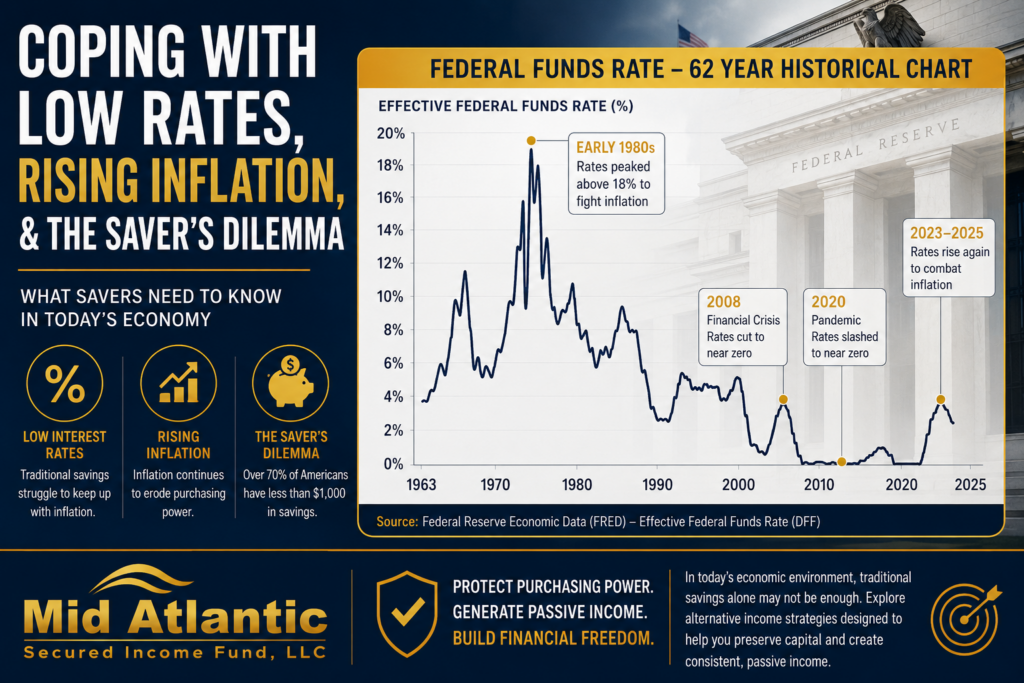
The Federal Reserve’s rapid interest rate hikes altered nearly every asset class.
Higher rates affect:
- commercial real estate valuations,
- mortgage activity,
- corporate borrowing,
- stock market valuations,
- and fixed-income securities.
Traditional portfolios experienced simultaneous pressure on both equities and bonds, challenging the historical assumption that bonds always hedge stock market volatility effectively.
Elevated Market Volatility
The CBOE Volatility Index (VIX) has experienced repeated spikes tied to:
- banking instability,
- recession fears,
- geopolitical tensions,
- regional conflicts,
- and macroeconomic uncertainty.
Periods of volatility often expose weaknesses in over leveraged or overly concentrated portfolios.
Demographic Retirement Pressures
Millions of Americans are approaching retirement age with concerns about:
- income sustainability,
- inflation,
- longevity risk,
- healthcare costs,
- and sequence-of-return risk.
According to the Federal Reserve’s Survey of Consumer Finances, retirement preparedness remains uneven across income groups, increasing demand for reliable income-oriented investment strategies.
The Institutional Approach to Risk Management
Large institutions rarely rely on a single asset class.
Instead, they construct diversified portfolios designed to withstand multiple economic environments.
This framework typically includes:
|
Strategy |
Purpose |
|---|---|
|
Diversification |
Reduce concentration risk |
|
Private Credit |
Generate contractual income |
|
Real Assets |
Hedge inflation |
|
Liquidity Management |
Preserve flexibility |
|
Downside Protection |
Limit severe losses |
|
Alternative Investments |
Reduce public market correlation |
|
Defensive Asset Allocation |
Improve stability |
Institutional investors focus heavily on risk-adjusted returns rather than simply chasing maximum yield.
Understanding the Difference Between Risk and Volatility
One of the most misunderstood concepts in investing is the distinction between volatility and risk.
Volatility
Volatility refers to short-term price fluctuations.
Public equities may experience significant swings even when underlying businesses remain fundamentally sound.
Risk
True investment risk often involves:
- permanent loss of capital,
- excessive leverage,
- poor underwriting,
- illiquidity,
- concentration,
- or unstable cash flow generation.
Sophisticated investors recognize that some lower-volatility assets can still carry significant hidden risk, while certain income-oriented alternative investments may exhibit lower correlation to broader market turbulence.
Why Sophisticated Investors Use Private Credit for Risk Mitigation
Private credit has emerged as one of the fastest-growing segments within alternative investments.
According to Preqin, global private debt assets under management surpassed $1.6 trillion in recent years and continue to grow as institutional capital reallocates toward income-oriented investments.
What Is Private Credit?
Private credit generally refers to non-bank lending arrangements where capital is provided directly to businesses, real estate projects, or borrowers outside traditional public bond markets.
Strategies may include:
- real estate-backed lending,
- bridge lending,
- senior secured lending,
- asset-backed financing,
- construction lending,
- receivables financing,
- and specialty finance.
Why Investors Allocate to Private Credit
1. Contractual Income
Unlike many growth-oriented equities, private credit investments are often structured around contractual interest payments.
This can provide:
- recurring income,
- cash flow visibility,
- and reduced dependence on market appreciation.
2. Senior Secured Positioning
Many private credit strategies operate in senior lien positions within the capital stack.
This means lenders may hold priority claims against underlying collateral before subordinate investors.
3. Asset-Backed Structures
Real estate-backed lending strategies may benefit from tangible collateral tied to:
- residential properties,
- multifamily projects,
- commercial real estate,
- or land assets.
4. Lower Correlation to Public Markets
Private credit performance may exhibit lower correlation to daily stock market volatility compared to traditional equities.
Are Debt Funds Safer Than Stocks?
Direct Answer
Debt funds are not inherently “safe,” but certain private credit and asset-backed lending strategies may offer lower volatility and stronger downside protections than many equity investments when structured conservatively.
Risk levels depend heavily on:
- underwriting quality,
- leverage,
- collateral strength,
- loan-to-value ratios,
- borrower quality,
- liquidity structure,
- and economic conditions.
Senior secured private lending strategies may provide additional protection through contractual income and collateral-backed structures.
Capital Preservation: The Foundation of Long-Term Wealth
One of the most important principles in institutional investing is that avoiding catastrophic losses matters enormously.
A portfolio that loses 50% requires a 100% gain to recover.
This asymmetry is why sophisticated investors emphasize:
- preservation first,
- growth second.
Capital preservation strategies often focus on:
- diversified income streams,
- downside protection,
- lower leverage,
- quality underwriting,
- inflation resilience,
- and cash-flow generation.
Diversification as a Risk Mitigation Tool
Diversification remains one of the most effective forms of risk management.
However, true diversification involves more than simply owning many stocks.
Institutional diversification may include exposure across:
Asset Classes
- Equities
- Fixed income
- Real estate
- Private credit
- Alternatives
- Cash equivalents
Geographic Exposure
- Domestic markets
- Southeast regional growth
- International exposure
Income Sources
- Dividends
- Interest payments
- Rental income
- Alternative income streams
Economic Sensitivities
- Inflation-sensitive assets
- Defensive sectors
- Cyclical sectors
- Real assets
Inflation and Risk Mitigation
Inflation represents one of the greatest long-term threats to purchasing power.
Even moderate inflation compounds significantly over decades.
For retirees and income-focused investors, inflation can quietly erode lifestyle sustainability.
Strategies often used to combat inflation include:
- real estate-backed investments,
- floating-rate lending,
- alternative income strategies,
- dividend growth equities,
- infrastructure exposure,
- and inflation-sensitive assets.
Real Estate as a Defensive Investment
Real estate continues to play an important role in institutional portfolios.
Historically, real assets have often provided:
- income generation,
- inflation sensitivity,
- collateral-backed value,
- and diversification benefits.
Why Real Estate-Backed Lending Matters
Rather than owning properties directly, some investors prefer exposure through debt positions tied to real estate collateral.
Potential advantages may include:
- contractual interest income,
- defined repayment structures,
- senior lien protections,
- reduced operational exposure,
- and shorter duration compared to equity real estate ownership.
The Psychology of Risk Management
Behavioral finance plays a major role in investment outcomes.
During periods of market stress, investors often make emotionally driven decisions that damage long-term returns.
Common mistakes include:
- panic selling,
- chasing speculative returns,
- excessive concentration,
- ignoring diversification,
- and overreacting to headlines.
Disciplined risk mitigation frameworks help investors maintain consistency through uncertainty.
Retirement Risk Mitigation
Retirement planning introduces additional layers of complexity.
Investors nearing retirement must consider:
- income sustainability,
- longevity risk,
- inflation,
- healthcare expenses,
- tax efficiency,
- and withdrawal sequencing.
Sequence-of-Return Risk
A major challenge for retirees is sequence risk—the danger that poor market performance early in retirement significantly reduces portfolio longevity.
Income-focused strategies and diversified alternative allocations may help reduce reliance on selling volatile assets during market downturns.
How Accredited Investors Use Alternative Investments
Accredited investors increasingly allocate portions of portfolios toward alternatives for:
- diversification,
- passive income,
- inflation mitigation,
- and reduced public market dependency.
Alternative investments may include:
- private credit,
- real estate debt,
- infrastructure,
- private equity,
- energy investments,
- and specialty finance.
According to BlackRock and Preqin research, institutional allocations to alternatives have steadily increased over the past decade.
The Role of Income in Portfolio Stability
Income generation can materially improve portfolio resilience.
Contractual income streams may provide:
- cash flow consistency,
- reduced emotional investing,
- and improved long-term planning visibility.
This is especially important for:
- retirees,
- family offices,
- income-focused investors,
- and wealth preservation strategies.
Why Downside Protection Matters
Sophisticated investing is often less about predicting the future and more about preparing for uncertainty.
Downside protection strategies may include:
- conservative underwriting,
- lower leverage,
- diversification,
- senior secured lending,
- liquidity management,
- and disciplined asset selection.
Investors increasingly recognize that avoiding severe losses often compounds wealth more effectively than speculative return chasing.
Risk Mitigation and Portfolio Construction
Modern portfolio construction increasingly emphasizes:
- risk-adjusted returns,
- downside resilience,
- income durability,
- and alternative diversification.
Rather than relying solely on a 60/40 stock-and-bond framework, many investors now incorporate:
- private credit,
- real assets,
- alternative income strategies,
- and inflation-aware allocations.
The Southeast Growth Story and Regional Risk Dynamics
The Southeast United States continues attracting population migration, business investment, and economic expansion.
Atlanta, in particular, has emerged as:
- a major logistics hub,
- corporate relocation destination,
- fintech center,
- and real estate growth market.
Population growth, infrastructure investment, and business migration trends may continue influencing regional lending and investment opportunities.
Why Conservative Underwriting Matters
In lending-oriented strategies, underwriting discipline is critical.
Risk mitigation often depends less on market predictions and more on:
- borrower quality,
- collateral evaluation,
- loan structure,
- repayment capacity,
- and conservative loan-to-value ratios.
Sophisticated investors increasingly evaluate managers based on:
- risk controls,
- transparency,
- alignment,
- and underwriting philosophy.
What Investors Should Evaluate Before Allocating Capital
Before investing in any private strategy, investors should carefully evaluate:
Investment Structure
- Debt vs. equity exposure
- Liquidity terms
- Distribution schedules
Risk Controls
- Collateral quality
- Underwriting standards
- Diversification practices
Manager Experience
- Historical track record
- Operational infrastructure
- Transparency
Alignment of Interests
- Sponsor participation
- Fee structure
- Incentive alignment
How The Mid Atlantic Secured Income Fund Approaches Risk Mitigation
The Mid Atlantic Secured Income Fund focuses on disciplined, income-oriented, asset-backed lending strategies designed to prioritize capital preservation principles and risk-aware investing.
Key themes include:
- senior secured positioning,
- real estate-backed collateral,
- income generation,
- underwriting discipline,
- and long-term relationship-driven lending.
Rather than emphasizing speculative growth narratives, the focus remains centered on:
- risk-adjusted opportunities,
- downside awareness,
- and durable income generation.
The Future of Risk Mitigation Investing
The investment landscape is evolving rapidly.
Persistent inflation uncertainty, geopolitical fragmentation, elevated debt levels, and changing interest-rate dynamics are reshaping portfolio construction globally.
As a result, investors increasingly prioritize:
- resilient income,
- diversification,
- real assets,
- alternative investments,
- and downside protection frameworks.
Institutional approaches once reserved primarily for pension funds and endowments are becoming more accessible to accredited investors seeking greater portfolio resilience.
Final Thoughts
Risk mitigation is not about eliminating uncertainty.
It is about building portfolios capable of enduring uncertainty intelligently.
Sophisticated investors increasingly recognize that successful long-term investing depends not only on pursuing returns, but also on protecting capital through disciplined strategy, diversification, underwriting rigor, and resilient income generation.
In today’s market environment, portfolios built solely around optimism may struggle.
Portfolios built around preparation may endure.
FAQ Section
What is risk mitigation in investing?
Risk mitigation refers to strategies designed to reduce the probability or severity of investment losses through diversification, asset allocation, downside protection, and disciplined portfolio construction.
Why is diversification important?
Diversification helps reduce concentration risk by spreading investments across multiple asset classes, industries, income streams, and economic sensitivities.
How does private credit reduce portfolio risk?
Private credit may provide contractual income, lower correlation to public markets, and asset-backed structures that can improve portfolio resilience when underwritten conservatively.
Are alternative investments less volatile?
Some alternative investments may exhibit lower correlation to public equities, though risk levels vary significantly depending on strategy, leverage, and liquidity.
Why do institutional investors use alternative investments?
Institutions often allocate to alternatives for diversification, inflation protection, income generation, and reduced dependence on traditional public markets.
What are senior secured loans?
Senior secured loans are debt instruments backed by collateral and positioned higher within the capital structure, potentially providing enhanced downside protection.
How do retirees mitigate investment risk?
Retirees often focus on diversification, income generation, inflation protection, liquidity planning, and reduced volatility exposure to preserve retirement sustainability.