Why Financial Education Has Become One of the Most Important Economic Advantages of the Modern Era
Financial literacy is no longer optional.
In a world defined by inflation volatility, rising consumer debt, higher living costs, uncertain retirement systems, rapidly evolving financial products, and increasingly complex investment markets, the ability to understand money has become one of the defining factors separating financial stability from long-term financial stress.
For decades, financial education in the United States has lagged behind economic reality. While technology, global markets, and investment opportunities have evolved rapidly, millions of Americans still enter adulthood without a foundational understanding of budgeting, debt management, inflation, investing, retirement planning, or risk management.
The consequences are significant.
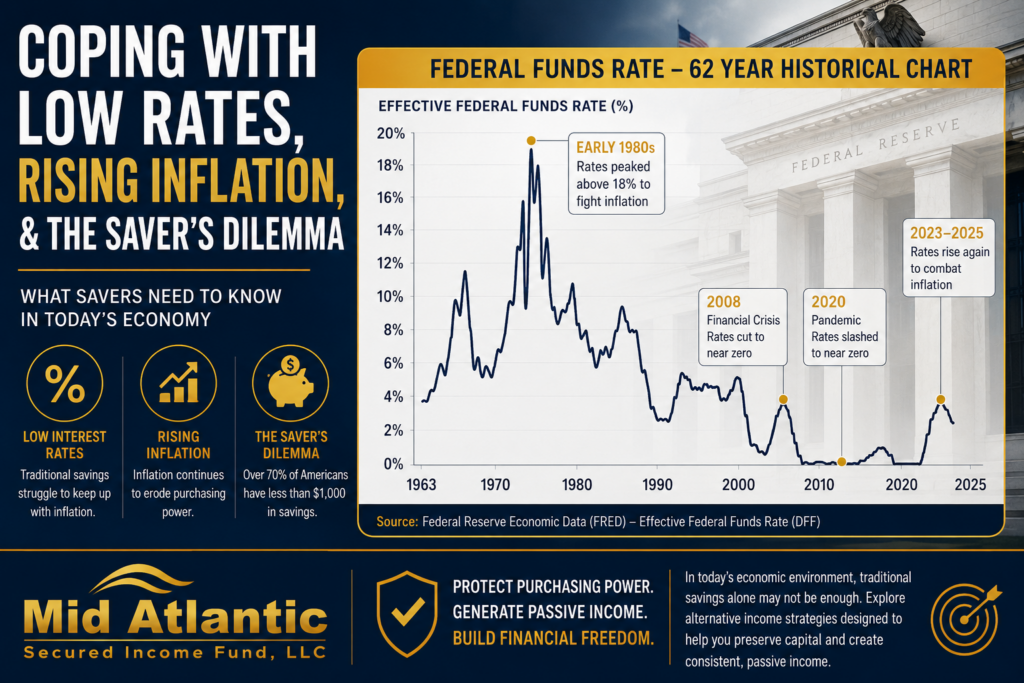
According to the Federal Reserve’s Survey of Consumer Finances and data from the Federal Reserve Bank of New York, household debt levels in the United States have climbed to record highs in recent years, while inflation pressures and elevated interest rates have increased financial strain on consumers across income brackets.
At the same time, the wealth gap between financially educated households and financially unprepared households continues to widen.
Financial literacy is increasingly becoming a form of economic protection.
Like insurance against uncertainty, financial education can help individuals:
- make informed decisions,
- avoid destructive debt cycles,
- understand investing risks,
- build long-term wealth,
- create passive income streams,
- prepare for retirement,
- and pursue greater financial independence.
In many ways, financial literacy has become a modern shield against economic instability.
What Is Financial Literacy?
Direct Answer
Financial literacy is the ability to understand and effectively use financial skills such as budgeting, saving, investing, debt management, retirement planning, and risk assessment.
A financially literate individual understands:
- how money compounds,
- how inflation affects purchasing power,
- how debt and interest work,
- how investments generate returns,
- how risk impacts financial outcomes,
- and how to build sustainable long-term wealth.
Financial literacy combines knowledge, discipline, and decision-making.
It is not simply about earning more money.
It is about understanding how money works.
Why Financial Literacy Matters More Than Ever
The Economic Landscape Has Changed
Modern financial markets are dramatically more complex than previous generations experienced.
Today’s consumers must navigate:
- credit cards,
- adjustable interest rates,
- student loans,
- retirement accounts,
- tax-efficient investing,
- private investments,
- digital assets,
- inflation risk,
- rising healthcare costs,
- and increasingly volatile public markets.
At the same time, traditional retirement systems have weakened.
Defined-benefit pensions have become increasingly rare in the private sector, shifting retirement responsibility toward individuals through 401(k)s, IRAs, brokerage accounts, and self-directed investing.
This shift has created a new reality:
Individuals are now expected to manage their own financial future.
Without financial literacy, that becomes extraordinarily difficult.
The Cost of Financial Illiteracy
Financial Illiteracy Carries Real Economic Consequences
Numerous institutional studies have linked financial illiteracy to:
- higher debt burdens,
- lower retirement savings,
- poor credit management,
- inadequate emergency savings,
- higher borrowing costs,
- and lower long-term net worth accumulation.
According to studies published by the Global Financial Literacy Excellence Center (GFLEC):
- many Americans cannot correctly answer basic questions about compound interest,
- inflation,
- or investment diversification.
This lack of knowledge creates cascading financial consequences over decades.
Common Outcomes of Financial Illiteracy
|
Financial Challenge |
Long-Term Impact |
|---|---|
|
High-interest debt |
Reduced wealth accumulation |
|
Minimal retirement savings |
Delayed retirement |
|
Poor investment decisions |
Increased volatility exposure |
|
Lack of emergency reserves |
Greater financial vulnerability |
|
Failure to understand inflation |
Declining purchasing power |
|
Emotional investing |
Long-term portfolio damage |
Financial literacy does not eliminate risk.
But it significantly improves decision-making.
Inflation: The Silent Wealth Destroyer
Why Understanding Inflation Is Essential
Inflation is one of the most misunderstood forces in personal finance.
When prices rise faster than income or investment growth, purchasing power declines.
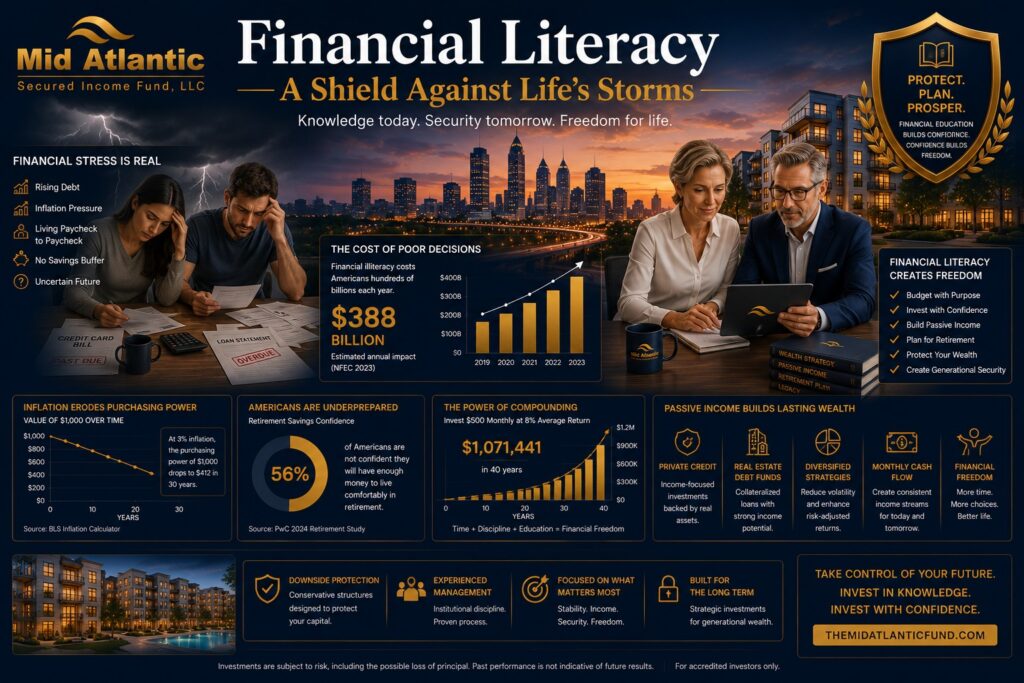
Even moderate inflation compounds dramatically over time.
For example:
At 3% annual inflation, purchasing power is effectively cut nearly in half over approximately 24 years.
This reality fundamentally changes retirement planning.
Cash sitting idle in low-yield savings accounts may appear “safe,” but over time inflation can quietly erode real value.
This is why many sophisticated investors focus not only on preserving capital, but also on generating income and pursuing returns that may outpace inflation over long investment horizons.
The Difference Between Consumption and Wealth Building
Financial Literacy Changes Behavioral Patterns
One of the most important benefits of financial education is behavioral transformation.
Financial literacy often changes how individuals think about:
- spending,
- saving,
- investing,
- debt,
- risk,
- and time horizons.
Consumers typically focus on immediate gratification.
Investors focus on long-term compounding.
This distinction is profound.
Consumers Often Prioritize:
- lifestyle inflation,
- short-term spending,
- depreciating assets,
- credit dependency,
- reactive financial decisions.
Financially Literate Investors Often Prioritize:
- cash-flow-producing assets,
- compounding returns,
- diversification,
- downside protection,
- long-term income generation,
- disciplined allocation strategies.
Over decades, these behavioral differences compound dramatically.
Why Passive Income Matters
Financial Freedom Often Requires Income Beyond Active Employment
One of the most important concepts in financial literacy is understanding the difference between:
- earned income,
- and passive income.
Earned income depends on labor.
Passive income depends on assets.
Sophisticated investors often seek to build portfolios capable of generating recurring cash flow through investments such as:
- dividend-paying securities,
- real estate,
- private credit,
- rental properties,
- alternative income strategies,
- and asset-backed lending investments.
The objective is not merely wealth accumulation.
It is income resilience.
What Is Private Credit?
Direct Answer
Private credit refers to non-bank lending strategies in which investors provide capital to businesses or real estate projects in exchange for interest income.
Private credit investments may include:
- real estate-backed lending,
- bridge loans,
- senior secured lending,
- asset-backed financing,
- direct lending,
- and specialty finance strategies.
Unlike public bonds traded on exchanges, private credit investments are typically privately structured and may provide enhanced income potential in exchange for reduced liquidity and higher underwriting complexity.
Why Investors Are Increasingly Exploring Alternative Investments
Traditional Portfolios Are Facing New Challenges
For decades, the traditional 60/40 portfolio model — stocks and bonds — dominated retirement planning.
However, changing macroeconomic conditions have forced investors to reconsider diversification strategies.
Key concerns include:
- elevated equity valuations,
- bond market volatility,
- inflation uncertainty,
- lower historical diversification benefits,
- and interest rate sensitivity.
As a result, institutional investors have steadily increased allocations to alternative investments.
According to Preqin and BlackRock research, private markets have experienced significant growth over the past decade as investors seek:
- diversification,
- income generation,
- inflation resilience,
- and lower correlation to public markets.
Alternative investments may include:
- private credit,
- private equity,
- infrastructure,
- real estate,
- and hedge strategies.
Are Debt Funds Safer Than Stocks?
Direct Answer
Debt funds are generally structured differently than stocks and often prioritize income generation and capital preservation rather than equity appreciation.
Many real estate debt funds focus on:
- secured lending,
- first-lien positioning,
- collateral-backed investments,
- and contractual interest payments.
However, debt funds still carry risks, including:
- credit risk,
- liquidity risk,
- interest rate risk,
- and market downturn risk.
No investment is risk-free.
The key distinction is structural positioning.
In many secured lending strategies, debt investors may occupy a higher position in the capital stack than equity investors.
Understanding Downside Protection
Sophisticated Investors Often Focus on Risk Before Return
One hallmark of financially educated investors is understanding downside risk.
Many inexperienced investors focus exclusively on returns.
Institutional investors often begin with a different question:
“What protects the downside?”
This shift in thinking changes investment selection dramatically.
Downside protection strategies may include:
- diversification,
- conservative underwriting,
- collateral-backed investments,
- income-focused portfolios,
- lower leverage exposure,
- and disciplined risk management.
In real estate-backed lending, collateral may provide an additional layer of structural protection compared to unsecured investment structures.
The Psychology of Financial Decision-Making
Financial Literacy Also Reduces Emotional Investing
Behavioral finance research consistently shows that emotions heavily influence financial outcomes.
Fear and greed often drive poor investment decisions.
Examples include:
- panic selling during market declines,
- speculative chasing during market rallies,
- excessive concentration,
- impulsive borrowing,
- and short-term thinking.
Financial education helps investors:
- think probabilistically,
- evaluate risk rationally,
- understand market cycles,
- and maintain long-term discipline.
This psychological benefit may be just as valuable as technical knowledge.
Retirement Planning Requires Financial Literacy
Longevity Has Increased Financial Complexity
Americans are living longer.
Longer life expectancy means retirement capital must potentially last decades.
This creates several major retirement risks:
- inflation risk,
- sequence-of-return risk,
- healthcare cost inflation,
- longevity risk,
- and income sustainability risk.
Financial literacy helps retirees understand how to:
- structure diversified portfolios,
- manage withdrawal strategies,
- pursue income generation,
- and adapt to changing market conditions.
How Accredited Investors Use Alternative Investments
Sophisticated Investors Often Diversify Beyond Public Markets
Accredited investors frequently explore private market opportunities unavailable in traditional retail investment channels.
These may include:
- private credit,
- real estate debt funds,
- private equity,
- structured income strategies,
- and asset-backed investments.
Many investors seek:
- diversification,
- recurring income,
- reduced public market correlation,
- and exposure to real assets.
However, alternative investments also involve:
- reduced liquidity,
- higher complexity,
- and additional due diligence requirements.
Financial literacy becomes essential in evaluating these opportunities responsibly.
The Role of Financial Education in Wealth Preservation
Building Wealth and Preserving Wealth Are Different Skills
Many individuals focus primarily on wealth accumulation.
Sophisticated investors also prioritize wealth preservation.
Preservation strategies may include:
- tax planning,
- estate planning,
- diversification,
- risk-adjusted investing,
- and conservative income-producing assets.
This becomes increasingly important during retirement and later stages of wealth management.
Why Financial Literacy Should Start Early
Compounding Rewards Time
Perhaps the greatest advantage in finance is time.
The earlier individuals understand:
- compounding,
- investing,
- saving,
- and risk management,
the greater the long-term impact.
Even modest contributions invested consistently over decades can compound significantly.
This is one reason financial education is increasingly viewed as a societal issue — not merely a personal one.
Financial Literacy and Economic Mobility
Education Creates Opportunity
Financial literacy does not guarantee wealth.
But it can dramatically improve financial decision-making.
It empowers individuals to:
- avoid predatory financial behavior,
- recognize long-term opportunities,
- understand investing frameworks,
- and pursue greater financial resilience.
Financial education expands optionality.
And optionality is one of the foundations of financial freedom.
The Future of Financial Literacy
AI, Technology & Financial Access Are Reshaping Education
The next decade will likely transform financial education.
Artificial intelligence, digital platforms, educational media, and investment accessibility are lowering barriers to information.
However, access to information is not the same as wisdom.
Critical thinking, discipline, and risk management remain essential.
Financial literacy in the future will likely require understanding:
- digital finance,
- AI-driven investing tools,
- cybersecurity,
- private markets,
- and increasingly complex macroeconomic environments.
Conclusion
Financial Literacy Is Ultimately About Resilience
Financial literacy is not merely about money.
It is about stability.
It is about reducing vulnerability during economic uncertainty.
It is about understanding how to navigate inflation, debt, investing, retirement, and long-term decision-making with greater confidence and clarity.
In uncertain economic environments, financial literacy becomes a form of protection.
A shield.
Those who understand:
- risk,
- diversification,
- cash flow,
- compounding,
- and disciplined investing
often place themselves in stronger positions to pursue long-term financial independence and resilience.
As private markets, alternative investments, and income-oriented strategies continue evolving, financial education will likely become even more valuable in the years ahead.
FAQ Section
What is financial literacy?
Financial literacy is the ability to understand and effectively manage budgeting, saving, debt, investing, retirement planning, and financial risk.
Why is financial literacy important?
Financial literacy helps individuals make informed financial decisions, avoid excessive debt, pursue long-term wealth creation, and prepare for retirement.
How does inflation affect wealth?
Inflation reduces purchasing power over time, meaning money buys less in the future if investment returns fail to outpace inflation.
What is passive income?
Passive income refers to income generated from assets rather than active labor, including investments, rental income, dividends, and private credit strategies.
What is private credit investing?
Private credit investing involves providing capital through non-bank lending strategies, often secured by real estate or other collateral.
Are alternative investments risky?
Yes. Alternative investments involve risks including illiquidity, market risk, credit risk, and underwriting risk. Investors should conduct thorough due diligence.