
A New Era of Investing Has Emerged
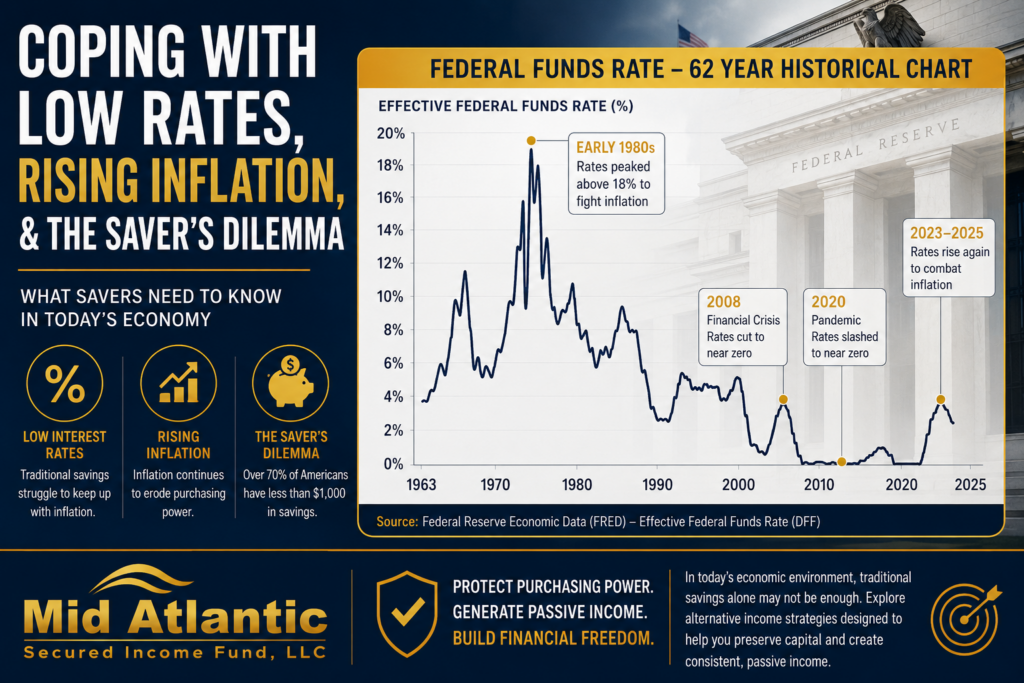
The investment landscape entering 2026 looks fundamentally different from the environment that defined much of the previous decade.
For years, investors operated in an era dominated by near-zero interest rates, aggressive monetary stimulus, elevated equity valuations, and abundant liquidity. Growth-oriented investing flourished. Risk assets surged. Passive index exposure often outperformed disciplined credit analysis.
That environment has changed.
Persistent inflationary pressures, higher-for-longer interest rates, rising geopolitical uncertainty, elevated government debt burdens, commercial real estate stress, and increased market volatility have forced investors to reassess how portfolios are constructed.
In response, a growing number of institutional investors, family offices, accredited investors, and retirement-focused allocators are shifting toward secured income investments — strategies designed to prioritize recurring cash flow, asset-backed protections, and downside-aware underwriting.
This shift is not simply tactical.
It reflects a broader structural evolution in modern portfolio construction.
Across institutional markets, private credit and secured lending strategies are increasingly viewed as essential components of diversified portfolios capable of navigating uncertain economic cycles while pursuing contractual income generation.
In many ways, 2026 is shaping up to be a defining year for secured income investing.
What Are Secured Income Investments?
Direct Answer
Secured income investments are investment strategies that generate recurring income through loans or debt structures backed by collateral or underlying assets. These investments often prioritize contractual cash flow, capital preservation, and downside protection.
Examples include:
- Private credit
- Real estate-backed lending
- Senior secured loans
- Asset-backed financing
- Bridge lending
- Specialty finance
- Commercial real estate debt
Unlike speculative equity investments, secured income investments generally occupy a higher position in the capital structure and may offer collateral protections in the event of borrower distress.
Why Secured Income Investments Are Rising in Popularity
Several macroeconomic and structural trends are driving increased investor interest.
1. Market Volatility Has Reintroduced Risk Awareness
The era of easy liquidity and relentless equity expansion created unusually high investor risk tolerance.
That dynamic has shifted considerably.
From interest rate shocks to banking instability, commercial real estate concerns, geopolitical conflicts, and inflation uncertainty, investors are increasingly focused on:
- downside protection
- volatility management
- capital preservation
- income reliability
- portfolio resilience
According to surveys from institutional firms including BlackRock and Goldman Sachs, risk management has become one of the defining portfolio themes entering 2026.
Secured income investments directly align with this priority.
2. Higher Interest Rates Have Revived Income Investing
For much of the 2010s, low rates compressed yields across traditional fixed-income markets.
As central banks raised rates to combat inflation, yields across credit-oriented investments improved significantly.
This created renewed interest in:
- private debt
- secured lending
- floating-rate loans
- real estate-backed credit
- income-producing alternatives
Investors seeking recurring cash flow suddenly had more attractive options than during the ultra-low-rate period following the Global Financial Crisis.
3. Institutional Investors Are Increasing Exposure to Private Credit
One of the most important structural shifts in modern investing has been the explosive growth of private credit markets.
Preqin estimates global private debt assets under management could exceed $2.8 trillion by 2028.
Large institutions including pension funds, insurance companies, sovereign wealth funds, and family offices have increasingly allocated capital toward:
- direct lending
- real estate debt
- specialty finance
- asset-backed credit
- infrastructure lending
Why?
Because these investments may provide:
- enhanced yield potential
- contractual income streams
- diversification benefits
- reduced public market correlation
- collateral-backed protections
This institutional adoption has helped legitimize secured income strategies as core portfolio components rather than niche alternatives.
Understanding Private Credit in 2026
What Is Private Credit?
Private credit refers to lending arrangements that occur outside traditional public bond markets and commercial banking systems.
These loans are typically negotiated privately between lenders and borrowers and may include:
- commercial bridge loans
- residential construction financing
- asset-backed lending
- receivables financing
- transitional real estate lending
- specialty business lending
Many private credit investments generate recurring income through contractual interest payments.
Why Private Credit Has Expanded So Rapidly
The private credit market accelerated after the 2008 financial crisis.
Increased banking regulations reduced the willingness of traditional banks to lend in certain sectors, particularly transitional or specialized lending environments.
This created opportunities for private lenders to fill financing gaps.
Over time, institutional investors recognized several advantages:
Enhanced Yield Potential
Private loans often command higher yields than traditional public fixed income due to complexity, illiquidity, and underwriting specialization.
Structural Protections
Many loans include:
- first-lien positioning
- asset-backed collateral
- personal guarantees
- covenants
- reserve requirements
Floating-Rate Structures
Floating-rate loans became especially attractive in rising-rate environments because income potential may adjust upward with interest rates.
Why Asset-Backed Lending Matters
One of the defining characteristics of secured income investments is collateralization.
In many private credit structures, loans are secured by tangible or contractual assets.
Examples include:
- real estate
- receivables
- inventory
- equipment
- business assets
- contractual cash flows
This differs materially from unsecured debt structures.
Collateral-backed lending may provide an additional layer of downside protection when underwriting is disciplined and loan-to-value ratios remain conservative.
Are Secured Income Investments Safer Than Stocks?
Direct Answer
Secured income investments are not risk-free, but they generally occupy a higher position in the capital structure than common equity investments.
In many structures, lenders receive repayment priority ahead of equity holders.
This can potentially reduce downside exposure, particularly when loans are secured by collateral and underwritten conservatively.
However, risks still exist, including:
- borrower default
- collateral impairment
- economic downturns
- liquidity constraints
- real estate market declines
- underwriting failures
Investment quality depends heavily on manager discipline and risk management processes.
The Growing Importance of Cash Flow Investing
Modern investors increasingly prioritize cash flow over speculative appreciation.
This trend has accelerated due to:
- retirement concerns
- inflation pressure
- economic uncertainty
- rising living costs
- aging demographics
Cash flow-oriented portfolios can potentially provide:
- recurring income
- reduced dependence on asset sales
- enhanced financial flexibility
- improved emotional resilience during volatility
This psychological dimension matters more than many investors realize.
The Behavioral Shift Toward Stability
Investor psychology has changed meaningfully since 2020.
The combination of pandemic disruption, inflation shocks, banking instability, geopolitical tensions, and public market volatility has increased investor demand for stability-oriented strategies.
Behavioral finance research consistently shows investors become more risk-aware after prolonged periods of uncertainty.
This helps explain the growing demand for:
- downside-aware investing
- capital preservation strategies
- contractual income streams
- diversified alternatives
Secured income investments sit directly at the intersection of these priorities.
Why Real Estate-Backed Lending Remains Attractive
Real estate-backed lending remains one of the most prominent areas within private credit markets.
Unlike speculative property ownership, debt-oriented real estate investing focuses on lending against underlying assets.
These loans may involve:
- multifamily developments
- bridge financing
- construction lending
- stabilized commercial properties
- transitional real estate assets
Many investors view real estate-backed lending as attractive because it combines:
- income generation
- collateral-backed protections
- shorter-duration structures
- real asset exposure
The Role of Duration in Modern Credit Markets
Duration risk became a major issue during the rate-hiking cycle.
Long-duration bonds experienced substantial price pressure as rates rose.
This increased investor interest in shorter-duration lending structures capable of:
- reducing interest rate sensitivity
- recycling capital more quickly
- repricing income streams faster
Bridge lending and transitional credit strategies have benefited from this trend.
Inflation Has Reshaped Portfolio Construction
Inflation is one of the most important forces shaping modern investing.
For years, many investors underestimated its long-term impact.
Today, inflation considerations influence nearly every institutional asset allocation discussion.
Investors increasingly seek assets capable of:
- generating yield spreads above inflation
- preserving purchasing power
- maintaining income consistency
- reducing real-return erosion
This has increased institutional interest in alternative income-producing investments.
Why Diversification Matters More Than Ever
Traditional 60/40 stock-and-bond portfolios faced significant pressure during periods when both equities and bonds declined simultaneously.
As a result, sophisticated investors increasingly seek diversified income streams outside traditional public markets.
This may include allocations toward:
- private credit
- infrastructure
- real assets
- real estate debt
- specialty finance
- alternative investment funds
Diversification remains one of the most important tools in risk management.
How Institutional Investors Evaluate Secured Income Strategies
Sophisticated allocators often focus on:
Underwriting Quality
How conservative is the lending process?
Loan-to-Value Ratios
How much equity cushion exists beneath the loan?
Sponsor Quality
Does the borrower have operational experience?
Market Fundamentals
How resilient is the local market?
Collateral Protection
What assets secure the loan?
Income Reliability
How predictable are cash flow streams?
Duration Profile
How long is capital committed?
These factors matter far more than headline yield alone.
The Southeast Growth Story
The Southeast United States continues to attract significant institutional capital.
Cities including Atlanta have benefited from:
- population migration
- corporate relocations
- employment growth
- infrastructure investment
- housing demand
This regional growth has supported increased lending activity across residential and commercial real estate sectors.
Institutional investors continue monitoring Southeast markets closely due to long-term demographic tailwinds.
Why Accredited Investors Are Exploring Alternatives
Accredited investors increasingly seek broader diversification beyond public equities and traditional bonds.
Alternative investments may provide exposure to:
- private markets
- non-correlated assets
- contractual income streams
- institutional credit opportunities
This has contributed to rising demand for private credit platforms and secured lending investments.
What Are the Risks of Secured Income Investments?
Direct Answer
Secured income investments involve meaningful risks despite their defensive characteristics.
Risks may include:
- borrower default
- real estate market declines
- liquidity constraints
- economic recession
- underwriting errors
- sponsor failure
- interest rate volatility
No investment strategy guarantees positive returns or protection against loss.
Risk management and underwriting discipline remain essential.
Why Discipline Matters More Than Yield
One of the most important lessons institutional investors emphasize is this:
Higher yield alone does not equal better investing.
Sophisticated credit investing prioritizes:
- structure
- collateral
- underwriting discipline
- sponsor quality
- market fundamentals
- downside awareness
Long-term performance often depends more on avoiding major losses than maximizing short-term yield.
The Rise of Income-Oriented Wealth Planning
Wealth management itself is evolving.
Increasingly, affluent investors are shifting from pure accumulation strategies toward:
- income durability
- retirement sustainability
- inflation resilience
- volatility management
- downside protection
This shift is helping drive broader adoption of secured income investments across modern portfolios.
Conclusion: 2026 May Mark a Defining Era for Secured Income Investing
The rise of secured income investments reflects more than a temporary market trend.
It reflects a structural evolution in how sophisticated investors think about:
- risk
- cash flow
- diversification
- resilience
- capital preservation
- portfolio construction
As volatility, inflation uncertainty, and macroeconomic complexity continue reshaping financial markets, investors increasingly recognize the importance of contractual income streams and disciplined underwriting.
Private credit and secured lending strategies are becoming central pillars within institutional portfolios because they address some of the defining challenges of modern investing:
- generating income
- managing volatility
- protecting capital
- diversifying risk
- pursuing long-term financial resilience
While no investment eliminates uncertainty, the growing demand for secured income strategies suggests investors are increasingly prioritizing stability, structure, and discipline over speculation alone.
That trend may define the next era of investing.
FAQ Section
What are secured income investments?
Secured income investments are income-producing investments backed by collateral or underlying assets. Common examples include private credit, real estate-backed lending, and senior secured loans.
Why are secured income investments growing in popularity?
Investors are increasingly prioritizing recurring income, downside protection, and diversification amid inflation, higher interest rates, and market volatility.
What is private credit?
Private credit refers to privately negotiated loans made outside traditional public bond markets and commercial banking systems.
Are secured lending investments safer than stocks?
Secured lending investments generally occupy a higher position in the capital structure than common equity, but they still carry risks including borrower default and market declines.
Why are institutional investors allocating to private credit?
Institutional investors often use private credit for enhanced yield potential, contractual income streams, diversification, and collateral-backed protections.
What risks exist in private credit investing?
Risks include default risk, liquidity risk, underwriting risk, collateral impairment, economic downturns, and real estate market volatility.