Financial Illiteracy Is One of America’s Most Expensive Problems
Financial illiteracy has quietly become one of the most damaging economic issues facing the United States. While inflation, housing affordability, interest rates, and retirement insecurity dominate headlines, a deeper structural problem continues to compound beneath the surface: millions of Americans lack the financial knowledge necessary to make informed long-term decisions about debt, investing, retirement planning, and wealth preservation.
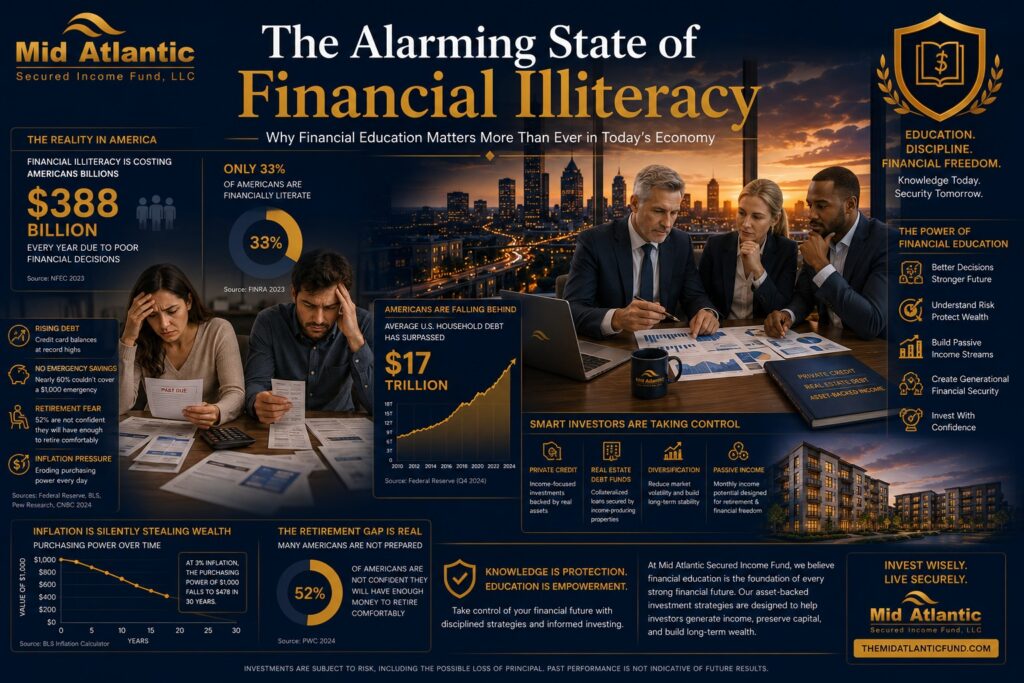
According to the National Financial Educators Council (NFEC), financial illiteracy cost Americans more than $388 billion in 2023 alone through poor financial decisions, excessive debt, inadequate savings, predatory lending, and investment mistakes. At the same time, Federal Reserve data continues to show that a significant percentage of Americans remain financially fragile, with many unable to absorb even modest emergency expenses without borrowing money or liquidating assets.
This growing financial education gap is occurring during one of the most complex investment environments in modern history.
Americans are simultaneously navigating:
- persistent inflation,
- elevated interest rates,
- volatile equity markets,
- rising healthcare costs,
- increased retirement burdens,
- shifting banking conditions,
- and rapidly evolving investment opportunities.
Yet despite these realities, financial literacy education remains alarmingly inadequate across schools, workplaces, and households.
For sophisticated investors, this trend creates both risks and opportunities. On one hand, financially uninformed markets often lead to poor investment behavior and emotional decision-making. On the other hand, investors who prioritize education, disciplined risk management, and long-term capital preservation may be positioned to navigate uncertainty more effectively.
At The Mid Atlantic Secured Income Fund, financial education remains a core principle behind long-term investing decisions, particularly within private credit, asset-backed lending, passive income strategies, and retirement-focused investing.
What Is Financial Illiteracy?
Definition of Financial Illiteracy
Financial illiteracy refers to the inability to understand or effectively use basic financial concepts such as:
- budgeting,
- saving,
- investing,
- debt management,
- compound interest,
- inflation,
- retirement planning,
- credit management,
- and risk diversification.
A financially illiterate individual may struggle to:
- build emergency savings,
- understand investment risks,
- manage high-interest debt,
- prepare for retirement,
- evaluate financial products,
- or make informed long-term investment decisions.
In today’s economy, these skills are no longer optional. They are foundational survival tools.
The Financial Literacy Crisis in America
The Statistics Are Alarming
Recent data paints a concerning picture of financial literacy across the United States.
According to the FINRA Investor Education Foundation:
- only about one-third of Americans can correctly answer basic financial literacy questions,
- many adults struggle to understand inflation, interest rates, and diversification,
- younger generations continue to report low confidence in managing money,
- and retirement preparedness remains historically weak.
Meanwhile:
- U.S. household debt surpassed $17 trillion according to the Federal Reserve,
- credit card balances reached record highs,
- average retirement savings remain inadequate for millions of households,
- and inflation continues to erode purchasing power.
The consequences are significant.
Financial illiteracy impacts:
- retirement readiness,
- home ownership,
- investment confidence,
- wealth inequality,
- economic mobility,
- and overall financial stability.
Why Financial Literacy Matters More Than Ever
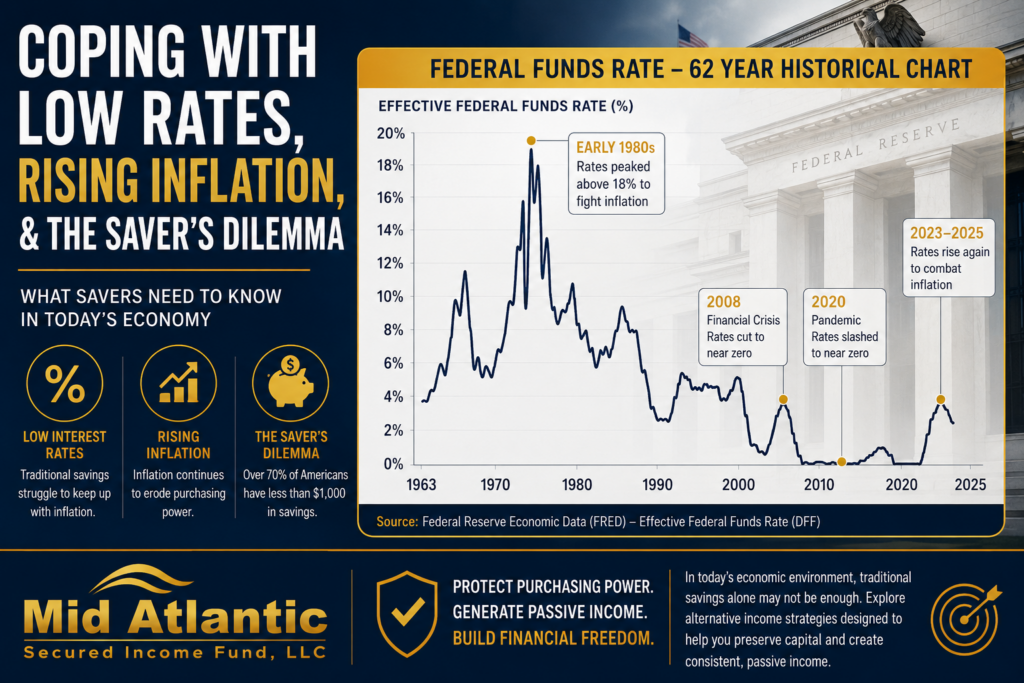
Inflation Has Changed the Financial Landscape
One of the most dangerous consequences of financial illiteracy is misunderstanding inflation.
Many individuals continue holding excessive cash positions in low-yield savings accounts while inflation steadily erodes purchasing power over time.
For example:
If inflation averages 3% annually, purchasing power can effectively decline by nearly 50% over approximately 24 years.
This creates enormous long-term challenges for retirees and income-focused investors.
Investors increasingly recognize the importance of:
- income-producing assets,
- inflation-aware investment strategies,
- diversified portfolios,
- and alternative investments with lower public market correlation.
This is one reason private credit and asset-backed investments have gained increasing institutional attention in recent years.
The Retirement Crisis Is Growing
Americans Are Living Longer — But Saving Less
Retirement planning has become increasingly complex.
According to Federal Reserve Survey of Consumer Finances data:
- many Americans remain significantly underprepared for retirement,
- defined benefit pensions have declined substantially,
- and individuals now carry far greater responsibility for generating retirement income.
At the same time:
- life expectancy remains elevated,
- healthcare expenses continue rising,
- and Social Security uncertainty persists.
This creates substantial pressure on retirement portfolios.
Historically, many retirees relied heavily on:
- CDs,
- Treasury bonds,
- dividend stocks,
- and traditional fixed-income investments.
However, elevated inflation and market volatility have caused many investors to reconsider how they generate stable income.
Increasingly, investors are exploring:
- private credit,
- real estate debt funds,
- alternative income investments,
- and asset-backed lending strategies.
How Financial Illiteracy Impacts Investing
Emotional Investing Often Destroys Long-Term Wealth
One of the most overlooked consequences of poor financial education is emotional investing behavior.
During periods of market volatility, financially inexperienced investors often:
- panic sell,
- chase speculative trends,
- over-concentrate portfolios,
- misunderstand risk,
- or fail to diversify properly.
Institutional investors, by contrast, typically focus on:
- disciplined underwriting,
- long-term cash flow,
- downside protection,
- asset-backed collateral,
- and risk-adjusted returns.
This distinction is critical.
Successful investing is rarely driven by emotion. It is driven by process, discipline, and education.
Why Sophisticated Investors Increasingly Explore Alternative Investments
Public Markets Are No Longer the Only Option
Over the past decade, alternative investments have become increasingly mainstream among accredited investors, family offices, pension funds, and institutional allocators.
According to Preqin and BlackRock research:
- private markets continue experiencing long-term asset growth,
- institutional allocations to private credit have expanded significantly,
- and investors increasingly seek diversification beyond traditional stocks and bonds.
Alternative investments may include:
- private credit,
- private lending,
- real estate debt funds,
- infrastructure,
- private equity,
- and asset-backed investment strategies.
These investments are often attractive because they may provide:
- lower public market correlation,
- income-focused structures,
- collateral-backed investments,
- and differentiated risk-return profiles.
At The Mid Atlantic Fund Knowledge Hub, investors can explore educational resources related to private credit, retirement income strategies, passive income investing, and real estate-backed lending.
What Is Private Credit?
A Growing Institutional Asset Class
Private credit refers to non-bank lending provided directly to businesses, real estate projects, or borrowers through private investment vehicles rather than traditional public bond markets.
Private credit strategies may include:
- bridge lending,
- real estate-backed loans,
- senior secured lending,
- receivables financing,
- asset-backed lending,
- and structured income investments.
Over the past several years, rising banking regulations and tighter credit conditions have created growing demand for private lending capital.
Institutional investors increasingly view private credit as:
- a diversification tool,
- an income-generating asset class,
- and a potential alternative to traditional fixed income.
Why Financial Education Matters for Retirement Investors
Understanding Risk Is More Important Than Chasing Yield
One of the biggest misconceptions among inexperienced investors is assuming higher yield automatically means higher quality opportunity.
Sophisticated investing requires understanding:
- collateral structure,
- underwriting quality,
- loan-to-value ratios,
- liquidity considerations,
- sponsor strength,
- macroeconomic risks,
- and capital preservation.
This is particularly important in private markets.
Financial education empowers investors to ask better questions such as:
- Is the investment asset-backed?
- What collateral secures the investment?
- How is risk managed?
- What happens during economic downturns?
- How are distributions generated?
- What underwriting standards exist?
These questions often matter more than headline returns alone.
Financial Literacy and Passive Income
Why Income-Focused Investing Has Gained Attention
Many investors today are increasingly focused on generating passive income.
This trend has accelerated due to:
- retirement uncertainty,
- inflation pressures,
- rising living costs,
- and concerns about stock market volatility.
Passive income strategies may include:
- dividend-paying investments,
- rental real estate,
- private credit,
- real estate debt funds,
- and income-focused alternative investments.
The appeal is understandable.
Many investors seek:
- predictable cash flow,
- lower volatility,
- and diversification from traditional public equities.
At Mid Atlantic Secured Income Fund IRA Investing, investors can explore educational resources surrounding retirement-focused investing and self-directed IRA opportunities.
The Role of Financial Education in Wealth Building
Wealth Building Requires Long-Term Thinking
Financial literacy ultimately shapes behavior.
Financially educated investors are more likely to:
- save consistently,
- invest long term,
- diversify appropriately,
- manage debt responsibly,
- understand inflation,
- and avoid emotionally driven decisions.
By contrast, financial illiteracy often leads to:
- excessive consumer debt,
- speculative investing,
- inadequate retirement preparation,
- poor budgeting,
- and short-term thinking.
The long-term wealth gap between these behaviors can be enormous.
Why Financial Literacy Should Matter to Every Investor
Education May Be the Greatest Long-Term Investment
Financial literacy is not merely about budgeting or avoiding debt.
It is about understanding how capital works.
It shapes:
- retirement outcomes,
- investment decisions,
- intergenerational wealth,
- risk management,
- and financial independence.
As markets become increasingly complex, financially educated investors may be better positioned to:
- identify opportunities,
- manage volatility,
- preserve capital,
- and pursue long-term financial stability.
The Future of Financial Education
AI, Technology & Investment Education
Artificial intelligence and digital platforms are rapidly transforming financial education.
Investors now have unprecedented access to:
- macroeconomic data,
- investment research,
- portfolio analytics,
- financial planning tools,
- and educational content.
However, access to information alone is not enough.
The real differentiator will increasingly become:
- discernment,
- critical thinking,
- risk analysis,
- and disciplined investment behavior.
In a world flooded with financial content, trusted institutional-quality education may become more valuable than ever.
Final Thoughts
Financial Illiteracy Is Expensive — But Education Creates Opportunity
The financial literacy crisis in America continues to grow at a time when economic complexity is accelerating.
Inflation, retirement uncertainty, debt burdens, and market volatility are forcing investors to become more proactive and informed.
For sophisticated investors, financial education is not simply academic. It is foundational to capital preservation, long-term income generation, and risk management.
Understanding:
- inflation,
- private credit,
- retirement income,
- diversification,
- and asset-backed investing
may help investors make more informed long-term decisions.
As financial markets evolve, investors who prioritize education, discipline, and thoughtful portfolio construction may be better positioned to navigate uncertainty while pursuing long-term financial stability.
FAQ Section
What is financial illiteracy?
Financial illiteracy refers to the lack of understanding of basic financial concepts such as budgeting, investing, debt management, inflation, and retirement planning.
Why is financial literacy important?
Financial literacy helps individuals make informed decisions about saving, investing, retirement planning, debt management, and long-term wealth creation.
How does financial illiteracy impact retirement?
Poor financial literacy can lead to inadequate retirement savings, excessive debt, poor investment decisions, and insufficient long-term income planning.
What are alternative investments?
Alternative investments include private credit, private lending, real estate debt funds, private equity, and other investments outside traditional stocks and bonds.
What is private credit investing?
Private credit investing involves lending capital directly to businesses or real estate projects through private investment vehicles rather than public bond markets.
Why are investors exploring private credit?
Many investors seek private credit for income generation, diversification, lower public market correlation, and asset-backed investment structures.