Financial Ignorance Is Quietly Destroying Wealth Across America
Financial ignorance is one of the most underestimated economic risks in modern society.
While headlines focus on inflation, interest rates, recession fears, stock market volatility, and political uncertainty, a far deeper issue continues eroding financial stability for millions of Americans: the widespread lack of financial education.
The consequences are staggering.
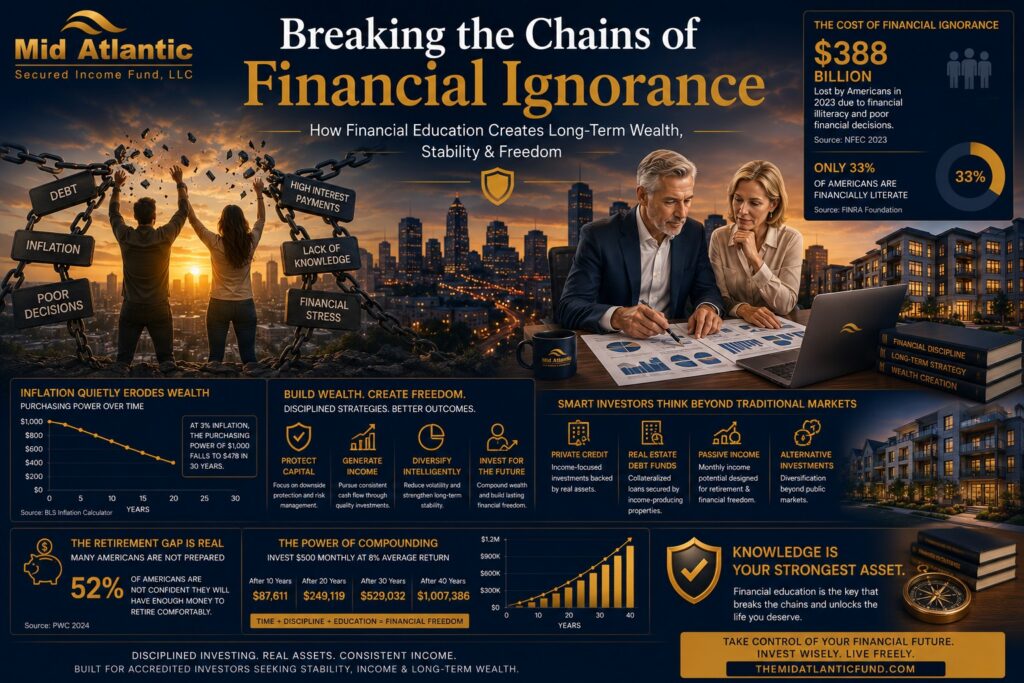
According to the National Financial Educators Council (NFEC), financial illiteracy cost Americans an estimated $388 billion in 2023 alone through:
- excessive debt,
- poor investment decisions,
- inadequate retirement planning,
- predatory lending,
- insufficient savings,
- and lack of long-term financial strategy.
At the same time:
- household debt continues climbing,
- retirement insecurity remains elevated,
- inflation has permanently increased living costs,
- and many Americans remain financially unprepared for economic disruptions.
The reality is uncomfortable but increasingly unavoidable:
Many people work hard for decades yet never fully understand how money, investing, debt, inflation, or wealth creation actually function.
This is not merely a budgeting problem.
It is a structural education problem.
And in today’s economy, financial ignorance can become extraordinarily expensive.
At The Mid Atlantic Secured Income Fund, financial education remains central to long-term investing philosophy because informed investors are often better positioned to navigate volatility, preserve capital, and pursue stable income-oriented investment strategies.
What Is Financial Ignorance?
Definition of Financial Ignorance
Financial ignorance refers to a lack of understanding regarding:
- investing,
- inflation,
- compound interest,
- retirement planning,
- debt management,
- risk diversification,
- passive income,
- and long-term wealth preservation.
It often manifests through behaviors such as:
- living paycheck to paycheck,
- carrying excessive high-interest debt,
- avoiding investing entirely,
- misunderstanding risk,
- chasing speculative investments,
- or failing to prepare for retirement.
Financial ignorance is not limited to low-income households.
Even high earners can struggle financially if they lack:
- investment discipline,
- tax awareness,
- risk management,
- or long-term wealth strategies.
Why Financial Education Matters More Than Ever
The Economy Has Become More Complex
Today’s financial environment is significantly more complicated than previous generations experienced.
Modern investors must navigate:
- inflationary pressures,
- rising interest rates,
- volatile markets,
- housing affordability challenges,
- healthcare inflation,
- retirement longevity risk,
- and rapidly evolving investment products.
At the same time, traditional financial safety nets have weakened.
Defined-benefit pensions have largely disappeared, leaving individuals increasingly responsible for funding their own retirement.
This shift has fundamentally changed the importance of financial education.
Understanding how capital compounds, how inflation impacts purchasing power, and how income-producing investments function is now essential for long-term financial stability.
Inflation Is Quietly Eroding Wealth
One of the Biggest Hidden Financial Risks
One of the most dangerous consequences of financial ignorance is underestimating inflation.
Inflation reduces purchasing power over time, meaning money sitting idle in low-yield accounts gradually loses real value.
For example:
At 3% annual inflation, purchasing power can effectively decline by nearly half over approximately 24 years.
This creates major long-term consequences for:
- retirees,
- savers,
- conservative investors,
- and households dependent on fixed income.
Many investors today are increasingly exploring:
- passive income investments,
- private credit,
- real estate-backed lending,
- and alternative income strategies
in an effort to generate income streams that may better align with inflationary environments.
The Debt Crisis Reflects a Broader Education Problem
Americans Continue Struggling With Debt
According to Federal Reserve data:
- U.S. household debt has surpassed $17 trillion,
- credit card balances remain near record highs,
- and consumer borrowing costs have increased substantially due to elevated interest rates.
Many households remain trapped in cycles of:
- high-interest debt,
- inadequate savings,
- and poor financial planning.
Financial ignorance often causes individuals to underestimate how compounding interest works against them in debt structures.
Ironically, the same compounding principles that build wealth through investing can rapidly destroy wealth through poorly managed liabilities.
Financial Ignorance and Retirement Insecurity
Millions of Americans Are Underprepared for Retirement
Retirement insecurity continues growing across the United States.
According to multiple studies from the Federal Reserve and retirement research organizations:
- many Americans remain behind on retirement savings,
- a significant percentage of workers lack adequate emergency reserves,
- and confidence in retirement preparedness remains historically weak.
Several factors contribute to this:
- longer life expectancy,
- rising healthcare costs,
- inflation,
- market volatility,
- and lack of financial planning education.
Historically, many investors relied heavily on:
- pensions,
- savings accounts,
- CDs,
- and traditional bonds.
Today, however, retirement income planning has become significantly more sophisticated.
This is one reason alternative income-oriented investments have gained growing attention among accredited investors and retirement-focused allocators.
Why Sophisticated Investors Prioritize Education
Knowledge Often Shapes Investment Outcomes
Sophisticated investors rarely rely solely on headlines or emotion.
Instead, they focus on:
- risk-adjusted returns,
- capital preservation,
- diversification,
- cash flow,
- macroeconomic conditions,
- and disciplined underwriting.
Financial education helps investors ask critical questions such as:
- What collateral supports the investment?
- How is downside risk managed?
- What is the loan-to-value ratio?
- What income sources support returns?
- How does inflation impact purchasing power?
- What are the liquidity considerations?
These questions become particularly important within private markets and alternative investments.
The Rise of Alternative Investments
Investors Are Expanding Beyond Traditional Stocks & Bonds
Over the last decade, institutional investors have significantly increased allocations toward alternative investments.
According to Preqin and BlackRock research:
- private credit assets under management have expanded substantially,
- institutional portfolios increasingly include alternative income strategies,
- and diversification beyond public equities has become more common.
Alternative investments may include:
- private credit,
- private lending,
- real estate debt funds,
- infrastructure,
- private equity,
- and asset-backed investments.
Many investors are drawn to these strategies because they may provide:
- income-focused structures,
- diversification,
- lower public market correlation,
- and collateral-backed exposure.
At The Mid Atlantic Fund Knowledge Hub, investors can explore educational content focused on private credit, retirement income strategies, passive income investing, and real estate-backed lending.
What Is Private Credit?
Understanding a Rapidly Growing Asset Class
Private credit refers to lending capital directly to borrowers outside traditional public banking or bond markets.
Private credit strategies may include:
- bridge lending,
- real estate-backed loans,
- receivables financing,
- senior secured lending,
- asset-backed investments,
- and structured private lending solutions.
Institutional investors increasingly explore private credit because it may offer:
- consistent income potential,
- collateral-backed structures,
- and diversification benefits.
As banks tighten lending standards, private credit markets have expanded to fill growing financing demand.
Financial Ignorance Often Creates Emotional Investing
Emotion Is Frequently the Enemy of Long-Term Wealth
Financially inexperienced investors often make decisions based on:
- fear,
- market headlines,
- short-term speculation,
- or social media narratives.
This can lead to:
- panic selling,
- chasing market bubbles,
- concentration risk,
- and poor long-term performance.
Sophisticated investing typically requires:
- patience,
- discipline,
- diversification,
- and understanding of macroeconomic cycles.
Financial education helps investors separate short-term noise from long-term strategy.
Passive Income and Financial Independence
Why Income-Focused Investing Has Gained Momentum
Many investors today increasingly prioritize passive income generation.
This shift reflects growing concerns about:
- retirement stability,
- inflation,
- market volatility,
- and economic uncertainty.
Passive income strategies may include:
- dividend-focused investments,
- rental income,
- private credit,
- real estate debt funds,
- and asset-backed lending investments.
The objective is often to generate:
- recurring cash flow,
- diversification,
- and long-term financial flexibility.
At Mid Atlantic IRA Investing Resources, investors can learn more about retirement-focused investment strategies and self-directed IRA opportunities.
Why Financial Literacy Is a Long-Term Competitive Advantage
Education Creates Better Decision-Making
Financial literacy impacts nearly every aspect of wealth building.
Financially educated individuals are generally more likely to:
- save consistently,
- invest early,
- diversify intelligently,
- avoid excessive debt,
- and maintain long-term investment discipline.
Over decades, these behaviors compound significantly.
Conversely, financial ignorance often leads to:
- delayed investing,
- inadequate retirement preparation,
- poor risk management,
- and excessive reliance on consumer debt.
The difference in long-term outcomes can be dramatic.
The Future of Financial Education
AI, Technology & the Democratization of Information
Technology is rapidly transforming financial education.
Investors today have access to:
- institutional research,
- portfolio analytics,
- economic commentary,
- AI-driven tools,
- and educational resources
at levels previously unavailable to the average individual.
However, access to information alone is not enough.
The future advantage will increasingly belong to investors who can:
- interpret data intelligently,
- manage emotional decision-making,
- evaluate risk,
- and apply disciplined long-term strategies.
Final Thoughts
Financial Freedom Begins With Financial Education
Breaking the chains of financial ignorance requires more than motivation.
It requires:
- education,
- discipline,
- long-term thinking,
- and informed investment behavior.
In today’s economic environment, understanding:
- inflation,
- passive income,
- diversification,
- retirement planning,
- and alternative investments
may be essential to preserving purchasing power and building long-term financial stability.
For sophisticated investors, financial education is not simply an academic exercise.
It is a foundational component of:
- wealth preservation,
- retirement planning,
- risk management,
- and generational financial security.
As economic complexity continues increasing, informed investors may be better positioned to pursue stability, income generation, and long-term opportunity in an increasingly uncertain world.
FAQ Section
What is financial ignorance?
Financial ignorance refers to a lack of understanding about budgeting, investing, debt management, inflation, retirement planning, and long-term wealth-building strategies.
Why is financial literacy important?
Financial literacy helps individuals make informed decisions about saving, investing, managing debt, retirement planning, and preserving long-term purchasing power.
How does inflation impact wealth?
Inflation reduces purchasing power over time, meaning cash and low-yield savings lose real value if investment returns fail to outpace rising costs.
What are alternative investments?
Alternative investments include private credit, private lending, real estate debt funds, infrastructure, and other investments outside traditional stocks and bonds.
Why are investors exploring private credit?
Many investors seek private credit because it may provide income generation, diversification, asset-backed structures, and lower correlation to public markets.
What is passive income investing?
Passive income investing focuses on generating recurring cash flow through investments such as dividends, private credit, rental income, and other income-producing assets.