
Why Investors Are Re-Evaluating Traditional Income Strategies
The global investment landscape has fundamentally changed.
For decades, many investors relied on a relatively predictable formula for generating portfolio income:
- public bonds,
- dividend-paying equities,
- and traditional fixed income products.
However, persistent inflation, elevated interest rate volatility, regional banking instability, and shifting macroeconomic conditions have caused both institutional and individual investors to reassess how income portfolios are constructed.
In response, a growing number of investors are exploring secured income funds and private credit strategies designed around:
- recurring income generation,
- asset-backed lending,
- downside mitigation,
- and institutional-style underwriting discipline.
This shift is not occurring in isolation.
According to Preqin, global private debt assets under management have expanded dramatically over the last decade as institutional capital increasingly allocates toward private credit and alternative income-oriented investments.
Family offices, pension funds, endowments, RIAs, and accredited investors are all increasingly seeking:
- diversified cash-flow generation,
- lower correlation to public equities,
- and investments supported by contractual income structures.
The broader investment conversation is evolving from:
“How do we maximize returns?”
toward:
“How do we generate durable income while managing downside risk?”
That question sits at the center of modern secured income investing.
What Is a Secured Income Fund?
Direct Answer
A secured income fund is an investment vehicle that primarily seeks to generate recurring income through secured lending strategies, asset-backed investments, private credit, or collateralized debt structures.
These funds often focus on:
- real estate-backed loans,
- bridge lending,
- commercial lending,
- private credit,
- asset-backed financing,
- and income-oriented alternative investments.
Unlike traditional equity-focused investment strategies, secured income funds generally prioritize:
- income consistency,
- capital preservation,
- collateral protection,
- and disciplined underwriting.
However, all investments carry risk, including the potential loss of principal.
Why Secured Income Strategies Are Gaining Attention
Income Has Become Increasingly Valuable
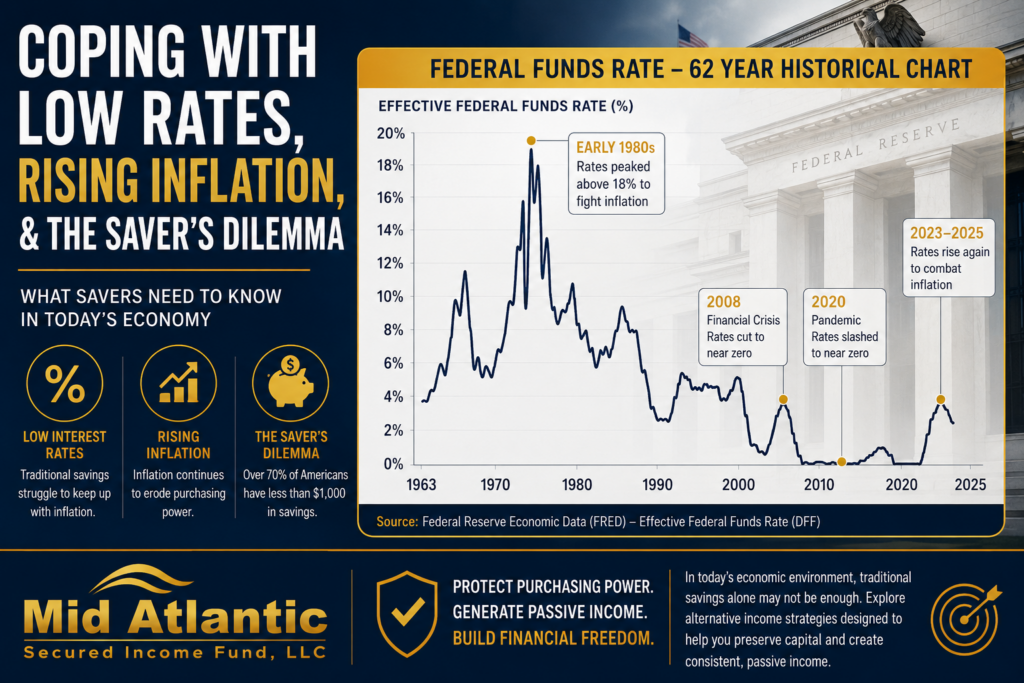
After years of near-zero interest rates, investors are once again prioritizing income generation.
Several structural trends are driving this shift:
Persistent Inflation
Inflation continues pressuring purchasing power, particularly for retirees and income-focused investors.
Market Volatility
Equity market fluctuations have increased investor demand for portfolio stabilization.
Longer Retirement Horizons
Investors increasingly require durable income streams capable of supporting multi-decade retirements.
Institutional Capital Rotation
Large institutions have expanded allocations to private credit and alternative income investments.
Bank Lending Constraints
Regional banking pressures have created lending gaps increasingly filled by private capital providers.
These macroeconomic conditions have accelerated interest in secured lending and alternative income investments.
How Secured Income Funds Work
The Core Structure
Most secured income funds generate returns by deploying capital into lending opportunities backed by collateral or contractual repayment obligations.
Examples may include:
|
Strategy Type |
Typical Collateral |
|---|---|
|
Real Estate Bridge Loans |
Residential or commercial property |
|
Construction Lending |
Real estate development projects |
|
Asset-Backed Lending |
Receivables or business assets |
|
Private Credit |
Corporate cash flows or collateral |
|
Secured Commercial Lending |
Business assets or property |
The fund typically receives:
- contractual interest payments,
- origination fees,
- and repayment proceeds.
In many secured lending structures, the lender maintains a senior claim against collateral in the event of borrower distress.
This is one reason many investors view secured income strategies as potentially more defensive than unsecured lending structures.
What Is Private Credit?
Direct Answer
Private credit refers to non-bank lending investments where capital is provided directly to borrowers outside traditional public debt markets.
Private credit may include:
- direct lending,
- bridge lending,
- real estate debt,
- asset-backed lending,
- specialty finance,
- and secured commercial loans.
Private credit has become one of the fastest-growing alternative investment sectors globally.
Why Institutional Investors Are Allocating to Private Credit
The Institutional Shift Is Significant
According to BlackRock, Apollo, and Preqin research, institutional investors continue increasing allocations to private markets.
Several factors explain why:
Higher Income Potential
Private credit often offers yields above traditional public bonds due to complexity, illiquidity, or niche lending opportunities.
Diversification Benefits
Private lending investments may behave differently than public equities.
Asset-Backed Structures
Many private credit investments involve collateral-backed lending.
Floating Rate Structures
Certain private loans adjust alongside interest rate movements.
Reduced Public Market Correlation
Alternative investments may help diversify portfolio risk.
This institutional adoption has significantly expanded the visibility of secured income strategies.
Secured Income Funds vs Traditional Bond Funds
Key Differences
|
Feature |
Secured Income Funds |
Traditional Bond Funds |
|---|---|---|
|
Asset Type |
Private lending |
Public bonds |
|
Collateral |
Often asset-backed |
May be unsecured |
|
Liquidity |
Typically lower |
Generally higher |
|
Income Source |
Loan interest & fees |
Bond coupons |
|
Correlation to Public Markets |
Often lower |
Higher |
|
Complexity |
Higher |
Lower |
Neither structure is inherently superior.
Suitability depends on:
- investor objectives,
- liquidity needs,
- risk tolerance,
- and portfolio construction goals.
Why Cash Flow Matters More Than Ever
Modern Investors Increasingly Prioritize Income Durability
In today’s environment, many investors are shifting focus away from purely speculative growth.
Instead, they are emphasizing:
- recurring income,
- portfolio stability,
- and long-term resilience.
This is especially true among:
- retirees,
- family offices,
- accredited investors,
- and income-focused portfolios.
Income-producing investments may help reduce dependence on forced asset sales during volatile markets.
That psychological and strategic benefit has become increasingly important in uncertain economic conditions.
The Role of Real Estate-Backed Lending
Why Real Assets Continue to Matter
Real estate-backed lending remains one of the most common secured income strategies because it combines:
- contractual income,
- collateral support,
- and tangible underlying assets.
Examples may include:
- residential bridge lending,
- construction financing,
- stabilized asset lending,
- and commercial real estate debt.
Sophisticated investors often view real assets as potentially valuable during inflationary periods because physical asset values and rental markets may adjust over time.
However, real estate investments also involve risks, including:
- property value declines,
- borrower default,
- construction delays,
- and broader economic deterioration.
What Risks Do Secured Income Funds Carry?
No Investment Is Risk-Free
Although secured income funds emphasize collateral protection and disciplined underwriting, they still involve meaningful risks.
Credit Risk
Borrowers may default.
Real Estate Risk
Property values can decline.
Liquidity Risk
Private investments may not be easily sold.
Economic Risk
Recessions can impact borrower performance.
Interest Rate Risk
Financing conditions may change.
Underwriting Risk
Poor loan selection may impair performance.
Sponsor Risk
Fund manager execution matters significantly.
Sophisticated investors evaluate not only projected returns, but also:
- underwriting discipline,
- collateral quality,
- portfolio diversification,
- and sponsor experience.
Are Secured Income Funds Safer Than Stocks?
Direct Answer
Secured income funds are not inherently safer than stocks, but many investors view certain secured lending strategies as potentially less volatile because they focus on contractual income and collateral-backed investments rather than pure equity appreciation.
However, these investments still carry substantial risks, including illiquidity and potential principal loss.
Risk profiles vary significantly between managers and strategies.
Why Downside Protection Matters
Institutional Investors Prioritize Risk Before Return
One of the defining characteristics of institutional investing is the emphasis on downside management.
Professional investors increasingly recognize that:
Avoiding catastrophic losses may be more important than maximizing short-term gains.
This philosophy has become increasingly relevant following:
- inflation shocks,
- regional banking instability,
- bond market volatility,
- and broader macroeconomic uncertainty.
As a result, many investors increasingly focus on:
- capital preservation,
- collateral-backed investments,
- and disciplined underwriting frameworks.
Portfolio Diversification Beyond Stocks and Bonds
Diversification Has Evolved
Traditional diversification once centered almost entirely around stocks and bonds.
Today, institutional portfolios increasingly include:
- private credit,
- infrastructure,
- real assets,
- alternative income strategies,
- and private market investments.
The objective is to create:
- multiple income streams,
- lower portfolio concentration,
- and improved resilience across economic cycles.
Sophisticated investors increasingly recognize that diversification is not about owning more assets.
It is about owning assets that behave differently under varying conditions.
Why Accredited Investors Are Exploring Alternative Income Strategies
Access to Private Markets Has Expanded
Accredited investors increasingly have access to investment categories once dominated by large institutions.
This includes exposure to:
- private credit,
- real estate-backed lending,
- specialty finance,
- and alternative income-producing assets.
According to SEC definitions, accredited investors may qualify based on:
- income thresholds,
- net worth thresholds,
- or professional certifications.
Many accredited investors seek alternative investments to potentially:
- diversify portfolios,
- pursue enhanced income,
- and reduce reliance on public market volatility.
Retirement Planning and Secured Income Funds
Retirement Portfolios Are Becoming More Institutional
Retirement planning increasingly prioritizes:
- cash flow durability,
- inflation management,
- and portfolio resilience.
Income-oriented strategies may play a role in helping retirees:
- manage withdrawal needs,
- diversify income streams,
- and reduce emotional responses to volatility.
This trend partially explains why private credit and alternative income strategies have gained visibility among retirement-focused investors.
How Sophisticated Investors Evaluate Secured Income Funds
Key Evaluation Criteria
Professional investors often evaluate:
Underwriting Standards
How conservative is the lending process?
Loan-to-Value Ratios
How much collateral coverage exists?
Diversification
How concentrated is the portfolio?
Asset Quality
What backs the loans?
Sponsor Experience
How experienced is the management team?
Risk Controls
How are defaults and impairments managed?
Market Exposure
What economic sectors are involved?
Institutional investors generally focus heavily on risk-adjusted returns rather than headline yield alone.
Why Economic Volatility Is Reshaping Investor Behavior
Stability Is Becoming More Valuable
Over the last several years, investors have experienced:
- inflation spikes,
- regional banking instability,
- interest rate shocks,
- geopolitical tensions,
- and heightened market volatility.
As a result, investor psychology is shifting.
Increasingly, investors are prioritizing:
- durability,
- predictability,
- and risk management.
This broader shift is one reason secured income strategies continue gaining institutional attention.
The Future of Secured Income Investing
Private Markets Are Becoming More Mainstream
Institutional adoption of private credit and secured lending continues expanding.
Several long-term trends support this evolution:
- growing retirement income demand,
- banking disintermediation,
- demand for diversification,
- institutional private market expansion,
- and increased focus on contractual cash flow.
While risks remain substantial, secured income investing is increasingly becoming part of the broader modern portfolio conversation.
Final Thoughts
Secured income funds represent an increasingly important segment of modern portfolio construction.
As investors navigate inflation, volatility, and economic uncertainty, many are seeking strategies focused on:
- recurring income,
- asset-backed lending,
- capital discipline,
- and diversified cash flow generation.
Institutional investors have spent years expanding allocations to private credit and alternative income strategies.
Today, accredited investors increasingly have access to similar investment frameworks.
While no investment strategy guarantees success or eliminates risk, sophisticated secured income investing emphasizes:
- underwriting discipline,
- collateral protection,
- portfolio diversification,
- and long-term financial resilience.
In modern markets, investors are increasingly discovering that durability may matter just as much as return potential.
FAQ Section
What is a secured income fund?
A secured income fund is an investment vehicle focused on generating recurring income through secured lending, private credit, or collateral-backed investments.
How do secured income funds generate returns?
These funds typically generate returns through interest payments, lending fees, and contractual repayment structures tied to private lending investments.
What is private credit investing?
Private credit investing involves non-bank lending opportunities such as direct lending, real estate debt, or asset-backed financing outside public bond markets.
Are secured income funds risky?
Yes. Risks may include borrower default, illiquidity, real estate market declines, underwriting failures, and broader economic downturns.
Why are institutional investors interested in private credit?
Institutional investors often seek private credit for diversification, contractual income generation, and potential yield enhancement relative to traditional fixed income markets.
Are secured income investments appropriate for retirement portfolios?
Some investors use secured income strategies within retirement portfolios for diversification and income generation, though suitability depends on individual financial circumstances and risk tolerance.
What does asset-backed lending mean?
Asset-backed lending refers to loans secured by collateral such as real estate, receivables, or business assets.