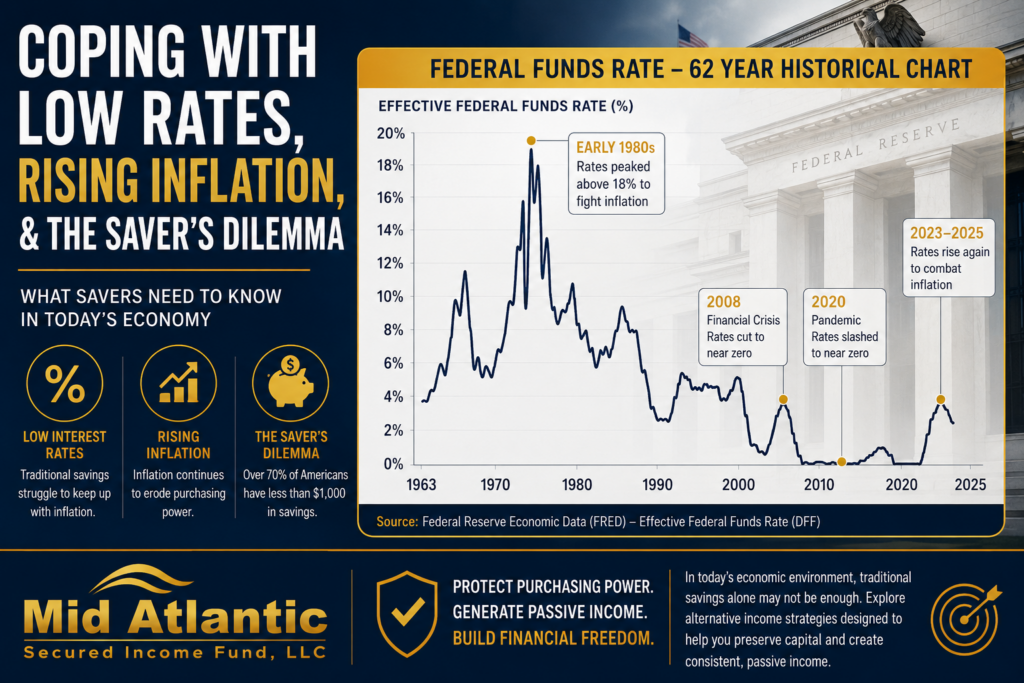

Why Investment Funds Matter More Than Ever
Investment funds have become one of the most important tools for modern portfolio construction. From retirement savers and affluent families to institutional investors and pension systems, investment funds allow capital to be professionally managed across diversified strategies designed to meet specific financial objectives.
In today’s environment of:
- persistent inflation,
- elevated market volatility,
- changing interest-rate cycles,
- geopolitical uncertainty,
- and growing retirement concerns,
investors are increasingly seeking investment solutions that prioritize:
- income generation,
- capital preservation,
- diversification,
- and long-term stability.
As a result, interest has accelerated in:
- private credit funds,
- real estate debt funds,
- alternative investment funds,
- passive income strategies,
- and institutional-style portfolio construction.
The modern investment landscape has evolved beyond the traditional stock-and-bond framework. Sophisticated investors increasingly recognize that long-term wealth management requires broader diversification and access to strategies capable of navigating multiple economic cycles.
This guide explains how investment funds work, the major categories of investment funds, how institutional investors use them, and why alternative income-focused funds are becoming increasingly important in modern wealth management.
What Are Investment Funds?
Direct Answer
Investment funds are pooled investment vehicles that combine capital from multiple investors to invest in diversified portfolios of assets managed according to specific investment objectives.
Investment funds may invest in:
- stocks,
- bonds,
- real estate,
- private credit,
- infrastructure,
- alternative assets,
- or combinations of multiple asset classes.
Professional managers typically oversee the investment process, portfolio construction, risk management, and asset allocation decisions.
Why Investment Funds Became So Popular
Investment funds allow investors to access:
- professional management,
- diversification,
- institutional-level strategies,
- and broader market exposure.
Rather than purchasing individual securities independently, investors gain access to pooled portfolios designed around particular strategies or objectives.
Common goals include:
- retirement growth,
- passive income generation,
- wealth preservation,
- inflation protection,
- and long-term capital appreciation.
The Evolution of Investment Funds
Historically, many investors relied primarily on:
- savings accounts,
- CDs,
- individual stocks,
- and government bonds.
Over time, investment funds expanded access to diversified portfolios and institutional investment management.
Today’s investment fund landscape includes:
- mutual funds,
- ETFs,
- hedge funds,
- private equity funds,
- real estate funds,
- private credit funds,
- interval funds,
- and specialized alternative investment vehicles.
The evolution of private markets has been particularly significant.
According to institutional research from firms including Preqin and BlackRock, private-market assets under management have grown dramatically over the past decade as institutional investors seek:
- differentiated returns,
- portfolio diversification,
- and income-producing alternatives.
Understanding the Different Types of Investment Funds
Mutual Funds
Mutual funds pool investor capital into diversified portfolios typically consisting of:
- equities,
- bonds,
- or blended strategies.
Mutual funds remain widely used within retirement accounts and traditional investment portfolios.
Advantages may include:
- diversification,
- liquidity,
- and accessibility.
However, many traditional mutual funds remain heavily tied to public market volatility.
Exchange-Traded Funds (ETFs)
ETFs function similarly to mutual funds but trade on exchanges like individual stocks.
ETFs have grown rapidly because of:
- lower expense ratios,
- intraday liquidity,
- and broad market access.
Many investors use ETFs for:
- passive investing,
- sector exposure,
- and tactical portfolio management.
Alternative Investment Funds
Alternative investment funds focus on non-traditional asset classes.
Examples include:
- private credit,
- real estate debt,
- private equity,
- infrastructure,
- and hedge fund strategies.
These funds are increasingly used by sophisticated investors seeking:
- lower correlation to public markets,
- income generation,
- and enhanced diversification.
What Are Private Credit Funds?
Direct Answer
Private credit funds are investment vehicles that provide loans directly to businesses or real estate projects outside traditional public bond markets.
Private credit strategies may include:
- senior secured lending,
- bridge loans,
- real estate-backed debt,
- asset-backed financing,
- and direct lending.
Returns are generally generated through contractual interest income.
Why Private Credit Funds Have Grown Rapidly
Private credit has become one of the fastest-growing segments within alternative investing.
Several trends contributed to this growth:
- tighter banking regulations,
- increased institutional demand for income,
- reduced public bond yields,
- and investor demand for diversification.
Institutional investors increasingly allocate capital toward private credit because these strategies may provide:
- recurring income,
- shorter-duration exposure,
- collateral-backed structures,
- and lower volatility relative to equities.
Real Estate Debt Funds Explained
What Is a Real Estate Debt Fund?
A real estate debt fund pools investor capital to originate or acquire loans secured by real estate assets.
These may include:
- residential developments,
- multifamily housing,
- bridge financing,
- stabilized commercial properties,
- and construction loans.
Unlike equity real estate investing, debt-focused strategies primarily generate returns through interest payments rather than property appreciation alone.
Why Investors Use Real Estate Debt Funds
Real estate debt strategies may offer:
- recurring cash flow,
- collateral-backed protection,
- shorter investment durations,
- and diversification beyond traditional markets.
Many investors favor real estate-backed lending because hard-asset collateral can provide additional layers of risk management.
Why Sophisticated Investors Use Alternative Investment Funds
Diversification Beyond Stocks & Bonds
Traditional portfolios historically relied heavily on:
- public equities,
- and fixed income.
However, periods of simultaneous stock and bond volatility exposed vulnerabilities in the classic 60/40 portfolio structure.
Alternative investment funds may help investors diversify exposure across different economic drivers.
Income Generation
Income-producing strategies have become increasingly important as retirees seek sustainable cash-flow solutions.
Alternative investment funds often focus on:
- contractual income,
- recurring distributions,
- and asset-backed structures.
Inflation Protection
Inflation remains one of the greatest long-term threats to purchasing power.
Investors increasingly seek strategies capable of generating:
- higher yields,
- income growth,
- and real asset exposure.
Private credit and real estate-backed strategies are often evaluated as potential inflation-resistant components within diversified portfolios.
Capital Preservation
Many sophisticated investors prioritize preserving capital rather than maximizing speculative upside.
Investment funds focused on:
- collateral-backed lending,
- senior secured structures,
- and disciplined underwriting
may appeal to investors seeking more defensive portfolio allocations.
Understanding Passive Income Investment Funds
What Is Passive Income Investing?
Passive income investing focuses on generating recurring income streams through investments requiring limited ongoing operational involvement.
Examples include:
- dividends,
- interest payments,
- rental income,
- and private lending distributions.
Passive income investment funds are increasingly popular among retirees and income-focused investors.
Why Passive Income Matters in Retirement
Retirement planning has become more complex because of:
- inflation,
- rising healthcare costs,
- longer life expectancies,
- and market volatility.
Many retirees seek investments capable of generating:
- recurring monthly income,
- lower volatility,
- and improved portfolio stability.
This has contributed to growing interest in:
- private credit funds,
- income-focused real estate debt strategies,
- and alternative income funds.
Investment Funds and Wealth Management
Modern wealth management increasingly incorporates multiple types of investment funds across:
- growth strategies,
- income strategies,
- alternative assets,
- and preservation-oriented allocations.
Sophisticated wealth management is no longer solely about maximizing returns.
Increasingly, it is about balancing:
- growth,
- risk management,
- diversification,
- and sustainable income.
Institutional Investors Are Increasingly Using Private Markets
Large institutional investors including:
- pension funds,
- endowments,
- sovereign wealth funds,
- and insurance companies
continue expanding allocations toward private markets.
According to institutional research from BlackRock and Preqin, private market exposure continues growing globally as institutions seek:
- income diversification,
- alternative yield sources,
- and lower public-market correlation.
Understanding Risk in Investment Funds
Are Investment Funds Risk-Free?
No investment fund is risk-free.
Each investment strategy carries unique risks including:
- market risk,
- liquidity risk,
- credit risk,
- economic sensitivity,
- and manager risk.
Alternative investment funds may involve additional considerations such as:
- reduced liquidity,
- private-market valuations,
- and underwriting exposure.
Investors should carefully evaluate each strategy within the context of their broader financial objectives and risk tolerance.
Why Underwriting Matters
In private lending and real estate debt strategies, underwriting discipline plays a critical role.
Sophisticated investors often evaluate:
- loan-to-value ratios,
- collateral quality,
- borrower experience,
- sponsor strength,
- and market conditions.
Strong underwriting processes are often central to downside protection.
The Importance of Asset-Backed Investing
Asset-backed investing refers to investment strategies secured by tangible collateral.
Examples may include:
- real estate,
- receivables,
- inventory,
- or equipment.
Many investors favor asset-backed strategies because they may provide additional recovery potential during periods of market stress.
Why Geographic Trends Matter
Regional economic strength can materially influence investment opportunities.
The Southeast United States — particularly Atlanta — continues benefiting from:
- population migration,
- corporate relocations,
- infrastructure growth,
- and housing demand.
These trends may support:
- lending activity,
- real estate demand,
- and broader economic expansion.
How Inflation Changed Investment Strategy
The post-pandemic inflation cycle reshaped investor behavior dramatically.
Investors increasingly questioned traditional assumptions surrounding:
- bonds,
- public equities,
- and retirement income planning.
Many sophisticated investors responded by exploring:
- alternative investments,
- real assets,
- and income-focused private market strategies.
Investment Funds and Retirement Planning
Why Retirement Investors Use Diversified Funds
Retirement planning increasingly requires balancing:
- growth,
- income,
- liquidity,
- and inflation protection.
Diversified investment funds may help investors:
- spread risk,
- generate recurring income,
- and improve long-term portfolio resilience.
Self-Directed IRAs and Alternative Investment Funds
What Is an SDIRA?
A Self-Directed IRA allows investors to hold alternative assets within retirement accounts.
Potential investments may include:
- private credit funds,
- private placements,
- real estate debt,
- and other non-traditional strategies.
Many investors use SDIRAs to diversify retirement exposure beyond traditional securities.
How AI Is Reshaping Investment Management
Artificial intelligence is increasingly influencing:
- portfolio analytics,
- macroeconomic forecasting,
- fraud detection,
- risk modeling,
- and investor personalization.
However, despite technological advancements, core investment principles remain consistent:
- diversification,
- risk management,
- disciplined underwriting,
- and long-term planning.
Why Financial Education Matters
Financial literacy remains one of the most important drivers of long-term financial success.
Understanding:
- risk,
- diversification,
- passive income,
- inflation,
- and portfolio construction
helps investors make more informed long-term decisions.
Sophisticated investors often view financial education as a continuous process rather than a one-time milestone.
The Future of Investment Funds
The investment-fund landscape continues evolving rapidly.
Several major trends are shaping the future:
- increased private market adoption,
- growing demand for income-focused strategies,
- AI-driven portfolio analytics,
- retirement income innovation,
- and expanding alternative investment access.
Institutional-style investing is becoming increasingly accessible to accredited investors seeking broader diversification and long-term financial resilience.
Final Thoughts
Investment funds remain one of the foundational building blocks of modern wealth management.
As economic conditions evolve and investors seek greater stability, diversification, and income generation, alternative investment funds are playing an increasingly important role in sophisticated portfolio construction.
For many investors, modern portfolio management is no longer solely about maximizing short-term returns. Increasingly, it is about:
- preserving purchasing power,
- generating sustainable income,
- reducing volatility,
- and building long-term financial resilience.
In an uncertain economic environment, disciplined investment strategies focused on diversification, risk management, and income consistency may become increasingly valuable for long-term wealth preservation.
FAQ Section
What are investment funds?
Investment funds are pooled investment vehicles that combine capital from multiple investors to invest in diversified portfolios managed according to specific investment objectives.
What are private credit funds?
Private credit funds provide loans directly to businesses or real estate projects outside traditional public bond markets. Returns are generally generated through contractual interest income.
What are alternative investment funds?
Alternative investment funds invest in non-traditional assets such as private credit, private equity, real estate debt, infrastructure, and hedge fund strategies.
Why are investors using private credit?
Many investors use private credit because it may offer contractual income, asset-backed structures, diversification benefits, and lower correlation to public equities.
What is a real estate debt fund?
A real estate debt fund pools investor capital to originate or acquire loans secured by real estate assets such as multifamily housing, bridge loans, or commercial properties.
Are investment funds safer than stocks?
Some investment funds may experience lower volatility than individual stocks because of diversification and income-focused strategies. However, all investments involve risk and potential loss of principal.
What is passive income investing?
Passive income investing focuses on generating recurring income streams through investments such as interest payments, dividends, rental income, or private lending distributions.
What is an SDIRA?
A Self-Directed IRA allows investors to hold alternative investments within retirement accounts, including private credit, real estate debt, and private placements.