
A fully occupied rental property can still produce a disappointing investor experience if cash flow is thin, repairs are constant, and financing costs rise faster than rent. That is the central issue behind how investors generate passive income in real estate: the asset class is broad, but the quality of income varies dramatically depending on where an investor sits in the capital stack, how much control they want, and how much risk they are willing to absorb.
For accredited investors, passive real estate income is rarely about owning a duplex and hoping appreciation does the rest. More often, it is about selecting the right structure for income generation, capital preservation, and operational simplicity. Some approaches lean on property ownership. Others, especially private real estate credit, focus on lending against real estate collateral and collecting contractual interest rather than relying on rent growth or resale timing.
How investors generate passive income real estate offers today
Real estate can produce passive income in several distinct ways. The most familiar route is direct ownership of income-producing property. An investor acquires a residential or commercial asset, leases it, and receives net cash flow after expenses and debt service. This can work well when occupancy is stable, leverage is conservative, and property management is strong. It can also become less passive than advertised when maintenance, turnover, taxes, insurance, and capital expenditures start to pressure distributions.
A second route is public real estate securities such as REITs. These can provide liquidity and convenience, and many investors appreciate the ease of buying and selling. The trade-off is that listed real estate securities often behave more like public market instruments than purely private real estate assets. Price volatility can be substantial, especially during periods of rate uncertainty or broader market stress.
A third route, and one that has gained attention as investors seek alternatives to low-yield traditional fixed income, is private real estate credit. In this structure, investors do not own the underlying properties directly. Instead, they participate in a fund or lending strategy that originates or acquires loans secured by real estate. Income is generally derived from borrower interest payments, fees, and structured lending spreads rather than from rents or property appreciation.
That distinction matters. Equity ownership can offer upside, but it also absorbs the first loss if a project underperforms. Secured lending takes a different position. When underwriting is disciplined and loan-to-value ratios are conservative, the investor’s capital may benefit from a collateral cushion and a clearer contractual income stream.
The main passive income models and their trade-offs
Direct rental ownership remains attractive for investors who want tangible control. They can choose the market, asset type, leverage, and manager. They also keep the economic upside if property values rise. The challenge is that net income is highly sensitive to expenses. A single roof replacement, vacancy stretch, or insurance increase can materially alter cash flow. For higher-net-worth investors who do not want landlord responsibilities, direct ownership may feel more like an operating business than a passive investment.
Private real estate syndications and funds reduce the burden of managing property directly. Investors can access multifamily, industrial, storage, or mixed-use assets through professional operators. In many cases, these structures target a blend of current income and appreciation. That can be compelling, but the income profile is often less predictable than lending-based strategies because distributions depend on property operations, leasing performance, refinancing conditions, and exit timing.
REITs offer diversification and low minimums, but their daily pricing can introduce volatility that some income-focused investors are trying to avoid in the first place. Correlation with broader public markets is an important consideration, particularly for retirees or family offices focused on steadier cash flow.
Private real estate debt occupies a middle ground that many sophisticated investors find attractive. It is real estate backed, but typically structured around income first. Instead of taking ownership risk, the strategy is to lend against the value of residential or commercial real estate, collect interest, and rely on underwriting discipline to manage downside risk. The quality of the strategy depends on factors such as lien position, collateral value, borrower quality, duration, market selection, and servicing capability.
Why private credit has become part of the passive income conversation
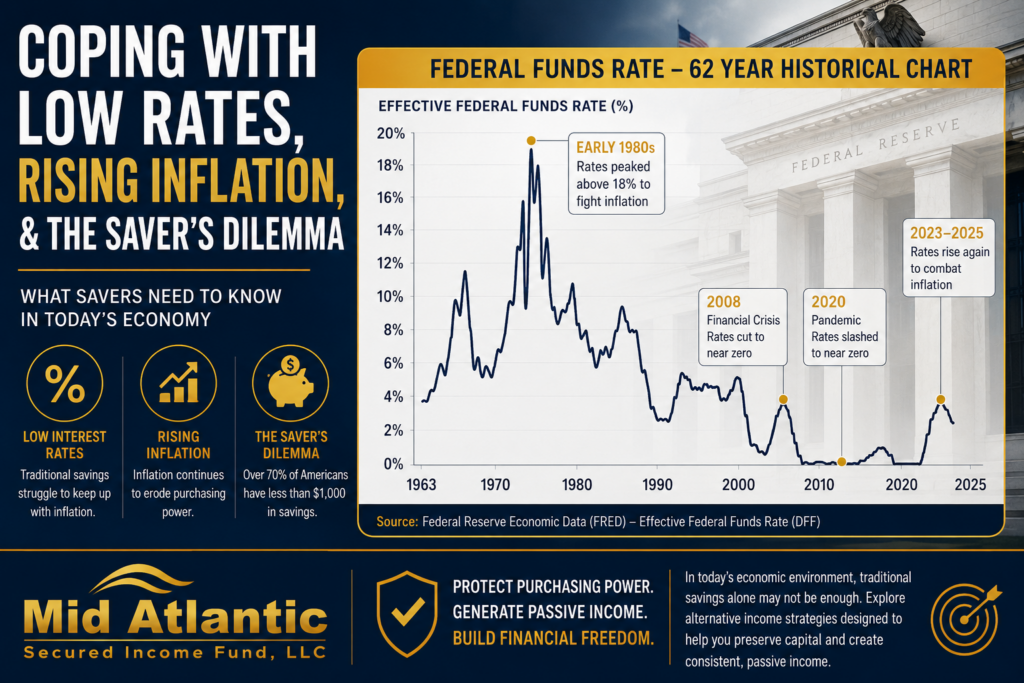
Higher rates have changed how investors think about income. For years, many investors accepted substantial duration risk or equity volatility in pursuit of yield. Now, the comparison set is different. Investors can evaluate whether the return premium from private credit is supported by asset backing, shorter duration, and underwriting controls.
This is where secured real estate lending becomes relevant. A first-position mortgage on a real asset is not the same as an unsecured promise to pay. If structured conservatively, the lender benefits from a defined collateral interest and legal rights that are generally stronger than those of unsecured creditors. For investors focused on monthly or periodic cash flow, that can be a meaningful difference.
It is also worth noting that private credit income is usually driven by contractual loan payments rather than pro forma rent growth. That does not remove risk. Borrowers can default, projects can face delays, and real estate values can fluctuate. But the source of return is more straightforward. Investors are being compensated for financing risk, underwriting complexity, and illiquidity, not simply for hoping an asset sells at a higher price later.
What disciplined investors look for before allocating capital
The phrase passive income can lead some investors to focus too heavily on yield alone. In practice, experienced allocators usually start somewhere else. They ask what supports the income, what protects principal, and what has to go right for distributions to continue.
In private real estate credit, that means examining whether loans are first-position, how collateral is valued, and how much equity the borrower has beneath the lender. Conservative loan-to-value ratios matter because they create room for error if a project stalls or market values soften. Loan duration matters as well. Shorter-duration loans may reduce exposure to long-term rate uncertainty and allow capital to be recycled more frequently.
Servicing and workout capability also deserve attention. A fund can originate attractive loans, but investor outcomes depend on what happens when a borrower misses milestones, requests extensions, or defaults. Operational discipline is not a marketing detail. It is part of risk management.
Track record should be read carefully. Investors should look beyond stated returns and ask whether income distributions have been consistent, whether losses have occurred, and how prior loans performed across different market conditions. Data from institutions such as the Federal Reserve and Mortgage Bankers Association continue to show that credit conditions and property market liquidity can tighten quickly. That makes manager discipline more important, not less.
Where passive income fits in retirement and portfolio construction
For many accredited investors, the question is not whether to choose real estate or fixed income in isolation. It is how to build a portfolio that balances cash flow, volatility, inflation sensitivity, and capital preservation. Real estate-backed private credit can serve a specific role in that framework.
For retirees and investors using self-directed IRAs or rollover IRA capital, the appeal is often practical. They want current income, but they do not want to manage tenants, chase renovation budgets, or take full equity risk in a late-cycle market. A secured lending strategy may offer a more predictable distribution profile than direct ownership, with less operational complexity.
That said, private investments are not liquid in the same way public securities are. Investors need to understand lock-up terms, redemption limits, and distribution policies. Passive should not be confused with risk-free, and income should not be confused with guaranteed principal protection. The right allocation depends on liquidity needs, risk tolerance, tax structure, and investment horizon.
How investors generate passive income in real estate more prudently
The most durable approach is usually the least glamorous one. Rather than chasing the highest projected yield, sophisticated investors often prioritize alignment between structure and objective. If the objective is current income with lower volatility, a collateralized credit strategy may be more suitable than a speculative equity deal. If the objective is long-term appreciation and the investor accepts more variability, equity ownership may still have a place.
In the current environment, prudence means asking where the income comes from, what secures it, and how a manager handles adverse outcomes. Firms such as Mid Atlantic Secured Income Fund position that question around first-lien lending, conservative loan-to-value ratios, and a capital-preservation-first approach. That framework reflects a broader truth in private markets: good passive income is not just produced by real estate. It is produced by structure, underwriting, and discipline.
For investors evaluating their next allocation, the most useful starting point is simple. Look past the label of passive income and study the engine behind it. The steadier opportunities are often the ones built to protect capital before they try to maximize return.