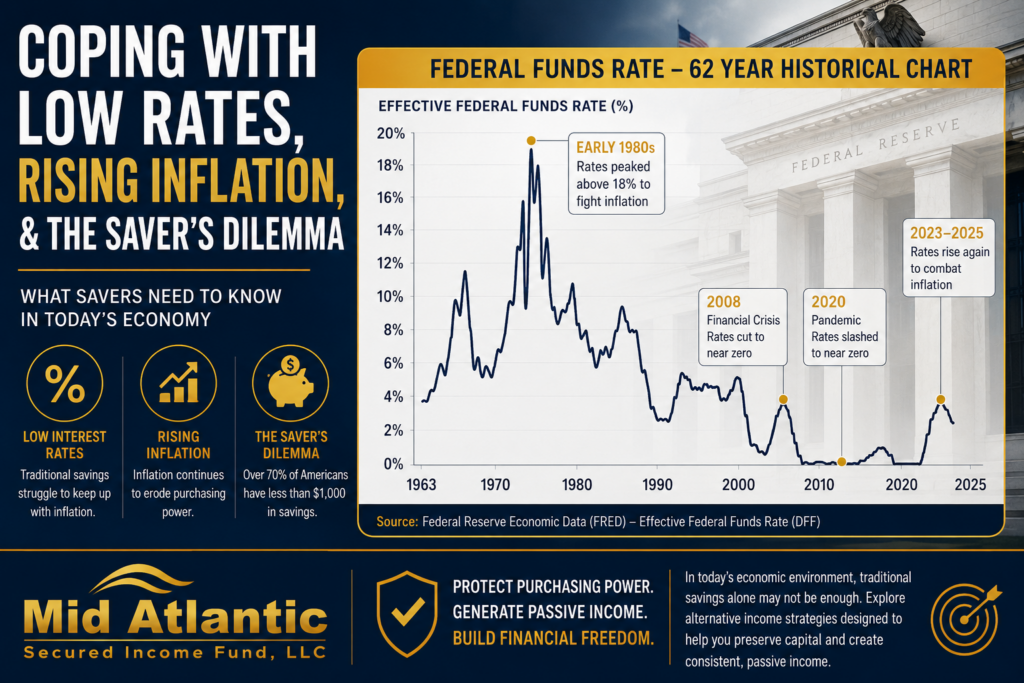

A retiree with a ladder of Treasurys bought in 2020 learned a hard lesson the hard way. The income looked thin, inflation ran hotter than expected, and when rates moved up, bond prices moved down. That experience is why more accredited investors are now looking seriously at alternatives to bonds for income – not to replace discipline, but to broaden it.
For investors who prioritize current cash flow and capital preservation, the real question is not whether bonds still have a role. It is whether public fixed income alone is enough. In many cases, it is not. Yields can be sensitive to duration risk, purchasing power can erode under inflation, and market pricing can introduce volatility precisely when stability matters most.
Why investors are seeking alternatives to bonds for income
Bonds remain a foundational income asset, but they come with trade-offs that are easy to overlook in a low-volatility portfolio review. Interest rate risk is the most obvious. When rates rise, the market value of existing bonds typically falls. Credit risk matters too, especially when investors move down the quality spectrum to chase yield.
There is also reinvestment risk. A bond portfolio that looks attractive today may not maintain the same level of income as securities mature and proceeds are rolled into a different rate environment. For retirees, self-directed IRA investors, and family offices drawing regular cash flow, that uncertainty can be frustrating.
This is where alternatives can serve a purpose. The right income-producing alternative may offer higher current yield, lower correlation to public markets, shorter duration, or security tied to tangible collateral. That does not make it risk-free. It simply means the risks may be different, and in some cases more understandable, than the risks embedded in a traditional bond allocation.
The main alternatives to bonds for income
Dividend-paying equities
Dividend stocks are often the first substitute investors consider. Established companies with strong cash flow can provide regular distributions, and some have long histories of maintaining or increasing dividends.
But dividend equities are still equities. Their prices can move sharply with the market, even when the underlying dividend remains intact. That means they may offer income, but not necessarily the low-volatility profile many bond investors are actually seeking. For investors whose first priority is stable principal and predictable distributions, dividend stocks can be useful, but they are not a direct bond replacement.
Preferred securities
Preferred stocks sit between debt and equity in the capital structure and often pay higher yields than common stock dividends or investment-grade bonds. They can appeal to income-focused investors because of their fixed or floating-rate structures.
The trade-off is complexity and sensitivity. Preferreds can be highly interest-rate sensitive, can carry call risk, and may lack the principal stability investors expect from a conservative income allocation. Credit quality also varies widely by issuer. In practice, they may fit as a satellite holding rather than the core of an income strategy.
REITs and publicly traded real estate income vehicles
Real estate investment trusts can generate attractive income and provide access to sectors such as multifamily, industrial, healthcare, and self-storage. For investors who want real estate exposure without direct property management, REITs are often the most accessible entry point.
However, publicly traded REITs are still public securities. They can move with broader equity markets, and their valuations may compress when rates rise. The income can be meaningful, but investors should not confuse exchange-traded liquidity with insulation from volatility.
CDs, money market funds, and insured cash alternatives
For pure capital stability, insured deposits and cash equivalents deserve mention. In certain rate environments, CDs and money market funds can produce respectable income with minimal credit risk.
The limitation is obvious. Over a full cycle, these vehicles may struggle to outpace inflation after taxes, and their yields can reset lower quickly when short-term rates decline. They can be useful for liquidity reserves, but rarely solve a long-term income objective on their own.
Private credit
Private credit has become one of the most closely watched alternatives to bonds for income, particularly among accredited investors. Instead of buying publicly traded debt, investors allocate capital to privately originated loans that may be structured around businesses, assets, or real estate collateral.
This market is broad, so underwriting discipline matters. Some private credit strategies focus on corporate cash flow lending. Others emphasize asset-backed lending, where repayment is supported by hard collateral. For income-oriented investors, the appeal is straightforward: potentially higher current yield, less mark-to-market volatility than public bonds, and loan structures that may include protective covenants, shorter durations, and negotiated terms.
The key question is not whether private credit offers more income. Often it does. The key question is what stands behind the loan and how conservatively the manager underwrites risk.
Real estate-backed private debt
Within private credit, real estate-backed lending deserves special attention. This is a category where the source of return is not property appreciation or speculative development upside. It is contractual interest income generated by loans secured by real estate.
For accredited investors seeking dependable distributions, this structure can be compelling when executed conservatively. A first-position mortgage, meaningful borrower equity, and disciplined loan-to-value parameters can create a margin of safety that many unsecured income strategies lack. Shorter-duration loans may also reduce sensitivity to long-term interest rate moves.
That does not eliminate risk. Real estate values can decline, projects can stall, and execution matters. But compared with owning equity in a property, secured lending generally occupies a more defensive place in the capital stack. For investors who want income tied to tangible assets rather than public market sentiment, this can be a more aligned solution.
Private real estate equity income funds
Some investors also consider private real estate funds that target income-producing properties. These vehicles may distribute cash flow from rents and can provide diversification across geographies and asset types.
The distinction is that equity sits behind debt. Property-level cash flow can weaken, occupancy can fall, and exit timing may affect total returns. These strategies may work well for investors comfortable with a blend of income and appreciation, but they are generally a different risk profile than secured private lending.
What to compare before making a shift
When evaluating alternatives to bonds for income, yield should not be the starting point by itself. A higher stated distribution rate does not say enough about underlying risk.
Look first at the source of income. Is the cash flow coming from contractual loan payments, corporate earnings, rental operations, or portfolio withdrawals? Contractual income backed by collateral is fundamentally different from income that depends on market conditions or management discretion.
Then assess position in the capital stack. Senior secured lending generally offers stronger downside protection than preferred equity, common equity, or subordinated credit. If principal protection matters, this is one of the most important distinctions.
Liquidity also deserves a realistic review. Public bonds and money market funds can offer daily liquidity. Private investments usually do not. That is not automatically a disadvantage if the capital is truly long-term, but it should match the investor’s time horizon and cash needs.
Finally, study underwriting and manager behavior. In private markets, manager selection is central. Investors should understand leverage policies, collateral standards, duration profile, loss history, servicing capabilities, and how the platform performed in stressed environments. Conservative underwriting is not exciting marketing language, but for an income strategy, it is often what matters most.
Where real estate-backed private credit fits
For many accredited investors, the most practical answer is not replacing bonds entirely. It is building a more resilient income allocation with multiple sources of cash flow. High-quality public fixed income can still provide ballast and liquidity. But adding secured private credit may improve current income while reducing reliance on long-duration bond exposure.
That is especially relevant for investors using rollover IRAs or self-directed IRAs who want passive income without taking on direct property ownership responsibilities. A well-structured real estate-backed private credit strategy may offer monthly or periodic distributions, short-duration exposure, and security anchored by hard assets rather than public market pricing.
Firms such as Mid Atlantic Secured Income Fund operate in this part of the market by focusing on short-term, first-position mortgage loans backed by residential and commercial real estate, with an emphasis on conservative loan-to-value ratios and capital preservation. For the right accredited investor, that approach can sit in the gap between low-yield traditional fixed income and more volatile equity-oriented alternatives.
A disciplined income portfolio should not ask a single asset class to do everything. If bonds no longer meet all of your cash flow needs, the better response is not to chase yield blindly. It is to move up in diligence, understand what secures the income stream, and choose structures built to protect principal when conditions change.