
The Modern Portfolio Challenge
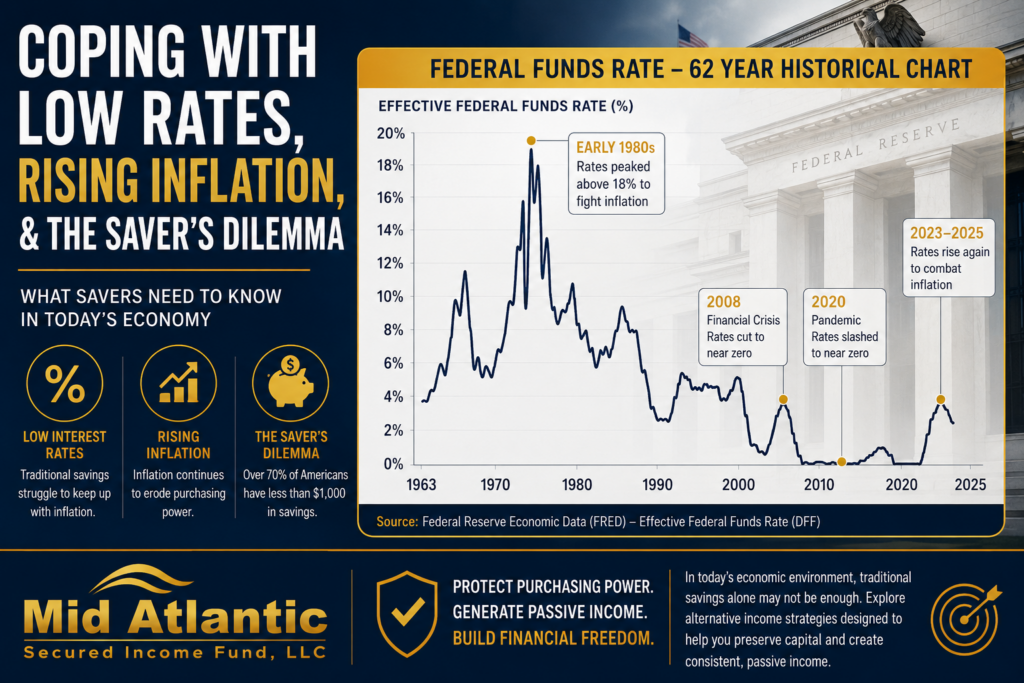
For decades, traditional portfolio construction revolved around a familiar framework: equities for growth and bonds for stability. Yet the investment environment entering 2026 looks materially different from the one investors navigated in prior decades.
Persistent inflationary pressures, elevated interest rates, geopolitical instability, regional banking concerns, and increased market volatility have forced both institutional and high-net-worth investors to rethink portfolio construction.
The result is a growing shift toward alternative income-producing assets — particularly private credit and secured income strategies.
Secured income funds have emerged as one of the fastest-growing categories within alternative investments because they seek to address three core investor objectives simultaneously:
- Consistent income generation
- Capital preservation
- Portfolio diversification
This trend is not limited to institutional allocators. Family offices, RIAs, accredited investors, retirement-focused investors, and income-oriented portfolios are increasingly allocating capital toward secured lending and asset-backed income strategies.
According to Preqin, global private debt assets under management surpassed approximately $1.7 trillion in recent years, with continued projected expansion driven by institutional demand for yield, downside protection, and reduced correlation to public markets.
At the same time, higher interest rates have materially reshaped investor expectations around income generation and risk management.
Investors are no longer simply chasing maximum returns. Increasingly, they are prioritizing durability, resilience, liquidity management, and capital discipline.
Secured income funds sit directly at the center of that transition.
What Is a Secured Income Fund?
Direct Answer
A secured income fund is an investment vehicle that generates income primarily through secured lending strategies backed by collateral such as real estate, receivables, or other assets.
Unlike traditional bond funds that primarily invest in publicly traded debt securities, secured income funds often focus on private credit opportunities where investors may benefit from:
- contractual interest income,
- collateral-backed loans,
- senior lien positions, and
- enhanced downside protection structures.
Many secured income funds concentrate on:
- real estate-backed lending,
- bridge lending,
- commercial lending,
- construction financing,
- asset-backed loans, or
- private credit transactions.
The defining feature is collateralization.
In many cases, loans are secured by tangible underlying assets that may help reduce loss severity in distressed scenarios.
How Secured Income Funds Work
The Core Structure
Most secured income funds operate by pooling investor capital into a professionally managed lending strategy.
The fund manager originates, underwrites, services, and manages loans made to borrowers.
Borrowers may include:
- real estate developers,
- investors,
- operating businesses,
- bridge financing borrowers, or
- commercial entities seeking short-term capital solutions.
Investors in the fund receive returns generated primarily through:
- loan interest payments,
- origination fees,
- servicing income, and
- other structured lending economics.
Example of a Secured Lending Structure
A borrower seeks a $2 million bridge loan secured by a residential redevelopment project.
The secured income fund may:
- underwrite the project,
- verify collateral value,
- structure loan terms,
- establish a first-position lien, and
- collect monthly interest payments.
If the borrower performs successfully, the fund collects contractual income.
If the borrower defaults, the collateral structure may provide recovery mechanisms unavailable in unsecured lending structures.
This distinction is central to why secured income investments have become increasingly attractive during volatile market environments.
Why Investors Are Increasingly Using Secured Income Funds
1. Income Generation in a Volatile Market
Traditional fixed-income allocations have faced significant challenges in recent years.
Bond volatility increased materially during the Federal Reserve’s aggressive rate-hiking cycle.
Meanwhile, many investors discovered that traditional 60/40 portfolios did not provide the same defensive characteristics historically expected.
Secured income funds attempt to address this by emphasizing:
- contractual income streams,
- floating-rate exposure in some structures,
- shorter duration lending, and
- asset-backed collateral.
For investors prioritizing cash flow, these strategies may offer attractive alternatives to traditional public fixed-income products.
2. Portfolio Diversification
One of the primary reasons sophisticated investors allocate toward private credit and secured lending is diversification.
Private credit strategies often exhibit lower correlation to public equities than traditional stock portfolios.
This can help reduce portfolio concentration risk.
Diversification benefits may include exposure to:
- private market lending,
- real estate debt,
- short-duration lending,
- non-public market income streams, and
- alternative yield sources.
In volatile equity environments, diversification can become particularly valuable.
3. Capital Preservation Focus
Many investors increasingly prioritize downside management over aggressive return maximization.
Secured lending strategies frequently emphasize:
- conservative underwriting,
- loan-to-value discipline,
- collateral security,
- borrower vetting, and
- senior debt positioning.
These structural protections may reduce potential loss severity compared to unsecured lending structures.
The Rise of Private Credit and Alternative Income Investments
Private credit has become one of the defining investment trends of the modern era.
Several macroeconomic developments contributed to this growth:
Bank Retrenchment
Following regulatory changes after the Global Financial Crisis, many traditional banks reduced exposure to certain middle-market lending categories.
This created financing gaps increasingly filled by private lenders.
Higher Yield Demand
Institutional investors began searching for alternatives to historically low-yield bond environments.
Private credit offered:
- higher contractual yields,
- floating-rate structures, and
- customized lending opportunities.
Institutional Adoption
Major institutional firms including Apollo, Blackstone, Ares, KKR, and Blue Owl dramatically expanded private credit capabilities over the past decade.
This institutional validation accelerated adoption among RIAs, family offices, and accredited investors.
Are Secured Income Funds Safer Than Stocks?
Direct Answer
Secured income funds are not inherently “safer” than stocks, but they may offer different risk characteristics.
Equities typically provide long-term growth potential but can experience substantial volatility.
Secured income strategies may prioritize:
- income generation,
- lower volatility,
- collateral-backed structures, and
- downside protection mechanisms.
However, risks still exist.
Investors should understand:
- credit risk,
- liquidity risk,
- borrower default risk,
- real estate market risk, and
- fund management risk.
Risk profiles vary significantly between strategies.
Common Types of Secured Income Investments
Real Estate Bridge Lending
Short-term loans secured by residential or commercial real estate.
Often used for:
- acquisitions,
- renovations,
- repositioning projects, or
- transitional financing.
Construction Lending
Financing provided for development or construction projects.
May involve staged draw structures and detailed underwriting oversight.
Asset-Backed Lending
Loans secured by receivables, inventory, equipment, or contractual cash flows.
Commercial Real Estate Debt
Income-focused lending tied to stabilized or income-producing properties.
Private Corporate Credit
Senior secured loans made to operating businesses.
Often structured with covenants and collateral protection.
How Accredited Investors Use Secured Income Funds
Accredited investors frequently use secured income strategies as part of broader wealth management frameworks.
Common objectives include:
- generating passive income,
- reducing public market concentration,
- improving diversification,
- managing volatility exposure, and
- pursuing inflation-aware income strategies.
Many investors allocate alternative income strategies alongside:
- equities,
- municipal bonds,
- treasuries,
- REITs, and
- other alternative investments.
The Role of Secured Income Funds in Retirement Planning
Retirement planning has evolved significantly.
Historically, investors relied heavily on:
- pensions,
- treasury bonds, and
- dividend-paying blue-chip stocks.
Today’s environment presents new challenges:
- inflation risk,
- longevity risk,
- healthcare cost inflation, and
- increased market volatility.
As a result, many retirement-oriented investors seek income-producing strategies that may offer:
- recurring cash flow,
- reduced duration exposure,
- lower correlation to equities, and
- capital preservation focus.
Secured income funds increasingly play a role within those discussions.
Key Risks Investors Should Understand
Credit Risk
Borrowers may default on obligations.
Even secured loans carry risk.
Real Estate Risk
Collateral values can decline during market downturns.
Liquidity Risk
Private investments are often less liquid than publicly traded securities.
Interest Rate Risk
Changing rates may impact lending spreads, refinancing activity, and borrower demand.
Manager Risk
Performance depends heavily on underwriting discipline and operational execution.
What Sophisticated Investors Often Evaluate
Institutional and accredited investors frequently analyze:
- loan-to-value ratios,
- collateral quality,
- underwriting standards,
- borrower concentration,
- geographic diversification,
- default history,
- liquidity structures, and
- asset management experience.
This due diligence process is critical.
Why Portfolio Diversification Matters More in 2026
Diversification is no longer simply a textbook investment concept.
Modern markets have become increasingly interconnected.
Public equities, bonds, and macroeconomic shocks often move simultaneously during periods of stress.
As a result, investors increasingly seek differentiated income sources and alternative exposures.
Private credit and secured income strategies may offer:
- alternative return drivers,
- reduced public market sensitivity, and
- contractual income components.
This explains why alternative investments continue expanding across institutional portfolios.
The Psychological Shift Toward Stability
Investor behavior has materially changed in recent years.
Following periods of:
- inflation spikes,
- banking instability,
- interest-rate shocks, and
- equity volatility,
many investors increasingly prioritize resilience over speculation.
This behavioral transition is reshaping portfolio construction.
The modern investor conversation increasingly centers on:
- durability,
- downside protection,
- predictable income, and
- long-term financial stability.
The Evolution of Fixed Income Alternatives
Traditional bond markets historically dominated defensive allocations.
However, many investors now explore:
- private credit,
- direct lending,
- structured income,
- real estate debt, and
- secured lending alternatives.
This evolution reflects changing expectations around:
- yield,
- inflation resilience,
- diversification, and
- risk-adjusted returns.
What Makes Asset-Backed Strategies Different
Asset-backed structures create an additional layer of underwriting discipline.
Unlike unsecured obligations, collateral-backed lending may provide recovery pathways during borrower distress.
Examples include:
- real estate collateral,
- receivables,
- equipment,
- contractual cash flows, or
- inventory assets.
This collateral framework often appeals to investors focused on capital preservation.
Institutional Adoption Signals a Structural Trend
The growth of private credit is no longer niche.
Large institutional allocators increasingly dedicate meaningful capital toward alternative income strategies.
This trend reflects structural shifts in global capital markets.
Institutional adoption often reinforces:
- liquidity infrastructure,
- underwriting sophistication,
- market transparency, and
- broader investor education.
How Investors Evaluate Secured Income Opportunities
Important Questions Investors Often Ask
- What collateral secures the loans?
- What is the loan-to-value ratio?
- Is the strategy senior secured?
- How diversified is the portfolio?
- What underwriting standards are used?
- What are historical default rates?
- How is liquidity managed?
- What experience does the management team possess?
The Future of Income Investing
The future of income investing increasingly appears tied to:
- alternative credit markets,
- private lending,
- asset-backed strategies, and
- diversified income frameworks.
As institutional capital continues flowing into private credit, investors may continue reallocating portions of traditional fixed-income exposure toward alternative income-producing assets.
Final Thoughts
Secured income funds represent a growing segment of modern portfolio construction because they align with several increasingly important investor priorities:
- income generation,
- diversification,
- downside awareness, and
- capital discipline.
While no investment is risk-free, secured lending strategies may offer differentiated characteristics compared to traditional public market investments.
For accredited investors, retirement-focused portfolios, family offices, and income-oriented allocators, secured income investments have become an increasingly important part of the modern alternative investment landscape.
As markets evolve, investors are no longer focused solely on maximizing returns.
Increasingly, they are seeking resilient portfolio construction designed to balance:
- income,
- risk management,
- diversification, and
- long-term financial stability.
That structural shift may continue defining investment strategy discussions well into the future.
FAQ Section
What is a secured income fund?
A secured income fund is an investment vehicle that generates income through collateral-backed lending strategies such as private credit, real estate lending, or asset-backed financing.
How do secured income funds make money?
These funds primarily generate returns through interest payments, lending fees, and structured financing arrangements.
Are secured income funds risky?
Yes. Risks include borrower defaults, liquidity constraints, collateral value declines, and economic downturns. However, secured structures may provide additional downside protection compared to unsecured lending.
Why are investors using private credit?
Investors increasingly use private credit for diversification, income generation, and alternative exposure outside traditional stock and bond markets.
Are secured income funds good for diversification?
Many investors use secured income strategies to diversify portfolios because private credit may exhibit lower correlation to public equities.
Can retirement accounts invest in secured income funds?
Some self-directed IRAs and retirement structures may allow alternative investment exposure, depending on custodial and regulatory considerations.