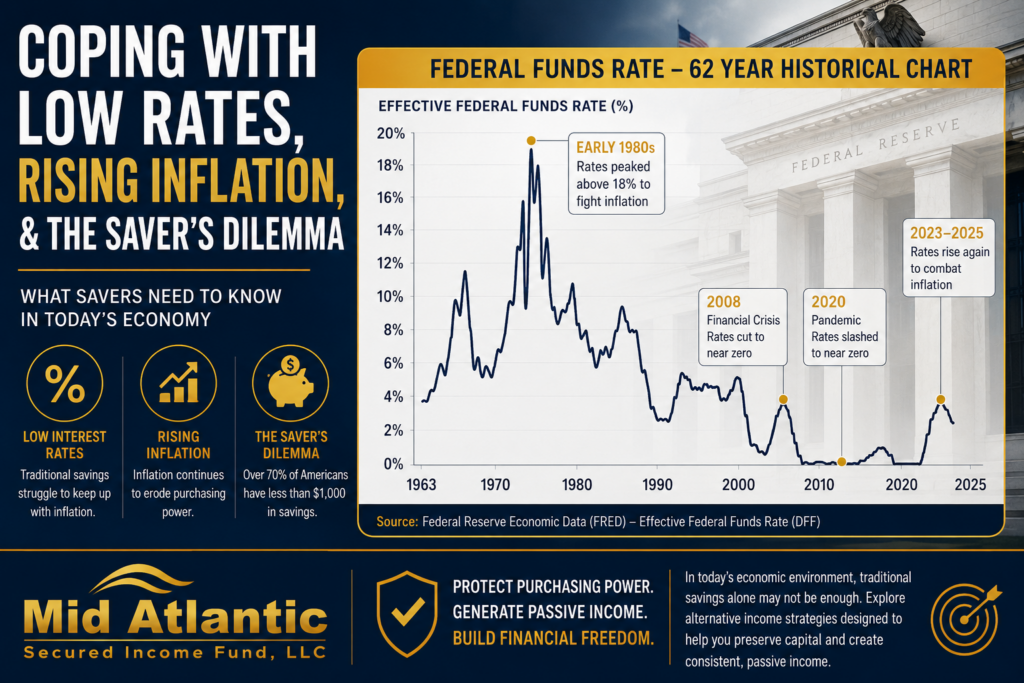

When income investors compare their options today, the real question is often not how to reach for more yield, but how much risk they are being asked to accept to get it. A secured lending investment fund sits in that gap between low-yield traditional income products and higher-volatility equity strategies. For accredited investors, it offers a different approach: capital deployed into short-duration loans backed by real estate collateral, with income generated from borrower interest payments rather than property appreciation.
That distinction matters. In a secured lending structure, the investment thesis is not based on selling an asset at a higher price later. It is based on disciplined underwriting, conservative loan structures, and the borrower’s obligation to repay according to agreed terms. For investors who prioritize capital preservation and dependable cash flow, that can be a more straightforward proposition than taking direct ownership risk in real estate projects.
How a secured lending investment fund works
At its core, a secured lending investment fund pools capital from qualified investors and uses that capital to originate or participate in loans. Those loans are typically secured by specific collateral, often real estate, and structured with defined terms, rates, and repayment schedules. In the private credit context, that may include first-position mortgage loans for construction, renovation, bridge financing, or other short-term business-purpose needs.
The source of investor income is generally the spread created by lending activity. Borrowers pay interest and fees for access to fast, flexible capital. The fund then distributes a portion of that income to investors, often on a monthly or semi-annual basis, depending on the fund structure.
The word secured is doing important work here. It means the loan is backed by pledged collateral, and in many real estate private credit strategies, that collateral is recorded through a mortgage or deed of trust. If performance does not go as planned, the lender has legal rights tied to the asset. That does not eliminate risk, but it changes the risk profile in a meaningful way.
Why accredited investors consider secured lending funds
Many accredited investors are looking for income that is less correlated to daily market swings and less dependent on broad market sentiment. Public fixed-income products may offer limited yield, while equities can introduce price volatility that works against near-term income goals. A secured lending investment fund can appeal to investors who want current income tied to contractual loan payments and supported by tangible collateral.
There is also a practical advantage in the fund format itself. Investors gain exposure to a managed portfolio of loans without sourcing deals, underwriting borrowers, handling servicing, or taking title to properties. That can be especially relevant for self-directed IRA investors, family offices, and high-net-worth individuals who want real estate credit exposure without the time demands and concentration risk of owning individual projects directly.
Still, this is not a passive income strategy in the simplistic sense sometimes implied by marketing in the broader investment market. It requires a manager with experience in underwriting, documentation, servicing, workouts, and collateral enforcement. The quality of the operator is often as important as the quality of the collateral.
The risk controls that matter most
Not all secured lending funds are built the same. The strongest structures are usually defined less by headline yield and more by underwriting discipline. Investors evaluating a fund should pay close attention to how loans are selected, how leverage is managed, and how the manager thinks about downside protection.
Conservative loan-to-value ratios
One of the clearest indicators of discipline is loan-to-value, or LTV. In a real estate-backed lending strategy, lower LTV ratios generally create a larger equity cushion beneath the loan. If a property needs to be sold or repositioned, that cushion may help protect principal. A lender operating in the 65 to 75 percent range is usually taking a different posture than one stretching leverage to win volume.
That does not make every loan safe. Property type, borrower experience, market liquidity, construction risk, and exit strategy all still matter. But conservative attachment points are a foundational risk control.
First-position collateral
Priority in the capital stack matters. First-position mortgage loans typically stand ahead of junior debt and equity in a recovery scenario. For investors, that priority can improve the alignment between the strategy’s income objective and its capital preservation focus.
A first lien is not a substitute for underwriting, but it is a meaningful structural protection. When a fund emphasizes first-position lending rather than subordinate or unsecured exposure, it is usually signaling that downside management is central to the strategy.
Short loan duration
Short-term lending can reduce exposure to long-cycle uncertainty. Construction and bridge loans with shorter maturities allow a manager to reprice risk more frequently, respond to changing market conditions, and avoid locking capital into long-duration assets through multiple market cycles.
There is a trade-off, of course. Short-duration lending requires active origination and servicing capabilities. A manager must maintain deal flow, monitor projects closely, and manage repayments efficiently. The benefit to investors is that capital can often be rotated through multiple opportunities rather than remaining tied to a single long hold period.
Where returns come from – and what can affect them
In a secured lending fund, returns are generally driven by loan interest, origination fees, extension fees, and sometimes default-related protections. That makes the return profile different from equity real estate investments, where outcomes may depend more heavily on rent growth, refinancing conditions, and sale timing.
For investors, that can translate into a more income-oriented experience. But predictable income does not mean identical outcomes in every environment. Returns can be affected by loan payoffs occurring faster or slower than expected, periods of higher cash drag if capital is waiting to be deployed, borrower extensions, and workout timelines if a loan becomes impaired.
This is where manager execution becomes especially important. A disciplined fund operator is not simply making loans. It is maintaining underwriting consistency, servicing assets actively, and preserving portfolio quality through changing market conditions.
Comparing secured lending to direct real estate ownership
For some investors, the comparison is not between one fund and another. It is between a secured lending investment fund and owning rental or development property directly.
Direct ownership offers upside if a property appreciates and performs well operationally. It also introduces tenant risk, leasing risk, expense variability, renovation overruns, and concentrated exposure to a small number of assets. A lending strategy typically gives up some of that upside in exchange for a contractual claim on income and a senior position in the capital structure.
That trade-off is not better in every case. It depends on the investor’s priorities. If the goal is maximum appreciation potential, direct ownership or equity-style real estate investing may be more appealing. If the goal is current income, lower volatility, and a stronger emphasis on principal protection, secured private credit may be the better fit.
What to evaluate before investing
An informed investor should look beyond target yield and ask how the fund is built. Underwriting standards, collateral type, lien position, average duration, borrower profile, servicing capabilities, and historical loss experience all deserve attention. So does the manager’s approach when a loan does not perform as expected.
It is also worth reviewing distribution policy and liquidity terms carefully. Private funds are not the same as publicly traded income products. Capital is generally committed for a defined period, and redemption features may be limited or subject to manager discretion. That illiquidity can be acceptable, even advantageous, for investors allocating a portion of capital to private credit. But it should be understood clearly at the outset.
A well-run platform will usually be transparent about process. That includes how deals are sourced, how valuations are established, how draws are managed on construction loans, and how the manager monitors borrower performance over the life of each loan.
For accredited investors seeking dependable income outside the public markets, the appeal of this strategy is simple: lend against tangible assets, stay senior in the capital stack, and let underwriting discipline drive outcomes. Firms such as Mid Atlantic Secured Income Fund are built around that premise. The right question is not whether secured lending removes risk. It is whether the structure, collateral, and manager give you a level of protection that fits your income objectives and your tolerance for uncertainty.
A careful investor does not need the most exciting strategy in the room. Often, the better choice is the one built to hold up when conditions are less forgiving.