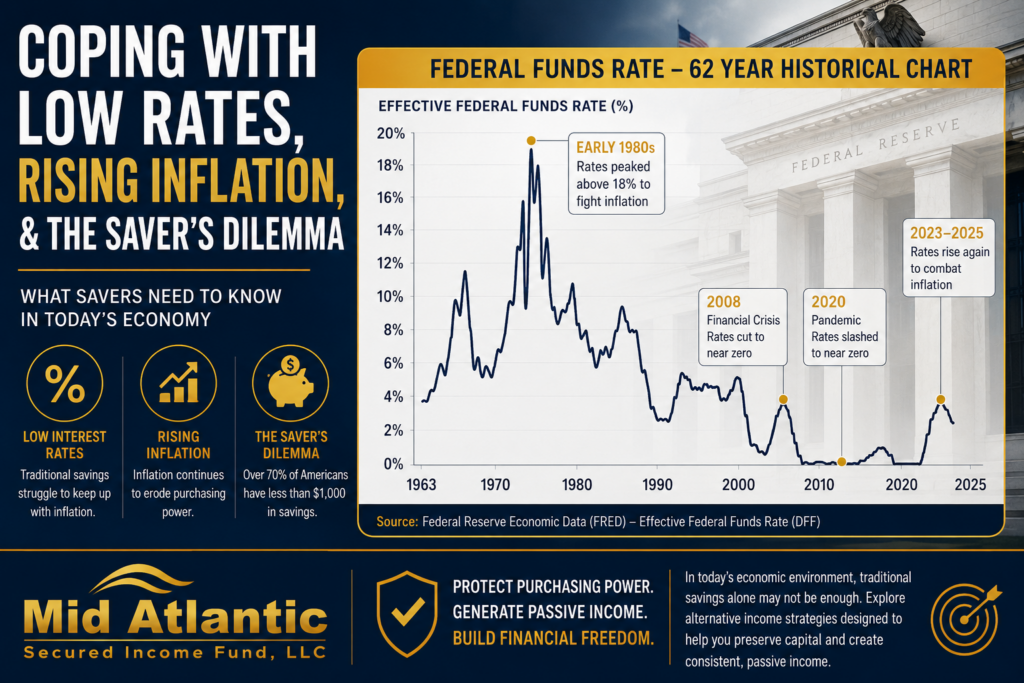

Inflation changes the questions investors should ask about income investments. The central question is not whether real estate debt funds during inflation will benefit automatically. It is whether the fund’s loan structure, collateral, underwriting discipline, and liquidity terms are positioned to manage a period in which borrowing costs, operating expenses, and property values may all move at different speeds.
For accredited investors evaluating private real estate credit, inflation is a reminder to look beyond a stated income objective. A senior-secured loan can offer a defined contractual claim and a first-position lien on real estate, but that structure does not eliminate credit risk, valuation risk, interest-rate risk, or the possibility of loss. The quality of the underwriting matters most when market conditions become less forgiving.
Why Inflation Changes the Real Estate Credit Equation
Inflation can affect a real estate loan through several connected channels. Higher costs may pressure a borrower’s construction budget, renovation plan, operating margins, or ability to complete a project on schedule. At the same time, higher interest rates can increase refinancing costs and reduce the pool of buyers for some properties. Those pressures can affect property values and a borrower’s available exit options.
A lender is therefore evaluating more than the property’s current condition. It is evaluating the borrower’s plan, the time required to execute it, the durability of projected cash flow, and the plausibility of a sale or refinance under changed market conditions. A loan that appeared conservatively structured when originated may require closer attention if costs rise, demand softens, or financing becomes less available.
Inflation can also create uneven outcomes across property types. A stabilized property with recurring revenue may respond differently than a land development project, a major rehabilitation, or a property dependent on a near-term sale. Location, tenant demand, lease structure, local supply, insurance costs, and property taxes can all influence how resilient the underlying collateral may be.
How Real Estate Debt Funds During Inflation May Respond
Private real estate debt funds generally seek to generate income by making or acquiring loans secured by real property. Their experience during inflation depends on the specific portfolio and governing offering documents, not on the label “real estate debt fund.” Investors should understand whether a fund originates loans, purchases existing loans, uses leverage, concentrates in particular property types, or has discretion to change its investment approach.
Loan Rate Structure Matters
The distinction between fixed-rate and floating-rate loans is particularly relevant when rates rise. A floating-rate loan may adjust over time according to its contractual terms, which can help a lender’s income align more closely with a changing rate environment. That adjustment can also increase the borrower’s debt-service obligation, potentially heightening default risk if the property’s cash flow does not keep pace.
A fixed-rate loan offers more certainty about its stated contractual rate, but its economic value may be affected when newly originated loans carry higher rates. Whether that is a concern depends on the loan’s duration, prepayment provisions, credit quality, and the fund’s ability to redeploy capital as loans repay. Neither structure is inherently superior in every environment.
Collateral Value Is a Risk Control, Not a Guarantee
Senior-secured, first-position lending is designed to establish priority in the collateral relative to junior debt. That priority can be a meaningful part of a capital-preservation-focused strategy. Still, a first lien does not assure repayment. If a borrower defaults, a lender may face workout costs, delays, legal complexities, declining collateral values, or an outcome in which collateral proceeds are insufficient to repay the loan balance and related expenses.
Disciplined underwriting considers the property’s value, marketability, condition, use, sponsor experience, and the borrower’s proposed repayment source. During inflationary periods, it should also test whether the business plan can withstand higher carrying costs, extended timelines, or a less favorable refinancing market. Conservative assumptions are useful only when they are applied consistently and revisited as conditions change.
Shorter Duration Can Be Helpful, but It Adds Reinvestment Questions
Some private credit strategies emphasize loans with shorter expected durations. When principal is repaid, a fund may have an opportunity to originate or acquire new loans under current market terms. That can be advantageous when lending rates have increased.
However, repayment is not assured on the expected timetable. Extensions, modifications, defaults, and prepayments can alter a portfolio’s duration. Reinvestment also depends on the availability of loans that meet the fund’s underwriting standards. Investors should treat duration as an exposure to understand, not a promise about liquidity or future income.
What Disciplined Underwriting Looks for When Costs Rise
During inflation, strong underwriting begins with a realistic view of the borrower’s exit. For a bridge or transitional real estate loan, an exit may depend on a sale, refinance, stabilization, construction completion, or another defined event. Each path should be assessed against current market conditions rather than assumptions that were valid in a lower-rate environment.
Construction and redevelopment loans deserve particular scrutiny because cost escalation can affect both the budget and schedule. A lender may review project contingencies, contractor arrangements, permits, borrower liquidity, draw controls, and evidence supporting projected value. The objective is not to predict every market movement. It is to identify where a project has limited room for error and structure the credit decision accordingly.
For income-producing collateral, underwriting may focus on revenue durability, occupancy trends, lease expirations, operating expenses, and capital needs. Inflation can increase insurance, repairs, utilities, taxes, and labor costs. A property’s gross revenue may rise while its net operating income remains under pressure. The distinction is material to debt service and the property’s potential refinancing value.
A disciplined manager also monitors loans after origination. Investor reporting should help eligible investors understand the fund’s strategy, portfolio composition at an appropriate level of detail, and material developments as required by its governing documents. Transparency does not remove risk, but it supports informed oversight and more thoughtful allocation decisions.
Due Diligence Questions for Accredited Investors
A private fund investment is not the same as buying an individual mortgage note. The investor owns an interest in a fund and is exposed to its overall investment strategy, expenses, governance, liquidity provisions, and credit outcomes. Before investing, accredited investors, family offices, RIAs, and self-directed IRA investors should review the offering documents carefully and consider how the investment fits their own objectives, time horizon, and risk tolerance.
Useful questions include how the fund defines eligible collateral, whether it emphasizes senior-secured first-position loans, and how it evaluates borrower repayment sources. Investors may also ask about concentration limits, valuation practices, use of leverage if any, loan modification authority, conflicts of interest, servicing arrangements, fees and expenses, and redemption or transfer restrictions.
Liquidity deserves direct attention. Private fund interests can be illiquid, and any repurchase or redemption feature may be limited, suspended, delayed, or subject to conditions described in the offering documents. Investors should not commit capital they may need for near-term obligations. A fund’s income objective should also be considered alongside the possibility of missed payments, impaired loans, reduced distributions, or loss of principal.
Tax treatment, retirement-account considerations, and securities-law eligibility are fact-specific. Investors should consult qualified tax, legal, and financial advisers rather than relying on general educational material to make an investment decision. Past performance, if presented in approved fund materials, does not guarantee future results.
Keep Fund Investing Separate From Borrower Financing
The Mid Atlantic Secured Income Fund’s investor offering should be evaluated on its own offering documents, investment strategy, and risk disclosures. The broader alternative lending platform may provide qualified borrowers with business-purpose financing options, including commercial bridge, acquisition, construction, renovation, redevelopment, site development, lot acquisition, and fix-and-flip financing.
The platform may also evaluate certain non-real-estate business-purpose financing needs, such as medical receivables financing, purchase-order funding, litigation finance, commercial automotive financing, inventory-based lending, and working capital. These borrower products are separate from an investment in the fund. Their availability, underwriting requirements, collateral, terms, and funding sources vary, and they should not be assumed to be held by, collateralize, or generate returns for the fund.
For borrowers, inflation reinforces the value of complete documentation and a credible repayment plan. A financing request should clearly explain the asset or project, sources and uses of funds, budget assumptions, timeline, existing obligations, and expected exit. Qualified borrowers benefit from presenting current information, while understanding that approval is not assured and terms depend on underwriting.
Inflation Is a Test of Process
Real estate credit can remain relevant in an inflation-sensitive allocation because contractual lending structures, collateral, and portfolio turnover may offer characteristics that differ from equity ownership. Yet those characteristics are not substitutes for careful manager selection. Rising rates can improve prospective lending opportunities while simultaneously making borrower performance and collateral values harder to assess.
The more useful question is whether the manager’s process remains disciplined when market conditions challenge the original plan. Investors should look for a clear focus on senior-secured lending, collateral quality, borrower underwriting, active servicing, transparent reporting, and honest disclosure of illiquidity and downside risk. That is the foundation for investing with confidence when inflation makes easy assumptions less reliable.