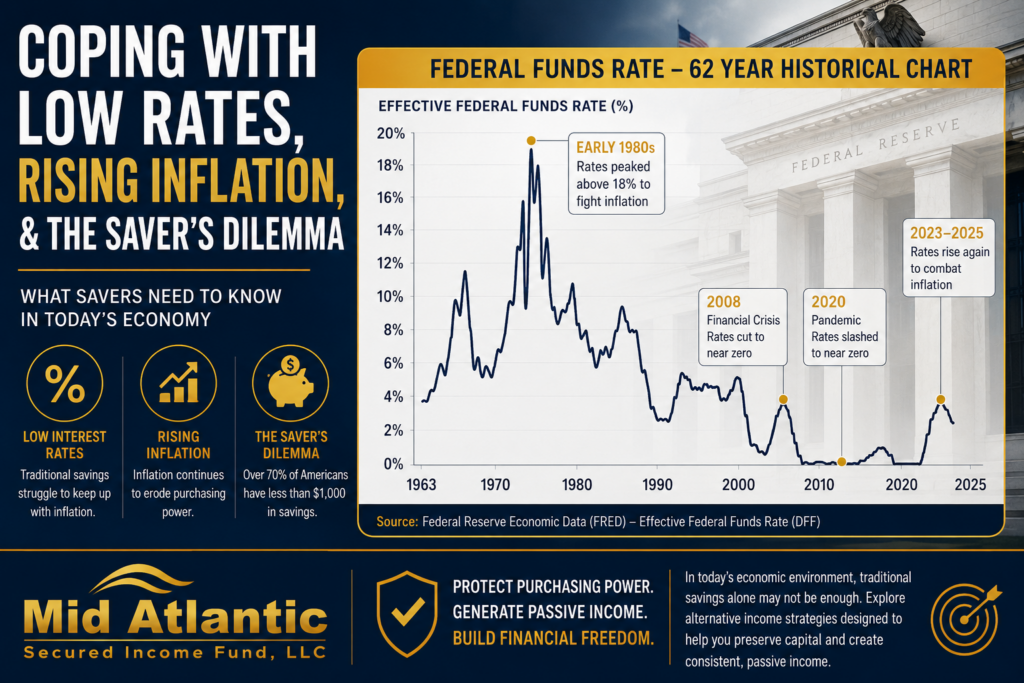

A dollar of income has two jobs: it must arrive, and it must still buy something when it does. That is the practical starting point for assessing the inflation impact on investments. For accredited investors evaluating private-market income strategies, inflation is not simply a headline economic number. It can affect real purchasing power, borrowing costs, property values, borrower performance, portfolio liquidity, and the discipline required to preserve capital.
Inflation does not affect every asset or investment structure in the same way. A portfolio positioned for current income may react differently than a portfolio built primarily for long-term appreciation. In private credit, the relevant questions are often more specific: What collateral supports the loan? Where does the lender sit in the capital stack? How durable is the borrower’s repayment plan? What happens if financing costs, construction costs, insurance, taxes, or sale timelines move against expectations?
Why inflation changes investment outcomes
Inflation is generally understood as a broad increase in prices over time, which reduces the purchasing power of money. The U.S. Bureau of Labor Statistics publishes Consumer Price Index data that investors commonly use to monitor changes in consumer prices. Current data should be reviewed using the release date applicable to the period under consideration. (Source: U.S. Bureau of Labor Statistics, Consumer Price Index releases, accessed August 21, 2026.)
For investors, the distinction between nominal income and real income matters. A distribution, interest payment, or other cash flow may remain unchanged in dollar terms while its purchasing power declines. If an investment produces income that does not keep pace with an investor’s cost of living or future obligations, its real economic contribution may be lower than the stated cash amount suggests.
That does not mean higher inflation automatically makes income investments unattractive. It means the income stream should be evaluated alongside duration, pricing structure, fees, credit quality, liquidity, and the investor’s own time horizon. A short-term loan portfolio may have more opportunities to reprice as loans repay and new loans are originated. A longer-duration fixed-payment asset may have less flexibility. Neither structure is inherently superior without understanding the underlying terms and risks.
Inflation impact on investments depends on structure
Public markets can reprice quickly when inflation expectations change. Private investments may not be quoted daily, but they are not insulated from economic conditions. Their value and cash-flow profile can still be influenced by the cost of capital, collateral markets, borrower fundamentals, and the availability of exit financing.
In senior-secured real estate lending, inflation can create both challenges and areas for careful underwriting attention. Rising material, labor, insurance, property-tax, or debt-service costs can pressure a development or renovation budget. Higher interest rates may reduce buyer demand, change refinancing assumptions, or lengthen the time required to sell a property. A borrower whose plan depends on a narrow timing window or an aggressive valuation assumption may face greater execution risk.
Collateral quality and lien position become especially relevant in that environment. A senior-secured, first-position loan is structurally different from a subordinate claim because repayment priority and remedies may differ if a borrower defaults. That priority does not eliminate loss risk, valuation risk, legal risk, or the possibility that collateral disposition takes time. It is one component of a broader risk-management framework.
Disciplined underwriting should examine the property, the borrower, the proposed business plan, sources of repayment, project budget, market conditions, and reasonable downside scenarios. It should also consider whether the loan structure leaves room for changing costs or a longer-than-expected exit. The appropriate analysis will vary by asset type and transaction. A stabilized commercial property, a redevelopment project, and land intended for future development do not present the same risks.
Interest rates are related, but not identical, to inflation
Inflation and interest rates often move in the same conversation, but they are not interchangeable. The Federal Reserve sets monetary policy based on its assessment of employment, inflation, and other economic conditions, while market rates also reflect expectations, credit conditions, and investor demand. (Source: Board of Governors of the Federal Reserve System, Monetary Policy, accessed August 21, 2026.)
When rates rise, borrowers may face higher financing costs, and real estate values can be affected as market participants reassess required returns and available debt. Existing fixed-rate assets may behave differently from newly originated loans. Private credit strategies with shorter contractual terms may have an opportunity to originate new loans under updated market conditions, but that potential must be weighed against the possibility of weaker borrower demand, slower property transactions, and tighter refinancing markets.
For investors, the key point is not to assume that a higher-rate environment automatically produces a better outcome. The quality of new opportunities matters. A lender can increase stated pricing while also taking on weaker collateral, a more complex project, or a borrower with less capacity to withstand disruption. Capital preservation requires examining both sides of that equation.
Purchasing power is only one risk to measure
It is tempting to frame inflation as the central risk and look for an investment that will offset it. That approach can obscure other material considerations. A private fund may offer a different return profile from publicly traded securities, but it can also involve limited liquidity, valuation judgment, management fees and expenses, concentration, credit losses, and reliance on the manager’s underwriting and servicing practices.
For self-directed IRA investors, family offices, RIAs, and other accredited investors, suitability is not determined by inflation alone. An allocation should be considered in the context of portfolio liquidity needs, future spending requirements, concentration limits, risk tolerance, and the ability to remain invested through changing market conditions. Private investments should not be treated as a substitute for readily available cash reserves.
Illiquidity deserves particular attention. Redemptions, transfers, and distributions, if available, are governed by the applicable offering documents and may be subject to restrictions. Investors should understand how capital is committed, how investments are valued, how conflicts are managed, and what circumstances could affect the timing or amount of cash returned. These are due-diligence questions, not administrative details.
What to examine in a private real estate credit strategy
A thoughtful review of private credit should move beyond a headline income objective. Investors can ask how the manager defines an acceptable lending opportunity and how that discipline is maintained when market conditions shift.
First, review collateral and loan priority. In a senior-secured, first-position real estate lending strategy, investors should understand the type and condition of the property collateral, the proposed use of proceeds, and the lender’s legal position. The existence of collateral does not ensure full recovery, but it is central to evaluating the repayment framework.
Second, examine underwriting and asset management. Ask how borrower financial capacity, project feasibility, construction or renovation budgets, market demand, and exit strategies are assessed. It is also reasonable to understand how exceptions are handled, how loans are monitored after closing, and how potential problems are identified and addressed.
Third, consider portfolio construction. A fund’s exposure may be affected by property type, geography, loan maturity, borrower concentration, and market cycle. Diversification can reduce the impact of a single adverse outcome, but it cannot eliminate investment risk.
Finally, read the offering documents closely. These materials should explain the investment objective, material risks, fees and expenses, liquidity provisions, conflicts of interest, valuation practices, and eligibility requirements. Past performance, where provided, does not guarantee future results. Investors should consult qualified legal, tax, and financial advisers before making an investment decision.
Keeping investor and borrower decisions separate
A private credit fund’s investment strategy must be evaluated on its own documented terms. Mid Atlantic Secured Income Fund emphasizes senior-secured, first-position real estate lending, disciplined underwriting, collateral quality, capital-preservation objectives, and transparent investor reporting. Its Safe, Simple, Secured positioning describes an approach to decision-making, not a guarantee against loss.
Separately, qualified borrowers may seek business-purpose financing through an alternative lending platform for needs such as commercial bridge financing, acquisition and construction projects, renovation and redevelopment, site and land development, lot acquisition, or fix-and-flip activity. The broader platform may also evaluate other business-purpose financing requests, including receivables, purchase-order, inventory, automotive, litigation, and working-capital uses where appropriate.
Those borrower products are distinct from an investor’s interest in the fund. A financing product offered through a lending platform should not be assumed to be held by, collateralize, or generate returns for the fund. Eligibility, documentation, underwriting, and terms vary by transaction, and no borrower should interpret general information as an approval or commitment to lend.
A disciplined response to an uncertain price environment
Inflation can reward investors who focus on the durability of cash flows rather than the appearance of yield alone. In private real estate credit, that means giving appropriate weight to senior lien position, collateral analysis, conservative assumptions, servicing capability, transparency, and liquidity constraints. It also means accepting that even well-structured investments can face adverse conditions.
The most useful question is not whether an investment can defeat inflation in every period. It is whether its structure, underwriting standards, and risk disclosures fit the role you expect it to play in a diversified portfolio. Review current economic data, read the governing documents, and make the decision with the same discipline you expect from the manager of your capital.