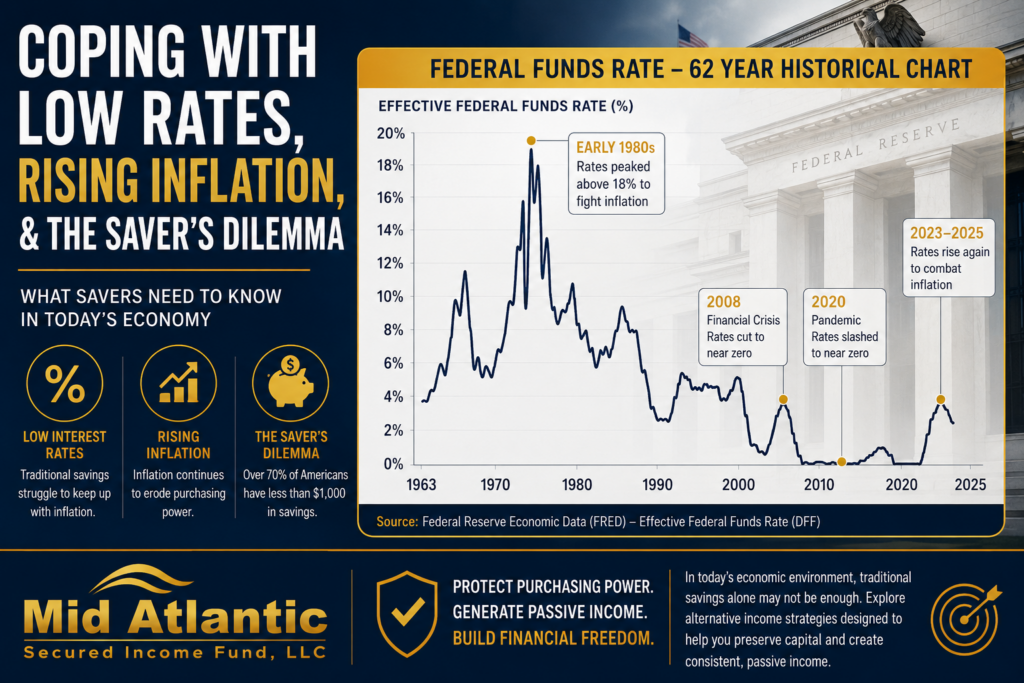

A 5% money market yield can look attractive right up until rates move, inflation persists, or public markets remind investors how quickly sentiment can change. For many high-net-worth investors, the real question is not simply where to earn income, but how to earn it with greater control over risk. That is why private debt funds for accredited investors have moved into sharper focus, particularly among those looking for asset-backed cash flow outside traditional stocks and bonds.
Private debt is not a new idea. What has changed is investor demand. As banks tighten lending standards and many borrowers still need flexible capital, private lenders have stepped into the gap. For accredited investors, that creates access to a segment of the credit market that may offer higher current income than many conventional fixed-income products, with risk management rooted in underwriting discipline rather than market momentum.
What private debt funds for accredited investors actually are
At a basic level, a private debt fund pools capital from eligible investors and deploys that capital into non-public loans. Those loans can be corporate, asset-based, or real estate-backed. The structure matters because not all private debt strategies carry the same risk profile.
For investors focused on stability and income, real estate-backed private credit often stands apart from unsecured lending or highly leveraged corporate deals. In a secured real estate lending strategy, the fund is generally making loans against tangible collateral, often in a first-lien position. That means the lender has a defined claim on the underlying asset if the borrower defaults. It does not eliminate risk, but it changes the risk equation in a meaningful way.
This is one reason accredited investors often compare private debt funds not only to bond funds, but also to direct real estate ownership. A well-structured credit fund can provide exposure to real estate economics without the operational burden of tenants, leasing, maintenance, or property-level management. The investor is financing the asset, not running it.
Why accredited investors are paying attention
The appeal starts with income, but it should not end there. Private debt funds are often evaluated by investors who want regular distributions, limited correlation to public equity markets, and a more defensive place in the capital stack.
That last point matters. Equity investors in real estate generally participate in upside, but they also absorb first-loss risk when a project underperforms. A senior secured lender has a different objective. It is typically seeking principal protection and contractual interest payments, not speculative appreciation. For retirees, rollover IRA investors, and family offices building income-oriented portfolios, that distinction is often central.
Research from institutions such as the Federal Reserve has consistently shown that bank credit availability can tighten during periods of uncertainty. When that happens, private lenders with available capital and disciplined underwriting can find attractive opportunities. The opportunity, however, is not just about yield. It is about structuring loans conservatively enough that repayment does not depend on a perfect market environment.
The role of collateral and underwriting
If you are evaluating private debt funds for accredited investors, underwriting standards deserve more attention than headline return targets. In private credit, the spread can look compelling on paper, but the durability of investor outcomes usually comes back to credit selection, collateral quality, and loan structure.
In a real estate-backed strategy, several underwriting factors deserve close review. The first is loan-to-value. Conservative LTV ratios can provide a meaningful equity cushion if a project runs into delays, cost overruns, or softer resale conditions. Many investors view lending in the 65% to 75% range as materially different from pushing leverage to the edge.
The second is lien position. First-position loans generally provide stronger control rights and repayment priority than junior debt or preferred equity structures. The third is duration. Shorter-duration loans can reduce sensitivity to longer market cycles and allow managers to reprice capital more frequently as conditions change.
Then there is servicing and borrower oversight. Origination alone is not the whole job. Strong private credit managers monitor projects, track draws, verify collateral conditions, and stay engaged through repayment. In practice, investor protection often depends as much on post-close discipline as on initial screening.
Where private debt can fit in an income portfolio
Private debt is not a replacement for every bond allocation, and it is not appropriate for every investor. It can, however, serve a clear role for accredited investors who want to diversify income sources beyond public fixed income and dividend equities.
Traditional bonds offer liquidity and transparency, but their yields and price sensitivity can shift meaningfully with interest rate expectations. Public REITs offer real estate exposure, but they also trade with stock market volatility. Private debt can occupy a different lane – one centered on contractual loan income, lower mark-to-market noise, and collateral-backed structures.
That said, the trade-off is liquidity. Investors should expect private funds to involve holding periods, transfer restrictions, and less frequent valuation updates than publicly traded instruments. For many accredited investors, that is an acceptable exchange if the underlying strategy emphasizes capital preservation and dependable distributions. But it only works when the illiquidity matches the investor’s time horizon and cash flow needs.
This is also why self-directed IRA and rollover IRA investors often explore private credit. Investors with dormant retirement capital from old 401(k) accounts may be looking for income-oriented alternatives that are less exposed to daily market swings. Within the right account structure and with proper custodial handling, private debt can be part of that conversation. The key is understanding that retirement account suitability depends on the investor’s broader objectives, liquidity needs, and professional guidance.
Questions to ask before investing
A sophisticated investor should approach any private debt offering with the mindset of a credit committee, not a marketing brochure reader. Manager quality matters, but manager process matters more.
Start with the investment mandate. Is the fund focused on senior secured loans, subordinate debt, or a blend? Is the strategy narrowly defined or broad enough to create style drift? Ask how the manager sources deals, who underwrites them, and whether underwriting is handled internally.
Next, look at risk controls. What are the target LTV parameters? What property types or borrower profiles are excluded? How are reserves, guarantees, or draw schedules handled? If the strategy is real estate-backed, you want to know whether repayment depends primarily on refinance proceeds, asset sale, operating cash flow, or some combination.
Track record should be evaluated carefully. Total originations alone do not tell the whole story. Ask about realized losses, workout experience, foreclosure history, and distribution consistency across different market conditions. A conservative manager should be able to explain not just returns, but how capital was protected when deals did not go as planned.
Fees also deserve scrutiny. In private credit, net income to investors can be affected by management fees, incentive structures, servicing costs, and fund-level expenses. High gross yields can become less impressive after layers of fees. Clear alignment between the manager and investors is usually a better sign than complicated economics.
What can go wrong
Private debt is often described as lower volatility, but lower volatility is not the same as low risk. The absence of daily price quotes can make an investment feel calmer than it really is. The real risks are usually found in borrower defaults, collateral impairment, leverage, concentration, and weak underwriting.
For example, a fund concentrated in one geography, one borrower type, or one property niche may face sharper stress if local conditions change. A manager who stretches LTVs late in a cycle may create limited room for error. And a fund that reaches for yield by moving down the capital stack can behave very differently from one focused on first-position secured lending.
This is where discipline separates durable income strategies from fragile ones. Investors should prefer managers who are willing to pass on loans that do not meet their standards. In private credit, avoiding weak deals is just as important as closing attractive ones.
Why strategy selection matters more than the label
The term private debt covers a wide range of approaches. Some funds lend to middle-market companies. Others finance distressed situations. Others focus on asset-backed or real estate-backed loans. Those are not interchangeable exposures.
For an accredited investor seeking passive income with an emphasis on capital preservation, a senior secured real estate credit strategy may feel more intuitive than unsecured corporate lending. The assets are tangible, the loan terms can be shorter, and the path to repayment can be easier to analyze. That does not make it immune to loss. It does mean the investment thesis is grounded in collateral value, borrower equity, and structured repayment rather than broad market sentiment.
This is the framework many investors use when evaluating specialized managers such as Mid Atlantic Secured Income Fund. The question is not whether private debt sounds appealing in general. The question is whether a specific fund has the underwriting standards, collateral controls, and operating discipline to support consistent income through changing market conditions.
Private credit tends to reward patience, selectivity, and skepticism. For accredited investors, that is not a drawback. It is often the point. When income matters and capital preservation comes first, the best opportunities are usually found not in the highest advertised yield, but in the strategies built to keep doing their job when conditions get harder.