Bridge Loans for Real Estate Investors
Bridge loans for real estate investors provide fast, asset-backed financing for acquisitions, rehab, and refinance timing gaps.
Bridge Loans for Real Estate Investors Read More »


Bridge loans for real estate investors provide fast, asset-backed financing for acquisitions, rehab, and refinance timing gaps.
Bridge Loans for Real Estate Investors Read More »

What Is an Accredited Investor? An accredited investor is an individual or entity that meets specific financial criteria established by the U.S. Securities and Exchange Commission (SEC), allowing access to private investment opportunities not generally available to the public markets. These investments often include: Private credit funds Real estate debt funds Private equity Venture capital Hedge funds Institutional private lending Asset-backed investments Alternative income strategies In today’s investment environment, accredited investors are increasingly seeking alternatives to traditional stock-and-bond portfolios as they search for: income stability, downside protection, portfolio diversification, inflation resilience, and access to private markets. As institutional capital continues flowing into private credit and real estate-backed lending, accredited investors are gaining access to strategies once reserved almost exclusively for pension funds, insurance companies, endowments, and large family offices. SEC Accredited Investor Requirements (2026) Individual Income Qualification Under current SEC guidelines, an individual qualifies as an accredited investor if they have: earned more than $200,000 annually for the past two years individually, OR earned more than $300,000 jointly with a spouse or spousal equivalent, AND reasonably expect to maintain similar income levels. Net Worth Qualification An investor may also qualify if they possess: a net worth exceeding $1 million, excluding their primary residence. Professional Certifications Certain financial professionals may qualify through credentials including: Series 7 Series 65 Series 82 licenses Entity Qualification Trusts, LLCs, partnerships, family offices, and corporations may qualify if they meet SEC asset or ownership thresholds. Why Accredited Investors Are Moving Beyond Traditional Portfolios Over the past decade, institutional investors have steadily increased allocations to private markets. According to BlackRock and Preqin research, global private credit assets under management have grown from roughly $500 billion in 2015 to well over $1.7 trillion in recent years, with forecasts projecting continued expansion throughout the decade. Why? Because many accredited investors are becoming increasingly concerned about: stock market volatility, inflation risk, bond market instability, declining purchasing power, and concentration risk inside traditional 60/40 portfolios. The sharp rise in interest rates between 2022 and 2024 exposed vulnerabilities within traditional fixed-income markets. Long-duration bonds experienced some of their worst drawdowns in decades, while equity markets faced heightened volatility. This has accelerated interest in: private credit, secured lending, real estate-backed investments, and institutional-style income strategies. What Is Private Credit? Private credit refers to non-bank lending conducted outside traditional public debt markets. Instead of purchasing publicly traded bonds, investors allocate capital into privately negotiated loans often secured by: commercial real estate, residential real estate, business assets, receivables, equipment, or contractual cash flows. Private credit strategies may include: bridge lending, mortgage funds, commercial real estate loans, receivable factoring, purchase order financing, asset-backed lending, construction financing, and specialty finance. Why Private Credit Has Become One of the Fastest Growing Asset Classes Institutional investors have significantly expanded exposure to private credit because of several structural trends: 1. Banks Have Tightened Lending Standards Following the Global Financial Crisis and evolving banking regulations, traditional banks reduced participation in many types of middle-market and specialty lending. This created opportunities for private lenders and debt funds to fill financing gaps. 2. Investors Are Seeking Income In a higher-rate environment, investors increasingly prioritize: predictable cash flow, yield generation, and income-producing investments. 3. Real Assets Provide Collateral Many private credit investments are backed by tangible collateral, helping support capital preservation strategies. 4. Portfolio Diversification Private credit often behaves differently than public equities and traditional bonds, potentially improving diversification. How Real Estate Debt Funds Work Real estate debt funds pool investor capital to originate or acquire loans secured by real estate assets. These loans may finance: residential developments, multifamily projects, bridge financing, acquisition financing, renovation projects, stabilized income-producing assets, or commercial real estate transactions. Rather than owning the real estate directly, debt funds occupy the lender position within the capital stack. This distinction is critical. Debt investors generally prioritize: income generation, collateral protection, contractual repayment, and downside mitigation. Equity vs. Debt Investing in Real Estate Feature Real Estate Equity Real Estate Debt Position in Capital Stack Lower Higher Income Priority After debt Before equity Volatility Higher Typically lower Cash Flow Structure Variable Often contractual Downside Protection Lower Higher Return Potential Higher upside More stable income focus Why Accredited Investors Use Alternative Investments Accredited investors often seek alternative investments because they provide access to opportunities unavailable within public markets. Common objectives include: Income Stability Private lending strategies may provide recurring income streams through interest payments. Inflation Mitigation Certain floating-rate or short-duration lending structures may adapt more effectively to changing rate environments. Diversification Alternative investments can reduce concentration in traditional equity markets. Access to Institutional Strategies Private markets historically favored: pension funds, sovereign wealth funds, endowments, and institutional asset managers. Today, accredited investors increasingly participate in similar strategies. Risks Accredited Investors Should Understand All investments involve risk. Private credit and alternative investments are no exception. Illiquidity Private investments are generally less liquid than publicly traded securities. Credit Risk Borrowers may default on obligations. Real Estate Market Risk Property values may fluctuate. Interest Rate Risk Financing conditions may impact lending performance. Manager Selection Risk Underwriting discipline and operational experience matter significantly. This is why accredited investors often prioritize: experienced management, conservative underwriting, collateral protection, disciplined loan structures, and strong risk management frameworks. Why Institutional Investors Favor Asset-Backed Lending Many institutional allocators prefer asset-backed lending because tangible collateral may help reduce downside exposure. Examples include: first-lien mortgages, secured commercial loans, residential collateral, receivable-backed structures, and contractual repayment agreements. This differs materially from unsecured lending models. The Rise of Income-Focused Investing Retirement planning dynamics are evolving. According to Federal Reserve and Census Bureau data: Americans are living longer, retirement horizons are expanding, and many investors increasingly prioritize income consistency over speculative growth. As a result, demand has grown for: passive income investments, real estate-backed income, private lending strategies, and alternative fixed-income solutions. How Accredited Investors Build Diversified Portfolios Sophisticated accredited investors often diversify across: public equities, private credit, real estate, fixed income, cash equivalents, and alternative investments. The goal is not necessarily maximizing returns at all costs. Instead,

Capital preservation investment strategies can reduce drawdowns, support income, and improve portfolio resilience through disciplined risk control.
Capital Preservation Investment Strategies Read More »

Low volatility income investments can help accredited investors pursue steady cash flow with less market swing through disciplined, asset-backed risk.
Low Volatility Income Investments Explained Read More »

Learn how an accredited investor income fund works, where returns come from, and how real estate-backed private credit may support steady cash flow.
What Is an Accredited Investor Income Fund? Read More »

How Sophisticated Investors Build Durable Wealth Through Diversification, Private Credit & Income-Focused Strategies For decades, wealth management for high net worth individuals centered primarily around traditional stock-and-bond allocation models. Public equities drove long-term growth. Municipal and Treasury bonds provided income and stability. Private banking relationships focused heavily on tax efficiency, estate planning, and market participation. But the wealth management landscape has changed materially. Persistent inflation pressures, elevated interest rates, banking sector stress, geopolitical volatility, and rising public market concentration risk have forced many affluent investors and family offices to rethink portfolio construction entirely. Increasingly, financial advisors for high net worth individuals are expanding beyond traditional 60/40 allocation frameworks and incorporating alternative investments, private credit, real estate-backed lending, secured income strategies, and institutional-style diversification models into client portfolios. The result is a more resilient approach to wealth preservation and long-term income generation. In many cases, sophisticated investors are prioritizing: downside protection, durable cash flow, reduced public market correlation, inflation resilience, capital preservation, and tax-aware portfolio construction. This shift is not theoretical. According to Preqin, global private credit assets under management surpassed approximately $1.7 trillion in recent years and continue expanding rapidly as institutional investors seek alternatives to traditional fixed income. Simultaneously, family offices are allocating larger portions of portfolios to private markets, alternative lending, infrastructure, real estate debt, and secured income vehicles. The modern wealth advisor increasingly acts less like a traditional broker and more like a strategic portfolio architect. What Does a Financial Advisor for High Net Worth Individuals Actually Do? Direct Answer A financial advisor for high net worth individuals helps affluent investors manage, preserve, grow, and transfer wealth through sophisticated portfolio construction, tax planning, alternative investments, estate strategies, risk management, and long-term income planning. Unlike traditional retail advisors, high-net-worth advisors often coordinate: portfolio diversification, private investments, family office services, retirement income strategies, estate planning, tax optimization, business succession, and institutional-grade risk management. Many advisors serving affluent investors now incorporate private credit, real estate-backed lending, structured income investments, and alternative assets alongside traditional equities and bonds. Why Wealthy Investors Are Rethinking Traditional Portfolio Models The Decline of the Traditional 60/40 Portfolio For decades, investors relied heavily on the classic 60% stock / 40% bond allocation model. The assumption was simple: equities generate long-term growth, bonds provide stability and income. However, recent market cycles exposed structural weaknesses in this framework. During periods of elevated inflation and rising interest rates: both stocks and bonds experienced simultaneous pressure, duration risk increased, bond prices declined materially, and volatility spread across asset classes. According to BlackRock and Goldman Sachs research, many institutional allocators now view portfolio diversification through a broader lens that includes private markets, real assets, infrastructure, and private lending. This evolution has accelerated interest in: private credit, secured income funds, real estate-backed debt, floating-rate investments, and alternative fixed income strategies. The Rise of Alternative Investments Among Affluent Investors Why High Net Worth Investors Are Moving Beyond Public Markets High net worth individuals often face different portfolio challenges than average investors. Their objectives may include: preserving multi-generational wealth, generating consistent income, reducing volatility, minimizing taxes, and lowering exposure to public market drawdowns. As a result, affluent investors increasingly allocate capital toward alternative investments. Common Alternative Allocations Include: Asset Type Purpose Private Credit Income generation Real Estate Debt Asset-backed cash flow Infrastructure Inflation resilience Private Equity Long-term growth Structured Credit Yield enhancement Real Assets Diversification Secured Lending Capital preservation focus Family offices and institutional investors frequently utilize these strategies because they may offer: lower correlation to equities, enhanced income potential, collateral-backed structures, and more customized risk profiles. What Is Private Credit? Direct Answer Private credit refers to non-bank lending investments where capital is provided directly to borrowers through private transactions rather than public bond markets. Private credit strategies may include: real estate lending, bridge lending, construction financing, asset-backed loans, commercial lending, specialty finance, and secured private debt. Private credit has become increasingly attractive as banks tighten lending standards and institutional investors seek higher-yielding alternatives to traditional fixed income. Why Financial Advisors Are Increasingly Using Private Credit Income Generation in a Higher-Rate Environment Traditional investment-grade bonds historically produced relatively modest yields during years of near-zero interest rates. Private credit strategies emerged as a compelling alternative because they often offer: floating-rate structures, higher income potential, shorter duration exposure, and collateral-backed underwriting. For many advisors, private credit helps address one of the biggest modern portfolio challenges: How do investors generate meaningful income while managing downside risk? Are Debt Funds Safer Than Stocks? Direct Answer Debt funds are not risk-free, but many secured lending and private credit strategies may offer lower volatility and stronger downside protection characteristics than equities because debt investors often sit higher in the capital structure and may benefit from collateral-backed lending structures. Key distinctions include: Stocks Secured Debt Investments Ownership stake Loan position Higher volatility Often lower volatility Dependent on earnings growth Income-focused Subordinate in bankruptcy Often senior secured Market sentiment driven Cash-flow driven This is one reason many institutional allocators increasingly incorporate secured income investments into diversified portfolios. The Importance of Portfolio Diversification Diversification Is More Than Owning More Stocks Sophisticated diversification involves exposure across: asset classes, income streams, liquidity profiles, economic drivers, and risk factors. Many affluent investors now diversify beyond: public equities, Treasuries, and municipal bonds. Instead, portfolios increasingly include: private credit, real estate-backed debt, alternative income funds, and inflation-sensitive assets. This broader diversification framework may help reduce dependency on any single market environment. How Family Offices Approach Wealth Preservation Family offices increasingly focus on three primary portfolio objectives: 1. Capital Preservation Protecting wealth becomes increasingly important as net worth rises. Affluent investors often prioritize: downside mitigation, risk-adjusted returns, liquidity management, and portfolio durability. 2. Income Stability Many family offices seek investments capable of generating: recurring cash flow, lower volatility income, and predictable yield profiles. 3. Long-Term Multi-Generational Planning Wealth management increasingly incorporates: estate structures, tax-aware strategies, trusts, philanthropy, and succession planning. Investment strategy becomes integrated with long-term family governance. The Role of Real Estate-Backed Lending in Modern Portfolios Why
Financial Advisors for High Net Worth Individuals Read More »

How Accredited Investors Are Structuring Portfolios for Long-Term Wealth Preservation, Income & After-Tax Performance Why After-Tax Returns Matter More Than Ever For decades, investors primarily focused on one question: “How much return can my portfolio generate?” But increasingly, sophisticated investors, family offices, wealth advisors, and accredited investors are asking a more important question: “How much of those returns do I actually keep after taxes?” That distinction has become increasingly important entering 2026. Higher investment income, elevated capital gains exposure, shifting tax policy discussions, inflationary pressures, and growing wealth concentration have made tax efficiency a central component of modern portfolio construction. Institutional investors increasingly recognize that strong nominal returns alone are insufficient if portfolios are structured inefficiently from a tax perspective. In many cases, improving after-tax efficiency can materially enhance long-term compounded wealth without requiring additional investment risk. This shift explains why accredited investors are increasingly exploring: self-directed IRAs (SDIRAs), private credit, real estate-backed investments, tax-advantaged retirement structures, alternative income strategies, and diversified portfolio frameworks designed around long-term capital preservation. The modern investment environment is no longer simply about chasing returns. It is about structuring portfolios intelligently. What Are Tax-Efficient Investment Strategies? Direct Answer Tax-efficient investment strategies are portfolio management approaches designed to maximize after-tax returns by minimizing unnecessary tax liabilities through investment selection, asset location, diversification, income structuring, and long-term planning. These strategies may involve: tax-advantaged retirement accounts, capital gains management, private market investments, municipal bonds, alternative income strategies, real estate structures, and diversified asset allocation. The goal is not tax avoidance. The goal is strategic tax optimization within existing regulatory frameworks. Why Tax Efficiency Matters More in 2026 Several structural economic trends are increasing investor focus on tax-aware portfolio construction. 1. Higher Portfolio Income Creates Higher Tax Exposure Rising interest rates have increased yields across many asset classes. While higher yields can improve portfolio income, they may also increase taxable income exposure depending on account structure and investment selection. Investors generating income from: bonds, private credit, dividends, rental cash flow, and alternative investments must increasingly evaluate the after-tax implications of portfolio design. 2. Inflation Makes Tax Drag More Painful Inflation reduces purchasing power. Taxes can compound that erosion. For example: An investor earning a 7% return while paying combined federal and state taxes may retain substantially less real purchasing power after inflation is considered. As a result, investors increasingly seek: tax-advantaged income, tax-deferred growth, and long-term compounding efficiency. 3. Public Market Volatility Has Increased Tax Awareness Market volatility often creates both risks and opportunities. Sophisticated investors increasingly use: tax-loss harvesting, rebalancing strategies, and diversification frameworks to improve long-term after-tax outcomes. The Difference Between Pre-Tax and After-Tax Returns Many investors underestimate the long-term impact of taxes on compounding. Consider two portfolios: Portfolio Annual Return Effective Tax Rate After-Tax Return Portfolio A 9% 35% 5.85% Portfolio B 7.5% 15% 6.38% Over long time horizons, tax efficiency can materially alter wealth outcomes. This is why institutional investors increasingly evaluate: tax-adjusted performance, after-tax yield, and tax-aware portfolio construction. Core Components of Tax-Efficient Investing 1. Asset Location Strategy Asset location refers to placing investments in the most tax-efficient account structures. For example: Asset Type Potential Preferred Location High-income investments Tax-advantaged accounts Growth equities Taxable accounts Alternative investments SDIRAs or retirement vehicles Municipal bonds Taxable accounts Real estate debt Tax-advantaged structures Strategic asset placement can improve long-term compounding. 2. Long-Term Capital Gains Management Long-term capital gains rates are generally lower than ordinary income tax rates. As a result, many investors emphasize: longer holding periods, tax-aware rebalancing, and lower-turnover strategies. This differs significantly from short-term speculative trading. 3. Tax-Advantaged Retirement Structures Retirement accounts remain central to tax-efficient investing. Common structures include: Traditional IRAs, Roth IRAs, 401(k)s, SEP IRAs, and Self-Directed IRAs (SDIRAs). These structures may provide: tax deferral, tax-free growth potential, or enhanced portfolio flexibility. What Is an SDIRA? Direct Answer A Self-Directed IRA (SDIRA) is a retirement account that allows investors to access alternative investments beyond traditional stocks, bonds, and mutual funds. SDIRAs may include: private credit, real estate, secured lending investments, private equity, and other alternative assets. For accredited investors, SDIRAs can create opportunities for portfolio diversification and tax-advantaged alternative investing. Why Accredited Investors Use SDIRAs Sophisticated investors increasingly use SDIRAs because they may provide: broader investment flexibility, tax-deferred or tax-free growth, alternative asset access, and enhanced diversification. In particular, SDIRAs have become increasingly popular for investors seeking exposure to: real estate-backed lending, private credit, and alternative income investments. The Growing Role of Private Credit in Tax-Efficient Portfolios Private credit has become one of the fastest-growing segments of alternative investing. According to institutional research from Preqin and Goldman Sachs, private credit assets under management have expanded significantly as investors seek: yield, diversification, and reduced public market correlation. What Is Private Credit Investing? Direct Answer Private credit investing involves non-bank lending structures where investors provide capital directly to borrowers through privately negotiated debt investments rather than publicly traded bonds. Private credit investments may include: bridge lending, commercial lending, asset-backed lending, real estate-backed loans, and specialty finance structures. These investments often emphasize: recurring income, collateral-backed security, and contractual cash flow. Why Tax Structure Matters for Passive Income Passive income is often viewed favorably by investors seeking: financial independence, retirement cash flow, and wealth preservation. However, not all passive income is taxed equally. Income from: dividends, interest, real estate, and private credit may carry different tax implications depending on: account structure, holding period, investment vehicle, and investor circumstances. This is why tax-efficient income planning has become increasingly important among high-net-worth investors. Tax-Efficient Wealth Preservation Strategies Wealth preservation and tax efficiency are closely connected. Taxes can significantly impact long-term portfolio durability. Modern wealth preservation strategies increasingly combine: diversification, tax-aware structuring, alternative investments, and income optimization. Why Family Offices Emphasize Tax Efficiency Family offices often focus heavily on: multigenerational wealth transfer, estate efficiency, tax minimization, and long-term capital durability. According to Deloitte family office surveys, alternative investments continue gaining popularity among family offices seeking: diversification, inflation resistance, and tax-aware portfolio construction. Real Estate and Tax Efficiency Real estate
Tax-Efficient Investment Strategies in 2026 Read More »

Building Resilient Wealth Through Diversification, Private Credit & Income-Focused Investing For decades, strategic investment planning largely revolved around a familiar formula: public equities, investment-grade bonds, and broad market diversification. But the investment environment entering 2026 looks materially different than the one many investors built their portfolios around during the ultra-low interest rate era. Persistent inflation pressures, elevated market volatility, shifting Federal Reserve policy, geopolitical uncertainty, and changing retirement demographics are reshaping how sophisticated investors think about long-term wealth preservation and income generation. As a result, accredited investors, family offices, and institutional allocators are increasingly expanding beyond traditional 60/40 portfolio frameworks toward more diversified, income-oriented investment strategies that incorporate private credit, real estate-backed lending, alternative income vehicles, and non-correlated assets. Strategic investment planning today is no longer simply about maximizing returns. Increasingly, it is about balancing: capital preservation, downside management, inflation resilience, tax efficiency, predictable income, liquidity considerations, and long-term portfolio durability. This evolution is driving growing interest in alternative fixed-income strategies and secured lending investments that can potentially provide recurring income streams while maintaining a more conservative risk posture than many speculative growth assets. What Is Strategic Investment Planning? Direct Answer Strategic investment planning is the process of building, allocating, managing, and periodically adjusting an investment portfolio based on an investor’s long-term financial goals, risk tolerance, liquidity needs, tax considerations, and market conditions. A strategic investment plan typically includes: portfolio diversification, asset allocation, risk management, income generation, tax optimization, retirement planning, and long-term capital preservation strategies. Sophisticated investment planning often incorporates both traditional and alternative asset classes to improve portfolio resilience across varying economic environments. Why Strategic Investment Planning Matters More in 2026 The macroeconomic environment has fundamentally changed from the decade following the Global Financial Crisis. Between 2009 and 2021, many investors benefited from: historically low interest rates, abundant liquidity, strong equity market expansion, and suppressed volatility. However, several structural shifts are changing the investment landscape: 1. Higher-for-Longer Interest Rates The Federal Reserve’s tightening cycle significantly altered fixed income dynamics. While higher rates have improved bond yields compared to prior years, they have also introduced: duration risk, refinancing pressure, commercial real estate stress, and elevated market uncertainty. Investors are increasingly seeking income strategies less dependent on public market volatility. 2. Inflation Remains a Long-Term Concern According to U.S. Bureau of Labor Statistics data, inflation surged to multi-decade highs during 2022–2023 and, while moderating, continues to influence consumer costs, wage pressures, and long-term purchasing power considerations. This has made real return preservation increasingly important for retirees and wealth-focused investors. 3. The Retirement Wave Is Accelerating The U.S. Census Bureau projects continued expansion of retirement-age demographics through the 2030s as Baby Boomers transition into income-focused portfolio stages. This demographic shift is increasing demand for: recurring cash flow, lower-volatility investments, capital preservation strategies, and alternative income-oriented assets. 4. Public Market Volatility Has Increased The S&P 500 experienced significant volatility throughout 2020–2024 due to: inflation uncertainty, banking sector stress, geopolitical instability, AI-driven market concentration, and rapidly shifting monetary policy. As a result, investors are increasingly exploring portfolio diversification strategies that extend beyond public equities and traditional bonds. The Core Pillars of Strategic Investment Planning Effective strategic investment planning generally rests on five foundational pillars. 1. Portfolio Diversification What Is Portfolio Diversification? Portfolio diversification involves spreading investments across multiple asset classes, industries, geographies, and risk profiles to reduce concentration risk. The objective is not simply maximizing returns, but improving risk-adjusted outcomes over time. Why Diversification Matters Different asset classes perform differently under varying economic conditions. For example: Asset Class Potential Strength Public Equities Long-term growth Investment-Grade Bonds Stability & income Private Credit Yield & lower public correlation Real Estate Inflation hedge Cash & Treasuries Liquidity Alternative Investments Portfolio diversification According to research from BlackRock and JP Morgan Asset Management, diversified portfolios historically experience lower volatility and improved long-term consistency versus concentrated allocations. 2. Asset Allocation Asset allocation refers to determining how capital is distributed among investment categories. This is often considered one of the most important drivers of long-term portfolio outcomes. A strategic allocation may include: equities, fixed income, private credit, real estate debt, infrastructure, cash reserves, and alternative income investments. Sophisticated investors increasingly utilize alternative investments to reduce reliance on traditional stock market performance. 3. Income Generation Historically, many portfolios relied heavily on bonds for income. However, prolonged periods of low rates forced many investors to seek alternative income-producing investments. Today, investors are increasingly evaluating: private credit, secured lending, real estate-backed debt, infrastructure income, and alternative yield-oriented investments. The objective is often to generate recurring cash flow while maintaining disciplined underwriting and risk management standards. 4. Risk Management Strategic investment planning is fundamentally about risk management. This includes evaluating: market risk, credit risk, liquidity risk, inflation risk, concentration risk, and duration risk. Sophisticated investors increasingly focus on downside mitigation rather than solely maximizing upside. 5. Tax Efficiency Tax-aware investing can materially improve after-tax outcomes. Common tax-efficient strategies include: tax-deferred retirement accounts, Roth conversions, tax-loss harvesting, municipal bonds, SDIRA structures, and long-term capital gains planning. For accredited investors, self-directed IRAs (SDIRAs) have become increasingly popular vehicles for accessing alternative investments with potential tax advantages. Why Accredited Investors Are Expanding Into Private Credit Private credit has emerged as one of the fastest-growing segments of alternative investing. According to Preqin, global private credit assets under management exceeded $1.7 trillion in recent years and continue expanding rapidly. Several factors are driving this trend. Reduced Correlation to Public Markets Unlike publicly traded equities, many private credit investments are less directly tied to daily market sentiment and stock market volatility. This may improve diversification within broader portfolios. Income-Oriented Structures Many private credit investments are designed around recurring interest income rather than speculative capital appreciation. This appeals to: retirees, family offices, income-focused investors, and wealth preservation strategies. Asset-Backed Structures Certain private credit strategies utilize: first-position liens, real estate collateral, secured lending agreements, and conservative underwriting frameworks. This can provide an additional layer of downside-oriented structuring compared to unsecured investments. Strategic Investment Planning and Retirement Income Why Retirement Planning Has
Strategic Investment Planning in 2026 Read More »
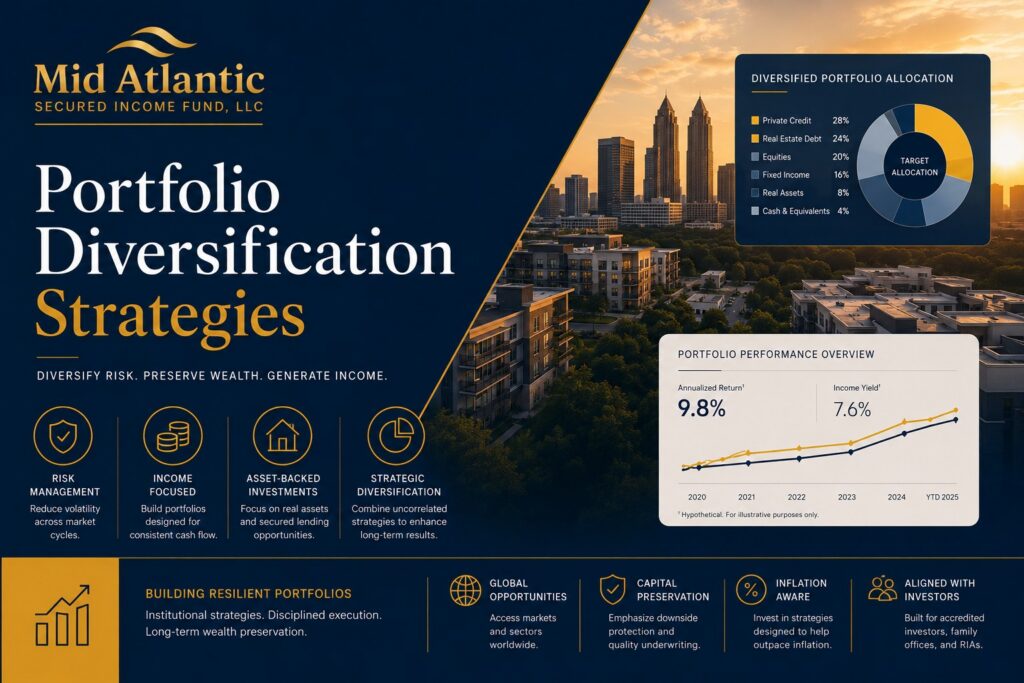
Why Diversification Matters More Than Ever For decades, diversification has been one of the foundational principles of portfolio management. Yet in today’s investment environment — defined by elevated interest rates, persistent inflation concerns, market concentration risk, geopolitical instability, and increased volatility across public equities and bonds — diversification has evolved from a textbook concept into a critical risk-management discipline. Institutional investors, family offices, pension funds, and sophisticated accredited investors increasingly recognize that traditional 60/40 portfolio frameworks may no longer provide the same balance of growth, income, and downside protection that they once did. According to research from BlackRock and JPMorgan Chase, correlations between traditional asset classes have risen meaningfully during periods of market stress over the past decade. At the same time, private market allocations among institutional portfolios continue to increase. This shift reflects a broader evolution in how sophisticated investors think about diversification: Diversification is no longer simply about owning “many stocks.” It is about owning assets with different risk drivers. It is about balancing liquidity, income, volatility, and correlation. It is about building portfolios capable of navigating multiple economic regimes. For retirement-focused investors especially, diversification has become increasingly tied to three primary objectives: Capital preservation Income consistency Risk-adjusted long-term growth The result is a growing institutional focus on alternative investments, private credit, real estate-backed lending, infrastructure, and income-oriented assets that may behave differently than public markets during periods of uncertainty. What Is Portfolio Diversification? Definition Portfolio diversification is the investment practice of allocating capital across multiple asset classes, sectors, industries, geographic regions, and investment strategies to reduce concentration risk and improve long-term risk-adjusted returns. In simple terms: Diversification seeks to avoid excessive dependence on any single investment, market segment, or economic outcome. The goal is not necessarily to maximize returns in every year. Rather, diversification aims to create a more resilient portfolio over full market cycles. Why Diversification Works Different assets tend to respond differently to economic conditions. For example: Economic Environment Assets That May Perform Better Falling interest rates Growth stocks, long-duration bonds Rising inflation Real assets, commodities, private credit Economic recession Defensive sectors, high-quality fixed income Strong economic growth Equities, cyclical industries Banking stress Hard assets, secured lending, precious metals Diversification attempts to combine assets whose performance drivers are not perfectly correlated. This can help: Reduce portfolio volatility Smooth returns over time Preserve liquidity Protect retirement income streams Reduce behavioral investing mistakes during market drawdowns The Problem With Traditional Diversification Historically, investors relied heavily on diversification between stocks and bonds. The classic “60/40 portfolio” — 60% equities and 40% bonds — became one of the most widely adopted allocation frameworks in modern investing. However, structural changes in markets have challenged this model. Rising Correlation Between Stocks and Bonds In 2022, both equities and bonds experienced significant declines simultaneously as inflation surged and central banks aggressively raised rates. According to Morgan Stanley research, one of the key assumptions underlying traditional diversification — negative stock-bond correlation — weakened materially during this period. This forced many investors to reevaluate whether public market diversification alone is sufficient. Modern Diversification Strategies Today’s institutional portfolios increasingly diversify across: Public equities Investment-grade bonds Private credit Real estate Infrastructure Private equity Hedge strategies Real assets Cash-flowing alternatives Inflation-sensitive investments The objective is broader diversification across economic drivers rather than simply more securities. Asset Allocation vs Diversification These concepts are related but distinct. Asset Allocation Asset allocation refers to how capital is distributed among major investment categories. Example: 50% equities 25% fixed income 15% private credit 10% real assets Diversification Diversification refers to how risk is spread within and across those categories. Example: Within fixed income: Treasury bonds Corporate bonds Private real estate debt Floating-rate credit Within equities: Large-cap International Dividend-focused Defensive sectors Institutional portfolio construction combines both. Why Accredited Investors Are Increasingly Looking Beyond Public Markets Over the past decade, institutional capital has steadily shifted toward private markets. According to Preqin, global private capital assets under management surpassed $14 trillion and continue to grow as investors seek: Income diversification Reduced public market volatility Alternative sources of yield Lower correlation assets Inflation-sensitive cash flows Private credit, in particular, has seen substantial growth. The Rise of Private Credit in Diversified Portfolios Private credit has become one of the fastest-growing alternative asset classes globally. What Is Private Credit? Private credit refers to non-bank lending strategies in which capital is provided directly to borrowers outside traditional public bond markets. Examples include: Real estate-backed loans Bridge lending Construction lending Senior secured debt Asset-backed financing Commercial lending Private credit strategies often emphasize: Income generation Senior collateral positions Floating-rate structures Downside protection Contractual cash flows Why Investors Use Private Credit for Diversification Private credit may offer several diversification characteristics: Potential Benefit Explanation Lower correlation to equities Returns often tied to contractual cash flows Income generation Many structures distribute recurring interest income Collateral-backed structures Certain strategies emphasize secured positions Reduced mark-to-market volatility Private assets may not reprice daily like public securities Inflation resilience Floating-rate loans may adjust upward with rates Sophisticated investors increasingly view private credit not as a replacement for traditional investments, but as a complementary portfolio component. Real Estate-Backed Debt as a Diversification Tool One increasingly popular diversification strategy involves real estate-backed secured lending. This differs materially from direct real estate ownership. Equity Real Estate vs Debt Real Estate Equity Ownership Investors own the property itself and rely on appreciation and rental income. Debt Investing Investors provide financing secured by the property. The distinction is important. Debt-focused structures may emphasize: Capital preservation Senior lien priority Income consistency Defined repayment structures Rather than depending entirely on appreciation. How Institutional Investors Think About Risk Sophisticated diversification is not simply about maximizing returns. It is about managing multiple forms of risk simultaneously: Market risk Liquidity risk Inflation risk Interest rate risk Concentration risk Sequence-of-return risk Credit risk Behavioral risk This is particularly important for retirees and income-focused investors. Retirement Portfolio Diversification Why Diversification Changes During Retirement Accumulation portfolios and retirement portfolios are not identical. Younger investors may prioritize: Aggressive growth Long-duration
Portfolio Diversification Strategies: Building Resilient Wealth Across Market Cycles Read More »

The Shift Toward Personalized Portfolio Construction For decades, retirement investing followed a relatively standardized formula. Investors accumulated capital through employer-sponsored retirement plans, diversified across stocks and bonds, and gradually reduced risk exposure nearing retirement. The traditional “60/40 portfolio” became a cornerstone of modern portfolio management. Today, however, investors are operating in a fundamentally different environment. Persistent inflation pressures, elevated interest rate volatility, longer life expectancy, demographic shifts, and increasingly uncertain equity market cycles are reshaping how sophisticated investors approach retirement planning. According to the Federal Reserve’s 2025 Survey of Consumer Finances, affluent households are allocating increasing portions of their portfolios toward alternative assets, income-producing investments, and customized allocation strategies designed to reduce correlation risk while improving income durability. As a result, customized investment solutions have emerged as one of the defining trends in modern wealth management. Rather than relying exclusively on generalized public-market allocations, investors are increasingly seeking portfolio structures aligned with: Individual risk tolerances Liquidity preferences Tax objectives Income requirements Retirement timelines Macroeconomic outlooks Inflation sensitivity Estate planning goals Alternative asset exposure preferences Institutional investors, family offices, pension funds, and accredited investors have long utilized customized portfolio structures. Increasingly, individual retirement investors are adopting similar approaches. The evolution reflects a broader realization: retirement planning is no longer simply about accumulation. It is increasingly about resilience, income stability, risk management, and capital efficiency. What Are Customized Investment Solutions? Direct Answer Customized investment solutions are portfolio strategies specifically tailored to an investor’s financial objectives, risk profile, income needs, liquidity requirements, tax considerations, and long-term retirement goals rather than relying on standardized investment models. These strategies may incorporate: Public equities Fixed income Private credit Real estate-backed debt Alternative investments SDIRA allocations Cash-flow-oriented assets Inflation-sensitive investments Tax-advantaged structures The objective is not merely diversification for its own sake, but purposeful portfolio construction designed to improve long-term outcomes under varying economic conditions. Why Investors Are Moving Beyond Traditional Portfolio Models The Traditional 60/40 Portfolio Faces Structural Challenges Historically, balanced portfolios relied on stocks for growth and bonds for stability. However, several structural shifts have complicated that framework. 1. Interest Rate Volatility From 2022 through 2025, bond markets experienced some of the most volatile periods in modern history. Rising interest rates pressured traditional fixed-income assets while equity markets simultaneously faced valuation compression. This challenged the historical assumption that bonds would always provide reliable downside protection. 2. Inflation Risk According to the U.S. Bureau of Labor Statistics, inflation remained materially above long-term historical averages during several recent periods, reducing the real purchasing power of traditional retirement portfolios. Retirees face unique inflation sensitivity because portfolio withdrawals occur precisely when preserving purchasing power matters most. 3. Longevity Risk The average retirement horizon continues expanding. Many affluent investors must now structure portfolios designed to potentially support 25–35 years of retirement income. This creates tension between: preserving capital, generating income, and maintaining growth exposure. 4. Equity Market Concentration Large-cap technology companies now represent historically elevated portions of major indexes like the S&P 500. Concentration risk has become a growing concern among institutional allocators. Customized investment strategies help mitigate dependence on narrow areas of market performance. The Institutionalization of Alternative Investments Alternative Assets Are Becoming Core Portfolio Components Alternative investments were once largely reserved for institutions and ultra-high-net-worth investors. That landscape has changed considerably. According to Preqin, global alternative assets under management surpassed $16 trillion in recent years, with continued growth expected across: private credit, private real estate, infrastructure, private equity, and alternative income strategies. Institutional investors increasingly allocate substantial capital toward alternatives because these investments may offer: differentiated return drivers, lower public-market correlation, income generation, downside mitigation, inflation sensitivity, and broader diversification. How Customized Investment Solutions Work Customized portfolios begin with investor-specific variables rather than standardized models. Core Inputs Typically Include Risk Tolerance Investors differ dramatically in their tolerance for volatility, illiquidity, and drawdowns. Some prioritize: capital preservation, stable income, and lower volatility. Others emphasize: long-term growth, opportunistic allocations, or inflation hedging. Income Requirements Retirement investors increasingly focus on: monthly income consistency, cash-flow predictability, and withdrawal sustainability. This often drives interest toward: private credit, secured lending, real estate-backed income strategies, and alternative yield-oriented investments. Liquidity Needs Customized solutions account for: emergency liquidity, expected withdrawals, tax payments, healthcare costs, and legacy planning. Tax Considerations Tax-sensitive investing has become increasingly important. Strategies may involve: Roth conversions, SDIRAs, tax-efficient income structures, or asset location optimization. Macroeconomic Outlook Sophisticated investors increasingly incorporate: inflation expectations, rate cycles, recession probabilities, and demographic trends into portfolio construction. The Growing Role of Private Credit in Customized Portfolios Why Private Credit Has Expanded Rapidly Private credit has emerged as one of the fastest-growing segments of institutional investing. According to IMF and Preqin research, private credit growth accelerated substantially following the Global Financial Crisis as banks reduced certain forms of direct lending exposure. Private credit strategies may include: senior secured lending, real estate-backed loans, bridge lending, construction financing, specialty finance, and asset-backed lending. Many investors are drawn to private credit because of its: income orientation, contractual cash flows, floating-rate structures, collateralization, and reduced correlation to public equity markets. Are Debt Funds Safer Than Stocks? Direct Answer Debt funds and private credit investments are not risk-free, but many investors view certain secured debt strategies as structurally different from equities because debt investors typically sit higher in the capital stack and may benefit from contractual repayment terms and collateral backing. However, risk varies significantly depending on: underwriting quality, leverage, asset selection, collateral coverage, liquidity structure, and economic conditions. No investment strategy eliminates risk entirely. Why Accredited Investors Pursue Customized Investment Strategies Accredited investors often seek customized investment solutions because they provide access to broader portfolio construction opportunities beyond traditional public securities. These may include: private credit, private real estate, alternative income funds, direct lending, structured debt, and institutional-grade alternative investments. Many affluent investors increasingly prioritize: diversification, income consistency, inflation resilience, and reduced dependence on public market performance. Customized Retirement Portfolios and SDIRAs The Expansion of Self-Directed Retirement Investing Self-Directed IRAs (SDIRAs) allow eligible investors to allocate retirement capital into alternative assets