
When markets reprice quickly, the real test of a portfolio is not how much it can make in a strong year. It is how well it protects principal when liquidity tightens, credit spreads widen, or public markets turn volatile. That is why capital preservation investment strategies remain a central concern for accredited investors who depend on their portfolio to generate income without taking unnecessary downside risk.
For many investors, preservation is not a defensive afterthought. It is the foundation for compounding, income planning, and portfolio durability. Recovering from large losses takes time and often requires assuming more risk later to regain lost ground. A 10% decline requires an 11.1% gain to recover. A 25% decline requires 33.3%. That math is simple, but its implications are often underestimated.
What capital preservation investment strategies actually prioritize
At their core, capital preservation investment strategies are designed to limit permanent impairment of principal. That is different from trying to avoid all volatility. Short-term mark-to-market fluctuations are not always the same thing as a realized loss. The more relevant question is whether the investment structure, underwriting, and asset coverage can withstand stress without forcing a loss of capital.
This distinction matters because many assets that appear stable can still carry meaningful risk if their value depends on favorable refinancing conditions, aggressive growth assumptions, or constant market liquidity. By contrast, preservation-oriented investing tends to emphasize contractual cash flow, asset coverage, shorter duration, seniority in the capital stack, and conservative underwriting.
For accredited investors evaluating alternatives, the objective is usually not maximum return. It is attractive risk-adjusted income with a credible path to principal protection. In practical terms, that means looking beyond headline yield and examining how the yield is produced.
Why public market volatility has changed the conversation
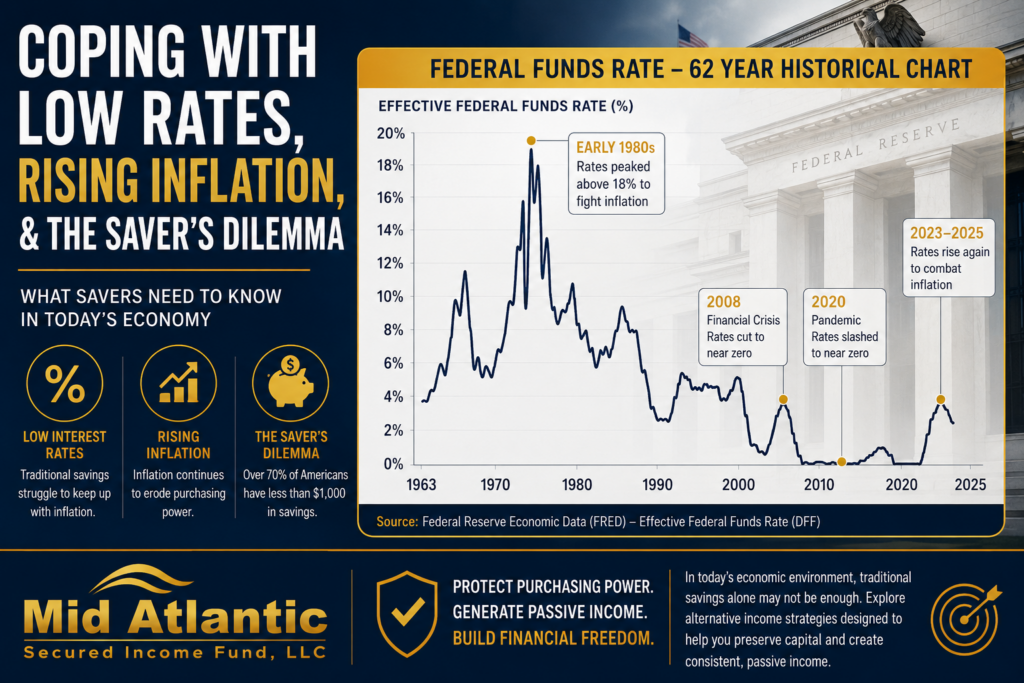
Recent years have reminded investors that traditional diversification does not always behave as expected. Federal Reserve tightening cycles can pressure both equities and conventional fixed income at the same time. The FDIC’s insured deposit framework protects cash balances only within defined limits and does not solve the reinvestment problem when yields fail to keep pace with inflation or income needs.
At the same time, longer-duration bonds can be more sensitive to rate changes than many investors expect. The result is a more serious search for income-oriented allocations that are less correlated to public markets and less exposed to duration risk. That has drawn more attention to private credit, particularly strategies backed by hard assets and structured around current income rather than appreciation.
This is where discipline matters. Not all private credit is preservation-focused. Some segments rely on unsecured lending, thin covenants, or aggressive leverage. A true preservation-first approach usually starts with collateral, legal protection, and a margin of safety at origination.
The role of asset-backed private credit in capital preservation
Real estate-backed private credit can be compelling within a capital preservation framework because it combines contractual loan payments with tangible collateral. That does not eliminate risk, but it changes the nature of the risk. Instead of depending primarily on market sentiment or future valuation expansion, the investment thesis can rest on borrower performance, collateral value, and loan structure.
Senior secured lending is especially relevant. First-position mortgage loans sit at the top of the repayment hierarchy relative to junior debt or equity. If a loan is underwritten conservatively, the collateral value may provide a meaningful buffer against loss. In private real estate credit, loan-to-value ratios are one of the most important indicators of that buffer.
For example, a lender originating short-term first-position loans at 65% to 75% loan-to-value starts with embedded protection that higher-leverage structures simply do not have. If market values soften or a project encounters delays, there is still collateral equity ahead of the lender’s principal. That does not guarantee a positive outcome in every scenario, but it materially improves the odds of capital recovery.
Data from sources such as the Mortgage Bankers Association and Federal Reserve have also reinforced a broader point. Credit outcomes are driven less by asset class labels than by underwriting discipline, leverage, liquidity, and sponsor quality. In other words, the structure often matters more than the story.
How to evaluate capital preservation investment strategies in practice
Preservation-minded investors should approach any income opportunity with a credit lens first and a return lens second. That means asking what protects principal before asking what boosts yield.
Start with collateral quality. In a real estate-backed strategy, the type, location, condition, and marketability of the underlying asset matter. Residential and commercial properties can both support secured lending, but the collateral should be understandable and independently valued. Investors should also pay attention to whether the loan is backed by completed assets, transitional properties, or construction projects, since each carries different execution risk.
Next, review loan structure. First-position security, personal or corporate guarantees where appropriate, title protections, insurance requirements, and clearly defined maturity terms all support a stronger credit profile. Shorter-duration loans may also reduce exposure to changing rate environments and shifting market conditions.
Underwriting discipline is equally important. Conservative loan-to-value ratios, verification of borrower exit strategy, sponsor experience, budget controls, and third-party due diligence all matter. A high current income strategy is only as durable as its underwriting. If a manager cannot explain exactly how downside is assessed, the yield should not be trusted.
Track record deserves close attention, but it should be interpreted carefully. Investors should ask not only about gross returns, but also realized losses, impairment history, default management, and distribution consistency. In a preservation-oriented strategy, operational execution during stress periods often reveals more than performance during favorable markets.
Finally, understand liquidity and alignment. Private funds are not the same as traded securities. They may offer lower volatility in part because they are not continuously repriced by the market, but that also means investors should be comfortable with the investment term and redemption framework. The trade-off can be worthwhile when the underlying assets are short duration, income-producing, and managed with strict risk controls, but the structure must fit the investor’s liquidity needs.
What investors often get wrong about safety
One common mistake is assuming that lower stated volatility automatically means lower risk. It depends on what sits underneath the return stream. Another is equating familiarity with safety. Publicly traded bonds, dividend equities, and bank products may feel familiar, but familiarity does not prevent principal erosion when rates rise, spreads widen, or equity valuations compress.
A better way to think about safety is to focus on risk of permanent loss, income reliability, and the existence of asset coverage. Some investments appear stable because they defer recognition of risk. Others are genuinely more resilient because they were structured with creditor protections from the start.
This is why many sophisticated investors now separate the concepts of growth capital and preservation capital more explicitly. Growth capital may tolerate higher volatility and a longer time horizon. Preservation capital is expected to defend principal, generate current income, and remain grounded in conservative underwriting standards.
Where real estate-backed private debt fits in a broader allocation
For accredited investors, real estate-backed private debt can serve as a middle ground between low-yield cash alternatives and higher-volatility market exposure. It may fit particularly well for investors seeking monthly or periodic income, self-directed IRA allocations, or portfolio ballast alongside more growth-oriented holdings.
The appeal is straightforward. Properly structured private debt can offer a combination of high current income, lower correlation to public markets, and collateral-backed downside protection. But selectivity is critical. The manager’s process matters as much as the asset class. Conservative credit culture, direct origination, active servicing, and disciplined workout capabilities all affect outcomes.
Mid Atlantic Secured Income Fund reflects this preservation-first philosophy by focusing on short-term first-position mortgage lending backed by real estate collateral and conservative underwriting standards. That kind of approach will not appeal to investors chasing the highest possible return in a risk-on cycle. It is designed for a different objective: protecting capital while pursuing dependable income.
No investment strategy is without trade-offs. Private credit is less liquid than cash and less transparent than exchange-traded instruments on a minute-by-minute basis. Real estate values can change. Borrowers can default. Markets can slow. The relevant question is whether those risks are identified early, underwritten conservatively, and managed with enough structural protection to preserve principal through normal market stress.
For investors who take that question seriously, capital preservation is not passive. It is an active process of selecting structures where collateral, underwriting, and discipline do the heavy lifting long before a loan is funded. That is often where confidence begins.