The Shift Away From Traditional Investing Models
For decades, traditional portfolio construction revolved around a relatively straightforward framework: public equities for growth and bonds for stability.
That framework is now under increasing pressure.
Persistent inflation concerns, rising interest rates, geopolitical uncertainty, elevated equity valuations, and shifting global liquidity conditions have forced both institutional and individual investors to rethink how portfolios are constructed.
In response, alternative investment strategies have moved from the periphery of portfolio management into the mainstream of institutional capital allocation.
What was once largely reserved for pension funds, sovereign wealth funds, endowments, and ultra-high-net-worth investors is increasingly becoming accessible to accredited investors seeking:
- diversification,
- downside awareness,
- passive income generation,
- inflation resilience,
- and reduced dependence on public market performance.
According to Preqin, global alternative assets under management are projected to exceed $24 trillion by 2028, reflecting one of the most significant structural shifts in modern investing.
This evolution is not simply about chasing higher returns.
It reflects a broader rethinking of:
- portfolio durability,
- cash flow consistency,
- risk-adjusted performance,
- and long-term wealth preservation.
What Are Alternative Investment Strategies?
Direct Answer
Alternative investment strategies are portfolio approaches that allocate capital to assets outside traditional publicly traded stocks, bonds, and cash equivalents.
Alternative investments may include:
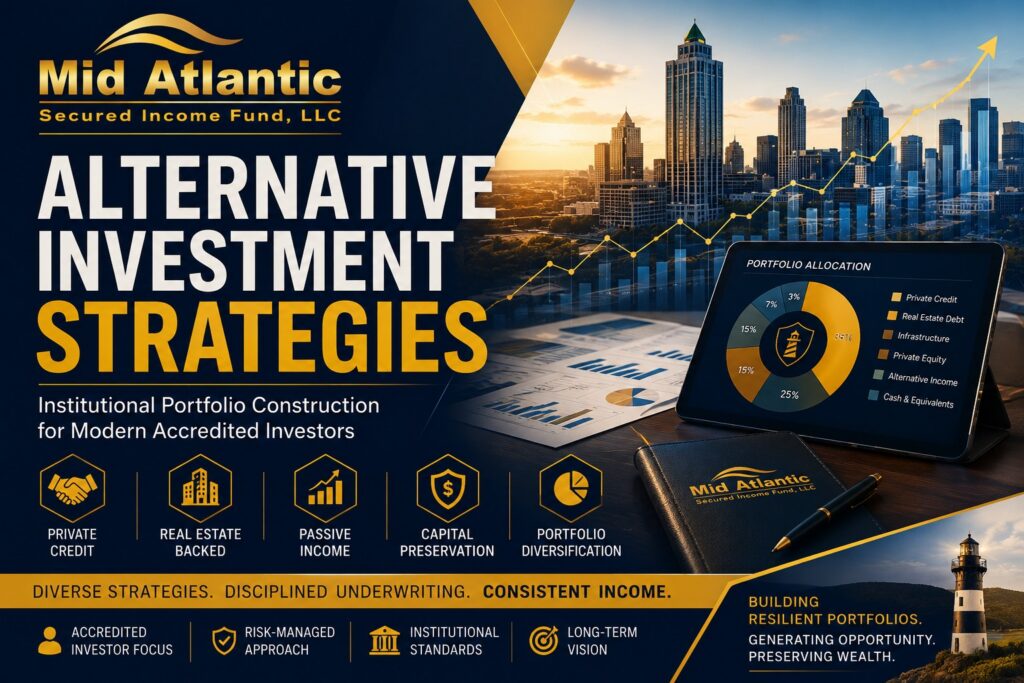
- private credit,
- real estate debt,
- private equity,
- infrastructure,
- hedge strategies,
- asset-backed lending,
- private real estate,
- commodities,
- and other non-traditional investments.
Institutional investors often use alternative investments to improve diversification, generate passive income, reduce public market correlation, and enhance long-term portfolio resilience.
Why Alternative Investments Have Expanded Rapidly
The Institutionalization of Alternatives
Alternative investments were historically associated with exclusivity and limited access.
That dynamic has changed significantly over the past two decades.
Several macroeconomic and structural developments accelerated the growth of alternatives:
1. Lower Expected Public Market Returns
Many institutional research firms, including BlackRock and Goldman Sachs, have projected more muted long-term public equity returns compared to historical averages.
2. Increased Market Volatility
Public markets have become increasingly sensitive to:
- central bank policy,
- inflation data,
- geopolitical events,
- and concentrated technology-sector performance.
3. Demand for Income
Investors seeking predictable income streams increasingly explore private credit and alternative yield-oriented investments.
4. Search for Diversification
Alternative investments may behave differently from traditional stocks and bonds during certain market environments.
5. Expansion of Private Markets
Private markets have grown substantially as companies remain private longer and institutional capital increasingly flows into non-public investments.
Understanding Private Markets
Public Markets vs Private Markets
Public Markets
Public markets include securities traded on exchanges such as:
- the New York Stock Exchange,
- NASDAQ,
- and public bond markets.
These investments offer:
- daily liquidity,
- broad accessibility,
- and transparent pricing.
Private Markets
Private markets involve investments that are not publicly traded.
These may include:
- private credit,
- private equity,
- real estate lending,
- infrastructure financing,
- and specialty finance strategies.
Private market investments are often characterized by:
- longer investment horizons,
- reduced liquidity,
- negotiated structures,
- and institutionally driven underwriting processes.
What Is Private Credit?
Direct Answer
Private credit is a form of non-bank lending where investors provide capital directly to borrowers through privately negotiated debt investments rather than traditional public bond markets or commercial bank financing.
Private credit strategies may include:
- bridge lending,
- commercial real estate lending,
- construction lending,
- asset-backed lending,
- direct corporate lending,
- receivables financing,
- and specialty lending strategies.
Why Private Credit Became One of the Fastest-Growing Asset Classes
Following the 2008 financial crisis, banking regulations tightened significantly.
As traditional banks reduced lending activity in certain segments, private lenders increasingly filled the financing gap.
According to research from Apollo Global Management and the International Monetary Fund, private credit has evolved into a major institutional asset class.
Several dynamics continue driving growth:
|
Structural Driver |
Impact |
|---|---|
|
Bank retrenchment |
Increased need for private lenders |
|
Higher interest rates |
More attractive yield potential |
|
Investor demand for income |
Greater capital inflows |
|
Real estate financing gaps |
Expanded private lending opportunities |
|
Institutional adoption |
Increased market maturity |
How Institutional Investors Use Alternative Investment Strategies
Institutional investors rarely view alternatives as speculative add-ons.
Instead, they often integrate alternatives strategically into broader portfolio construction frameworks.
Common Institutional Objectives
Income Generation
Private credit and real estate debt strategies may generate contractual cash flow.
Diversification
Alternative assets may exhibit lower correlation to public markets.
Inflation Protection
Certain real asset-oriented investments may provide inflation resilience.
Volatility Reduction
Some alternative investments are less exposed to daily public market fluctuations.
Portfolio Resilience
Institutions increasingly focus on constructing portfolios capable of navigating multiple economic regimes.
Real Estate-Backed Alternative Investments
Why Real Estate Debt Has Attracted Institutional Capital
Real estate-backed lending occupies an increasingly important role within alternative investment strategies.
Unlike equity real estate ownership, debt-oriented real estate investments often prioritize:
- collateral protection,
- defined repayment structures,
- seniority in the capital stack,
- and recurring interest income.
This distinction becomes especially important during uncertain economic environments.
Senior secured lending structures are generally designed to provide multiple layers of downside awareness through:
- underwriting standards,
- loan-to-value thresholds,
- collateralization,
- and repayment priority.
Are Alternative Investments Safer Than Stocks?
Direct Answer
Alternative investments are not inherently safer than stocks, but certain alternative investment strategies may offer different risk-return characteristics, reduced volatility, contractual income structures, or lower public market correlation depending on the asset class and underwriting quality.
Risk varies substantially across:
- private credit,
- private equity,
- hedge strategies,
- real estate debt,
- infrastructure,
- and other alternative investments.
Investors should evaluate:
- liquidity,
- leverage,
- underwriting discipline,
- diversification,
- manager experience,
- and economic sensitivity.
Risks of Alternative Investment Strategies
Understanding the Trade-Offs
Sophisticated investing is not about eliminating risk entirely.
It is about understanding risk.
Alternative investments carry unique considerations that investors must evaluate carefully.
Liquidity Risk
Many alternatives are less liquid than publicly traded securities.
Credit Risk
Borrowers may default on obligations.
Economic Risk
Macroeconomic downturns may impact collateral values and repayment ability.
Manager Risk
Execution quality and underwriting discipline vary significantly between firms.
Valuation Risk
Private investments may not have continuously transparent market pricing.
Regulatory Risk
Changes in financial regulation can affect lending and private market activity.
Why Diversification Still Matters
The Modern Diversification Problem
Many investors mistakenly assume diversification simply means owning multiple stocks.
However, true diversification involves exposure to different:
- asset classes,
- economic sensitivities,
- income sources,
- and market drivers.
This has become increasingly important in periods where stock and bond correlations rise simultaneously.
Institutional portfolio construction increasingly incorporates:
- private credit,
- real assets,
- alternative income streams,
- and asset-backed investments.
Inflation and Alternative Investments
Inflation Changed Investor Priorities
The post-pandemic inflation surge significantly altered investor behavior.
According to the U.S. Bureau of Labor Statistics, inflation reached levels not seen in decades following unprecedented monetary stimulus and supply chain disruptions.
Inflation erodes purchasing power over time.
This has driven investor interest toward:
- income-producing investments,
- floating-rate credit,
- real assets,
- and alternative portfolio strategies.
Behavioral Finance and Alternative Investing
Investor Psychology Shapes Outcomes
Behavioral finance research consistently demonstrates that investor behavior often damages long-term returns.
According to studies referenced by Morningstar, emotional market timing remains one of the largest drivers of investor underperformance.
Alternative investment strategies may help certain investors reduce:
- reactionary trading,
- daily portfolio anxiety,
- and excessive exposure to public market volatility.
This does not eliminate risk.
However, portfolio structure can influence investor behavior and long-term decision-making.
Alternative Investments and Retirement Planning
Retirement Portfolios Are Evolving
Retirement planning today involves significantly different challenges than previous generations faced.
Key concerns include:
- longevity risk,
- inflation risk,
- sequence-of-returns risk,
- healthcare inflation,
- and income sustainability.
As a result, many accredited investors explore alternative investment strategies that may provide:
- passive income,
- diversification,
- and reduced dependence on traditional bond markets.
Investors researching retirement diversification strategies may also explore:
How Accredited Investors Use Alternative Investments
Accredited investors often integrate alternatives into portfolios for several reasons:
Common Objectives
Passive Income
Private credit strategies may provide recurring income distributions.
Portfolio Diversification
Alternative assets may diversify exposure beyond traditional markets.
Inflation Resilience
Real asset-oriented investments may offer inflation sensitivity advantages.
Long-Term Capital Strategy
Many alternatives are designed for longer-term investing horizons.
Institutional Access
Private markets historically favored institutions and ultra-high-net-worth investors.
Institutional Portfolio Construction Principles
How Institutions Think About Risk
Institutional investors generally focus less on maximizing short-term performance and more on:
- risk-adjusted returns,
- portfolio durability,
- liquidity management,
- and long-term consistency.
Several institutional principles increasingly influence accredited investor portfolios:
|
Institutional Principle |
Objective |
|---|---|
|
Diversification |
Reduce concentration risk |
|
Cash Flow Management |
Improve income stability |
|
Downside Awareness |
Preserve capital |
|
Long-Term Allocation |
Reduce emotional decision-making |
|
Risk Budgeting |
Align risk with objectives |
Alternative Investment Strategies in a Higher Rate Environment
Interest Rates Changed Portfolio Construction
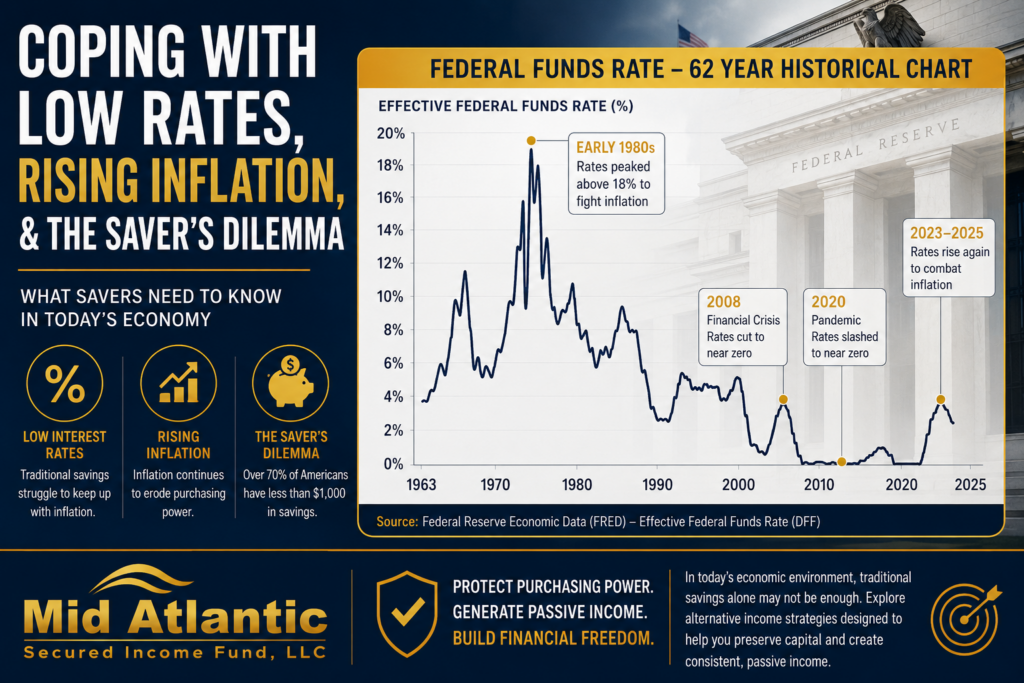
The rapid increase in interest rates between 2022 and 2025 reshaped multiple asset classes simultaneously.
Higher rates impacted:
- public equities,
- commercial real estate,
- mortgage markets,
- bond pricing,
- and private lending spreads.
However, certain private credit strategies benefited from:
- higher contractual yields,
- floating-rate structures,
- and stronger income potential.
This dynamic increased investor interest in private lending and asset-backed credit.
The Rise of Income-Focused Investing
Investors Increasingly Prioritize Cash Flow
One of the most important shifts in modern investing is the increasing emphasis on cash flow.
Many investors now prioritize:
- recurring income,
- portfolio stability,
- and downside management.
This is particularly relevant for:
- retirees,
- business owners,
- and investors seeking reduced reliance on asset liquidation.
Private credit and real estate-backed lending strategies often appeal to income-oriented investors because they may generate contractual interest payments rather than relying exclusively on market appreciation.
The Role of Self-Directed IRAs
Alternative Investments Inside Retirement Accounts
Self-directed IRAs allow eligible investors to hold certain alternative assets within tax-advantaged retirement structures.
Depending on custodial rules and regulations, these may include:
- private funds,
- real estate,
- private credit,
- and other alternative investments.
Additional educational resources:
- Knowledge Hub
- Private Credit Products
- Passive Income Investment Calculator
- Why Invest in Mid Atlantic Fund
How The Mid Atlantic Fund Fits Into the Alternative Investment Landscape
The Mid Atlantic Secured Income Fund operates within the growing private credit and real estate-backed lending ecosystem that has become increasingly important in institutional portfolio construction.
The broader educational focus surrounding the fund centers on:
- income-oriented investing,
- alternative portfolio diversification,
- asset-backed lending,
- and disciplined underwriting principles.
This institutional approach aligns with broader market trends emphasizing:
- downside awareness,
- contractual income,
- and portfolio resilience.
Final Thoughts
Alternative investment strategies have evolved from niche institutional allocations into a central component of modern portfolio construction.
As investors navigate:
- inflation uncertainty,
- changing interest rate environments,
- public market volatility,
- and longer retirement horizons,
many are increasingly looking beyond traditional portfolios toward:
- private credit,
- real estate-backed lending,
- alternative income strategies,
- and institutional-style diversification frameworks.
The future of investing increasingly appears less dependent on a single asset class and more focused on building resilient portfolios capable of navigating multiple economic environments over time.
Frequently Asked Questions (FAQ)
What are alternative investment strategies?
Alternative investment strategies involve allocating capital to assets outside traditional publicly traded stocks and bonds, including private credit, real estate debt, private equity, infrastructure, and other private market investments.
Why do investors use alternative investments?
Investors often use alternative investments for diversification, passive income generation, inflation protection, and reduced correlation to traditional public markets.
What is private credit investing?
Private credit investing involves directly lending capital to borrowers outside traditional bank and public bond markets through privately negotiated debt investments.
Are alternative investments risky?
Yes. Alternative investments carry risks including illiquidity, borrower default, economic downturns, valuation uncertainty, and manager execution risk.
How do accredited investors use private credit?
Accredited investors often use private credit strategies to seek passive income, diversification, and exposure to asset-backed lending opportunities.
What is a self-directed IRA?
A self-directed IRA is a retirement account that permits eligible alternative investments such as real estate, private credit, and private funds depending on custodial rules.
Why are institutions increasing alternative allocations?
Institutions increasingly allocate to alternatives to improve diversification, generate income, reduce public market dependence, and build more resilient portfolios.