
Private Credit, Real Estate Debt & Asset-Backed Income Strategies Explained
For decades, traditional retirement and income-focused investors largely depended on publicly traded stocks, bonds, dividend portfolios, certificates of deposit, and savings accounts to generate recurring income.
But the investment landscape has changed dramatically.
Persistent inflation, elevated interest rate volatility, regional banking instability, and increased public market uncertainty have caused many sophisticated investors to rethink traditional income strategies.
As a result, alternative income-oriented investments — particularly private credit and real estate-backed lending — have experienced substantial growth among institutional investors, family offices, accredited investors, and retirement-focused portfolios.
According to Preqin, the global private credit market has surpassed $1.7 trillion in assets under management and continues expanding rapidly as investors seek income, diversification, and downside protection outside traditional public markets.
This shift reflects a broader reality:
many investors are increasingly prioritizing predictable cash flow, asset-backed strategies, and lower correlation to public market volatility.
That is where passive income investing through private credit and real estate-backed lending enters the conversation.
What Is Passive Income Investing?
Direct Answer
Passive income investing refers to investment strategies designed to generate recurring income streams with limited day-to-day operational involvement from the investor.
Common passive income investments include:
- dividend-paying assets,
- bonds,
- real estate,
- private credit,
- debt funds,
- REITs,
- and income-focused alternative investments.
The goal is often to generate consistent cash flow while preserving long-term capital.
Why Passive Income Matters More in Today’s Market
Inflation Has Changed Retirement Planning
Inflation has materially reshaped how investors think about income generation.
Over the last several years, inflationary pressures have increased costs across:
- housing,
- healthcare,
- insurance,
- food,
- transportation,
- and retirement living expenses.
According to the Bureau of Labor Statistics, cumulative inflation since 2020 has significantly impacted purchasing power for retirees and income-focused households.
This creates a critical challenge:
traditional low-yield investments may struggle to keep pace with inflation over time.
As a result, investors increasingly seek:
- higher income potential,
- diversified cash-flow strategies,
- and investments backed by tangible collateral.
The Rise of Private Credit Investing
Private Credit Has Become One of the Fastest-Growing Alternative Asset Classes
Private credit refers to non-bank lending strategies where capital is deployed directly into privately negotiated loans.
These loans may include:
- real estate-backed lending,
- bridge loans,
- construction financing,
- acquisition lending,
- receivable financing,
- and commercial lending solutions.
According to BlackRock and Preqin research, private credit continues attracting institutional capital because investors value:
- income generation,
- floating-rate exposure,
- diversification,
- and lower correlation to traditional equity markets.
Unlike publicly traded bonds, many private credit investments are not subject to the same degree of daily market pricing volatility.
How Passive Income Strategies Work in Private Credit
Understanding Income Generation
Private credit and debt-focused investment strategies typically generate income through interest payments made by borrowers.
In many cases, investors participate in portfolios backed by:
- real estate collateral,
- commercial assets,
- receivables,
- or other secured lending structures.
This differs substantially from speculative equity investing.
Instead of relying entirely on appreciation, many income-oriented private credit strategies prioritize:
- recurring interest income,
- contractual payments,
- collateral-backed structures,
- and capital preservation frameworks.
What Is Real Estate-Backed Lending?
Direct Definition
Real estate-backed lending refers to loans secured by real property collateral.
Examples may include:
- residential developments,
- multifamily housing,
- commercial properties,
- bridge financing,
- acquisition financing,
- or construction-related lending.
The collateral component can provide an additional layer of downside protection compared to unsecured lending structures.
Why Sophisticated Investors Are Exploring Alternative Income Strategies
Public Markets Have Become Increasingly Volatile
Over the last decade, many investors have experienced:
- interest rate shocks,
- inflation concerns,
- banking instability,
- bond market drawdowns,
- and equity market volatility.
Historically, many investors viewed traditional fixed income investments as conservative income generators.
However, recent bond market volatility demonstrated that even investment-grade bond portfolios can experience material price declines during aggressive interest rate cycles.
As a result, sophisticated investors increasingly explore:
- alternative income sources,
- private credit exposure,
- and asset-backed lending strategies.
Passive Income vs Traditional Fixed Income
Key Differences
|
Traditional Fixed Income |
Private Credit & Alternative Income |
|---|---|
|
Publicly traded bonds |
Privately negotiated loans |
|
Subject to market pricing volatility |
Often less correlated to daily market swings |
|
Lower yields historically |
Potentially higher income potential |
|
Interest rate sensitivity |
Floating-rate structures possible |
|
Institutional bond markets |
Asset-backed lending opportunities |
This does not mean private credit is risk-free.
All investments carry risks.
However, many investors increasingly view alternative income strategies as potential portfolio diversifiers.
Why Asset-Backed Investing Matters
Tangible Collateral Can Change Risk Profiles
One reason many sophisticated investors favor real estate-backed lending strategies is collateral support.
Asset-backed investments may include:
- first-lien positions,
- secured lending structures,
- real property collateral,
- and contractual repayment obligations.
This differs materially from unsecured or speculative investments.
The emphasis often shifts toward:
- capital preservation,
- downside mitigation,
- and recurring income generation.
How Rising Interest Rates Impact Passive Income Investments
Interest Rates Changed the Investment Landscape
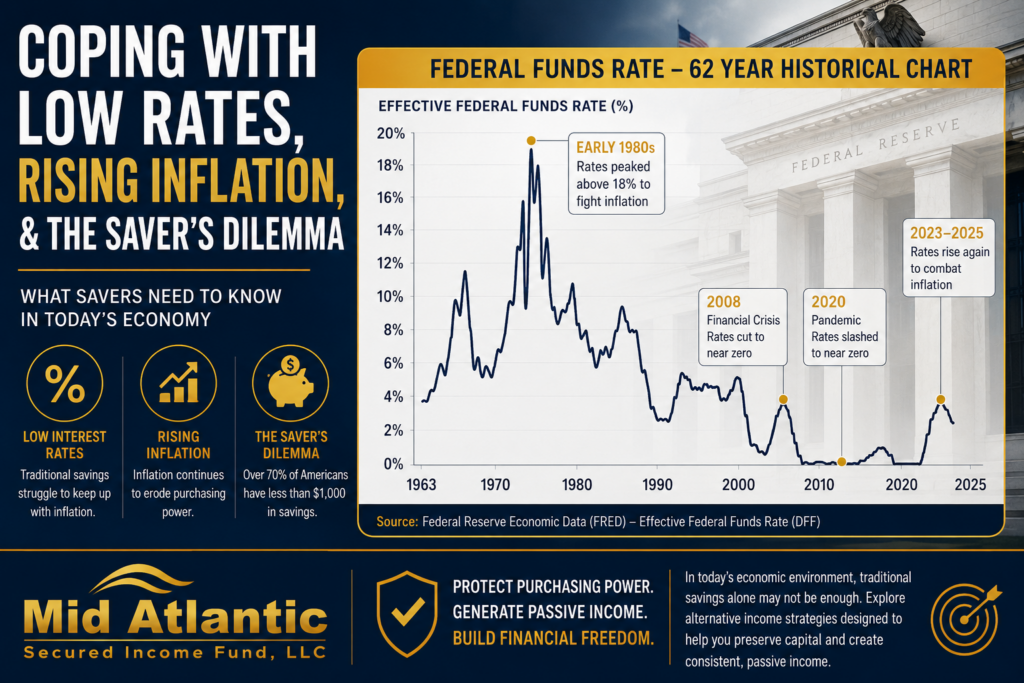
The Federal Reserve’s aggressive rate increases over recent years reshaped both public and private markets.
Higher rates impacted:
- commercial lending,
- mortgage activity,
- bond pricing,
- real estate financing,
- and investor portfolio construction.
At the same time, many private credit strategies benefited from:
- wider lending spreads,
- increased borrower demand,
- and reduced traditional bank competition.
This has helped drive increased institutional interest in private lending markets.
Why Alternative Investments Continue Growing
According to institutional research from McKinsey and BlackRock, alternative investments continue expanding globally because investors increasingly seek:
- diversification,
- inflation resilience,
- yield enhancement,
- and differentiated sources of return.
Alternative investments now represent a core allocation for many institutional portfolios.
This includes:
- pension funds,
- family offices,
- endowments,
- insurance companies,
- and high-net-worth investors.
Understanding Risk in Passive Income Investing
No Investment Is Risk-Free
It is important to understand that all investments involve risk.
Potential risks may include:
- borrower defaults,
- economic downturns,
- interest rate changes,
- liquidity limitations,
- real estate market shifts,
- and broader macroeconomic pressures.
Sophisticated investors often evaluate:
- collateral quality,
- underwriting discipline,
- market selection,
- sponsor experience,
- and portfolio diversification.
Risk management remains central to long-term investment outcomes.
Why Geography Matters in Real Estate-Backed Lending
The Southeast Growth Story
Regional economic growth trends increasingly influence lending opportunities.
Markets experiencing:
- population growth,
- infrastructure expansion,
- housing demand,
- and business migration
may create stronger lending demand over time.
The Southeast United States — particularly markets like Atlanta — continues attracting:
- businesses,
- investors,
- entrepreneurs,
- and institutional capital.
These trends influence both real estate development and private lending opportunities.
How Accredited Investors Use Passive Income Strategies
Direct Answer
Many accredited investors use passive income investments to pursue:
- diversification,
- recurring cash flow,
- retirement income,
- inflation mitigation,
- and reduced reliance on traditional public markets.
Common strategies may include:
- private credit,
- real estate debt funds,
- alternative income investments,
- SDIRA allocations,
- and asset-backed lending exposure.
Passive Income and Retirement Planning
Income Stability Matters in Retirement
Many retirement-focused investors increasingly prioritize:
- cash-flow consistency,
- capital preservation,
- inflation protection,
- and portfolio diversification.
Passive income strategies may help supplement:
- retirement accounts,
- pension income,
- Social Security,
- and traditional investment portfolios.
This has contributed to rising interest in:
- SDIRA investing,
- private credit allocations,
- and alternative income-producing assets.
Why Investors Are Paying Attention to Private Lending
Traditional Banks Are Pulling Back
Regional banking stress and tighter credit conditions have created financing gaps across commercial lending markets.
According to Federal Reserve lending surveys, banks have tightened commercial lending standards significantly in recent years.
This creates opportunities for:
- private lenders,
- asset-backed credit strategies,
- and alternative financing providers.
As traditional credit availability contracts, private capital increasingly fills the gap.
The Importance of Due Diligence
Sophisticated investors typically evaluate:
- underwriting standards,
- collateral structures,
- geographic concentration,
- sponsor experience,
- loan-to-value metrics,
- and risk management frameworks.
Long-term investment success often depends on disciplined portfolio construction and risk oversight.
Why Educational Investing Content Matters
Modern investors increasingly seek:
- transparency,
- data-backed analysis,
- educational resources,
- and institutional-quality research.
This is particularly important in:
- alternative investments,
- private credit,
- retirement planning,
- and income-focused investing.
Understanding how investments function beneath the surface matters more than ever.
Conclusion
The investment landscape continues evolving rapidly.
Inflation, market volatility, higher interest rates, and tighter lending conditions have fundamentally reshaped how many investors think about passive income and portfolio diversification.
As a result, private credit and asset-backed income strategies continue gaining attention among sophisticated investors seeking:
- recurring cash flow,
- downside awareness,
- and differentiated investment exposure.
Real estate-backed lending and alternative income strategies are increasingly becoming part of broader conversations around:
- retirement income,
- diversification,
- capital preservation,
- and long-term financial planning.
For investors exploring passive income opportunities, understanding how private credit and asset-backed lending work is becoming increasingly important in today’s economic environment.
FAQ Section
What is passive income investing?
Passive income investing refers to strategies designed to generate recurring income streams with limited operational involvement from the investor.
What is private credit investing?
Private credit investing involves privately negotiated lending transactions outside traditional public bond markets.
Are private credit investments safer than stocks?
Private credit investments may offer lower correlation to public equity volatility and may include collateral-backed structures, but all investments carry risk.
How do real estate debt funds generate income?
Real estate debt funds typically generate income through interest payments from borrowers secured by real estate collateral.
Why are investors interested in alternative income strategies?
Many investors seek diversification, inflation mitigation, recurring income, and reduced reliance on traditional public market volatility.