For decades, many of the most attractive investment opportunities in the world were largely inaccessible to the average investor.
Private credit funds. Institutional real estate debt strategies. Alternative income investments. Specialty finance. Private equity. Structured lending.
These opportunities historically existed behind the walls of pension funds, insurance companies, endowments, family offices, and ultra-high-net-worth investors.
Today, accredited investors increasingly have access to portions of these private markets.
As public markets become more volatile and traditional stock-and-bond portfolios face new challenges from inflation, interest-rate shifts, and economic uncertainty, sophisticated investors are looking beyond conventional investment frameworks.
The rise of private markets and alternative investments is not simply a trend.
It represents a structural transformation in how wealth is being built, preserved, diversified, and protected.
What Is an Accredited Investor?
Direct Answer
An accredited investor is an individual or entity that meets specific financial criteria established by the U.S. Securities and Exchange Commission (SEC), allowing access to certain private investment opportunities not registered with the SEC.
Accredited investor status is intended to identify investors who may possess the financial sophistication, resources, or ability to withstand higher investment risks associated with private offerings.
Accredited Investor Requirements
Under current SEC guidelines, an individual may qualify as an accredited investor if they meet one or more of the following criteria:
Income-Based Qualification
An individual generally qualifies if they have:
- earned income exceeding $200,000 individually in each of the last two years,
- or joint income exceeding $300,000 with a spouse or spousal equivalent,
- with a reasonable expectation of maintaining that income level.
Net Worth Qualification
An investor may also qualify if they possess:
- a net worth exceeding $1 million,
- either individually or jointly with a spouse,
- excluding the value of a primary residence.
Professional Certifications
Certain financial professionals may qualify through recognized credentials, including:
- Series 7,
- Series 65,
- and Series 82 licenses.
Entity-Based Qualification
Certain entities may qualify based on:
- asset size,
- ownership structure,
- or institutional status.
Why Accredited Investor Status Matters
Accredited investor status provides access to segments of the market unavailable through most traditional brokerage accounts.
This may include:
- private credit funds,
- real estate debt investments,
- private equity,
- venture capital,
- hedge funds,
- specialty finance,
- structured lending,
- and institutional alternative investments.
For sophisticated investors, these opportunities may offer:
- diversification,
- contractual income,
- inflation resilience,
- and lower correlation to public markets.
The Evolution of Private Markets
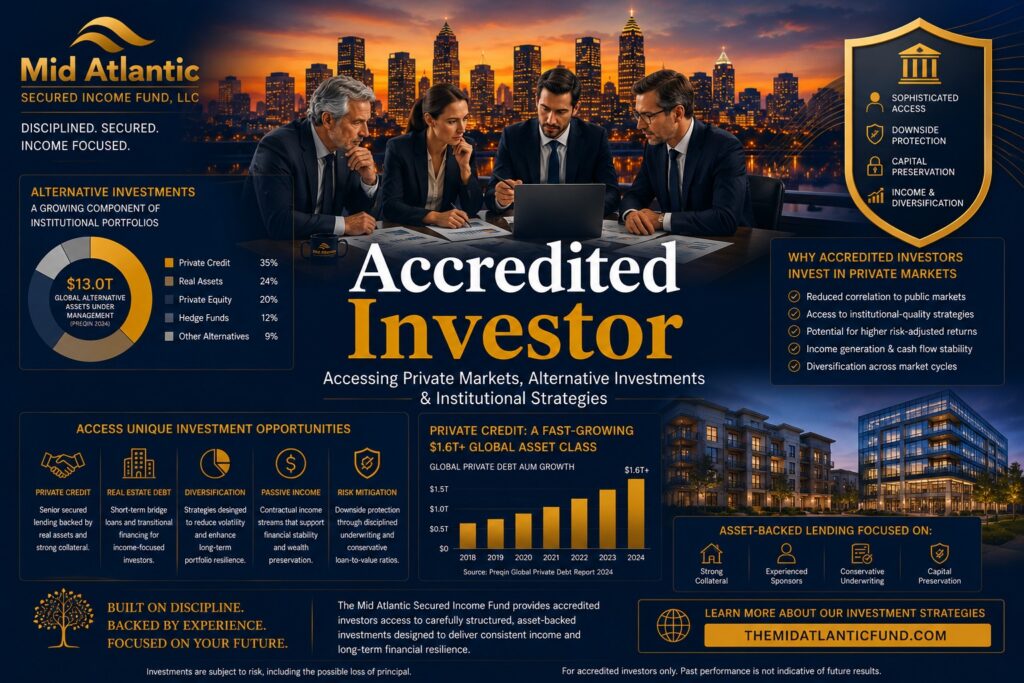
Private markets have grown dramatically over the past two decades.
According to Preqin and BlackRock research, global alternative investment assets have expanded into the trillions of dollars, driven largely by institutional demand.
Several factors are contributing to this growth:
Public Market Volatility
Investors increasingly seek strategies less dependent on daily stock market fluctuations.
Yield Compression
Traditional fixed-income investments have struggled to provide attractive real yields during inflationary periods.
Institutional Portfolio Shifts
Large pension funds and endowments have steadily increased allocations to alternatives, including private credit and real assets.
Inflation Concerns
Income-generating alternative assets may offer stronger inflation sensitivity compared to traditional bonds.
Why Sophisticated Investors Are Moving Beyond Traditional Portfolios
For decades, the classic 60/40 portfolio model dominated wealth management.
But modern markets have introduced new challenges:
- persistent inflation,
- elevated interest rates,
- increased volatility,
- geopolitical instability,
- and changing correlations between stocks and bonds.
Sophisticated investors increasingly recognize the importance of:
- diversification beyond public equities,
- alternative income streams,
- downside protection,
- and real asset exposure.
What Are Alternative Investments?
Direct Answer
Alternative investments are non-traditional assets that exist outside publicly traded stocks, bonds, and cash equivalents.
Examples include:
- private credit,
- real estate debt,
- private equity,
- infrastructure,
- hedge funds,
- specialty finance,
- and asset-backed lending.
Alternative investments may offer:
- diversification,
- contractual income,
- inflation resilience,
- and differentiated return drivers.
Understanding Private Credit
Private credit has emerged as one of the fastest-growing alternative asset classes globally.
What Is Private Credit?
Private credit refers to non-bank lending arrangements where investors provide capital directly to borrowers outside traditional public bond markets.
Strategies may include:
- bridge lending,
- senior secured lending,
- construction financing,
- receivables financing,
- real estate-backed lending,
- and specialty commercial finance.
Why Accredited Investors Use Private Credit
1. Income Generation
Private credit investments often generate contractual interest income.
This may appeal to:
- retirees,
- family offices,
- passive income investors,
- and wealth preservation strategies.
2. Senior Secured Structures
Many private lending strategies operate in senior lien positions, potentially improving downside protection.
3. Asset-Backed Exposure
Collateral-backed structures tied to real estate or other hard assets may reduce certain forms of investment risk.
4. Lower Public Market Correlation
Private credit may exhibit lower correlation to stock market volatility than many traditional investments.
Are Alternative Investments Risky?
Direct Answer
Alternative investments can involve significant risks, including illiquidity, underwriting risk, market risk, and operational complexity. However, when structured conservatively, certain alternative investments may improve diversification and risk-adjusted portfolio resilience.
Risk levels vary widely depending on:
- investment structure,
- leverage,
- collateral quality,
- manager experience,
- and economic conditions.
Understanding Risk in Private Markets
Sophisticated investors focus heavily on understanding:
- downside risk,
- capital structure,
- underwriting quality,
- and liquidity terms.
Private investments are not inherently safer or riskier than public investments.
What matters is:
- structure,
- discipline,
- and alignment.
The Institutional Investment Framework
Institutional investors rarely rely on a single asset class.
Instead, portfolios are often designed around:
|
Objective |
Institutional Approach |
|---|---|
|
Income Generation |
Private credit, dividend strategies |
|
Inflation Mitigation |
Real assets, real estate |
|
Diversification |
Alternative allocations |
|
Downside Protection |
Senior secured positioning |
|
Long-Term Growth |
Multi-asset exposure |
|
Volatility Reduction |
Lower correlation strategies |
Why Wealthy Investors Prioritize Diversification
Diversification remains one of the most powerful risk management tools available.
True diversification extends beyond simply owning many stocks.
Sophisticated investors diversify across:
- asset classes,
- income streams,
- geographies,
- durations,
- liquidity profiles,
- and economic sensitivities.
Real Estate and Accredited Investors
Real estate remains a cornerstone of many institutional portfolios.
Accredited investors increasingly gain exposure through:
- real estate debt funds,
- bridge lending,
- construction financing,
- and asset-backed lending strategies.
Many investors prefer debt exposure rather than direct property ownership because it may provide:
- contractual income,
- reduced operational burden,
- and senior secured positioning.
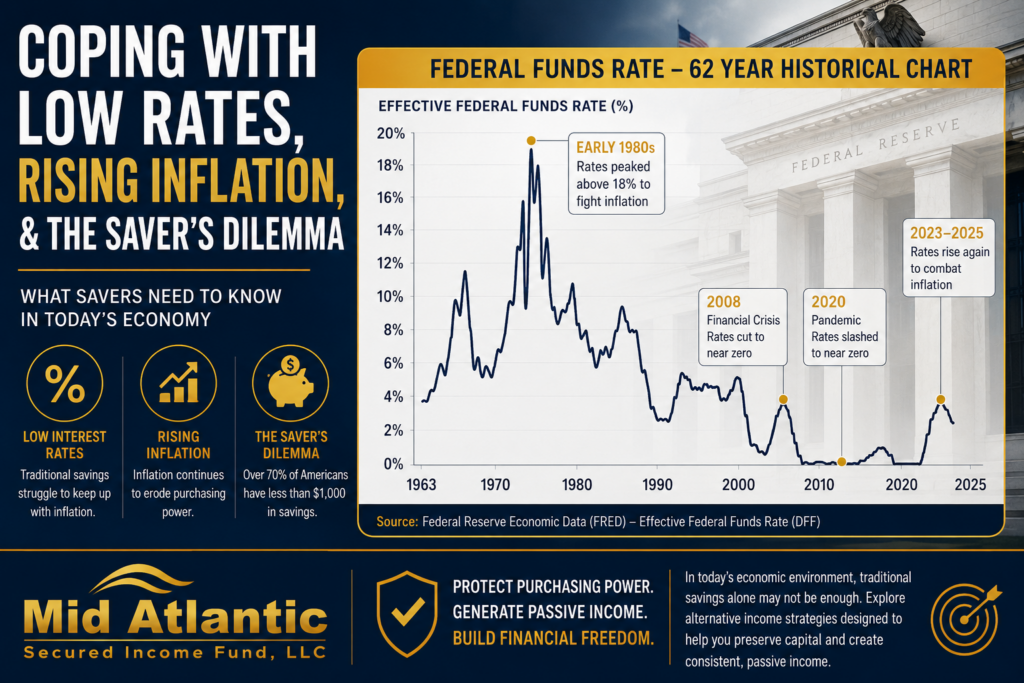
Inflation, Interest Rates & Alternative Investments
Inflation has fundamentally reshaped portfolio construction.
According to the Bureau of Labor Statistics, inflation reached multi-decade highs during recent economic cycles.
Sophisticated investors increasingly seek:
- inflation-resistant income,
- floating-rate lending,
- real assets,
- and alternative investment strategies capable of adapting to changing rate environments.
Why Passive Income Matters
Passive income has become one of the defining investment themes of modern wealth management.
Income-generating investments may provide:
- lifestyle flexibility,
- retirement support,
- inflation offset potential,
- and reduced reliance on asset liquidation.
For accredited investors, alternative income strategies increasingly play a role in diversified portfolio construction.
The Psychology of Sophisticated Investing
Behavioral finance often separates successful long-term investors from speculative participants.
Sophisticated investors typically emphasize:
- discipline,
- patience,
- diversification,
- underwriting,
- and long-term thinking.
Rather than chasing speculative trends, institutional-style investors often focus on:
- durability,
- income consistency,
- and capital preservation.
How Accredited Investors Evaluate Opportunities
Before allocating capital, sophisticated investors often evaluate:
Structure
- Debt or equity?
- Senior or subordinate?
- Collateral-backed?
Risk Management
- Underwriting quality
- Loan-to-value ratios
- Diversification practices
Sponsor Alignment
- Operational experience
- Transparency
- Co-investment alignment
Liquidity Terms
- Lock-up periods
- Redemption structures
- Distribution schedules
Accredited Investors and Retirement Planning
Retirement planning has become increasingly complex.
Longevity risk, inflation, and market volatility have caused many investors to rethink portfolio construction.
Alternative income strategies may complement traditional retirement frameworks through:
- diversification,
- recurring income,
- and lower public market dependency.
Why Alternative Investments Continue Growing
Institutional adoption of alternatives continues expanding globally.
According to Preqin, BlackRock, and Goldman Sachs research, alternative investments are expected to represent an increasingly significant share of global investable assets.
Key drivers include:
- demographic retirement pressures,
- public market volatility,
- inflation concerns,
- and demand for differentiated income streams.
The Southeast Growth Story and Investment Opportunity
The Southeast United States continues benefiting from:
- population migration,
- corporate relocation,
- housing demand,
- logistics expansion,
- and economic development.
Atlanta has emerged as a major financial, technology, logistics, and real estate growth hub.
Regional growth dynamics increasingly influence:
- real estate demand,
- lending activity,
- and investment opportunities tied to private markets.
How The Mid Atlantic Secured Income Fund Approaches Investing
The Mid Atlantic Secured Income Fund focuses on disciplined, asset-backed, income-oriented investment strategies centered around:
- senior secured lending,
- real estate-backed collateral,
- underwriting discipline,
- and long-term capital preservation principles.
The objective is not speculative growth at all costs.
The focus remains on:
- disciplined income generation,
- downside-aware investing,
- and institutional-minded portfolio construction.
What Sophisticated Investors Understand About Wealth
Wealth preservation often depends less on chasing maximum returns and more on avoiding catastrophic losses.
Institutional investors recognize that:
- risk management,
- diversification,
- income durability,
- and disciplined underwriting
frequently matter more over decades than short-term speculation.
Final Thoughts
The rise of private markets represents one of the most significant shifts in modern investing.
Accredited investors now have increasing access to institutional-style investment strategies once reserved primarily for large institutions and ultra-high-net-worth families.
But access alone is not enough.
Successful investing still depends on:
- discipline,
- risk management,
- diversification,
- underwriting quality,
- and long-term thinking.
In uncertain markets, sophisticated investors increasingly focus not only on growing wealth—but preserving it intelligently.
FAQ Section
What is an accredited investor?
An accredited investor is an individual or entity that meets SEC financial qualification standards allowing access to certain private investment opportunities.
How do I qualify as an accredited investor?
Individuals may qualify based on income, net worth, professional certifications, or institutional status under SEC guidelines.
Why do accredited investors invest in private markets?
Accredited investors often use private markets for diversification, passive income generation, inflation resilience, and access to institutional-style strategies.
What are alternative investments?
Alternative investments are non-traditional assets such as private credit, real estate debt, private equity, hedge funds, and infrastructure investments.
Is private credit safer than stocks?
Private credit is not inherently safer, but certain senior secured and asset-backed lending strategies may offer lower volatility and contractual income compared to some equity investments.
Why are institutional investors increasing alternative allocations?
Institutions increasingly allocate to alternatives for diversification, inflation protection, income generation, and reduced dependence on public markets.
Can accredited investors invest through IRAs?
Yes. Many accredited investors use self-directed IRAs and retirement accounts to access alternative investments and private market strategies.